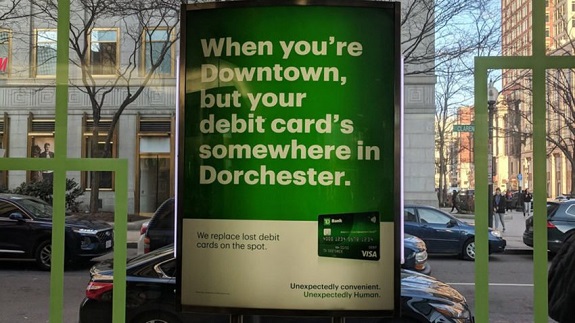
Yes, Dorchester is a community dominated by exactly the people you think it is. The ad says to the public, “If you bank with us, we know you’re white, and if you get robbed, we both know the thief is black.”
Nice.
Social media was on this like a shot, and TD Bank apologized, saying
“We are sorry that an ad that appeared in one of our stores was insensitive to the Dorchester community.The ad, which was removed today, does not reflect our core values around diversity and inclusion.”
This is a lie, and an obvious one. If the bank really had such core values, someone at the bank who saw the ad in production would have said, “Wait, are you out of your mind? We’re insulting Dorchester with this, and the message implies that our customers are likely to be robbed by blacks!”
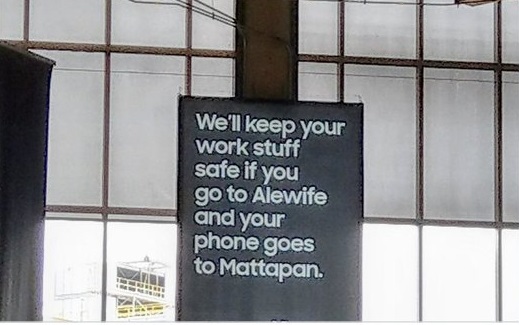
What made it worse for the bank is that Samsung got burned in Boston just two years ago by trying an almost identical ad, which was also condemned as racist.
Yes, Mattapan has demographics similar to Dorchester.
Time for “Singin’ in the Rain” again, when I’m in this kind of mood…It helps.
Fridays have been discouraging of late. The already diminished traffic here, which always slowed to a crawl on Saturdays, is now almost as weak on Fridays and Sundays too. I have no idea why this is, but it gets old devoting two to four hours a day on weekends producing blog content that I think is worthy of readers’ time and thought while knowing that it will be largely ignored. Of course, running a home ethics business, weekends have meant nothing for many years, holidays as well, and I don’t know what this “vacation” thing is that my friends keep blathering about. To be clear, I love doing what I do, or I wouldn’t do it. I just wish I were more effective at persuading others to care about the topic of ethics as much as I do.
1. How to beat Facebook! I tried something this morning: I posted an essay without including a photo, and tried to post it on Facebook. It took! No error message! Then I added a photo after the link was on Facebook. The link still worked! I’m going to see if this was just a fluke or not, and I’m going to post a few things without graphics or videos to see if readers have the same luck posting and sharing them. If the photos being removed actually does get around whatever it is causing Ethics Alarms to be unsharable on Facebook, then I’ll have a decision to make. Obviously the photos and videos enhance the posts, and are sometimes essential. Is it worth the trade-off to stop using graphics if it allows more circulation on social media? My choices are…
Refuse to compromise the integrity of the blog to satisfy Facebook. (You know this is my default reaction.)
Leave photos off posts until I’ve put them on my Facebook page. This will allow people to access Ethics Alarms using that link.
Leave photos and videos off all posts.
Leave photos and videos off selected posts that I think are likely to be shared.
All of these, of course, assume that I continue to investigate and try to find out why Facebook won’t accept Ethics Alarms posts as they are.
2. You don’t get business from an ethics company by lying in your introductory pitch. Just got an email beginning thusly…
We would like to share our observations pertaining to your website. Though, your website is great and has all the information that prospective customers of your niche will search for. However, it has a lot of scope for getting optimized in line with Search Engine Guidelines so as to come on the first page in search results. We have conducted a meticulous SEO audit of your website and found that it can give you more return than it might be giving you at present.
Right. It is obvious that you have NOT read this website, because if you had you would know that it is not seeking “potential customers” (though my other website is) and that you currently have no clue about Ethics Alarms, its scope or its “niche.” This is a form letter, pretending, and badly, not to be. If you are this incompetent in your own marketing, why would I trust you to advise me regarding mine?
Go away. I hate you.
3. Watch “Network” again, if you haven’t lately. TCM has been running movies about journalism on Thursdays this month. Why do I suspect the network was lobbied to do this as CNN et al. try to make the false case that journalists are noble, ethical, devoted and trustworthy as a public defense against President Trump’s attacks on “fake news” and the “enemies of the people”? Well, most of the journalists portrayed in movies are like that. One reason I question the motives of the series is that it left “Absence of Malice” out, one of the very few negative (and accurate) Hollywood portrayals of journalists.
TCM could not credibly neglect to show “Network, ” however, Paddy Chayefsky’s wild satire of TV news that was a runner-up to “Rocky” as Best Picture at the 1977 Academy Awards, and is now on Broadway in a stage adaptation. (I agreed with that award then and do still: “Network”is intellectual and satiric, “Rocky” is visceral and emotional, they are both classics, but if they are both showing at the same time, I’m choosing “Rocky,” which makes me feel good, over Network, which makes me want to jump into the blender.) Watching it all the way through for the first time in many years, I realized that the film should be required viewing for all American citizens. What seemed hilariously cynical and over-the-top 40 years ago seems depressingly prophetic now.
The film (Screenwriter Paddy Chayefsky was the sharpest and most flamboyant of the great quartet of Golden Age TV writers; Rod Serling, Reginald Rose and Abby Mann were the others) portrays a TV network culture that is amoral and ruthless, willing to breach ethics, taste and decency, not to mention journalism ethics, to pursue ratings, dollars, and power. I don’t know if he was making a prediction, warning us, or just trying to be entertaining, but by brilliance or chance, Chayefsky was giving society a preview of what would constitute “news” in 2019. The result is that what was funny in 1977 is horrifying now.
The TV shows “UBS” puts on the air all have direct avatars today in reality shows and other genres that didn’t exist pre-cable. The veteran newscaster-gone-nuts whose live rants become a sensation, Howard Beale, the Mad Prophet of the Airwaves, no longer seems like an outrageous invetion. We have seen many “mad prophets” in alleged newscasts since “Network.” Glenn Beck may have been the closest to Beale, but Bill O’Reilly was in the ballpark, and Don Lemon, Chris Cuomo and a raft of MSNBC talking heads routinely say things at least as outrageous as Howard, before he would suffer a seizure in his passion and collapse at the end of every broadcast.
Moreover, the iconic moment in the film where Beale spurs people all over America to run to their windows, open them, and shout, “I’m mad as hell, and I’m not going to take it any more!” is another excellent metaphor for the 2016 election (though I like teh parade in “Animal House” best). The network executives are the personification of the smug, arrogant “elites” who were (and are) so, so confident that they knew what was best for the public, while they lied, manipulated, postured and profited. Donald Trump was elected less as an individual than as the physical manifestation of shouting out the window, and it was a symbolic and necessary message that the two parties and the news media still haven’t received.
I am proud of Americans for sending it, and the unethical alliance of elites who refuse to understand are playing with dynamite.
Ethics Alarms is blessed with several commenters with specific expertise in areas that arise here often. Alexander Cheezem is our authority on autism and the various misconceptions and unethical practices surrounding it, and he contributed valuable perspective on why Amazon was under pressure to stop offering two books about the topic. I carelessly assumed that the problem was the further circulation of the dangerous myth that vaccinations cause autism, since that is the autism-related issue we hear about most often from the media. There’s a lot more to autism misinformation than that, and Alexander graciously enlightens us.
As he acknowledges, the thrust of the post is not dependent on why the two books have been pulled The remedy to bad information is good information, not censorship–like the useful information in Alexander Cheezem’s Comment of the Day on the post, “Tales Of The Slippery Slope: Amazon And Censorship”:
Okay. I’m actually quite familiar with one of the books in question — I even spent about five years dealing (over and over and over again) with its author and her brand of bullshit (yes, that’s actually the technical term)… and I have to say that your analysis is flat-out wrong on one major point and significantly off in another respect.
Of course, whether that impacts the rest of the analysis is another matter.
The major problem with your analysis is that what sets those books apart is not that they’re anti-vaccine… but don’t take my word for it. As I write this, I’m paging through my first-edition copy of Rivera’s Healing the Symptoms Known as Autism (my second-edition copy is somewhere), so I’ll use it to illustrate. Let me give you just a small sample of what the book actually contains.
The thing is essentially a protocol book, dedicated to “teaching” parents a complicated pseudoscientific and ritualistic protocol centered around having the parents feed industrial bleach (chlorine dioxide) to their children, bathe their children in a solution of industrial bleach, and give their children bleach enemas. Continue reading →
“Unethical, sketchy, and uncomfortable behavior among Herndon officials are some of the main reasons behind the push to strengthen the code. The councilmembers shared stories of unnamed former town officials who publicly berated staff, grabbed a staffer in a sexual manner, and solicited jobs from other elected officials in the performance of their official duties.”
Herndon, Virginia, isn’t too far from where I live.
The problem the article encompasses is as old as the hills. Simply passing laws, or regulations, or rules prohibiting wrongful conduct doesn’t do anything to make the people subject to these laws, regulations and rules better human beings. It simply tells them that there are specific consequences to their bad conduct. Maybe that will discourage them, and maybe it won’t. After all, they have to be caught first.
The conduct described in the quote is unethical, and anyone with functioning ethics alarms knows its unethical. Abusing subordinates? Sexual assault and harassment? Using official duties to barter for career advancement? If an official knows this conduct and others equally blatant are wrong, then they don’t need a code. If they don’t know they are wrong, no code is going to help them, and individuals that ethically clueless shouldn’t be government officials.
That doesn’t mean that codes of conduct aren’t essential tools of creating an ethical culture in a local government or tree house clubs. They are, but they are just a starting point, putting in place external standards that have to be internalized, which is to say that they are then used to fix the settings on everyone’s ethics alarms in that culture. By themselves, codes do nothing, and they may even cause more misconduct. Unethical people who are also smart love the Compliance Dodge, from the Rationalizations List:Continue reading →
Frequent commenter and old friend Vinnymick flagged this one, thus proving that someone took my recent appeal for out-of-the-way ethics topics seriously. He pointed me to a Washington Post article, which lays out its topic thusly:
“While browsing Twitter recently, I came across a post that suggested an innovative interview technique: Take a job candidate out for a lunch interview, then secretly ask the server to intentionally mess up the candidate’s order. The purported goal: to see the candidate’s true nature. “It’s easy to say how you would handle when things go wrong, [but] hard to fake your reaction as it happens,” the post concluded.”
Or, as another type of sabotage, have an old high school colleague of the interviewee sit down at the table and accuse him of sexual assault. Then observe how he reacts to that!
The Kavanaugh debacle came to mind immediately, in part because so many who rationalized the Democrats’ abuse of Justice (now, judge then) Kavanaugh was that it was a “job interview.” No, it wasn’t, as I repeatedly had to explain to people (but, you know, when progressives are in the process of a Trump-related freak-out, you can’t explain anything to them(, in a real, fair and professional job interview, the interviewer hasn’t already decided that he or she doesn’t want to hire you, as nearly every single Democrat regarded Kavanaugh before the hearings began . In a job interview, you are being interviewed by your potential supervisors and those who you will be working with if you are hired. The Supreme Court doesn’t report to the Senate, take orders from the Senate, or work with the Senate. In a job interview, there is a presumption of good faith between the job seeker and the interviewer. No, the Kavanaugh hearings were a transparent effort to sabotage the judge’s nomination from the outset.
Now back to the article’s hypothetical: Of course pulling a stunt like the one described is unethical. An earlier Ethics Alarms essay on “silly job interview ethics”—it’s pretty good, I must say, and I had completely forgotten that I wrote it— recommended that if an interviewer starts abusing you, and this is abuse, excuse yourself, saying, “I’m sorry. I was under the impression that I was applying for a position with an organization that respected serious professionals, and that would never exploit the interview process for its own amusement at the discomfort of someone who expected fair and courteous treatment. I apparently was mistaken.”
I added,
I think the use of odd interview questions is a symptom of an arrogant and essentially untrustworthy corporate culture. There may exceptions, but I don’t believe it’s worth the gamble. If the interviewer starts messing with your emotions and confidence, tell him or her to cut it out, or better yet, leave.
Preface:This is the kind of issue that can be hard to find, unless one has unlimited time to search all sources and for better or ill, I don’t. Ethics Alarms is still feeling the effects of losing the regular services of topic scout Fred, who had a remarkable reach, finding ethics issues in all sorts of places I never would (though Fred does drop by here to comment, and I am grateful for that, as well as his long service.) I really do depend on the readers for tips, particularly in the non-political arena. Even the news aggregating sites like The Daily Beast, The Daily Caller, the Blaze and Huffington Post have become more politics obsessed than ever, so Ethics Alarms has to dig deeper and go farther. Some of our best discussions have arisen out of obscure venues. So please: keep an ye open, and write me at jamproethics@verizon.net/
There are many fascinating, upsettingdetails in the story of Elizabeth Holmes, but my favorite is her voice. Holmes, the ousted Theranos founder who was indicted last year on federal fraud charges for hawking an essentially imaginary product to multi-millionaire investors, pharmacies, and hospitals, speaks in a deep baritone that, as it turns out, is fake. Former co-workers of Holmes told The Dropout, a new podcast about Theranos’s downfall, that Holmes occasionally “fell out of character” and exposed her real, higher voice — particularly after drinking. One can only assume the voice will be discussed in the upcoming HBO documentary, too.
To begin with, as anyone can hear from the video above, Theranos did not and does not speak in deep baritone voice, which tells us immediately that the author, Katie Heaney, doesn’t know what she’s talking about. Neither, apparently, does Ann, who directs us to another video and describes Holmes’ voice as “a ludicrous phony voice.” There’s nothing ludicrous about it, and if she is not using a ventriloquist, it’s not phony either. Continue reading →
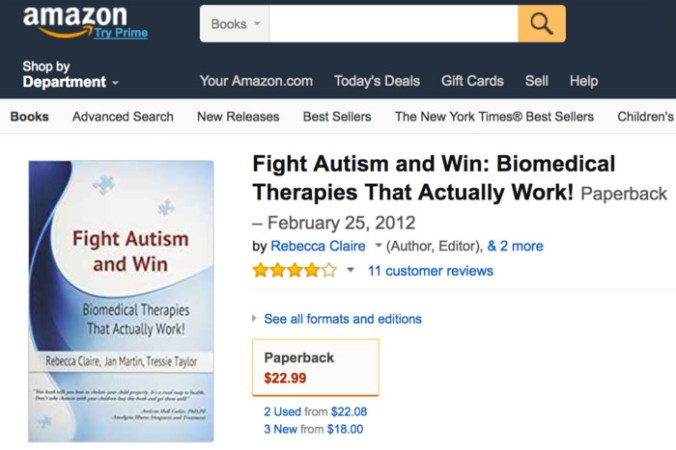
Amazon has removed the online listings for two books that claim to contain cures for autism, a move that follows recent efforts by several social media sites to limit the availability of anti-vaccination and other pseudoscientific material. The books, “Healing the Symptoms Known as Autism” and “Fight Autism and Win,” which had previously been listed for sale in Amazon’s marketplace, were not available on Wednesday. The company confirmed that the listings had been removed, but declined to discuss why or whether similar books would be taken down in the future.
And what does “similar books” mean?
Based on what I’ve seen from our tech giants, “similar books” could soon include a scientist’s arguments against climate change, a hagiography of President Trump, or an expose of the misconduct of the Obama Administration. Amazon has decided that anti-vax arguments are dangerous and wrong, and though I happen to agree with them, it is not Amazon’s job to decide what ideas, positions, opinions and theories are worthy of public consumption. Amazon dominated the book retail business (and many other businesses as well). Its censorship policies constrain debate, the free expression of ideas, and the expression of dissent from the majority.
Defenders of civil liberties and freedom of speech must express their disapproval of Amazon’s Big Brother act, even if it has the “right” to abuse its power, and even if it isn’t the government choosing which citizens to muzzle. Conduct like this places me squarely on the side of Elizabeth Warren, who is advocating breaking up companies like Amazon, Google and Facebook. When we start allowing speech labeled “dangerous” or “untrue” to be blocked, no matter who is doing the blocking, then we are damaging our democracy and the free circulation of ideas, as well as abetting elite attempts at thought control.
1. Fight racial hate with cognitive dissonance. It is apparent that the Left’s battle plan depends on making sure that minorities hate and fear white people, and it’s up to whites and all the shades lumped in with them—I’m kind of olive colored, or as an old girl friend used to say, “green”—to foil it. It’s simple cognitive dissonance: the more positive experiences minorities have with whites, the more the cognitive dissonance scale works in favor of racial respect and comity.
Yesterday, in a rush, I arrived in the line to pick up my drug refills simultaneously with an African-American man who was probably about my age, and looked pretty grim. I asked him if he wanted to play paper-stone-scissors to see who got to go first. He appeared genuinely startled that I spoke to him, then smiled and told me to go ahead. “You sure? ” I asked. “I really like playing paper-stone-scissors !” He waved me ahead of him, and I noted that I was rushing to pick up a carry-out order from my favorite Chinese restaurant.
“That’s a good reason to be in a hurry,” he said. I asked him if he liked Chinese food, and he nodded, so I asked if he had eaten at The Peking Gourmet Inn nearby. (It really is the best Chinese eatery in the D.C. area, and except for a little hole in the wall we stumbled into in London, the best I’ve ever encountered.) He hadn’t, so we got in a long conversation about the menu, how to get there, why he really owed it to himself and his family to check it out. I also learned that he and I both favored the same local Thai restaurant. Great guy.
After I got my pills and started to leave, he crossed over to me with his hand outstretched. “Thanks for the tip,” he said, with a big smile. “It was nice talking with you.” “Same here.” I said, as we shook hands.
One down, about a hundred million to go. Of course, if he had been much younger, I never would have been able to talk to him because his eyes would have been glued to smartphone screen…. Continue reading →
Has any state…heck, has any 10-year-old’s tree house club…had as many terrible ideas as California? No wonder its presidential vote single-handedly gave the popular vote to Hillary. And the United States is supposed to allow itself to be the dog wagged by this Bizarro World ethics culture?
The latest: Under a bill now heading through the California State Legislature, millions of criminal Californians who have misdemeanor or lower-level felony records would have their criminal records officially sealed from public view once they completed prison or jail sentences. I’m shocked to read that the legislation would not apply to people convicted of committing murder or rape. Well, give the Golden State time.
We are told with a sniff and a tear that in the United States, a record showing a criminal conviction or even an arrest that does not lead to a conviction can make it difficult for someone to find a jobs, rent an apartment or obtain professional license. Well, that’s because conduct has consequences, and in particular breaking trust has consequences. Society is based on mutual trust. Committing criminal acts raises reasonable doubts in society as to whether an individual can be trusted to–let’s see, handle money for an employer, follow rules, meet financial obligations or serve in a professional capacity, the primary requirement of which is trustworthiness.
Simply because someone has been in jail doesn’t mean they have become more trustworthy. Why would it? So under California’s brilliant scheme, a bank could hire a convicted embezzler as a bank teller. A law school could hire a convicted bank-robber as a law pro—oops. Sorry. My alma materalready did that. But at least it had the opportunity to know what it was doing.
This is kindergarten easy: if I am going to trust someone with my business or my property, I have a right to know who that person is, and if he or she has a record of warranting trust. The fact that convicted criminals have a tough time doesn’t mean I should be put at risk. They committed the crime, why are the citizens who haven’t broken any laws being forced to take risks they don’t want to take? Continue reading →
1. Air Travel Ethics #1: Ethics Alarms has noted the ridiculous trend of air travelers imposing on their fellow passengers by exploiting the overly-permissive airlines polices of permitting emotional support animals on flights, resulting in innocent passengers having to share as aisle with emotional support toucans, sloths, goats and lizards. Finally, one airline has declared an end to the madness, or close to it. American Airlines updated its emotional support and service animal policies this week, and new “emotional support” companion policies go into effect on April 1.
After that date, service animals will be limited to dogs, cats, and …all right, this is still nuts..,miniature horses. Only one emotional support animal per passenger will be allowed, and animals under the age of four months cannot fly.
GOOD!
2. Air Travel Ethics #2. This one is a bit more complicated ethically. Britain’s Virgin Atlantic airlines has eliminated the requirement that female flight attendants wear makeup, joining other major carriers that have loosened their dress and grooming standards after complaints about turning female employees into sex objects.
Virgin Atlantic announced this week that female cabin crew members can skip the makeup if they choose, and also can wear pants instead of Virgin’s familiar red skirts.
“Not only do the new guidelines offer an increased level of comfort, they also provide our team with more choice on how they want to express themselves at work,” Virgin Atlantic Executive Vice President Mark Anderson said in a statement.
This has always been a strange area. There is nothing wrong, and a lot right, with any employer in a service industry requiring employees who deal with the public to meet reasonable standards of professionalism in their appearance. Are attractive, well groomed, neatly dressed employees a legitimate service enhancement? I believe so; on the other hand, what level of discrimination against the older, heavier and not so cute is acceptable? None? Some? The fact that women in the workplace wear make-up and men do not is automatically a cultural anomaly, but nonetheless, if all of the female attendants are wearing make-up and one isn’t, and looks like she just rolled out of bed, threw on some slacks and said, “The hell with it,” I’m not sure I trust that flight attendant.
The sex appeal aspect of flight attendants has always been one way, however, as if the only business flyers were still male, and National Air Lines was still using “I’m Cheryl! Fly me!” as a slogan. There is obviously no effort whatsoever to make male attendants attractive to female flyers: I estimate that more than half of all young male attendants are openly gay. Continue reading →


 Ethics Alarms
Autism “cures”, aka “Snake oil.”
Ethics Alarms is blessed with several commenters with specific expertise in areas that arise here often. Alexander Cheezem is our authority on autism and the various misconceptions and unethical practices surrounding it, and he contributed valuable perspective on why Amazon was under pressure to stop offering two books about the topic. I carelessly assumed that the problem was the further circulation of the dangerous myth that vaccinations cause autism, since that is the autism-related issue we hear about most often from the media. There’s a lot more to autism misinformation than that, and Alexander graciously enlightens us.
As he acknowledges, the thrust of the post is not dependent on why the two books have been pulled The remedy to bad information is good information, not censorship–like the useful information in Alexander Cheezem’s Comment of the Day on the post, “Tales Of The Slippery Slope: Amazon And Censorship”: