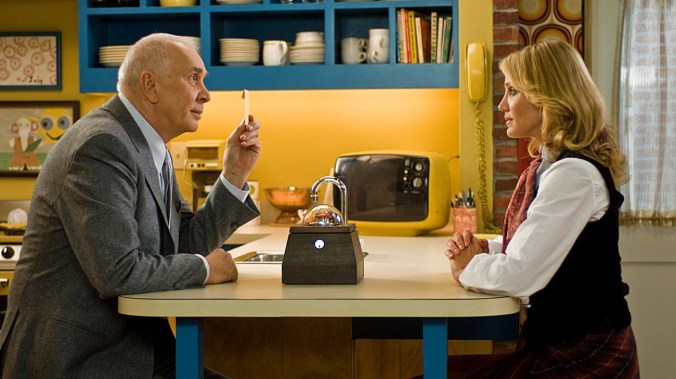
Thinking About “The Box”

I recently re-watched “The Box,” which my wife and I had first seen more than a decade ago. It is a horror movie based on the 1970 short story “Button, Button” by Richard Matheson, one of the writers of the original “Twilight Zone,” and Matheson’s conceit, a mash-up of science fiction and ethics as his work often was, had been turned into an episode of one of the reboots of Rod Serling’s creation.

If I recall, I didn’t make it to the end of the film the first time, because the set-up was so annoying. A strange, disfigured man shows up at a couple’s door with a strange box in his hands. It consists of a red button under a locked glass dome that must be opened with a key. The man explains to the stunned wife (her husband is at work, getting bad news about his job) that they have been chosen to be the recipients of a gift. All they have to do is push the red button, and the man will return to hand over a brief case filled with a million dollars, which will be tax free. However, when the button is pushed, someone, somewhere in the world, will die. He assures the wife that they won’t know the doomed individual. They have only 24 hours to consider the offer, at the conclusion of which the man will return and take the box away to offer to someone else.

It is, obviously, an ethics hypothetical that has been posed in many different ways through the years. What bothered me originally, and worries me now, is that anyone I would care to have in my community would ever push the button. (As you can guess, one of the couple does—“Why not? It’s just a box…” and a chain reaction is launched that causes havoc.)

Continue reading

Curmie’s Conjectures: Court Storming and the Absence of ‘Sprezzatura’

by Curmie

After the Wake Forest Demon Deacons beat the Duke Blue Devils 83-79 in basketball Saturday afternoon in Winston-Salem, hordes of Deac fans stormed the court .  Actually, the previous sentence isn’t quite accurate.  Video footage shows that several fans who had gathered under one of the baskets ran onto the court and were already at the free throw line before the game even ended.

These incidents are increasingly commonplace, abetted by television coverage of the events, even as the networks pretend to be appalled by the potential for injuries resulting from the practice.  Court-storming may be part of the culture of the sport, but there are—or at the very least should be—limits.  I have no problem with displays of post-adolescent exuberance, but the safety of players, coaches, and officials must be paramount.

The inevitable finally happened, and Duke star Kyle Filipowski was not merely jostled, but injured, in the melee, seriously enough that he had to be helped off the court.  As the recipient of a degree from the University of Kansas, I am morally and ethically obligated to despise all things related to Duke basketball 😉, but whereas I want them to lose every game, I don’t really want anyone to get hurt.

The exact extent of Filipowski’s injury is still unclear, but it certainly could affect both the Blue Devils’ chances for the rest of the season and post-season, and, importantly, Filipowski’s future.  He’s projected as a first-round draft choice, possibly even a lottery pick, in the upcoming NBA draft.  He stands to make tens of millions of dollars over the course of his career… assuming he can play.  There is such a thing as a career-ending injury, especially when we’re talking about knees, and that’s what this is; if this injury wasn’t severe, that’s only because of what Jack would call “moral luck.” 

The video shows that at least three different Wake Forest fans made contact with Filipowski as he was trying to leave the court.  Whether or not the bumping was “intentional” and “personal,” as Filipowski alleges, it was at best reckless and at worst criminal.  Let’s face it: the man is seven feet tall; it’s not like he couldn’t be seen.  The ethics of the situation, of course, would be the same if it had been a bench player, a student manager, a coach, or a referee who was injured.  The incident attracts more headlines because it was Kyle Filipowski who needed to be helped off the court, but the rationale for banning court storming would be the same. 

At least two other visiting players have been bumped into by opposing fans in court stormings this season.  One of them is Iowa’s Caitlin Clark , probably the most famous women’s basketball player in the country—even more so than WNBA stars.  She was “blind-sided” and actually knocked to the floor by an Ohio State fan in a court storming in Columbus. 

Imagine if she’d been seriously injured.  She wouldn’t have broken the NCAA scoring record for the women’s game, and she wouldn’t be closing in on the real record, held by Lynette Woodard.  (The NCAA wasn’t the organization in charge of the women’s game when Woodard played, and they’re being predictably petty, narcissistic, and anal retentive about recognizing Woodard.)

Oops.  Once again, I indulged in a little inaccuracy.  What I referred to above as “the inevitable” had long since happened, as ESPN’s William Weinbaum reports:

 In a 2004 court storm, Tucson H.S. star Joe Kay suffered a stroke & was partially paralyzed. “It’s way too long that we’ve been putting up with this,” Kay told ESPN Sat. after Duke’s Kyle Filipowski got hurt. “I’m completely in favor of banning court storms & field storms.”  Now 38, Kay said, “The police should arrest people for going places they are not allowed to go… enforce the rules as they do at other places. It’s exactly the same thing.” “Hopefully people will now come to their senses.”

The only thing that’s changed is that Filipowski is known by virtually all college basketball fans across the country, whereas Kay may have been a local celebrity, but folks like me in East Texas weren’t saying “OMG, Joe Kay got hurt in a court storm.”  Now, maybe, something will happen… but not unless the powers-that-be actually want it to, and that, despite the copious tut-tutting from the NCAA, conferences, universities, and the media, doesn’t seem to be the case.  Indeed, statements of concern and promises of future action from the likes of ACC commissioner Jim Phillips seem very much to be what my mom would call “balloon juice.”

Among those who have engaged in court storming this season, both in games in which their team beat Kentucky, were LSU women’s star Angel Reese and South Carolina President emeritus Harris Pastides, who even took to social media to boast about his participation.  The problem isn’t going to go away, even in the wake of an injury to a star player, unless there are real, enforceable, guidelines designed both to allow celebrations and to protect the visiting team.  And by “enforceable,” I mean sanctions that will be felt, not petty fines of a few thousand dollars to multimillion-dollar programs.

Jay Bilas, probably ESPN’s best analyst (and a former star big man for Duke himself), is outspoken about this issue:

“It’s got to stop but it’s not going to.  There’s no appetite in college basketball to stop it. The SEC has a rule against it but the institutions are happy to pay the fine because they like the visual. And the truth is, we in the media like the visual too.  We put it at the end of every highlight. Years ago, when people used to run out on the field or on the floor, we wouldn’t show it. That was our policy. We don’t have that kind of policies with court stormings. We like it. It’s not stopping and it’s a shame.

Duke coach Jon Scheyer said after the game that when he played, “at least it was 10 seconds and then you could storm the court. Now, it’s the buzzer doesn’t even go off and they’re running on the floor.” 

Ten seconds isn’t enough, but 30 probably is.  It wouldn’t be difficult to institute a rule that no fans are allowed onto the court, ever, until 30 seconds after the final buzzer.  The mechanism already exists in the 30-second clock; let it serve another purpose.  The home university can forbid court storming altogether, but they must enforce the ban for 30 seconds.  If fans want to celebrate on the court and the home team doesn’t object, so be it, but not until the officials and the opposing team are out of harm’s way.

And if fans are on the court before the game clock has expired, that should be a technical foul on the home team in addition to the other penalties.  Would it have mattered this weekend?  Duke would have had two free throws and the ball with about a second left in the game.  Could they have forced overtime or even won in regulation?  It’s extremely unlikely, but the chances wouldn’t have been quite zero.

Whatever the exact rules become, violations must be punished severely.  At present, neither the NCAA nor the ACC (in which Wake Forest and Duke play) have any specific sanctions at all in place for court storming.  The home university must be responsible for enforcing the rules; failure to do so should be punishable by a significant fine even for the first offense.  I’d suggest $500,000 for the first offense, with half paid to the NCAA or the conference and the other half to the opposing school.  Subsequent offenses within a 36-month period would involve stiffer fines, loss of scholarships, and perhaps a prohibition against post-season play.

Continue reading

A Relatively Minor Incident That Explains Why Nobody Can Trust Anybody in Politics, and Shouldn’t.

A robo call supposedly featuring President Biden urging New Hampshire Democrats not to vote in the state’s presidential primary was immediately used by the news media to accuse Republicans of suppressing votes, because, you know, that’s what they do. The media reported that two Texas companies were the source of the calls: Life Corporation and Lingo Telecom, and that the Federal Communications Commission (FCC) had issued cease-and-desist letters to both companies. Texas companies—well, we all know what THAT means.

Surprise! The deep-fake recording was not the work of those racist Republicans, but of a Democratic consultant who worked for Democrat Dean Phillips’s quixotic Presidential campaign. Phillips has the ethical mission of giving his party’s voters the opportunity to show that they would prefer not to have a rapidly declining dementia sufferer carry the Democratic banner in November.

Paul Carpenter, a New Orleans magician—that’s him doing street magic above— came forward to admit that he was hired to use artificial intelligence to impersonate President Joe Biden for the robocalls. Carpenter explained that he was hired in January by veteran Democratic consultant Steve Kramer, who has been advising Phillips. “I created the audio used in the robocall. I did not distribute it,” Carpenter said. “I was in a situation where someone offered me some money to do something, and I did it. There was no malicious intent. I didn’t know how it was going to be distributed.” He says he was paid $150.

Continue reading

The Chrystal Clanton Saga: I Don’t Understand This Story At All…

Does this make sense to you?

SCOTUS Justice Clarence Thomas has hired Crystal Clanton to be his law clerk beginning in the upcoming term. In 2015, when Clanton was 20 and working for Turning Point USA, she was accused of sending racist texts to a fellow employee. One alleged text read, “I HATE BLACK PEOPLE…Like fuck them all … I hate blacks. End of story.” The New Yorker’s Jane Mayer wrote about the texts in 2017 in an article about Turning Point USA, which is close with Thomas’s activist wife Ginni. Clanton wrote in an email to Mayer, “I have no recollection of these messages and they do not reflect what I believe or who I am and the same was true when I was a teenager.” The first aspect of the story I don’t understand: I am reading everywhere that Clanton didn’t deny writing the texts, which points to her guilt. I would say that stating that you don’t recall sending a message and that it isn’t something you believe, believed or would ever say is the equivalent of a denial.

Continue reading

Now THIS Is an Unethical Lawyer!

The Tennessee Supreme Court this month disbarred a Nashville lawyer, Brian Philip Manookian, for habitual unethical conduct that I have a hard time believing that any lawyer would dare to engage in even once. Manookian, wrote the Court, “engaged in this long pattern of intimidating and degrading conduct” to succeed in a medical liability case, the Tennessee Supreme Court said. His goal was to coerce opposing lawyers “into standing down to avoid personal humiliation and emotional distress for them or their families. A business model of sorts, based on fear….To say that Mr. Manookian engaged in multiple offenses is to understate,” the state supreme court continued. “Despite lectures, fines, sanctions and suspensions from judge after judge, Mr. Manookian did not choose merely to continue engaging in misconduct—each time he received the expected negative reaction to his behavior, he responded by escalating it.”

Continue reading

Alan Page, Esq.: Role Model

After being so critical of the NFL’s ethics and business practices, I feel obligated to highlight the impressive example of Alan Page, a Pro Football Hall of Fame inductee (in 1988) who does not suffer from CTE and who exemplifies the kind of role model American youth should know about and emulate. I’m embarrassed to admit that I had no idea that Page had gone on from his NFL exploits with the Minnesota Vikings to, among other things,

  • Establish and oversee the Page Education Foundation, which award Page Scholarships to black students who are then obligated  to mentor younger children. The foundation has awarded nearly 9,000 scholarships and taken in approximately $16 million in grants.
  • Earn a law degree from the University of Minnesota in 1978, while he was still playing football.
  • Practice employment law in a law firm,  join the Attorney General’s office, and eventually became assistant attorney general.
  • Get elected to the Minnesota Supreme Court four times,  sitting for 22 years on the court before  hitting the mandatory retirement age of 70.
  • Write inspirational children’s books with his daughter, Kamie Page.

Continue reading

From India, the Case of the Ethical Burglars

I am at a loss as to how to categorize this strange story, as Mallory’s outburst above suggests.

Thieves broke into the opulent home of celebrated Bollywood film director M. Manikandan, escaping with gold, silver and cash. A few days later, however, someone left a small plastic bag outside the mansion’s gates. It was carefully fastened shut, and contained an object wrapped in a white handkerchief. Upon unwrapping it, the director discovered a medal he had won in 2021 for one of his acclaimed films. Accompanying the prestigious award was a handwritten note from the burglars (in Tamil, one of India’s many regional languages). “Sir, please forgive us,” the note read. “Your hard work belongs to you alone.”

Continue reading

This Question to the Ethicist Sends Me to the Wood-chipper

[That would be my foot sticking out. I’m sure my good neighbor Ted would be willing to get me through…or any one of the thousands of people I’ve infuriated over the years.]

You can read Kwame Anthony Appiah’s answer to the most discouraging question he’s ever been asked (my description, not his) if you like. Essentially “The Ethicist” says (I’m counting here), “No, no, no, no, no, no, no, no, no, and no!” As usual the New York Times “Ethicist ” is thorough, but he could have written his response in his sleep, as I could have, and if you’re reading an ethics blog, so could you.

Here’s the question, and hold on to your heads…

A close friend of many years whom I’ve always thought of as an extremely honest, ethical person recently confided in me that she shoplifts on a regular basis. She explained that she never steals from small or independently owned businesses, only from large companies, and only when no small business nearby carries the items she needs. She targets companies that are known to treat their employees badly, or that knowingly source their products from places where human rights are violated, or whose owners/C.E.O.s donate to ultraconservative, authoritarian-leaning candidates, etc.

My friend volunteers in her community and has worked her entire life for nonprofit antipoverty and human rights organizations. While she isn’t wealthy, she is able to afford the items she steals and believes that she is redistributing wealth; she says she keeps track of the value of what she’s stolen and donates an equal amount to charity. She thinks of her actions as civil disobedience and says she will accept the consequences if she’s caught.

When she told me, I thought, Stealing is wrong. But as we discussed it, I realized I was oversimplifying a complex moral issue. Is it wrong to steal food to feed your starving children? What if I stole a legally purchased gun from a person I knew was about to commit a mass shooting? Are those who bring office supplies home from their workplace also thieves? I find myself struggling with the question of whether an individual’s actions are morally defensible if they do more good than harm. — Name Withheld

Continue reading

When JFK Called Ike: Will We Ever See the Like Again?

For some reason the Kennedy family waited a long time to release this recording; strange, because it reflects well on the sainted JFK. I just encountered it recently.

In the midst of the Cuban Missile crisis in 1962, President Kennedy called former President Eisenhower to brief him on the situation and extract any wisdom he could from his predecessor.

This is how our system is supposed to work, with leaders, officials and politicians interacting with each other respectfully and in the best interests of the nation. Ike and JFK were hardly pals: after the Bay of Pigs fiasco, White House staff reported hearing Eisenhower reaming out Kennedy from behind a closed door.

Nonetheless, this phone call shows two Presidents from opposing parties working together and showing each other the kind of courtesy and civility essential for productive cooperation. Our republic and our culture were healthier then, even as World War III loomed.

Ethics Hero: Lya Battle, “Our Lady of the Strays”

John Hammond, as every fan of Michael Crichton, “Jurassic Park” and dinosaurs knows, built an aspirational cloned dinosaur park on a Costa Rican island, and thanks to chaos theory and “Newman,” it turned out to be a deadly disaster. But the InGen founder wasn’t too far off; he just chose the wrong species. In Costa Rica’s Central Valley and its surrounding highlands, a woman named Lya Battle has been presiding over a farm inherited from her dog-loving father (who shot her mother, but that’s another story) known locally as Territorio de Zaguates (“kingdom of strays”). She and her staff take care of, feed and love nearly 1000 stray dogs, which Costa Rica, like most non-affluent countries has far more of than it does pet dogs. (There are an estimated one million strays.) Lya boasts that she knows the name of every one of them on her farm. Here’s another photo:

Netflix featured the Lya and the Territorio in the second episode of its series “Dogs;” National Geographic has featured her story, and I learned about the amazing dog haven from an old episode of Jack Hanna’s nature series.

Lya’s Territorio takes responsibility for spaying and neutering every new dog arrival. It operates like a typical shelter, providing food and medical attention, except that the dogs run free. The most stunning scene is when all 900-plus dogs “go for a walk,” with staff leading them into the hills and forests in a noisy, barking pack.

You can get a sense of what this is like from this video…