What Should Ethics Alarms Call Rep. Marjorie Taylor Greene After Her Hunter Porn Stunt? Ethics Dunce? Incompetent Elected Official?

I choose “disgusting.” The GOP Georgia representative embarrasses me as an American. And she’s incompetent and unethical.

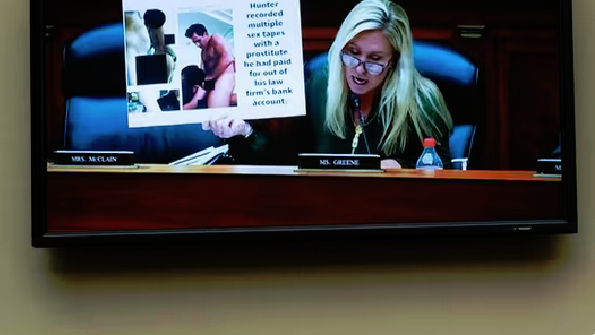
A member of the House Oversight and Accountability Committee, Rep. Greene thought it was appropriate to use her allotted time during a hearing to display nude photographs of Hunter Biden in various situations that could not be put on non-porn television (except, in this case, C-Span, as in the photo above). A member of Congress was displaying graphic shots of the President’s son engaged in sexual acts with alleged prostitutes. “Here is proof Hunter Biden paid prostitutes through his law firm, OWASCO PC, and trafficked his victims across state lines in violation of the Mann Act,” she tweeted. “Not only that, IRS whistleblowers confirm Hunter Biden committed tax fraud by deducting payments to prostitutes from OWASCO’s taxes.”

The photos “proved” neither. In a trial, they would be excluded as prejudicial and irrelevant.

“Before we begin, I would like to let the committee and everyone watching at home know that parental discretion is advised,” Greene said. That was thoughtful. The obscene photos shed no light whatsoever on any of the matters regarding the President’s sad and corrupt son that are legitimate topics of Congressional attention: whether he engaged in influence peddling with foreign governments that benefited his father or influenced his actions, and whether he has been shielded from the legal consequences a non-Presidential family member would face who engaged in the same activities. Greene claimed the photos were important supporting evidence regarding a tax fraud coverup and special treatment that resulted in Hunter cutting a deal with federal prosecutors to plead guilty to two minor tax crimes.

Oh. Huh?

Continue reading

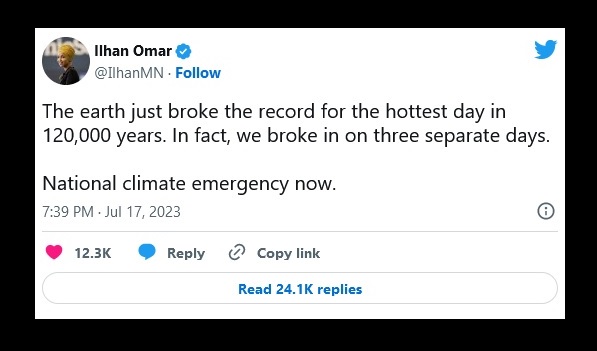
Incompetent Elected Official Of The Month (Well, One Of Them) And Unethical Tweet Of The Month: Rep. Ilhan Omar (D-MN)

Observations:

Continue reading

Me, Baseball, And Eddie Bressoud: I Missed An Opportunity To Let Someone Who Had A Positive Influence On My Life Know, And I Botched It. Now It’s Too Late…

Not long before he died, Mickey Mantle, who had spent his baseball playing days as a fearful, bitter, anti-social drunk with low self-esteem, had an epiphany when a man, with tears in his eyes, shook his hand and told him how much Mantle had meant to him growing up. Mantle was astonished that what he had done on the baseball field affected anyone so deeply, and said that from that point on, he no longer felt his life had no meaning or worth.

There are people and subjects that have influenced the course of my life, my interests, choices and beliefs far more than any school I have attended or any pursuit I have engaged in to make money: Presidential history, for which I have Robert Ripley to thank (but that’s another story); theater and performing, for which I credit Mr. Gilbert and Mr. Sullivan; Greek Mythology, a gift from my mother; rules for living, the specialty of my dad; and, last but far from least, baseball and the Boston Red Sox.

Eddie Bressoud died a week ago, at 91. He is primarily responsible for making me a lifetime baseball fan, with all the excitement, entertainment and wisdom that roller-coaster experience has supplied.

In the winter of 1962, I was reading the Herald sports pages and read about the Red Sox trading their much-reviled shortstop, Don Buddin, to the new expansion Colt .45s for Bressoud, who had been their first pick in the expansion draft. I hadn’t followed the Red Sox closely before that, though all of my friends were big baseball fans like most normal kids in Boston, Mass. You know me: I don’t follow crowds, I avoid them. I don’t know whether it was Eddie’s name or what that intrigued me, but I watched Opening Day specifically to see the new guy play.

I learned that he was called “Steady Eddie;” that he had a Masters degree and was a teacher; I saw that he was always in motion on the field, talking to other players, pointing, intense, an obvious field leader. Bressoud got a hit and started a 14-game hitting streak, sucking me in to watching or listening to all those games to see how long he could keep it up. I was hooked: I didn’t miss a game for 8 years.

Bressoud wore #1, and backed up every catcher’s throw to the pitcher with men on base, a fundamental move coaches teach by few major league shortstops continue. Eddie had a Fenway stroke, a strange, chopping, 2/3 swing that was perfect for knocking balls off of or over “the Green Monster” in left. He also had a knack for clutch hits and doing the little things that helped score runs, like moving runners to the next base even when grounding out. Eddie hit safely in the first 20 games in 1964, setting a Red Sox record for a beginning of a season.. When the team was behind in the 9th, which was often in those days,it seemed like he never failed to get on base somehow. 

Bressoud was unusually articulate and smart: he was a teacher in the off-season, and always made it clear that his passion was education. I was the only fan I knew who was so enamored of Bressoud: Carl Yastrzemski was the rising superstar on those bad teams before the Boston miracle pennant of 1967, though the Sox manager and coaches sang Bressoud’s praises for playing the game ‘the right way” and being both intense and productive. My loyalty was a family joke long after Eddie had left the game. All three of his seasons as the regular shortstop were excellent, and he was was named to the All-Star team in 1964. He was the only position player who didn’t get into the game. I was crushed.

The next season, new manager Billy Herman took away Bressoud’s starting job before Spring Training, and then traded him to the Mets, I listened to their games on the radio so I could keep up with how Eddie was doing. He was a valuable part-timer for the Mets for two years, and was acquired by the Cardinals in 1967.  His last MLB appearance was, ironically, against the Red Sox in Fenway Park, when he ran onto the field as a defensive replacement for St. Louis in the 1967 World Series. The Boston fans gave him a nice ovation.

Baseball has given me too much pleasure and perspective to recount in the decades since Eddie retired, and I apply the lessons I have learned from the game regularly in everything I do. I designed a baseball trivia game and launched a company to promote it, leading me to my first marketing job. Baseball has given me lifetime friends, and experiences I will never forget. It allowed me to cope with personable disappointments and failures, and to not to be overly impressed with the occasional success. It taught me much about critical thinking and bias (thank-you, Bill James!), character, leadership, ordering priorities, recognizing corruption, and culture.

Continue reading

Indiana Jones And The March Of Folly

I have to ask: what the hell is going on with Harrison Ford’s nose in the photo above from “Indiana Jones and the Dial of Destiny”? It looks like he borrowed it from Dustin Hoffman’s make-up kit from “Little Big Man,” when Dustin played a 111-year old man. But I digress…

It is now certain that Disney’s fifth and one hopes final Indiana Jones movie will be a financial disaster. It cost $300,000,000 to make, and with marketing and other costs, a big Hollywood film has to clear about twice its filming costs to break even. That’s not happening; three weeks after its release, “Dial of Destiny” is already trailing two less-hyped summer films, and is being treated as “dud on arrival.”

“Movie Web” has done the best analyses I’ve seen regarding the film’s conceptual, artistic and marketing problems (here and here), and I’d love to write about those, but this is an ethics blog, so I’m officially interested in just one aspect of the debacle: Why didn’t anyone stop it?

Continue reading

“Curmie’s Conjectures” #3: Confucius and the Fourth Circuit

by Curmie

Twentysomething years ago, a few months after completing my PhD, I got a phone call from my mentor in Asian theatre, who, upon learning job search wasn’t going as well as I might have hoped, asked if I wanted to teach a couple sections of the university’s Eastern Civilizations course.  I asked if I was really qualified to teach such a course.  His response: “You know something, and you can read.” 

Based largely on his recommendation, I got an interview for the position.  I made no attempt to conceal my ignorance of a lot of what I’d be teaching.  But the department had struggled with grad students who had lost control of their classrooms, and I’d taught full-time for ten years before entering the doctoral program; I got the job.  The head of the Eastern Civ program closed the interview with “There are some books in my office you’ll want to read before you start.”  I knew something, and I could read.

That’s relevant to my consideration of the recent ruling of the Fourth Circuit Court of Appeals in Porter v. Board of Trustees of North Carolina State University, in which a tenured faculty member claimed to have been punished for arguing against certain initiatives undertaken by his department.  I’m no lawyer, so there’s some legalese I’m not so sure about, and I have no interest in chasing down all the precedents cited by either the majority or the dissent to see if they really say what these judges say they say.  But I know something and I can read. 

More to the point, one of the texts I taught in that Eastern Civ course was Confucius’s Analects, which I had to get to know a lot better than I did previously in order to teach it to someone else.  One of the central tenets of Confucian thought was his argument against having too many laws, as no one could possibly predict all the various special circumstances surrounding every dispute.  Context matters; timing matters; motives matter.  Confucius’s solution was to turn everything over to a wise counselor (like him) who would weigh all the relevant elements on a case by case basis.  That’s not the way our justice system works, nor would it be practical, but it’s easy to see its appeal… in theory, at least.

Significantly, Confucius’s reservations about laws’ inability to anticipate all the possible combinations of circumstances are the first cousin if not the sibling of what Jack calls the “ethics incompleteness principle” which asserts that there “are always anomalies on the periphery of every normative system, no matter how sound or well articulated.” 

Continue reading

On Lady Gaga’s Frenchies: Not Surprisingly, Criminals Don’t Comprehend “The Unclean Hands Doctrine” [Corrected]

[In the original version of this post I confused readers by forgetting to erase pieces of the source article that I had pasted to the draft to save me the time of jumping back and forth between screens. My fault. Then I compounded the problem by leaving out the link. Fixed. It was all my fault; can’t blame WordPress this time.]

What a moron.

But then if criminals were smart, we’d be in even more trouble than we are…

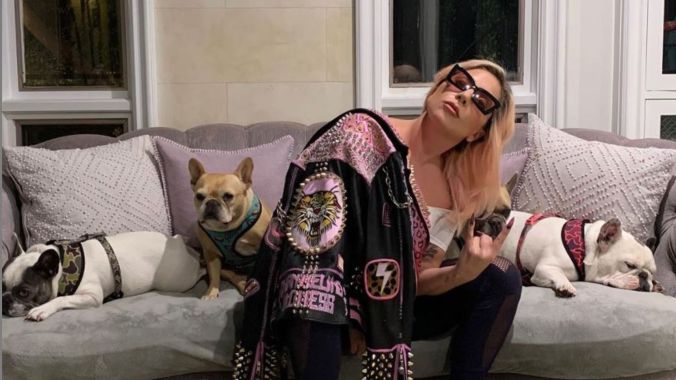
Lady Gaga promised to pay a $500,0000 reward for the return of her two kidnapped French Bulldogs Gustav and Koji (two of the three above: sorry, I don’t know which). The pop icon’s dogwalker was shot and injured during the theft. Emulating the plot twist in the Mel Gibson thriller “Ransom,” however, one of the participants in the kidnapping scheme decided to collect the reward, arguing that because Gaga had said she would pay for the dogs’ return “no questions asked,” she was obligated even to pay someone who was involved in the crime.

Seeking the outlandish reward, Jennifer McBride was arrested when she turned in the dogs at a police station. She pleaded no contest to knowingly receiving stolen property and was sentenced to probation. I suppose the scheme was to have her collect the reward and split it with the dognappers.

After Lady Gaga warbled, “You’ve got to be kidding!’ when McBride asked for the money, McBride sued her for breach of contract.

Uh, no.

In rejecting the claim, Judge Hollie J. Fujie of Los Angeles Superior Court cited the ancient “unclean hands doctrine,” which holds that a litigant cannot benefit from a situation he or she deliberately helped to bring about by illegal or unethical conduct.

“The unclean hands doctrine demands that a plaintiff act fairly in the matter for which he seeks a remedy,” Fujie wrote, adding that the UHD “is an equitable rationale for refusing a plaintiff relief where principles of fairness dictate that the plaintiff should not recover, regardless of the merits of their claim.”

Continue reading

This Biased Journalism Fiasco Explains So Much It Should Be Taught In Journalism AND Ethics Classes

Nah, there’s no mainstream media bias! And sure, journalism is a profession! You can always trust journalism icons!

No…no…and no.

Business Insider published an alleged news article headlined, “More people actually moved out of Florida than New York or California in 2021.” Part of the ongoing effort on both the political Rights and the Left to sink Florida Governor Ron DiSantis’s chances of keeping Donald Trump off the GOP 2024 Presidential ticket, the story claimed to debunk the conventional wisdom that the ultra Woke states are bleeding residents while DiSantis’s state’s population is growing. 674,740 residents left Florida, BI told us, exceeding the total of 433,402 residents who had fled California and the 287,249 residents moving out of New York.

It was pure confirmation bias. The stats were unbelievable on their face, but the Business Insider staff believed them anyway, because they wanted to. After being roundly smacked on social media, BI reversed itself with a replacement post headlined, “We got it wrong: More people moved out of New York and California than Florida in 2021,” that revealed,

Continue reading

Incompetent Elected Officials Of The Month: Oregon Mayors Dean Sawyer And Matt Diaz

It demonstrates a critical lack of integrity to claim you believe one thing when addressing the community that elected you and to privately say the opposite. It is also irresponsible and incompetent to assert positions your supporters would object to in less-than-reliably private forums, like social media. As an extra layer of incompetence, two Oregon mayors were active on social media behaving like this when they clearly didn’t understand the perils of social media (though I bet they do now).

First let’s take the case of Dean Sawyer, the three term mayor of Newport, a city of about 10,000 residents in Oregon. A 30 year police force veteran, he joined a private Facebook group called “LE (that is, Law Enforcement) Only in2016, two years before he was elected mayor. All these years, while he has been extolling “diversity” and celebrating LGTBQ+ “pride,” he was mocking both, as well as progressive sacred cows like illegal immigrants, in his posts, often with particularly vulgar and juvenile memes. (During “Pride Month,” for example, Sawyer posted a photo of disgusted-looking, scantily clad women in a dressing room with the legend, “Strippers waiting for EMS to untangle the new girl’s balls from the pole.”) his luck ran out as it usually does with reckless social media users. Somehow Oregon Public Broadcasting got a tip and managed to track down Sawyer’s politically incorrect and wildly hypocritical posts. Then it wrote, in a special report headlined, “For years the mayor of an Oregon Coast city has posted hateful memes on Facebook”...

Since 2016, Sawyer has posted racist memes mocking Mexicans and endorsing former President Donald Trump’s hardline policies on immigration. One post in April made fun of trans swimmer Lia Thomas. Several mocked Bud Light, which has drawn the ire of Republicans for the company’s business relationship with trans influencer Dylan Mulvaney. Both Thomas and Mulvaney have been targets of right wing smear campaigns and online harassment.

Continue reading

Of Local Radio, Law vs. Ethics, Ruthless Capitalism And “It Is What It Is”: The WOAS Saga

WOAS 88.5-FM is a high school radio station, one of only 200 remaining in the U.S., that has been broadcasting from the Ontonagon High School building in Michigan since 1978. It has only10 watts of broadcasting power, but is still one of only two radio stations in Ontonagon, on Michigan’s western Upper Peninsula. Not only does it provide some listening variety for the town, it also is a valuable educational and recreational vehicle for high school students. Two snack vending machines inside the school largely cover WOAS’s costs, and everyone is a volunteer. After school hours, members of the community volunteer their time as disc jockeys.

WOAS is a Class D station, the lowest FCC classification, covering low-power, noncommercial radio stations. These are considered too weak and disposable to warrant regulatory protection, so when unprotected” from other broadcasters, which can legally overpower its signal or simply apply to take over the station’s place on the dial. WHWL 95.7-FM, with10,000 times the broadcasting power of the school station, applied to the FCC to take over its frequency and place on the radio dial. The FCC said, “Sure! Go ahead!” granting a license for a new station on 88.5 FM, where WOAS lives. The high school radio station now has to find itself a frequency, which costs money, or go gently into that good night.

When the high school asked the radio giant why it chose its place on the radio dial to invade, the answer was classic Bill Clinton: it did it because it could. The big station said it needs to expand and FCC rules allow them to just take over. A consultant looked at available frequencies available to WHWL to add stations, and it deemed 88.5 FM “the best.”

The fact that a high school was currently operating from there was not, apparently, part of the equation, or considered at all.

Continue reading

Now THAT’S An Unethical Lawyer…And Maybe Two

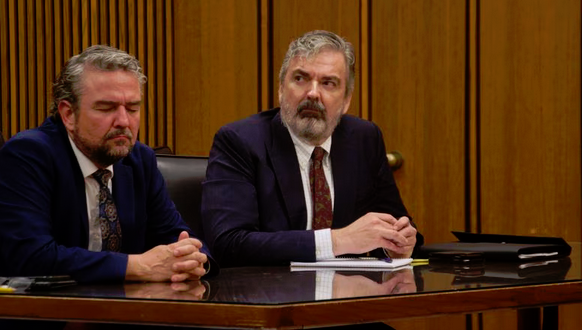
The Cleveland Plain Dealer reports that lawyer James Saunders, who previously worked for the Internal Revenue Service, violated the law by voting twice in both the 2020 and 2022 national elections. His public defender Scott Roger Hurley—he’s on the right above— is arguing that his client should be acquitted because it was “an accident.” “Mistakes do happen, accidents do happen,” he told the court.

Suuuuure.

Saunders voted in two separate locations in two separate states: Cuyahoga County in Ohio, and Broward County in Florida, and in both elections. “The fact that you do that in consecutive general elections I think takes ‘accident’ to the land of imaginary doubt, and not reasonable doubt,” the prosecutor said.

Ya think?

Continue reading