As you may have noticed, your host has been involuntarily separated from Ethics Alarms for about 24 hours. Several things occurred that under normal circumstances would have had me dashing off a post while waiting for flights or preparing to check out of my hotel—and there were definitely several comments that had me reaching for a phantom keyboard—but I was without laptop, thanks to leaving the power cord behind in my previous hotel.
So I have a little story to tell. I stayed at a decent Boston hotel last night, not a 4 star hotel like the one I just left in Atlanta (The Four Seasons), but a nice one, professionally run, dependable. Yet this morning this was my wake-up call, via recording:
“It’s 7 AM. This is your wake-up call for March 8, 2018.”
Almost at the same time, David Hogg was on CNN, explaining how darned easy it was to create a system that would prevent school shootings forevermore.
Wrong. Systems break down, you experience-free, arrogant, disrespectful, know-nothing puppet. The belief that human beings can devise systems that will solve every problem, or any problem, and do what they are designed to do without failing miserably at the worst possible times and in the worst imaginable ways is signature significance for a fool, or a child. O-Rings fail. Police don’t act on warnings that a kid is violent. Obamacare raises health care premiums. Political parties end up nominating Hillary Clinton and Donald Trump. Jack Ruby breaks past police security. Communism ends up killing hundreds of millions rather than creating a worker paradise. The Titanic hits the wrong iceberg exactly where it’s weakest. Hitler takes a sleeping pill during the Normandy invasion.
David Ropeik, who teaches at Harvard and who is a risk assessment expert, finally wrote the article I’ve been waiting for…and it was published almost a month after the Parkland shooting, following almost a month of the ignorant and arrogant grandstanding by the high school students who have been used as virtual human shields by the anti-gun lobby, almost a month after the news media and expedient politicians, including the President, began pandering to grief and ignorance while going out of their way to make the public believe that school shootings are a national crisis.
I’m glad that some sunlight of reality made it through the human-made fog, but it is unconscionable that it took this long, Now let’s see how thoroughly the news media, a full partner with the ban-gun effort, will bury it.
Before I start, however, let me salute the Washington Post. I have not read a Post Sunday Outlook section since switching over to the Times—a better paper but far, far more partisan and biased than its only close competitor—and it was stunning to be reminded what a Sunday news commentary supplement looked like that didn’t feature hysterical Trump -bashing in 75%-90% of its articles. Not only that, the Post had the courage to challenge the conventional, and false, wisdom about school shootings being actively promoted by the Times and the rest of the mainstream media.
“The Education Department reports thatroughly 50 million children attend public schools for roughly 180 days per year. Since Columbine (1999), approximately 200 public school students have been shot to death while school was in session, including the recent slaughter at Marjory Stoneman Douglas High School in Parkland, Fla. (and a shooting in Birmingham, Ala., on Wednesday that police called accidental that left one student dead). That means the statistical likelihood of any given public school student being killed by a gun, in school, on any given day since 1999 was roughly 1 in 614,000,000.”
This is not a great risk. This is not even a significant risk. To say, as the Kiddie Corps has been telling us, that this risk is “unacceptable” can only mean that the official, anti-gun position is that no risk is acceptable. Surely no one is going to argue that a 1 in 614,000,000 chance of being killed in another Parkland or Newtown is unconscionable, but a one in 1, 228,000,000 chance is just fine. And how do we reach no risk? We spend incredible amounts of money, trash our national liberties, send kids to lightless, joyless iron boxes…and there will still be a risk
“[S]ince the 1990s, shootings at schools have been getting less common.”
What? What about all those statistics that claim the opposite? They are advocacy statistics, spun and manipulated. Cheating, in other words. Ropeik is hardly an NRA shill: it’s clear that he is venturing to make these observations while aware that he is risking his progressive bona fides, and thus his invitations to Cambridge cocktail parties. He writes for example,
The problem with all of this is what our excessive fears could lead to. Having more guns in schools, as President Trump advocates — or more guns anywhere — increases the likelihood of gun violence. …The Parkland tragedy itself teaches that more guns don’t automatically mean more safety: The school was patrolled by an armed guard.
The studies claiming that more guns lead to more gun violence are all based on cross-cultural, international comparisons, which many believe (as do I) pollute the findings. Do more guns in the US lead to more gun violence? Reiko himself cited a stat that suggests otherwise: there are more guns in the U.S. now than before Columbine, and a decline in the frequency of shootings at schools. As for the armed guard, citing a professional with a gun who doesn’t do his job tells us nothing about guns, just that it is who is holding it that matters—which is what the NRA has been saying since I was knee-high to a chipmunk.
(The combination of an early morning seminar, a $^%%#! D.C. marathon that closed down access to the venue, and a lost power cord rendering my netbook useless conspired to prevent both late posts yesterday and early ones today: I’m sorry. I’m back at my desk, chagrined but unbowed…)
1 Why not 10? Why not 2? Poor, declining, Twitter-addict Lawrence Tribe’s ridiculous claim that the voting age should be lowered to 16 was so self-evidently silly that I assumed no one serious would adopt it. But, as H. L. Mencken kind of said, “No one ever went broke underestimating the intelligence of the American public,” and as I’ll say now, nobody can underestimate the level of irresponsible proposals that anti-gun zealots will float in their desperation to gut the Second Amendment.
Last week, Temple University’s Laurence Steinberg, a professor of psychology, issued a Times op-ed arguing for Tribe’s new voters, ignoring his own profession’s conclusions that children that young, in addition to not being, you know, adults, also have not mastered stable reasoning ability because their brains are not fully formed. Never mind, says the prof:
“The last time the United States lowered the federal voting age was in 1971, when it went from 21 to 18. In that instance, the main motivating force was outrage over the fact that 18-year-olds could be sent to fight in Vietnam but could not vote. The proposal to lower the voting age to 16 is motivated by today’s outrage that those most vulnerable to school shootings have no say in how such atrocities are best prevented. Let’s give those young people more than just their voices to make a change.”
Wow, what a well-reasoned argument! I can”t wait for the proposal to lower the voting age to minus-eight months out of outrage that those most vulnerable to abortions have no say in how such atrocities are best prevented. Yes, it’s true: the anti-gun Left is willing to follow President Trump with President Kendall Jenner, as long as we let the government and police have all the guns.
Maybe Temple psychologists and lapsed Harvard Law professors should lose the vote, since they apparently can’t reason above the level of 16-year-olds. Continue reading →
The latest tactic of the anti-gun Left is especially bizarre, but it nicely exposes the desperation and the essential dishonesty of the Parkland shooting extension of the Sandy Hook Ethics Train Wreck, which started its long journey of ethics carnage when gun control advocates decided to jettison fair and civil debate as well as any mooring to reality in exchange for demonizing, emotionalism, and hysteria.
In an op-ed in the Washington Post, gun-opponent Adam Weinstein accused pro-Second Amendment defenders and of bullying and deflection by what he called “gunsplaining.” The term was originally coined by Cosmopolitan four days before the massacre at Marjory Stoneman Douglas High School, though Cosmo’s version was that “gunsplaining” is just a sub-set of “mansplaining,” where men, the theory goes, inherently condescend to women by pointing out when they are wrong about anything. Weinstien’s version was a different, and even more foolish, a rationalization for ignorance:
“While debating the merits of various gun control proposals, Second Amendment enthusiasts often diminish, or outright dismiss their views if they use imprecise firearms terminology. Perhaps someone tweets about “assault-style” weapons, only to be told that there’s no such thing. Maybe they’re reprimanded that an AR-15 is neither an assault rifle nor “high-powered.” Or they say something about “machine guns” when they really mean semiautomatic rifles. Or they get sucked into an hours-long Facebook exchange over the difference between the terms clip and magazine.”
The Horror. In fact, what Weinstein is complaining about is that mean old gun-ownership supporters point out when a knee-jerk, emotion-filled gun control advocate obviously doesn’t know what he (or she!!!,Cosmo) doesn’t know what the hell they are talking about. Note the Post’s Eric Wemple, in the tweet above, calls this a “bad faith” tactic. It’s funny: pointing out that an opponent is full of malarkey has always been a valid debate tactic before, and for good reason. It means that that an advocate’s position is based on ignorance and laziness rather than sound research and facts. Why is this suddenly bad faith. “bullying” and below-the-belt tactics now?
The reason is that the anti-gun Left has bet all its chips on the power of children claiming moral authority to finally lead the anti-gun army to victory over the Second Amendment, and those children wield passion and anger but little else. Despite proclaiming themselves as “experts” on gun policy, as David Hogg recently did on Bill Maher’s “Real Time,” their expertise extends only as far as “Guns Bad!” Thus the “gunsplaining” dodge: who ever said you actually need to know what you’re talking about to be a respectable advocate? Continue reading →
The Washington Post, not for the first time, just referred to Jimmy Kimmel as “America’s conscience,” a title first conferred by, of course, CNN.
Any nation that seriously regards the slimy likes of Jimmy Kimmel as its conscience should just commit mass suicide like Jonestown, because it’s a menace to civilization.
(Wind storms all over Virginia, knocking out power and my e-mail, and blowing over a tree that narrowly missed my son’s car!)
1 Lack of Transparency? What lack of transparency? During a lecture and moderated discussion at U.C.L.A. this week in which he was a a participant and invited guest, Treasury Secretary Steven Mnuchin was heckled with hisses, jeers, shouted insults and profanity from students and protesters, some of whom were ushered and even carried out by police officers. A programmed sixth grader in the audience even questioned him about the fairness of passing permanent tax cuts for companies and expiring cuts for individuals, because as we all know, 10-year-olds are well-versed in tax policy theory.
Afterwards, Mnuchin revoked his consent for the official video of the event to be released, perhaps because he was flustered by the harassment and it showed. In response to criticism of this virtual censorship,
The Treasury Department, through a spokesperson, said that what the Secretary did wasn’t what he obviously did—a Jumbo, aka “Elephant? What elephant?”—saying,
“The event was open to the media and a transcript was published. He believes healthy debate is critical to ensuring the right policies that do the most good are advanced.”
He just doesn’t want anyone to see or hear the debate.
A related point: The protests were organized by Lara Stemple, a U.C.L.A. law professor, and students and faculty members participated. Protests are fine; disrupting the event is not. Faculty members who assisted in the heckling should be disciplined, and students who participated should be disciplines as well. It’s an educational institution, and all views sgould be openly explored and heard without interference. No guest of the university should be treated this way. Ever. No matter who it is or what their position. The treatment on Mnuchin was unethical.
2. More Supreme Court fun with ethics! Minnesota’s law banning “political” clothing and buttons from polling places is being challenged as an affront to free speech. The law prohibits people from wearing a “political badge, political button or other political insignia” at a polling place on an election day, and a member of the tea party movement sued after his “Tea Party” message got him in trouble when he came to vote.
“How about a shirt with a rainbow flag?” asked Alito. “Would that be permitted?”
“A shirt with a rainbow flag?” Rogan repeated. “No, it would — yes, it would be — it would be permitted unless there was — unless there was an issue on the ballot that — that related somehow to — to gay rights.”
Justice Alito: Okay. How about an NRA shirt?
Mr. Rogan: An NRA shirt? Today, in Minnesota, no, it would not, Your Honor. I think that that’s a clear indication—and I think what you’re getting at, Your Honor—
A T-shirt bearing the words of the Second Amendment? Alito asked.
Probably banned because of the gun-control issue, Rogan said.
The First Amendment? Alito asked. Probably not, Rogan answered.
Got it. The First Amendment isn’t a political statement, but the Second Amendment is. That led Justice Neil M. Gorsuch to observe: “Under your interpretation of ‘political,’ it would forbid people from wearing certain portions of the Bill of Rights into a polling place but not other portions of the Bill of Rights. And I guess I’m just wondering what compelling interest Minnesota has identified that requires a statute that goes so much further than the vast majority of states?”
In contrast, Justice Anthony M. Kennedy asked J. David Breemer, a lawyer for the Pacific Legal Foundation, representing the challengers, “Why should there be speech inside the election booth at all, or inside the what you call the election room? You’re there to vote.”
This is a problem requiring an “all or nothing” solution. Either all forms of political speech must be allowed, or no speech at all. In a sick time where citizens honestly argue that a MAGA cap or a picture of a gun makes them feel threatened and “unsafe,” the ethical option would seem to be Justice Kennedy’s. No speech, messages, no logos, no photos, no American flags. Last fall I voted wearing my Red Sox jacket.
(Why isn’t this another Afternoon Warm-up? Because I started it in the morning, and all hell broke loose here, that’s why.)
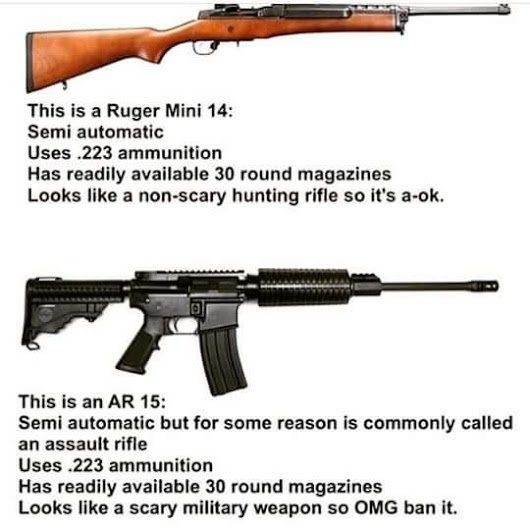
1 Injecting even more stupidity into the culture…Walmart’s virtue-signalling release yesterday reminded everyone that the big-box stores stopped selling AR-15 rifles three years ago. It also announced that it would be refusing to sell firearms to anyone under 21, and this…
“We are also removing items from our website resembling assault-style rifles, including nonlethal airsoft guns and toys.”
Ugh. This is how we end up with no-tolerance fascists in public schools punishing students for chewing their Pop Tarts and pizza slices into the shapes of guns. I had a Mattel burp gun–a plastic model of a Tommy Gun—as a kid. I shot it off in the school auditorium as a stunt during my speech when I was running for president of the 8th Grade. (I lost) One of my favorite toys ever. Now corporations want to assist in the anti-gun indoctrination.
Writes Stephen Green: “‘If an object resembles something we think is bad, then it is bad,’ is the sloppiest kind of magical thinking.” It’s worse than that, though. The more sloppy thinking injected into the culture, the less competent the culture becomes.
I hate memes as a rule, but this one is relevant:
2. The all-time false equivalency champ…The calls to raise the age of legal gun purchasing, one of many gun regulation issues where the NRA’s absolutist opposition makes little sense except that it is an absolutist, no infringement means no infringement organization, is another in a long list of confusing, partisan-divide jumping controversies over “age of responsibility.” laws. There are age limits on buying cigarettes, alcohol, driving, consent to have sex, right to sign binding contracts, military service (and formally the draft), and some other activities, and they have always been used to bootstrap each other. This has been going on for decades despite the fact that physical maturity, mental maturity and emotional maturity are not always nicely synchronized, individuals vary greatly, and if we followed recent scientific studies, we would consider restricting what young men especially could legally do until about age 23. Continue reading →
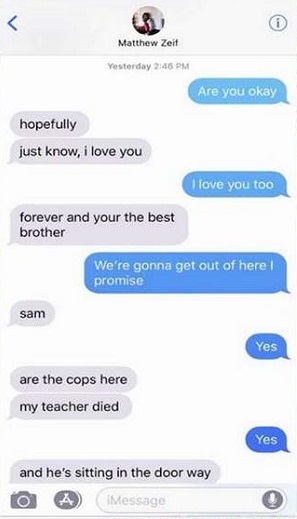
Night commenter Zanshin—he is one of the participants whose commentary frequently greets me in the morning–delivered a fascinating exercise expanding on my post about students in crisis situations defaulting to texting and social media rather than actively considering survival and defense alternatives. He was responding to yeoman commentator Chris, a teacher, who appeared to take deep offense at my suggestion that the texts of the Stoneman High School students reflected an unhealthy obsession with electronic devices rather than a healthy acculturation in self-reliance and fortitude in the face of danger.
I’ll mention here what I have said in the relevant comment thread: I know the issue flagged by commenter (and also a teacher) Andrew Myette was not the one I wrote about based on the link he sent me, but my job is to get everyone thinking about values and ethics even when it hurts, and I knew this angle would be especially uncomfortable to explore.
I can’t speak for Jack, but I sure can come up with,
a specific action the students could have taken that had a strong likelihood of being a better alternative than staying where they were.
Disclaimer 1. The text below is a possible scenario for a fictitious class involved in a school shooting. This is in no way intended to criticize schools, teachers, students and others who have been confronted with real school shootings.
One specific action could be … Oh, this is so good; this one is for you Chris … Haven’t you seen MacGyver? I believe he was part of (y)our generation. He would be so proud of this fictitious class who by relying on their unconventional problem-solving skills saved not only theirs but also other lives.
The teacher and about 5 of the strongest kids, may be members of the wrestling club, and yes, someone like Mack Beggs, who was born female and is transitioning to male while taking steroids, can also participate.
The entrance, the closed door is the one spot where one can get very close to the shooter if he/she tries to get in. That’s his/her vulnerable spot. So, the other kids hide in the safest spot. But the ‘welcoming committee’ stands on both sides of the door. With all the weapons and shields they can garner. Sticks and stones, a sharpened pencil, a can with hot water, pepper spray may be, certainly some chairs and tables. [I am here assuming the door opens to the outside.] On one side of the door you stack a few tables with one of the smaller kids on top with the can of hot water or a bag with the content of the waste bucket or what-ever one can throw on him from above (and that will not endanger the attackers on the ground).
On the other side of the entrance one of the kids has a broom. Continue reading →
Actually, that’s dishonest: it’s been a terrible day, morn to now.. A catalogue retailer took an email address my wife sent them a year ago and bombarded her account with hundreds of promotional messages yesterday, crashing her email. Then her efforts to fix the problem resulted in a Proethics system email crash that I have been trying to address for the past five hours. I finally decided to get something productive done, so I’m getting up this post while talking to my tech people. UPDATE: They just gave up.
1 Trump Tweets.Ugh. The President criticizing his own Cabinet member, in this case Jeff Sessions, in public via tweet, is horrific leadership and management practice. If I were Sessions, I would resign, It is disrespectful, disloyal, undermines morale on the President’s team, and is just plain stupid. I don’t understand how Trump had any success at all treating employees and subordinates like this. While we’re on this perpetual subject. the fact that the President would say out loud that he would have rushed the Parkland shooter without a weapon is just more evidence of a) a flat learning curve b) the lack of the usual filters from brain to mouth and c) the unethical tendency of third parties to critique the actions of others in rescue situations. No question: the resource officer who was required by policy, assignment and duty to try to intervene in the shooting deserves all the criticism he has been getting, and is accountable. But the President of the United States announcing that he is Batman is something else entirely.
My objections to the non-stop personal ridicule of our elected leader stands, but he also has a duty, as the steward of the Office, not to make himself look ridiculous.
2. An unethical boycott tactic, but I repeat myself. The anti-gun zealots have decided to attack a free and constitutionally protected Bill of Rights advocacy group as part of the news media-assisted effort to demonize the NRA as being somehow responsible for a school shooting that none of the proposed “common sense gun reforms” would have prevented. Now the Second Amendment-gutting crowd is using the boycott, a particularly odious weapon favored by progressives, which depends on the venality and spinelessness of corporate executives to constrict free speech. Delta Airlines announced it was ending a promotional discount with the National Rifle Association after threats and a social media campaign, then tried the weaselly explanation that its decision to stop offering discounted fares to the N.R.A. “reflects the airline’s neutral status in the current national debate over gun control amid recent school shootings.” Continue reading →
Cross the Parkland shooting with the ethical problems created by technology, and you get this..
One of our engaged readers sent me this story, about how real-time texting and tweeting have become standard fare during mass shootings and other crisis situations. The story is full of positive words for the phenomenon….
The texts hit a nerve with people because they’re so gut-wrenching and real, Pamela Rutledge, director of the Media Psychology Research Center, tells Yahoo Lifestyle. “They are highly emotional, and enable people to feel empathy and a connection to what the students were feeling at the time,” she says. Social media in particular is good for sharing these texts, Rutledge adds. “Removing the sense of mediation in connection is what social media does best,” she says. “It transports people into events and allows them to share the feelings more intensely.”
The messages are also stimulating to people and create a horror-story-type feeling — except they’re not made up, clinical psychologist John Mayer, author of Family Fit: Find Your Balance in Life, tells Yahoo Lifestyle. That can also make the experience more real. “They bring the reality of the dangers in the world into one’s life and right into your personal space,” Mayer says. “Therefore, it becomes even more frightening.”
The texts also allow people to experience the events vicariously, albeit from a safe distance, and can prompt feelings of gratitude and appreciation for the safety they do have, Rutledge says.
But these kinds of texts really resonate because they’re authentic and straight from the source. “They are real-time reporting of feelings and events,” Rutledge points out.
Well, it’s certainly nice that vivid reporting comes out of massacres! What would we do without social media and cell phones!
My reaction is completely different: Why are these people texting and tweeting in the middle of a crisis?Continue reading →