Wolf’s Question and the Ethical Answer

"Upon reflection, perhaps failing to buy health insurance was a mistake..."

Wolf Blitzer’s question to Rep. Ron Paul at the CNN/Tea Party Express Republican debate in Tampa, Fla. has received most of its publicity because of the idiotic response it elicited from the audience, or some of it. That is good fodder for the Tea Party-slimers, but it was the query itself that raised the most interesting ethical issue.

What should happen, Wolf asked, when a healthy 30-year-old man who can afford insurance chooses not to buy it, and then goes into a coma and needs intensive care for six months? Ron Paul, true to his libertarian soul, muttered unhelpfully that we should all take responsibility for ourselves, which is true, but non-responsive. Blitzer followed up: “But, Congressman, are you saying the society should just let him die?” (This is where the barbarians at the gates added their bloodthirsty shouts of “Yeah!”)

Slate’s Jonah Goldberg has written about what he calls the three possible options available to American society to handle the comatose slacker: Continue reading →

Comment of the Day: “Unethical Business Practices: Online Reputation Services”

For those offended by the fact that this is the second Comment of the Day, I can only note that I haven’t posted a COTD for a while, so they can consider this one as making up for say, September 9.

Tgt has some uncomfortable truths about the practicalities of taking principled stands, in the context of my discussing the dishonest and bullying tactics of so-called online reputation protection services without specifically naming any one company.

There are gradients of this dilemma, which I’m not sure the author sufficiently acknowledges. For example, in the recent Defense of Marriage Act controversy in which law firm King & Spalding arguably dumped an unpopular representation because of inappropriate but no less threatening warnings from its biggest client, there are core professional values involved: once a lawyer ( or firm) accepts a representation, he or she may not, consistent with professional norms, drop the new client because of fear that the representation will have unpleasant consequences. There is no ethical obligation, however, to engage in a protest or civil disobedience when one objects to an abuse of official power. There is an obligation to do something, and it is ethically legitimate to choose a course that addresses the wrong without causing unnecessary harm to oneself or others. One not  cowardly by not being foolhardy.

Unless I accept John Adams’ rather perverse conviction that the only way one knows one is doing the right thing is when he is certain that the consequences will be personally ruinous, I don’t agree that I have failed an ethical obligation by choosing to flag unethical conduct without specifically inciting a company whose business it is to intimidate websites.

Besides, as I noted in my response to this comment, I am not through with these guys. Not by a longshot. But here is tgt’s Comment of the Day to my opening volley: Continue reading →

Comment of the Day: “Unethical Quote of the Month: Canadian Judge Joanne Veit”

The Comment of the Day, by Eric Monkman, is one of many excellent comments on yesterday’s post on the words of a Canadian judge in allowing a woman who murdered her newborn infant to go free.

There are many threads in the discussion, and I am not caught up. I officially apologize to combatants Eric and tgt especially for not being able to respond in sufficient detail, or in some cases at all, to their thoughtful posts. This an example of the limitations of the blog comment format. I wish I could organize a conference call.

The discussion went into so many directions that the initial post’s point was distorted, in part by me. Here is how I would summarize it:

Judge Veit’s quote, the actual focus of the post, strikes me as ethically offensive because 1) the statement that “many believe” abortion is a less than ideal solution to unprotected sex suggests that abortion is acceptable as a primary method of birth control. The commenters object to my interpretation of the judge’s phrasing to mean that she personally believes the adverse of the statement, that abortion is an ideal solution to unprotected sex. (The ideal solution to unprotected sex is not to have unprotected sex.) OK. I see their point. I still read it differently, and my comments are based upon my reading. At best, it is a sloppy, imprecise statement. 2) The comparison, and equivalency, between grief for the child—who is dead, and who was killed by the person who was most responsible for her welfare—and grief for the murderous mother, who is alive, and who is avoiding legal sanctions for her crime, shows a warped set of ethical values. The implication is that the life of a child is no more important, nor has any more regard from the society, than the emotional comfort of the mother. I know that is the standard in Canada, and in much of the US. It is wrong.

The subsequent discussion about how acceptance of abortion leads to acceptance of infanticide was focused on the U.S., but mistakenly assumed that this was the order of events in Canada. It was not; I think that is affirmatively strange, as one would assume that a human life would not be less valued in a society as it became more viable. It doesn’t change my analysis regarding the U.S., however.

Eric asks some good questions which I will address at the end. Here is his Comment of the Day, on “Unethical Quote of the Month: Canadian Judge Joanne Veit”: Continue reading →

Unethical Web Post of the Week: “Screw Civility” by Rick Robinson

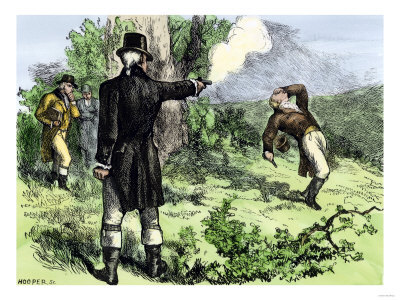
Tell Alexander Hamilton how much fun incivility is...

That an ethics dolt like Rick Robinson has spent so much time advising those in the Halls of Power speaks volumes about why our government institutions are dysfunctional and corrupt. His biography says he even ran for Congress. With ethical values like his—weak, dubious, and confused—it is a miracle he wasn’t elected.

In an essay for Tucker Carlson’s conservative news site The Daily Caller, Robinson defends the uncivil rhetoric of Jimmy (““Let’s take these sons of bitches out …”) Hoffa Jr and Rep. Joe ( “You lie!”) Wilson on the historically false and ethically idiotic grounds that “America was built on a solid foundation of uncivil political discourse.” It is ethically idiotic because this is consequentialism (“Everything turned out all right, so it was the right thing to do”) and a rationalization (“They did it, so we can too!), and it is historically false because no nation, indeed no functioning organization of any kind, was built on incivility….especially this one. Continue reading →

When Ethics Hero Meets Ethics Dunce: Alan Ehrlich and the Spirit of Citizenship vs. South Pasadena Police Chief Joe Payne and Official Arrogance

"Step away from the intersection, sir! You are not permitted to make my officers look bad by doing the essential jobs they cannot."

When a traffic light in South Pasadena went out during the morning rush hour, citizen Alan Ehrlich stepped into the breach and began directing traffic at the major intersection.

“I grabbed a bright orange shirt that I have and a couple of orange safety flags. I took it upon myself to help get motorists through that intersection faster,” said Ehrlich. Before he took action, traffic was backed up for more than a mile, as vehicles took more than a half hour to maneuver through the intersection.

“It was just kind of chaos of cars . . . there were stop signs up. But people were challenging each other to get through the intersection,” said a witness  who works at an office nearby. He reported that Ehrlich’s stint as volunteer traffic cop had traffic flowing within ten minutes.

South Pasadena police then responded to the scene, ordered Ehrlich to stop, and issued him a ticket, but refused to direct traffic at the intersection themselves. South Pasadena Police Chief Joe Payne explained that he did not have the man power needed to staff officers when lights fail, and that Ehrlich should have just allowed traffic to back up. Continue reading →

Obama’s Fractured History

"Don't know much about history..."

I have been, some say, too hard on Sarah Palin, Michele Bachmann, and Herman Cain, for their various gaffes related to our American heritage. The reason I believe that these politicians are especially blame-worthy for their fractured history is that they are all constantly evoking America’s historical past, especially its founding. If you are going to take on the responsibility of educating Americans about the Constitution (which Cain mixed up with the Declaration), Paul Revere (whose ride Palin mangled) and the Founders (to whose number Bachmann added John Quincy Adams), you better get your facts straight, because the public trusts what you say.

What then, is the proper and fair reaction when a President the media has anointed as brilliant states in a nationally televised speech before Congress that Abraham Lincoln was the “founder of the Republican Party”? Continue reading →

Gov. Perry, Social Security, and Condemning the Truth

He speaks the truth! STONE HIM!!!!

In the Bizarro World that is American politics, Gov. Rick Perry was deemed to have stumbled not at all when he spoke of his skepticism about evolution, because a depressing number of Americans are cheered by the delusion that humans were created in a god-like image 10,000 years ago, despite all evidence to the contrary. But Perry is now seen as making a possibly fatal blunder in his presidential aspirations by telling the truth. Stranger yet, the truth Perry told is an essential one that must be acknowledged to address America’s financial ills, and identifying problems is what leaders are supposed to do. Never mind. People don’t want to believe it, so speaking this truth is “wrong.”

The statement Perry made that has Republicans, Democrats and the media in a dither is that Social Security is a Ponzi scheme. Continue reading →

Ethics Dunces, and Crude Ones at That: Ben and Jerry

Stop, you're killing me...

Sorry. I’m ready to be jeered as a humorless prude.  Ice cream flavors should not be named after gross double entendre Saturday Night Live skits. Ben and Jerry’s new Schweddy Balls ice cream (‘sweaty BALLS,” get it?? HAR!)  is just one more step in coarsening the culture, and an unnecessary one.

The skit was a one-joke parody of earnest NPR cooking shows in which a character named Mr. Schweddy talked about his signature holiday confection, rum balls, or “Schweddy balls.” It was funny (hardly hilarious, though; anyone who thinks that is hilarious is 12); it also aired after midnight. Ben and Jerry’s ice cream is sold during the day, the joke is old, and the only point to naming the ice cream after the joke is to sneak something crude into plain view. Wow. What an accomplishment.

The ice cream name is no more or less tasteless, rude and juvenile than naming a New York bar “Buck Foston,” or a TV show called “$#*! My Father Says.” The slobs and foul-mouthed jerks among us won’t rest until everyone talks like sailors and ugliness is everywhere, and they will do it while being applauded by self-styled “liberals” who are really just old-fashioned boors.

It’s not a big deal, any more; the boors are getting their way, because not enough people are willing to endure the guaranteed “Oh, lighten up!” and “Get off your high horse!” sneers that will follow any objections. I hope those big belly laughs from  “Sweaty Balls” ice cream are worth it, I really do. As long as it makes you guys happy.

“Sweaty Balls” ice cream. You slay me.

Unethical Quote of the Week: Nutrition Advocate Marion Nestle

"First the came for the Frankenberry, and I said nothing..."

“The intent of the First Amendment was to protect political and religious speech. I cannot believe that the intent of the First Amendment was to protect the right of food companies to market junk foods to kids.”

—- Nutrition advocate, NYU professor and blogger Marion Nestle, arguing that the government should censor advertising “aimed directly at children,” in the interests of public health.

I should not need to lay out the slippery slope perils of accepting a definition of the First Amendment’s free speech guaranty that limits its protection only to “political and religious speech.” For a professor at a prestigious university to advocate this because it would make her own pet crusade easier should send chills up the spines of every citizen. Let’s see…what kind of speech isn’t political or religious? Commercial speech…artistic speech…workplace speech…academic speech… To zealots like Prof. Nestle, all of this, as well as the liberty it bolsters, should be put at risk in the pursuit of skinnier children, by designating the government to assume the parental function of teaching good eating habits. Continue reading →

Character, American Values and the Defiant Driver

"Drive, you say? OK, jerk, I'll drive. Watch THIS!!!"Character, the good kind, is a foundation of traits, instincts and values that support, inspire and activate ethical conduct.

A person may know the right thing to do, but without the courage to do it, it will not get done. Empathy, similarly, is a necessary quality if the Golden Rule is going to be any guidance at all. Determination and diligence are not ethical by themselves, for one can be determined and diligent in the pursuit of evil ends. Not applying diligence to a task one has taken on, however, will lead to a breach of trust. Although they are not exactly components of what we call character, intelligence and common sense are essential to the character trait of competence, which in turn is indispensable to behaving ethically, for it is difficult to make ethical decisions without the ability to make good decisions.

I was prompted to think about the links between character and ethics when I read a news story out of Kansas City. A woman driving her car in traffic was stunned when a man suddenly jumped on the hood of her vehicle, pointed a gun at her, and told her to drive. Continue reading →