Well, At Least He Didn’t Get Shot: Observations On An Unethical Confrontation On All Sides

Reginald Burks’ vehicle was pulled over for speeding in Alabama last December as he was driving his two children to school. The officer told Burks that he had exceeded the speed limit, but when Burks asked how fast he was going, the officer said he wasn’t sure because his radar gun was broken. He told the motorist that he had used his cruise control to estimate the speed.

Burks replied that the officer “ was full of crap” because he didn’t believe the cop could clock a car’s speed by cruise control. The officer gave him the ticket anyway, and was standing stood in front of Burks’ car. Burks said he asked the officer “politely at least twice” to get out of the way; the officer told Burks to go around him.

So Burks said, “Get your ass out of the way, so I can take my kids to school. That’s why y’all underpaid because y’all act dumb!”

Oh, good one.

Burks has already paid more than $200 to resolve the speeding ticket. A judge, however, has ordered him to apologize to the police officer in writing, and Burks refuses, calling it compelled speech and a First Amendment violation. Judge Nicholas Bull of the Ozark Municipal Court in Alabama says he’ll put Burks in jail for up to 30 days if he continues to refuse to write the ordered mea culpa letter.

As EA”s periodic columnist Curmie might say, “Oh bloody hell!”

1. Let’s assume arguendo that Burks was speeding. With kids in the car, that is unacceptable—it’s unacceptable without kids in the car. Speeding justified the officer pulling the car over. If his radar gun was broken, depending on the speed, a ticket might be successfully challenged in court. Maybe the officer was just going to issue a warning…until the driver decided to argue with him.

2. It’s unethical to use the process as the punishment, which is what the cop would be doing if he knew cruise control pacing would not stand up in traffic court. (I have no idea if it would in Alabama: it wouldn’t in Alexandria.)

3. It’s bad citizenship to escalate a police stop by telling an officer he’s “full of crap.” Citizens should treat police with respect, even when they are mistaken, or even full of crap. Why is that such a difficult concept to grasp? Or teach children before they become adults (or juvenile delinquents)?

4. By standing in front of the car, the officer was engaging in conduct I have experienced myself: deliberately inconveniencing a driver to “teach him a lesson.” That conduct is also unethical and unprofessional. It is also daring a motorist to misbehave.

5. OK, the cop was being an asshole. It doesn’t matter: that doesn’t justify Burks’ shifting into full asshole mode himself. Police officers should be treated with respect and civility because of the institution and mission they represent.

6. What a dangerous lesson Burks was teaching his children! He should apologize to them.

7. Burks is correct, however: a judge has no power to demand that a citizen say or write anything. Burks is willing to spend money on lawyer fees and go to jail to fight for this principle. The sound of one hand clapping for that: the judge shouldn’t order him to apologize, but Burks should want to apologize voluntarily.

8. So should the police officer.

Did I neglect to mention that Burks is black and the officer is white? Silly me. Yet why should that change the analysis here?

My exit question: How many lives would be saved if black Americans resolved to obey police orders and instructions (let’s forget about obeying the law for now) without incivility, hostility and resistance regardless of the circumstances?

Unethical (and Telling!) Quote of the Month: Rep. Nancy Pelosi

“[T]hese poor souls who are looking for some answers….we’ve given them to them, but they are blocked by some of their views on the three G’s: guns, gays, and God—that would be a woman’s right to choose—and these cultural issues cloud their reception to an argument that is really in their interests.”

—-Former House Speaker Nancy Pelosi, (D-Cal.) appearing at an Oxford Union debate to take the position that populism  is a threat to democracy in the United States.

Let me get a compliment out of he way and on the record up front: Pelosi showed guts by appearing in this forum, and that is worthy of a measure of respect. Of course, her daring may be less attributable to guts than hubris, arrogance, or stupidity, because her position is indefensible from a Jeffersonian and Madisonian point of view and stating it in a public forum demonstrates that the totalitarian disease now rampaging through the Democratic Party has so corrupted its values that leaders like Pelosi no longer are capable of realizing how repulsive its ideology has become. Continue reading →

From the Res Ipsa Loquitur Files…

This really does speak for itself, but indulge me as I make a few comments…

1. The “money quote”: “I wish I was more educated.”

2. Ah, yes, the young protesting just to protest, meet people, have fun, threaten Jews! This phenomenon was rife when I was a student, and it so nauseated me that my bias against protests and demonstrations has lasted to this day.

3. When I was 18, I was certain that giving the vote to 18-year-olds was a mistake. People like these women informed that opinion.

4. Immature, uncritical, peer-driven Americans like this are easy marks for propagandists, cultists and hucksters. Imagine: similar zombie activists enabled Black Lives Matter to warp the U.S. culture

5. Good job, American educational system! Well done, parents! The life competence rules that one should never take action on a matter before thoroughly understanding that matter, and that one should never allow others to dictate your conduct absent your informed consent—informed is a key word—have apparently never been taught, explained or conveyed.

6. Nice to see that Rudy isn’t letting his persecution by the legal community for daring to represent Donald Trump, though.

Confronting My Biases, Episode 8: People Who Don’t Speak English Clearly

I don’t know why it took me until #8 to hit this one, which has raised my metaphorical blood pressure (actually, my blood pressure is remarkably stable) for a very long time. I do know why I’m mentioning it now, though: my last month’s hellish dive into customer service departments, where the only good thing I can say about the crazy-making automated phone systems is that at least the faux humans on them speak distinctly and can be understood. Not so at least 70% of the agents I eventually reach after screaming myself hoarse. (A good freind, generally civil, told me that she has discovered that when caught in and endless loop in customer service phone system, screaming “fuck” continuously always gets you to an agent. In my experience that usually works, but I’ve encountered two systems that just disconnect you.)

Look, my grandmother was a Greek immigrant. She learned English diligently and quickly (unlike her sisters and brothers), but she never was able to ditch her strong Greek accent. That’s fine: I have complete sympathy for (legal) immigrants having difficulty mastering English. I am hopeless with foreign languages: I can’t imagine what it would be like committing to a life in a country where I had to learn a new one…..but I would still commit to learning it as a high priority, and constantly strive to master that new tongue as an obligation of living in that society and culture.

Continue reading →

Addendum: “Easter Morning Ethics Exultation”

The photo above, showing three illuminated cross along Lower Manhattan Skyline in New York city symbolizing the three crosses on Calvary, contrasts sharply with Item #3 of the previous post noting that the White House viewed Easter egg decorations with “religious symbols” inappropriate for the day’s festivities.

I ask, without irony or innuendo: “Is this progress?”

______________

Pointer: Sachin Jose

Another Democratic Party Strategy to Save Democracy: Blocking “More Choices on the Ballot”

I keep thinking some day, Democrats with ethics alarms and functioning cerebral cortexes are going to wake up, slap themselves sharply in the face, and shout, “This entire party is based on lies, deception, and hypocrisy! What the hell have I been doing?”

If today’s New York Times story titled “Democrats Prepare Aggressive Counter to Third-Party Threats” doesn’t have that effect, however, I wonder if anything will.

Since the Times here is carefully trying to inform readers about an organized effort by their readers favorite party that should be received as an indictment on its face, the article proceeds as if there are legitimate arguments pro- and con. “An army of lawyers aims to challenge the steadily advancing ballot-access efforts of independent candidates, who Democrats fear could peel votes away in swing states,” begins the Times. “The aim ”is to ensure all the candidates are playing by the rules, and to seek to hold them accountable when they are not,’ “the Times explains quoting one of the leaders of the party’s efforts. It doesn’t mention that this is pure deceit, as the paper has already explained the motivation for the assault on ballot access:

Continue reading →

Heluva SCOTUS Choice There, Joe!

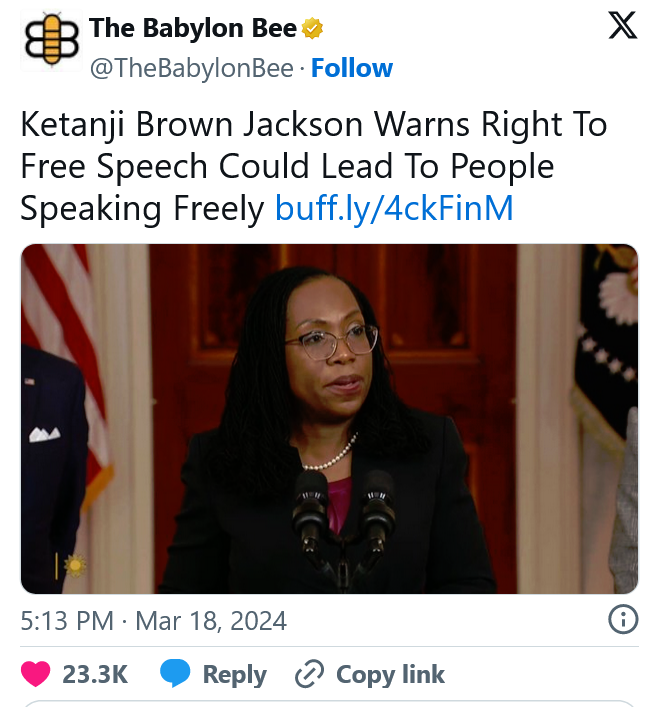
Great. We now have a U.S. Supreme Court Justice who doesn’t like the First Amendment. The Babylon Bee hardly had to be satirical to come up with that headline. During yesterday’s oral arguments before the U.S. Supreme Court in Murthy v. Missouri, the newest Justice and the only one appointed by President Biden, Kentanji Brown Jackson revealed a frightening hostility to the most important guaranteed principle of American freedom from oppressive government.

“My biggest concern is that your view has the First Amendment hamstringing the government in significant ways in the most important time periods,” Jackson told Louisiana Solicitor General Benjamin Aguiñaga as he argued against allowing Big Brother to recruit Big Tech as a political ally by intimidating social media platforms into removing posts the government finds inconvenient. I read Jackson’s quotes yesterday with genuine horror. My sister, a federal litigator of liberal tendencies, had assured me that Jackson was a smart, solid, trustworthy jurist based on her experiences appearing before her. Justice Jackson may be smart, but trustworthy she isn’t. Intentionally or accidentally, President Biden’s openly DEI appointment to fill the Court slot vacated by Stephen Breyer installed the perfect tool to assist aspiring Democrat totalitarians to achieve their agendas.

Oh please, tell us again how Donald Trump is the existential threat to democracy.

Continue reading →

The Latest Chaos in Haiti Brings Into Focus a Taboo Ethics Subject

Once again, Haiti is in the throes of violence and upheaval. It has ever been thus. While the nation Haiti shares the island of Hispaniola with, the Dominican Republic, has been relatively thriving (the key word is “relatively”) Haiti is in almost perpetual chaos. Florida is expecting another mass flotilla of refugees fleeing the hell-hole, and make no mistake, Haiti is a hell-hole. Under current law, and certainly under the warped Biden administration’s immigration policies, it is hard to imagine any scenario where thousands of Haitians do not enter the American populace.

Here is the ethics dilemma that it is politically incorrect to mention above a whisper: Haiti has a toxic, violent, ugly and undemocratic culture that has been ossifying for centuries. People who come from bad cultures, and this is a truly terrible culture, tend to have values and behavior traits that are antithetical to American society. Many in our “Imagine” subculture refuse to accept the fact that any culture is inferior to any other culture; hence they oppose “assimilation,” celebrating multi-culturalism instead. Multi-culturalism eventually metastasized into the DEI religion, and the success of the United States as a nation and a culture has been built on a once-solid foundation embodying the principle that immigrants come here to become Americans, with all the values and priorities that implies. Much of the division and cultural rot we are witnessing in the 21st century is a direct result of several decades of undermining that foundation.

Continue reading →

A Note on Civic Competence, Respect, and Responsibility

Sigh.

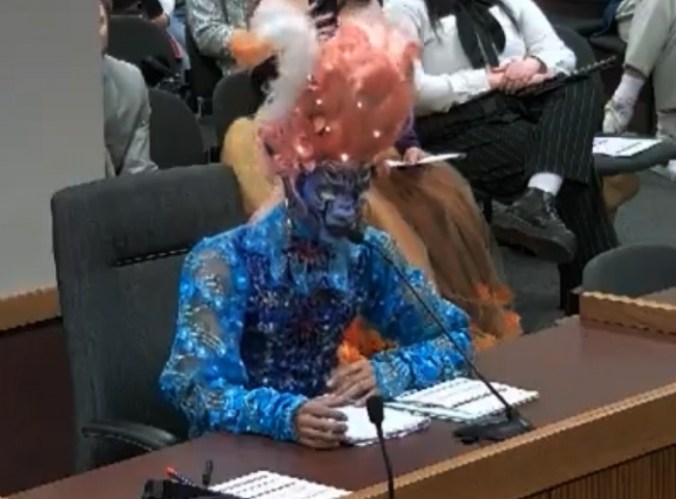
I’m trying to find out the name of the guy (it is a guy) above, but not too hard, because his name doesn’t really matter. Like a good and concerned citizen, he signed up and testified before the Missouri House against HB1650, a bill that would ban drag shows for audiences of children. The worth of the bill isn’t what I’m interested in right now, nor are the arguments for or against it. My concern is the demeanor of the testifying citizen, who was, I’m sure you will not be shocked to learn, on hand to show his opposition to the bill. As far as that goes, good for him. He is participating in the democratic process. He is civically engaged. I listened to some of his remarks; they seemed sincere, articulate, and thought out, if, in my view, misguided, but again, that’s not the issue.

The issue, an ethics one, is this: what THE HELL did he think he was doing showing up to testify dressed like that?

Continue reading →

From Texas, A “Better Late Than Never” Horror Story

The Texas Monthly story is titled, “The Juror Who Found Herself Guilty.” Its tone is celebratory: a juror who made an unethical decision (though the writer attempts to mitigate it in many ways throughout his article) courageously decided to undo the wrong, and succeeded. Far from being impressed with the alleged ethics hero, Estella Ybarra, I found the story infuriating, and its conclusion that Ybarra should be admired untenable.

The story is in the familiar, long-form format familiar to readers of the New Yorker, Esquire, Vanity Fair and The Atlantic. We are given more details about the lives of all the participants in a drama than we need as well as thick context about every facet of the tale. It can be summarized easily, however, and relatively quickly.

In 1990, when Ybarra was 48 years old, she served on a jury charged with determining the guilt of a Mexican-American man accused of rape. She was the hold-out juror, Henry Fonda in “Twelve Angry Men”; everyone else was certain Carlos Jaile (above) had raped an eight-year-old girl. Ybarra was not: she felt the evidence was thin. There was no physical evidence, the defendant had an alibi, and the main proof of his guilt offered was a child’s eyewitness identification after the fact. But, we are told, Estella was still learning English despite being born in the U.S. (Whose fault is that?) and didn’t understand the justice system very well. (Or that?). As a result, she allowed herself to be bullied into voting ‘guilty’ by the men on the jury, even though she was not at all convinced Carols Jaile was.

She went home after Jaile was convicted and sentenced to life in prison, and wept, we are told. This is supposed to make her seem sympathetic. Later, Estella received a certificate in the mail stating that by serving as a juror and “accepting this difficult and vital responsibility of citizenship in a fair and conscientious manner, you have aided in perpetuating the right of trial by jury, that palladium of civil liberty and the only safe guarantee for the life, liberty and property of the citizen.” Ybarra threw the document into a drawer. She told the writer, Michael Hall, that she thought to herself, “We sent an innocent man away for the rest of his life.”

Continue reading →