Michael R.has been a stand-out commenter at Ethics Alarms since the blog’s inception. He also has been missing in action for more than a year. Thus it was a pleasure not only to see him back on the field of ethics battle, but arriving with a Comment of the Day. Michael takes off from the discussion of the national reaction to Stephen Paddock’s puzzling rampage to examine the state of trust in our society. Here is his Comment of the Day on the post, Morning Ethics Warm-Up, 10/3/2017: In the Wake Of Las Vegas…
I think the worst part of the aftermath of this tragedy is I don’t know who to trust. Should I trust reporting on this event that comes from CBS after their vice president announced on social media that she had no sympathy for the victims because many were Republicans? When President Obama tweeted “A violent felon can buy the exact same weapon over the internet with no background check, no questions asked.” — @POTUS #StopGunViolence”, the media fact-checked this and stated it was ‘mostly true’, so should I trust any of them? What news outlet can I trust to give me a truthful account of what happened?
Should I trust the FBI? James Hodgkinson was a member of numerous anti-Republican newsgroups (like “Terminate the Republican Party”), believed Donald Trump was president because of Russian collusion, took photos of the baseball field after the New York Times published an article on where and when the Congressmen would practice as well as the fact that there would be little security, traveled to the D.C. area and was living out of his van right next to the baseball field for days before the attack, Googled “2017 Republican Convention” hours before the attack, and asked “Is this the Republican or Democratic team?” before firing on the Republican Congressmen. This man shot up a bunch of Congressmen and what did the FBI say about all this? They said that Hodgkinson “…had no target in mind” when he shot them, that they didn’t know who he planned on targeting, and that he may have just “happened upon” the baseball game and “spontaneously” started shooting. Should I trust the FBI on this one? All the information at the beginning of this paragraph was from the FBI and the latter part is the conclusion they drew from the info. The FBI also said they didn’t wiretap Trump Tower, then admitted that they did…at least twice. Continue reading →
I would love to post a Comment of the Day by a full-throated and honest advocate of new gun control measures that will “stop gun violence,” but have yet to read one that isn’t a poorly-veiled attack on the Second Amendment. On the other side, we have Rusty Rebar, one of many Second Amendment advocates on various post-Las Vegas Strip massacre threads here, who registered a tough indictment of the “do something!” anti-gun lobby.
“Hell, the NRA used to support background checks, although they no longer do. What’s changed? Why is there that disconnect?”
I think this is attributable to the gun control crowd. The NRA used to be more conciliatory when it came to “common sense” laws. But the gun control crowd kept pushing and pushing, and the NRA has basically said “not one more inch”. So now, even something that is considered “common sense” to everyone will get no traction, because the gun control crowd kept pushing things.
I have said this before, and will recap here. There is a way to do background checks that will be acceptable, and even preferable, to everyone, but the gun control crowd would never allow it.
First, we need to understand the purpose of a background check is to determine if the person buying the gun is legally eligible to do so, nothing more, nothing less. That is not what gun control proponents want though, they want more, they want a registry of all purchases. That is beyond the scope of a background check. Continue reading →
I don’t like only covering one ethics topic on a given day, but the NFL National Anthem Train Wreck posts certainly generated enough high-level commentary to justify it this time. My two posts on the topic also sparked several candidates for Comment of the Day. This one, by Chris Bentley, challenged the central premise of the NFL kneelers, to the extent that they have a premise: they certainly have been neither persuasive nor consistent in articulating whatever they think they are kneeling for.
“…of a man who said that he couldn’t honor a nation that “oppressed” blacks…”
Sincerely asking, Chris, because I took issue with when Kaepernick made the initial claim, and take issue with you repeating it. How is ours a nation that oppresses blacks?
That is a bold, and wide ranging claim to make. And, as I have invoked before (and at times you’ve shot down, at times legitimately, and at times not, IMO), how can a country that oppresses an entire race of people, a group of people that share the same race as I, somehow not oppress me? Not oppress my father? My brother? My sister, uncle, niece, cousins?
If there is something that makes us different, that makes Thomas Sowell, and Jason Riley, and Walter E. Williams, and Derrick Green (writer for Project 21, a leadership network for Black Conservatives), and many other blacks who are apparent immune to this different, then why is no time devoted to identifying what that secondary component is, that causes us to be excluded from this oppression? We spend so much time discussing intersectionality, but ignore the intersection where systemic racism meets some unknown, unspoken characteristic possessed by some of us, where we become immune to that aforementioned systemic racism. If that’s our goal, eradicating racism, why is no one asking those of us who aren’t finding racism around every street corner, what our secret is? Why are the cameras consistently shoved in the faces of the victims of our racist society, but never us? (You and I both damn well know the answer)
To me, it’s be like someone claiming that Jack is biased against ALL commenters that have “Chris” in their screen name. If Jack’s never been biased against you, can that claim be credibly made? Shouldn’t there be a deeper dive, to identify other characteristics held by the group being infringed upon, rather than lazily basing it on a trait that’s also held by many people who haven’t been affected?
But, to my original question…by what metric can one claim that America is oppressive towards blacks?
Is it the ritualistic, indiscriminate killing of blacks by cops? B/c according to the Washington Post Police Killings tracker, in 2017, twice as many whites are killed by cops than whites (164 to 326). And while, yes, Im fully aware that means (since whites outnumber blacks 5 to 1) that blacks are MORE LIKELY to be killed, it also means that whites are killed in high enough number, that police killings cannot be solely about race. And 95% of police killings involve men, but there’s no outrage about that…so if we’re being intellectually honest and consistent, it cannot be about police killing rates relative to a particular demographic’s representation in the population, right? Unless we’re willing to admit that men are over represented in activities that bring them into violent contact with police…but that can’t be it, unless we’re ALSO willing to admit (I think you see where this leads)…
Is it about black poverty rates? 46% of Black families with children that are headed by single Black women live in poverty, vs 8% of black families where the parents are married (which obviously trails statistics for while single mom headed households/married households), but as of 2014, only 29% of black adults were married, down from 61% in 1960. It stands to reason that a 2 income household leads to more financial stability, and is something that can be created regardless of how racist our society is (I mean, the black marriage rate was 80% in 1890, when the US was still in the immediate shadows of the Civil War and Reconstruction). Did the legacy of slavery just…skip a few generations? Is systemic racism somehow preventing us from marrying one another? Continue reading →
Yeoman commenter Chris issued a detailed response to the first of two posts about the anthem protest fiasco. It’s not all rebuttal, and raises other related issues; Chris is clear and articulate, and I wanted to get this up now so commenters could respond here.
I’ll just argue immediately with one of Chris’s points, because I have always found it bizarre when I have encountered it elsewhere. The Left’s aversion to rituals like standing for the National Anthem or saluting the flag seems to me to be a wonderful example of missing the crucially important forest for a scrawny tree. Rituals, traditions and ceremonies bind people, cultures and societies together. They also bind other cultures together, including small ones, like families. Singing and listening to that Anthem at public events is at worst harmless, and at best a binding and powerful group experience. I feel sorry for people who don’t or can’t experience it, just as I feel pity for those who cut themselves off from the culture’s celebration of Christmas to show their aversion to Christianity or religion. I have seen what havoc is raised in a family when a long and beloved tradition is suddenly rejected by a child. The family is wounded, and all its members are affected. This is just a microcosm of what happens in a nation when there is the kind of widespread rejection of values and symbols that Chris and those like him advocate.
The National Anthem at sporting events is theater, spectacle, and symbolic. Anyone on the field is part of the spectacle, and has the power to diminish the experience for people who care deeply about it. They also harm the tradition itself. For an organization like a sports team, it is important to make any on-field display professional, uniform, and pleasing to the audience. A player intentionally refusing to conform with the ritual and thus disrupting it is, at the minimum, rude and selfish. A team has every justification to take measures to prevent some players from standing respectfully, others kneeling, others turning their back, some waving competing flags and others making farting sounds. It looks bad. It will turn the tradition into a farce. Most important of all, it weakens the country and the culture. National pride and respect is part of the connective tissue that ensures the strength and health of any society. I cannot fathom why so many on the Left cannot grasp this concept, and I have dark suspicions that they do grasp it, and this is why they try to tear our traditions down.
Commenter John Glass also passed this along:
The specific rule pertaining to the national anthem is found on pages A62-63 of the NFL League Rulebook. It states: ‘The National Anthem must be played prior to every NFL game, and all players must be on the sideline for the National Anthem. ‘During the National Anthem, players on the field and bench area should stand at attention, face the flag, hold helmets in their left hand, and refrain from talking. The home team should ensure that the American flag is in good condition… …It should be pointed out to players and coaches that we continue to be judged by the public in this area of respect for the flag and our country. Failure to be on the field by the start of the National Anthem may result in discipline, such as fines, suspensions, and/or the forfeiture of draft choice(s) for violations of the above, including first offenses.’
Any employer has a right to set such rules and conditions for on the job conduct, and any employee has a right to ply his trade, or another, elsewhere.
sports should not be made a party to the current progressive indoctrination strategy of making everything in American life a political lecture
I agree, which is why the National Anthem should not be played at sporting events.
Nobody pays to go to sporting events to see continuations of the political disputes and debates they watch sports to avoid. Sports is entertainment, and entertainment is escapism.
I agree, which is why the National Anthem should not be played at sporting events.
It’s a useful distinction, and there is no question that the President, as misguided and inappropriate as his remarks were, wins the argument with the many, many millions who just want to watch their favorite teams without being bombarded by political bombast and grandstanding.
I agree, which is why the National Anthem should not be played at sporting events. (And was Trump’s statement not political bombast and grandstanding?
Players are welcome to have political views and to take part in demonstrations and other activism, but not while wearing their uniforms, and not on the field.
I agree, which is why players should not be forced to take part in a political demonstration during sporting events.
Yesterday, over a hundred NFL players “took a knee” during the National Anthem to protest…something…as the news media cheered them on.
It was very clear to me what they were protesting; you describe it here:
The US doesn’t need any more division now, and Trump’s crude outburst was indefensible. Presidents should not comment negatively on the conduct of citizens when they are acting within their Constitutional rights. Nor should they interfere with the policies and disciplinary decisions of private businesses
That’s what they’re protesting. It’s what I would be doing too. I’ve said before that I think flag burning is idiotic, but if Trump followed through on his threats to make flag burning illegal, I would become a flag burner. There may not have been a specific threat here, but the principle is the same. If Trump calls people who take a knee during the national anthem “sons of bitches,” then let me be a son of a bitch. Continue reading →
A commenter on the post on the studio tantrum thrown by MSNBC host Lawrence O’Donnell going viral on YouTube after it was leaked said that such a leak was “predictable.” I asked,
“Why should it be “predictable”? Why shouldn’t we be able to trust co-workers not to try to hurt us, e-mail correspondents not to send out our messages to strangers and on social media? Was it predictable that Donald Sterling’s mistress/beard would tape his comments in his bedroom to destroy his reputation?”
Exactly. It shouldn’t be predictable. However, it seems that for a lot of people, their first instinct with anything they come across is to put it on the net, no matter the consequences. It’s so easy ( and I assume, extremely satisfying to bully types) to shame and humiliate on a scale previously unknown in human history. It’s irresistible to too many.
The ability to find thousands of like-minded people in a relatively short period of time on social media, and the sheer volume of encouraging positive feedback you can receive ( ‘if so many people agree with me, I must be right!’) has brought grade-school level cliques and meanness to the fore in a great deal of adult communication. It’s the same mechanism on a large scale. People rarely step back and see themselves, but I read and just wonder at it daily…the people most stridently against fat shaming, objectification, being leered at, and other ‘lookist’ offenses on social media are routinely ridiculing Trump on his hair, weight, skin color, and posture while playing golf, comments on appearance are very common. Continue reading →
Once again, a Friday yielded multiple “Comments of the Day.” I’ve noticed this trend for some time, and have no explanation for it, but I am grateful nonetheless.
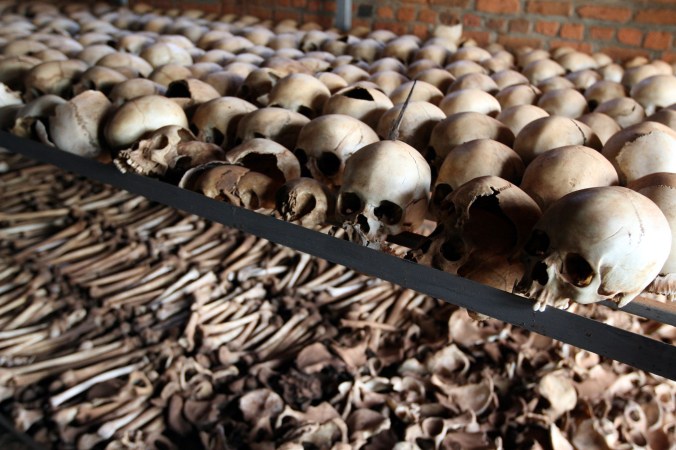
What with the current generation being famously ignorant about just about everything and all, it’s a shame they don’t know much about the Rwandan genocide (there are countless similar tales throughout history, but Rwanda was only 25 years ago and you’d think it’d be fresh in everyone’s mind.) The oppressed can very easily, and very quickly become the oppressors.
The Hutu were every bit the marginalized, persecuted victims. Exploited for labor by Europeans for generations, forced to obey and serve the fairer-skinned, wealthier Tutsi minority. Treated as second-class citizens. Gradually discrimination against them became illegal and the Hutu gained equal rights, and protection against discrimination. The Belgians had cleared out and the Hutu and Tutsi had a chance to treat one another as equals, share the country, and put the past behind them, which the Tutsi were for the most part willing to do. The laws were in place, there was a shared government with a Hutu majority, and the stage was set for reconciliation, but the Hutu were still, on the whole, poorer and less educated by the Tutsi. There was intense resentment among them, constant dredging up of the past, and an unwillingness to wait until time and intermingling evened things out economically. And of course, politicians and media-types willing to stir up the racial enmity for their own selfish reasons. Sounds awfully familiar. Continue reading →
Okay, I tried to read the article, and I made it no further than Blow describing Trump’s America as the ninth circle of hell. When one strikes that level of hyperbole, it eradicates any credibility one might have possessed.
One of the greatest counters to depression and despair is an attitude of gratitude, something I truly see lacking in anything coming from the left. We have a great nation. We have great opportunities, and we have a culture that truly seeks – if sometimes in very strange, even damaging ways — to right wrongs and make life as fair as possible. If you look around the world, and if you look at just about any culture that existed since the dawn of history, you won’t find any people who have been so richly blessed as those in our country today. This is especially true when you consider the stability our nation has, and its lack of credible enemies that pose any existential threat to our nation. We can go about life assured that tomorrow will indeed be much like today.
Even in the face of hurricanes, we have much for which to be grateful. We have incredible technology that gives us quite a bit of advanced warning that the storms were coming. We have minimized death tolls in the face of these natural disasters, and we have a government willing to pour billions of dollars into rebuilding communities destroyed by the hurricanes. We have seen an incredible outpouring of generosity from the nation at large to help the hurricane victims (the Knights of Columbus alone raised $1.3 million). Yes, the devastation is traumatic, and yes people have lost livelihoods, all their possessions, and even family members. But this strikes against one very important aspect of life. Continue reading →
I don’t know if anyone regularly commenting here cares about the punishment of the acting student for his politically incorrect choice of words in an improv exercise as much as Curmie (above) and I do, but we care about it a lot. As with the Ethics Alarms baseball ethics posts, the various theatrical ethics posts here sink quickly in readership, which, I’m afraid, speaks to a regrettable narrowness of vision. Ethical issues are seldom restricted in their applicability to the specific area in which they arise. I’m especially sensitive to ethics issues others might miss in certain areas where I have a lot of experience and expertise. The same is true, obviously, with Curmie.
Incidentally, I again urge readers to check on Curmie’s blog routinely. He has been through a light writing period of late, but when he speaks, as they once said of E.F. Hutton, people listen, or should. And maybe we can get him writing more again. I know of no more thoughtful, fair, and eloquent blogger, regardless of the topic.
I am not an acting teacher by trade, but I have taught about two dozen sections of various college-level acting courses over the years. I’ve also taught directing maybe 15 times, and I’ve directed about 40 full-length plays (and a bunch of one-acts)—I’ve used improv techniques in the classroom and in rehearsal many times, although perhaps fewer than some of my colleagues of equivalent experience may have done.
It is remotely possible that the professor, Craig Rosen, imposed some restrictions on the exercise. I’ve done this. For example, if a student is working on a period piece and the language is, shall we say, less explicit than that of a work by David Mamet or Neil Labute or Sarah Kane might be, that young actor may be having trouble finding the anger a character feels if the verbal expression of it seems mild by 21st-century standards.
I’m reminded of working on a book chapter about an Irish version of Chekhov’s Three Sisters. The translator/adapter had Masha, one of the title characters, refer to her sister-in-law as a “bitch.” I happened to have access to a good friend and native Russian speaker, who also happened to be a scholar of dramatic literature. No, she said, Masha’s expletive doesn’t really translate that way… but for her expression of class-driven disgust to have the same effect on a modern audience that Masha’s line would have had in Tsarist Russia, she’d have to call Natasha a “fucking shopkeeper.” Continue reading →
Ethics Alarms commenter Mrs. Q has proven herself the master of blending personal experience with ethical analysis, and we are blessed with another example of her best work, a Comment of the Day on the recent post about a Daily Beast editor’s attack on Russian tennis star Maria Sharapova. Here she enlightens us from her perspective on confirmation bias, and its current damaging effects on public discourse and independent thought.
What’s going on here is total BS in the form of Mr. Madison’s racism, not Sharapova’s. Clearly he conflated the very correct description of Williams body, with that of ….? I suspect the real story is this guy feels traumatized that everyone else is a racist when I bet if he looked in the mirror, he’d discover we all have prejudices and it’s part of what creates a society that forgives one another.
Back in the day primitive shamans used rituals to hypnotize victims into fear and trauma. Having been a Social Studies major and Women’s Studies minor, I must say, in a way, being a minority, especially brown and queer, is wild at a liberal arts school. Every day was a new trauma of story after story about how terrible America is. Before kids chanted “cultural appropriation” today, I was doing it when I saw Mohawks, African masks, and whatever else displeased my social justice blood thirst. One day I couldn’t take another class in exploring my own oppression. I needed to go live and set my mind free of the prejudices I came to have against whites, men, heterosexuals, etc. I just couldn’t wear myself and others out with indignant anger anymore.
When my wife and I; an interracial same-sex married couple, go traveling, we love to go to small towns and rural areas. Only liberals say to us “why would you go to X with all those rednecks?” People who have bumper stickers that say “Co-exist” or “Love is Love” will say to us “aren’t you scared to be around those Republicans with guns?” Every time we visit a place like rural Montana, Eastern Oregon, or all of Idaho, we meet the most friendly people. Those who we can tell aren’t abiding by the ‘Worship Diversity’ religion just treat us as anyone else and mind their business. It’s SO MUCH BETTER than being pandered to constantly in the city by Saint Social and Friar Justice. Continue reading →
I am very grateful for veteran commenter Extradimensional Cephalopod clarifying explanation regarding how and why adversaries on the “dreamer” issue so often talk past and around each other, with never the twain meeting. The first I heard of the “Honor vs. Compassion schism” was in this 2009 essay in The New Criterion by James Bowman. I should have referenced it before. He wrote in part,
Compassion is a virtue, but it is a private, a face-to-face virtue which almost invariably ceases to be one when it takes on a public dimension. An act of compassion by a government, in the full glare of publicity, is not a virtue but a bid to be given credit for moral superiority.
It’s a classic honor versus compassion schism. Honor represents orderly good, enforcing consistency and stability so that society may benefit from people knowing where they stand. Compassion represents chaotic good, making exceptions and doing things that cannot be expected or required so that society can benefit from such kindness. Both are necessary, but they must be balanced against each other.
Because your position is based on honor, and makes sense in that context, it’s impossible for people to rebut it in those terms. Instead, they assert that the harm allowed by not extending compassion outweighs the benefits provided by honor, or they reject the concept of honor entirely. They don’t really understand honor or the harm done by dismantling it. Maybe they never noticed the benefits of honor, and only saw its negative effects, or they were oppressed by an ill-conceived brand of honor. Continue reading →




 Ethics Alarms