The conundrum I discussed in the post was the proper degree to which accomplishments should be judged according to the effort and sacrifice they required.
Here is Jutgory’s Comment of the Day exploring the question further:
***
Not to solve your problem, but maybe I can make it clearer.
The distinction between effort and outcome is very basic. The Stoics observed that you have complete control over your effort, but no control over the outcome of those efforts. As a result, you can control how much effort you put into something, but it will not guarantee success. (Nietzsche kind of flipped this around and said that the great man is the one who could make reality to conform to his will. Maybe that is what a ton of effort, tenacity, and luck will get you. I am sure you can find examples of that in the lives of the Presidents.)
It is also embedded in the Declaration of Independence. Happiness is not an inalienable right; you only are guaranteed the right to pursue happiness. That is, you have the right to decide what you think will make you happy and pursue those goals, as long as they don’t infringe on the rights of others to do the same.
The commentariate on EA always surprises and delights me, and the response I got to an off the wall post inspired by an AP story about “biblically correct” angels was a perfect example. The resulting thread was a veritable primer on anglelology, with Ryan Harkins weighing in with three substantive posts and several others contributing valuable insight as well.
I don’t deserve you.
One more Christmas tradition that I left fallow this year—like almost all of them—in the absence of my wife was our Christmas Eve reading aloud of the children’s book “The Littlest Angel,” by Charles Tazwell. Grace loved the story so. She would always cry at the place where the Littlest Angel gives his most cherished possession, a simple wooden box where he kept his earthly treasures when he was a child on Earth, as his gift to the soon-to-be-born son of God:
“The Littlest Angel trembled as the box was opened, and there, before the Eyes of God and all His Heavenly Host, was what he offered to the Christ Child.And what was his gift to the Blessed Infant?
“Well, there was a butterfly with golden wings, captured one bright summer day on the high hills above Jerusalem, and a sky blue egg from a bird’s nest in the olive tree that stood to shade his mother’s kitchen door. Yes, and two white stones, found on a muddy river bank, where he and his friends had played like small brown beavers. And, at the bottom of the box, a limp, tooth-marked leather strap, once worn as a collar by his mongrel dog, who had died as he had lived, in absolute love and infinite devotion.”
Somehow, it doesn’t work quite as well if one is thinking of the Cherubim as having eyeballs all over his wings or three heads.But that’s just me…
Sarah B.’s perceptive and eloquent Comment of the Day about the inquirer to the NYT’s “The Ethicist” advice column who asked whether the threat of various catastrophes ahead (as she saw them) concluded with a sentence that reminded me of this famous speech from the film “Parenthood.” I’ve been looking for an opportunity to post it. Thanks Sarah B.
It is very easy to mock and deride someone who is silly enough to believe the mainstream media and all the horror stories the left has subscribed to. I like feeling superior for not believing in this version of fantasy land. I felt superior when I was not one of the wackos who declared themselves part of the Navi in Avatar, and I’m feeling the same general happiness when recognizing that I’m not so far gone as to believe this current set of beliefs. Indeed, it is tempting to feel even more so, because so many of my contemporaries follow this insane set of beliefs.
However, I think we need to dig deeper than the mocking laughter this letter so easily inspires. What is this woman really saying? First, she is discussing a desire to have children. This is a desire that fewer and fewer women are subscribing to, usually to their and to societies eventual sadness. Therefore, this desire should be encouraged. Second, she is fearing that we are entering a time of tribulation. Before addressing this in any depth, we should consider what she is probably meaning with these two concerns. The first worry is likely that she feels that bringing a child into this world in a time of trouble means that her child may suffer. The second worry is that in bring a child into this world in a time of trouble would cause this woman to suffer.
The concern of bringing a child into a world in a less than perfect time causing the child to suffer is not a valid one for several reasons. First, the USA, under Trump or not, is better than many if not most places in the world. In addition, the world in 2024 is a better place than nearly all of human history. Less people suffer, and they suffer less than in the past. The human misery index is very low. Children are a joy to the human race, and the hope for the future. Man has always had children, even in tougher times than any we can illogically expect to come about today. The idea that the child MIGHT suffer in the perfect storm is still less likely than the child having a normal life and enjoying every moment his parents lovingly gifted him. Besides, in the best of times, a child will get illnesses and injuries. That is part of growing up. To quote Calvin, quoting his dad, “being miserable builds character.” As some say, if it were not for the heat or the hammer, the steel could not be honed. Adversity is what helps us become the best version of ourselves.
The concern of a parent suffering because they brought a child into a troubled world is ridiculous, because parents will always suffer for their children. Labor is no picnic. Sleepless nights when breastfeeding are a form of suffering. Staying up with a sick kid, or sitting by a kid’s bedside when they are in the hospital for a tonsillectomy, appendectomy, or croup is not exactly enjoyable. Holding them still so a doctor can give them stitches is incredibly painful, even before they kick you. I certainly feel greater pain than my children when they are sick and in misery and I wish I could take their suffering from them, even if it is a good suffering. Heck, it really does hurt me more than my child when I have to discipline them. And again, in the perfect utopia of a Democratic paradise, a child will still cause their parents suffering. Children will be born with special needs. Children will slip past an exhausted or distracted parent and fall into a pool or run into traffic. Accidents will happen, no matter what we do. Also, children will grow up and make poor decisions that cause parents all kinds of heartbreak. (I could mention that many democratic policies make some of those decisions more likely, but that would be of little use talking with this woman.) In short, being a parent is accepting suffering in the course of bring joy to ourselves and others.
My final thoughts on this involve a song by Garth Brooks. “Our lives are better left to chance. I could have missed the pain, but I’d have had to miss the dance.” Today, too many people have become convinced that no dance is worth the pain we may have to suffer, especially if we only imagine what the pain may be. I choose the dance.
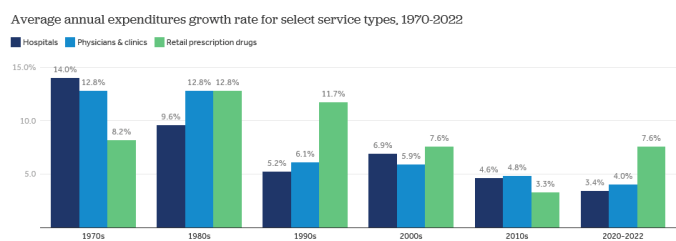
In his useful Comment of the Day on the recent essay about “wanted” posters going up around New York City to target health industry executives, Chris Marschner examines some of the factors underlying the high cost of staying alive in the U.S.
I worked on health care costs and the various schemes to keep them down in the 1980s at the U.S. Chamber of Commerce. Then, the big panacea was going to be HMOs. The cruel reality was that they were over-sold: HMO’s were great if you had something very simple or something very serious: in between, the care just wasn’t any good, as I found out when I first started suffering from chronic gout. Unless there is some incentive for the health care consumer to minimize costs, insurance helps make health care more expensive. Personally, I blame Franklin Roosevelt’s socialist theory that Americans should be guaranteed “Freedom from Want,” meaning guaranteed housing , jobs, a “living wage,” and cradle to grave health care. If people are not sufficiently motivated to avoid unnecessary trips to the doctor or emergency rooms because they won’t have to pay for the consequences of their life choices, medical costs will keep going up. Thus Obama’s “Affordable Care Act” was even less effective at keeping health care affordable than Biden’s Inflation Reduction Act was at reducing inflation.
These posters would be, in my humble opinion, incitement to violence and immediate threats to the individuals identified. As such, claims of free speech cannot be defended.
I read an interesting article on the history of health insurance from PubMed A (Brief) History of Health Policy in the United States – PMC. While it outlined the historical development it fails miserably with respect to why health care costs have risen so dramatically. The primary reason for health care inflation is that insurance decouples the patient from the provider when it comes to making choices. If health care providers were not compensated based on a fee for service model it stands to reason that the number of services would fall which would allow greater access to health care when actually needed. Having your primary care physician have you make an appointment every 3-6 months just to evaluate you is an appointment that cannot go to someone in need resulting in long wait times.
This Comment of the Day by new participant in the comment wars Dr. Blae cheers my pre-Christmas cockles more than most for two reasons: 1) I always love it when a first time commenter weighs in with a Comment of the Day. This is especially true since I spend so much time reading attempted first-time comments that read: “You suck, asshole!” 2) Genuine expertise on these topics is always a godsend. I am a pan-ethicist, meaning that I work in the ethics field regarding too many areas to count, legal ethics substantially but also business ethics, government ethics, sports ethics, academic ethics, journalism ethics, and more. I am neither a participant nor an expert in many of these fields themselves, so when ethics and one of them intersect, a specialist is especially welcome.
Federal agencies have been maintaining uninhabited office space in some of the most expensive real estate markets in the US.
The majority of federal workers, that can, telework/remote work and avoid coming into the office.
There is an assumption of a lack of efficiency due to telework/remote work, but the evidence is anecdotal or not directly relevant (e.g., office occupation).
Now for a couple of questions… prior to COVID:
When were government employees accused of being efficient?
What is efficiency? This is really important since the implication is a quantitative comparison, so we need some numbers.
Are all jobs/positions the same? Is there a single solution?
Where do most federal employees (in the DC area) come from?
How do you “drain the swamp” by reconcentrating employees in the swamp?
What is a comparison of costs between an employee doing telework/remote work v. being physically in the office?
Why do federal agencies continue to rent unoccupied spaces when according to GSA regulations/policies they are supposed to “right size” office space?
Here is the Comment of the Day, an illustrative reminiscence from Michael R. in response to the post, “Unethical Tweet Of The Week: President-Elect Donald Trump (Sigh!).” It requires no further introduction…
***
Well, for 4 years, the federal government, the media, academia, and Hollywood have called me a far right extremist (and a lot worse). Federal agencies have training that lists Christians, white heterosexuals, etc. as domestic terrorist threats. These are the rules now. As long as the left thinks that they can treat their political opponents as threats to democracy, as bigots, and as domestic terrorists without ever being treated similarly by their political opponents, nothing will change.
It is being reported that 30 tech company founders have recently been de-banked. This comes after thousand or tens of thousands of other conservatives have been de-banked for their personal beliefs or political affiliation. If you are a conservative, you can’t become a teacher (the teacher ed programs have viewpoint interviews), you can’t get government internships (you need to volunteer for leftist organizations as part of the pre-reqs), and you will have a hard time going to law school. Med School will soon be an impossibility with the current leftist ideology being pushed. As long as there are no consequences for the left, there will never be support to stop such viewpoint discrimination.
When I was in college, I found out that one of my classmates had been sleeping in the lobby of the dorm for several weeks. Her roommate had moved her boyfriend into the dorm room and they wouldn’t let her in. When she went to the RA and the dorm director, they told her that “You two are both adults, you just need to discuss it and work it out”. She was frustrated because the roommate would not compromise on this. I laughed and said “Why should she? She has everything she wants and there are no downsides for her. What are YOU going to do about it?” So, I asked a freshman football player to go to her dorm room, pretend to be her boyfriend and ‘discuss’ the matter with the roommate and boyfriend. Well, he brought along the entire offensive line. Once he announced that he was her boyfriend, the roommate’s boyfriend fled. The roommate left school the next week. Nothing will change unless there are consequences.
Gregg Wiggins, an old friend and frequent theater production colleague, issued this Comment of the Day in explanation of the reasons for my complaint yesterday about NBC’s crack staff repeatedly mispronouncing the name of the Radio City Musical Hall Rockettes during the Macy’s Thanksgiving Day Parade broadcast yesterday…. three different ways!
Not very related to Gregg’s post but related to the parade: The New York Tines reported yesterday that the parade became “the most-watched entertainment show in the United States only over the past three years.” Theories for the reasons this has happened vary. One is that the event is still completely apolitical (unlike almost every other form of entertainment programming); another is that the public increasingly longs for a simpler time, remembering that their families watched the parade when they were children and the holidays seemed magical. Yet another holds that a lot of people can’t afford to go to see shows in New York City any more, and the parade’s (lip-synced) street performances of current Broadway fare is the closest they will ever get. I think the development may be an encouraging example of how the culture can still be unified and brought together by shared traditions and experiences. The closest thing to a consensus that the New York Times found is that everyone agrees about the parade remaining essentially the same decade after decade, unlike almost everything else.
Except that the network broadcasters no longer know how to pronounce “Rockettes.”
The various issues being discussed around Jaguar’s weird, woke-pandering, car-less video ad have been covered twice at Ethics Alarms, initially here. The always trenchant EA comment whiz Mrs. Q issued this emphatic Comment of the Day explaining “What’s going on here?” from her perspective, and as ever, she doesn’t mince words. Here its is, on the post, “Apt Analogy of the Month: Jaguar’s Suicidal Ad=Kamala Harris’s Campaign”….
***
“Like most adverts now, this is a story of rich white heterosexuals selling stuff to other rich white heterosexuals, using images of multi-ethnic, pansexual, differently abled humans in order to appear progressive, without actually doing or changing anything…“
Recently, it was mentioned on this blog that furries were accepted by the “LGBTQ community.” First off there is no such thing as community here. Most gays can’t stand bisexuals and most trans don’t like gays. But let’s get to the real shit here.
The people who always have and always will sign off on supposed “edgy” lifestyles and content like this has always been what my wife and I refer to as the elite, bored, rich, and white. Ever heard of the term “academic lesbian?” Learn about it and the picture starts to become clear.
I love this Comment of the Day from the blog’s resident Canadian commentator, because it opens a discussion that I believe is essential for an understanding of the peculiar culture here in the United States, raised by someone who, unlike citizens here, has every reason to misunderstand it. I am especially sympathetic because an astounding number of U.S. citizens don’t understand it, in great part because of their failure to absorb the history of their own nation. So, in a slight departure from the usual format for EA Comments of the Day, here is Humble Talent’s COTD on the post asking of the meme above, “…What Is The Ethical Response To An Adult Who Posts This Fatuous Meme…?”, to be followed by my explanation in response to the question he poses.
Let me begin by thanking commenter Edward for tracking down the source of the Maher quote, which at the time I posted I could not track, and my source, Elon Musk, didn’t help any by not bothering to include it in his post. It is the Ted Talk above, made when Maher was CEO at Wikipedia.
Not to leave you in any unnecessary suspense, I hate her talk with the fury of a thousand typhoons. Any time I hear the “you have your truth and I have mine” New Age blather, I tune out, spit three times, and have a stiff drink. It is a cornerstone of woke ideology and subjective ethics, and I say to hell with it.
Nonetheless, Extradimensional Cephalopod does his usual meticulously fair and open-minded response, this time to my question of whether the statement, “I think our reverence for the truth might have become a bit of a distraction that is preventing us from finding consensus and getting important things done,” could be justified. He does as good a job as I can imagine anyone doing, but I’m not buying. Before realizing I should post this as a COTD, I replied to EC’s post on the original essay’s thread; I’ll re-post it following his (its?) Comment of the Day on the post, “Wait, WHAT??? Unethical Quote of the Month: NPR CEO Katherine Maher”…
***
“…what possible context could justify it?”
I can’t guarantee that Maher meant what she said in a benign sense, but such a sense does indeed exist.
Allow me to rephrase the statement in question:
Before: “I think our reverence for the truth might have become a bit of a distraction that is preventing us from finding consensus and getting important things done.”
After: “I think our obsession with forcing everyone to agree with our interpretations of the available evidence interfered with us finding enough relevant points of agreement that we could establish mutually acceptable approaches on important issues.”
The confusion lies in the conflation of “truth” to mean three different things: