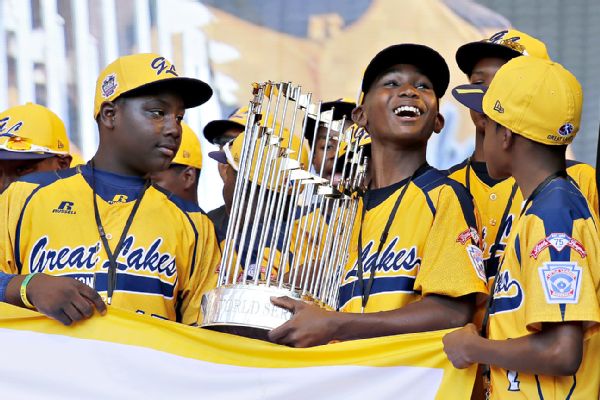
Comment of the Day: “Why Our Children Will Grow Up To Be Cheats and Liars: The Little League Champs Are Banned For Cheating, And Are Told That They Should Be Proud”

Well, one out of three isn't...no, actually, it IS bad...

Well, one out of three isn’t…no, actually, it IS bad…

johnburger2013 contributes the kind of Comment of the Day Ethics Alarms doesn’t see very often: a researched follow-up to the original post that raises separate ethics issues. My post was about the cheating involved in the Jackie Robinson West team’s championship; John’s explores how the Little League itself behaved unethically, and attempted to duck its duty. I often can’t research the stories covered here beyond the aspects of it that sparked the ethics commentary, and in some cases, like this one, the result is an incomplete picture. I am grateful to John and every other commenter who goes the extra mile that my futile attempts to cover the vast ethics landscape miss, skip over, or neglect.

Here is his Comment of the Day on the post “Why Our Children Will Grow Up To Be Cheats and Liars: The Little League Champs Are Banned For Cheating, And Are Told That They Should Be Proud” :

I am not sure that Little League International has all that integrity. LLI was perfectly content to encourage the feel good story of underprivileged kids from Chicago’s South Side making it all the way to the series final, only to lose to South Korea. These players were honored by the White House and had photo ops with the President and First Lady. In a sport that has lost interest from the Black community, here was a heart warming story of the little guy making it big.

However, LLI had been on notice that the boundary and residency requirements had been manipulated, or outright disregarded, to create a team of ringers vying for the title. LLI wanted the narrative so it closed its investigation, only then to have its decision to blow up in its face because a reporter kept asking questions. This has turned into a huge ethics problem for LLI. Continue reading

Why Our Children Will Grow Up To Be Cheats and Liars: The Little League Champs Are Banned For Cheating, And Are Told That They Should Be Proud Anyway

Littel League champs

When the Tom Brady/ Bill Belichick/New England Patriots cheating issue was at high pitch [Aside: Notice how we have heard nothing about this at all since the Super Bowl, which the Patriots won. This is why NBC thinks it will get away with not firing Brian Williams…both the news media and the public have the attention span of closed head injury victims, especially when it comes to liars, cheaters and betrayal. They call this phenomenon “America’s belief in redemption.” It is actually is a product of America’s crippling domination by chumps, dolts, suckers….and people who are liars and cheats themselves.], a friend of mine brushed it all off saying, “It’s a game.” Well, children learn a lot about ethics from games, and if they learn that adults think cheating is acceptable (never mind that a billion dollar business is hardly just a “game”), they will cheat in their games, and later in life.

Today we learn that the inspiring 2014 Little League Champions, the Jackie Robinson West team that was the first all-African-American team to win the tournament, has been stripped of all of its wins, including those from its Great Lakes Regional and United States championships. As a result, the United States championship has been awarded to Mountain Ridge Little League from Las Vegas.

A Little League investigation revealed that the Jackie Robinson team, which was supposed to field a team exclusively from the Chicago South Side, secretly used an expanded boundary map. Team officials conspired with neighboring Little League districts  to build what was essentially an all-star team by acquiring players from well beyond the South Side. Continue reading

Comment of the Day: “Someone Explain To Senator Tillis That It’s Unethical To Make People Sick On Principle”

hand-washing

Refusing to rest on his laurels, recently crowned Ethics Alarms “Commenter of the Year” texagg04 delivers a helpful, clarifying, erudite examination of the balancing process brought into play with the regulation of businesses for health and safety reasons. Here is his Comment of the Day on the post “Someone Explain To Senator Tillis That It’s Unethical To Make People Sick On Principle”:

Let’s unpackage this.

Purchasing Products and Services

When we buy a product or service, we don’t just buy the end result. We buy a long string of tasks leading up to that final product and sometimes we buy even more things than just the final product*. In this instance, that doesn’t just mean the food on your plate, as tasks, upon deep consideration are actually HUMONGOUS things that are composed of the Time necessary to complete, Material either used up in preparation or as a component of the end item, Personnel Knowledge needed to perform, Equipment which facilitates, and Space needed to complete the task.. You don’t purchase just the food. You purchase the time and care EACH employee puts into the process. From Day 1, you purchase the time a procurer makes a deal with a vendor OR personally hand selects the ingredients of your meal. You purchase the time and quality of the food storage in the pantry/refrigerator. You purchase the chef’s level of knowledge. You purchase the time he devotes to ensuring the burners are a certain temperature. You purchase the manager’s level of knowledge in keeping things efficient and cost effective. You purchase EACH AND EVERY action the server takes that could affect the final, tangible product or service. Continue reading

The Sixth Annual Ethics Alarms Awards: The Best of Ethics 2014

abstract door grand jury room

The Ethics Alarms Awards for the Best in Ethics 2014—sorry for the tardiness— are about 30% of the length of the Worst. Does this mean that the nation and the culture, not to mention the world, are doomed?

Not necessarily. I am well aware that most of the country is ethical, substantially fair and honest, diligent, and embodies ethical values in their every day dealings with you and me, and the world. We primarily hear, and to some extent, take note of, the corrupt, the irresponsible, the manipulative, the untrustworthy and the foolish. The Best Ethics list is smaller in part because only exemplary ethics gets publicity. I also should note that calling attention to unethical conduct and discussing it often does more to advance the mission of Ethics Alarms than confirming that right is right, though I sure wish there was more exemplary ethics to celebrate. Maybe the dearth of award winners here is my fault, and the result of my biases.

Boy, I hope so.

Here are the 2014 Ethics Alarms Awards for the Best in Ethics:

Most Important Ethical Act of the Year:

The Ferguson grand jury resisted public and media pressure to deliver a verdict of no indictment against police officer Darren Wilson, upholding the integrity of the justice system despite the injection of emotion, politics and race into a tragic incident where none of these belonged. Though the available evidence could never have supported a guilty verdict, it would have been easy and popular for the grand jury to make Wilson stand trial anyway, just as George Zimmerman did. Their reward has been to be attacked as fools and racists, but they did the right thing, when the wrong thing must have seemed very attractive.

Outstanding Ethical Leadership

The New York Yankees. (Bear with me now.) The Yankees are the most famous team in professional sports in the biggest sports market in the world. They make money without even trying. Yet when the team had a bad year and missed the play-offs in 2013, it committed nearly a billion dollars to re-building the team, a move that only makes sense in the quest to win games, not to maximize profit. Thus they prominently chose loyalty, mission and sportsmanship over greed. (The Yankees still missed the play-offs in 2014, too.) Then all year long the team placed a spotlight on Derek Jeter, their retiring hero, whose career and character single-handedly refutes the cynicism of sports critics fed up with the lack of character displayed by the Armstrongs, the Rices, the ARods, the Belichicks, the Winstons, the Paternos, and so many, many others. Finally, when two New York City police officers were assassinated after Al Sharpton, and the “Hands Up!” protestors, with the city’s own mayor’s support, had vilified the profession as violent, racist and untrustworthy, who will pay for the fallen officers’ children to go to college? The New York Yankees’ Silver Shield Foundation.  Add charity, compassion, civic duty and gratitude to the list of ethics values the New Your baseball club modeled for us. I know it seems odd and even trivial to follow up last year’s winner in this category—the Pope— with a sports franchise, but to paraphrase Babe Ruth’s famous rejoinder when the Yankees balked at his salary demands in 1930, saying he wanted to be paid more than then-President Herbert Hoover (“I had a better year that Hoover!”), the Yankees has a better year than the Pope.

Outstanding Sportsmanship

Jose Altuve, Houston Astros secondbaseman and American League batting champ….the right way. He began the final day of the 2014 season hitting .340, three points ahead of the Tigers’ Victor Martinez. If Altuve didn’t play in Houston’s meaningless last game, Martinez would have to go 3-for-3 to pass him, giving the DH a narrow .3407 average compared with Altuve’s .3399. By playing, Altuve risked lowering his average, providing Martinez with a better chance of winning the batting championship. Many players in the past have sat out their final game or games to “back in” to the prize, rather than give the fans a chance to watch a head to head battle injecting some much-needed drama into the expiring season.  Altuve, however, gave Martinez his shot. He played the whole game, had two hits in his four at-bats, and won the American League batting title on the field, not on the bench, as Martinez went hitless. The conduct, simple as it was, embodied fairness, integrity, courage, respect for an opponent, and most of all, respect for the game.

Best Apology

JESSICA_URBINA

 The Level #1 apology, according to the Ethics Alarms Apology scale, issued by Sacred Heart Cathedral Prep in San Francisco.The school had cruelly and needless embarrassed graduating senior Jessica Urbina (above), rejecting her inclusion in the yearbook because she chose to be photographed in a tuxedo rather than a dress, as the school’s dress code, which had not been previously made clear, demanded. I wrote…

“The rule is sexist, archaic, unthinking, prejudicial, arbitrary, cruel and wrong. The best way to change a rule that is sexist, archaic, unthinking, prejudicial, arbitrary, cruel and wrong is to break it, and see if those in charge have the sense and compassion to do the right thing. The administrators of Sacred Heart Cathedral High School flunked. I doubt that Jessica was even trying to provoke a confrontation: like any normal student, she wanted her image in the most important piece of memorabilia of her high school years to accurately portray her as she was, not as some alien ideal dictated by the Catholic Church. There was nothing to be achieved by banning the photo.”

The school reversed itself with grace and compassion. The apology is long, but a more humble or complete one would be unachievable. It achieved an ethical end to an ugly episode. You can read it here. Runner up: Writer Henry Rollins lovely and wrenching apology for his initial reaction to Robin Williams’ suicide.

Hero of the Year

Michael DeBeyer.  De Beyer has decided to sell his restaurant, which he opened more than 15 years ago and is worth an estimated  $2 million, to pay for whatever medical treatments are necessary to save the life of Brittany Mathis, 19. Brittany works for De Beyer at his Kaiserhof Restaurant and Biergarten in Montgomery, Texas, and  learned, in December 2013, that she has a 1.5 inch brain tumor.  She couldn’t afford the operation to find out whether the tumor was benign or malignant, and didn’t have health insurance. “I couldn’t live with myself; I would never be happy just earning money from my restaurant knowing that she needs help,” Michael told local reporters.

That’s what makes ethics heroes; really, really loud ethics alarms, combined with courage and caring.

Parent of the Year

NBA Star Kevin Durant’s Mom.

Most Ethical Celebrity

Matthew McConaughey. In a field notably sparse on exemplary ethics by celebrities, the 2013 Oscar winner for Best Actor stands out for a speech that was inspirational, thoughtful, and rife with ethics wisdom. It is worth recalling. Here it is:

Thank you. Thank you, thank you, thank you, thank you to the Academy for this—all 6,000 members. Thank you to the other nominees. All these performances were impeccable in my opinion. I didn’t see a false note anywhere. I want to thank Jean-Marc Vallée, our director. Want to thank Jared Leto, Jennifer Garner, who I worked with daily.

There’s a few things, about three things to my account that I need each day. One of them is something to look up to, another is something to look forward to, and another is someone to chase. Now, first off, I want to thank God. ‘Cause that’s who I look up to. He has graced my life with opportunities that I know are not of my hand or any other human hand. He has shown me that it’s a scientific fact that gratitude reciprocates. In the words of the late Charlie Laughton, who said, “When you’ve got God, you got a friend. And that friend is you.”

To my family, that who and what I look forward to. To my father who, I know he’s up there right now with a big pot of gumbo. He’s got a lemon meringue pie over there. He’s probably in his underwear. And he’s got a cold can of Miller Lite and he’s dancing right now. To you, Dad, you taught me what it means to be a man. To my mother who’s here tonight, who taught me and my two older brothers… demanded that we respect ourselves. And what we in turn learned was that we were then better able to respect others. Thank you for that, Mama. To my wife, Camila, and my kids Levi, Vida and Mr. Stone, the courage and significance you give me every day I go out the door is unparalleled. You are the four people in my life that I want to make the most proud of me. Thank you.

And to my hero. That’s who I chase. Now when I was 15 years old, I had a very important person in my life come to me and say “who’s your hero?” And I said, “I don’t know, I gotta think about that. Give me a couple of weeks.” I come back two weeks later, this person comes up and says “who’s your hero?” I said, “I thought about it. You know who it is? It’s me in 10 years.” So I turned 25. Ten years later, that same person comes to me and says, “So, are you a hero?” And I was like, “not even close. No, no, no.” She said, “Why?” I said, “Because my hero’s me at 35.” So you see every day, every week, every month and every year of my life, my hero’s always 10 years away. I’m never gonna be my hero. I’m not gonna attain that. I know I’m not, and that’s just fine with me because that keeps me with somebody to keep on chasing.

So, to any of us, whatever those things are, whatever it is we look up to, whatever it is we look forward to, and whoever it is we’re chasing, to that I say, “Amen.” To that I say, “Alright, alright, alright.” To that I say “just keep living.” Thank you.

Most Principled Politician

Thomas Menino

The late Thomas Menino, Boston’s beloved Democratic mayor for two decades (the longest in tenure in the city’s history), who retired last January and  died of cancer nine months later. Somehow I missed giving him the ethics send-off he deserved. Amazingly, he was the first Italian-American mayor in Boston’s history: the job has always been won by the city’s Irish machine. While mayors around the nation were embroiled in scandals and embarrassments, Menino undeniably improved the city, led it admirably in the aftermath of the Boston Marathon bombing in 2013, and left office with the admiration of conservatives as well as liberals despite being an aggressive agent of progressive policies.  His passion caused him to make some ethical missteps, such as joining other liberal mayors in telling Chick-Fil-A that it “wasn’t welcome” in Boston because of its owner’s anti-gay marriage sentiments. He joined Michael Bloomberg in creating Mayors Against Illegal Guns, and must share responsibility for some of the dubious tactics and misrepresentations of that organization. He also had a scandal or two involving political favors, but in 20 years, by my count, he had fewer than most Boston mayors had every year. In 2012, polls found that he had an approval rating over 80%, and left his position more popular than he entered it.  Boston is liberal, but it isn’t that liberal.

Most Ethical Company

Don’t ever let me do that again.

I just reviewed over a hundred posts about businesses and corporations from last year, and not one of them celebrated ethical conduct. The closest was, believe it or not, the Washington Redskins, for having the guts, orneriness and principles to stand against the forces of censorship and political correctness to refuse to change the name of their team and organization. It has been targeted as a symbolic scalp that race-baiters, grievance-hucksters and progressive bullies are determined to have hanging from their belts; the opponents of the team have recruited the U.S. government, and the pressure is tremendous. It would be so easy to change the name now, when support for the perpetually rotten team is at low ebb in Washington, D.C., but the principle is worth the battle. However, my gag reflex will not allow me to give this award to an NFL team, since by definition it must be engaged in so much else that is wrong.

So for a second straight year I’m going to send you to Ethisphere’s list of the most ethical companies in the world. Their criteria isn’t mine, but there’s got to be a genuinely ethical company of two on there somewhere. Let me know if you find it. Continue reading

Comment of the Day: “Unethical Quote of the Month: Patriots Quarterback Tom Brady”

"Is this a deflated ball I see before me?"

“Is this a deflated ball I see before me?”

“Inflategate”—-the developing NFL scandal about the New England Patriots’ under-inflated, more easily thrown footballs in the team’s last play-off win and perhaps others—is a big deal to 1) people who hate the Patriots; 2) football fans who care about whether their game has any integrity and 3) people like me, who think there is no justification for cheating, in sports, in business, or in life. Those who argue that it’s “much ado about nothing,” usually without being able to quote a line or explain a plot turn from the Shakespeare comedy they’re alluding to, do so because 1) they are Barry Bonds fans; 2) they don’t know the difference between a football and a plantain, and don’t care. except that they wouldn’t want to eat a football by mistake; 3) they are typical NFL football fans and want to “oh, pshaw!”  anything that reflects badly on the sport that gives their brutal lives meaning, 4) they are John Edwards, or 5) they are members of the New England Patriots organization, and perhaps were involved in the ball deflation.

Pats quarterback Tom Brady (that’s how you know I’m from Boston: I call the team the “Pats”) gave a highly unconvincing press conference yesterday in which he maintained that he would never notice that the tool of his trade that he has plied approximately since he exited the womb felt different than usual, and, like his coach, the brilliant and soulless Bill Belichick, has no idea how the team’s balls got deflated. The credibility of that claim was severely undermined for me by Brady’s use (“This isn’t ISIS…”) of my least favorite rationalization of them all on the Ethics Alarms compendium, the infuriating #22:

The Comparative Virtue Excuse: “There are worse things” : If “Everybody does it” is the Golden Rationalization, this is the bottom of the barrel. Yet amazingly, this excuse is popular in high places: witness the “Abu Ghraib was bad, but our soldiers would never cut off Nick Berg’s head” argument that was common during the height of the Iraq prisoner abuse scandal. It is true that for most ethical misconduct, there are indeed “worse things.” Lying to your boss in order to goof off at the golf course isn’t as bad as stealing a ham, and stealing a ham is nothing compared selling military secrets to North Korea. So what? We judge human conduct against ideals of good behavior that we aspire to, not by the bad behavior of others. We should each aspire to be the best human being that we can be, not to just avoid being the worst rotter anyone has ever met.

Behavior has to be assessed on its own terms, not according to some imaginary comparative scale. The fact that someone’s act is more or less ethical than yours has no effect on the ethical nature of your conduct. “There are worse things” is not an argument; it’s the desperate cry of someone who has run out of rationalizations.

(Or someone whose coach had the equipment guy deflate the footballs.)

Now comes blogger Windypundit to expand on my derision of Brady’s embrace of #22 from a different and useful perspective. Here is his Comment of the Day on the post, “Unethical Quote of the Month: Patriots Quarterback Tom Brady”:

In a way, Brady has a point, but it’s not what he thinks it is, and it doesn’t cut in his favor. In the grand scheme of things, nothing that happens on the field of play is very important. In fact, most of the rules of sports are arbitrary — the location of the free throw line, the number of bases the runners have to tag, the pressure in the football. The rules don’t have any higher meaning. And that’s precisely why there’s no excuse for not following them.

The big issues — when you can disconnect the life support, when a cop can shoot an unarmed person, when the President can order a drone strike — are full of complications and nuance. It’s hard to come up with a clear set of rules that will apply in every possible situation. You may think you have it all figured out, and then a scenario arises that you never thought of, and your simple set of rules, if followed blindly to the letter, would produce a terrible result. So maybe after you think through all the consequences, you decide that you’ve found a valid exception, and you change the rules. Or maybe, if the matter is important enough and you believe the rules are immoral, you break the rules as an act of conscience.

But I can’t see that happening much in sports. There is no greater good that could be used to justify breaking the rules. What terrible result could arise from blindly following the rules of football to the letter? A team loses a game? That might cost the team a bit of money, and I can see where crazed fans would get upset, but you know what? Nobody dies if the Patriots don’t make the playoff. This isn’t ISIS after all.


Comment of the Day: “A Failure To Understand Legal Ethics Kills”

armchair quarterback2

It shouldn’t shock anyone to see yet another Comment of the Day here authored by texaggo4. He has been the most prolific commenter—other than me, and he’s ahead of me so far in 2015— since the legendary tgt went into voluntary keyboard retirement, and has led all visitors in commentary the past two years. Last year, he contributed a staggering 3, 048 comments, more than twice as many as runner-up Steven Mark Pilling, who was hardly a piker with 1,082. (The rest of the top five: Ablativemeatshield/Scott Jacobs close behind at 1, 079—he would have finished #2 if he hadn’t quit the field in a pro-pot snit; Beth, with 881, and dragin-dragon at 809. Thanks, everyone, and all other commenters too. That’s a lot of quality content, some of the best on the web anywhere.)

The list is especially relevant to this COTD, as tex rebuts an accusation of “Armchair quarterbacking” against Beth from new commenter gokafilm. Beth had offered a comment to the post about Tampa lawyer Gienevee Torres, who called 911 to report a deranged client—he was wearing pajamas and thought she was God– who had just left her office with his 5-year-old daughter after making an ominous comment. The police decided that the man was harmless despite her warning, and the man eventually dropped the girl off a bridge. Beth wrote:

“I am furious at this lawyer — not the police. She should have said something like, “Yes, I am God. He commands you to give me your child and leave my office now and run to the nearest hospital.” I would have happily stood before the Bar Committee defending my actions if it meant that I had saved a child’s life.”

Gokafilm replied:

Easy to say Beth from the safety of your home/office/wherever. She had to be concerned for her safety and her staff as well. This most likely is a split second decision. Get the individual out and call the authorities…Did she not have a responsibility to herself and her staff to consider their safety as well? What’s to say he wouldn’t have harmed them if they forcibly tried to keep the girl. This lawyer did the right and only thing she could have. Got the individual out of her office, and contacted both 911 and DCF in order to protect the child. Any other conclusion is merely arm chair quarterbacking from the safety of your computer screen.

Another term for “armchair quarterbacking” is hindsight bias, the tendency to judge a difficult decision unreasonably harshly when it doesn’t work out well. “Obviously” conduct is “wrong” after the results are known. My response to Beth’s comment was that the whole, horrible incident was moral luck: if the lawyer had done the same thing and the girl had been rescued as a result of her violating client confidentiality, everyone would have said that her actions were appropriate and even heroic.

On the other hand, post-event analysis is invaluable; this website is based on it. The argument that nobody should criticize an individual’s conduct “unless he’s walked a mile in his shoes” is a lazy cop-out that impedes cultural wisdom and learning from the mistakes of others. I don’t completely agree with many, perhaps most, Comments of the Day, but I concur with this one.

Here is texaggo4’s Comment of the Day on the post, A Failure To Understand Legal Ethics Kills: Continue reading

Comment of the Day: “Of The Good Muslim, Paris, ‘1984’, And The Compulsion To Deny The Truth”

Mulsim women

Left-of-center Ethics Alarms follower deery gets a lot of heat on Ethics Alarms, but he has a much-valued knack for spawning edifying exchanges. In this reply to one of his comments arguing that Christianity and Islam near equivilency in their more extreme positions, Ulrike delivers the Comment of the Day, in the battle following the post, “Of The Good Muslim, Paris, ‘1984’, And The Compulsion To Deny The Truth.”

Here it is:

I’d like to make the claim that 1300 years ago, in almost any society women were the losers but now the distinction can be seen by anyone who has eyes. Christians moved on from those times and their nations became successful world powers. On the other hand, oil seems to be the main driving force behind anything in the Arab League.

And yes, in the beginning Islam had a positive influence on the scientific community in so far as it united the Arabic world which up to that date was splintered into tribes. Arabic became the lingua franca and facilitated the trade of knowledge and commodities. The Arabs become the driving force in translating ancient Greek literature – I could go on and on, the list is long, but I’m too lazy. So while we still lived like Neanderthals, the Arabic world had flourishing cities that were the trade centers of the Orient.

Now here’s the rub: The decline of science and the renunciation of modernity can also be attributed to Islam. How can that be, when I just stated that it was a major factor in the rise of science. Well, not Islam as a religion facilitated this rise but its role in uniting the arabic world economically and territorially. But when the Muslim faith came to be the established force behind everything and anything its disciples started to consolidate the belief that science was equal to renouncing Allah.

If you set yourself the task to name any invention in medicine, chemistry, physics or engineering from the last two hundered years that originated in the Arabic world – you have your answer which faith benefited progress more. Christian society developed towards modernity and Muslim society turned away from it… Continue reading

Comment of the Day: “Pop Quiz: The Bottom Of The Slippery Slope”

islamic-symbol

Going far afield from the post it followed, the Comment of the Day from texaggo4 examines the tricky question of whether militant, radical or extremist Muslims can be fairly regarded as representative of the faith. Taking off from a comment by Penn (in the blocks), tex examines various ways of analyzing the problem, in a long and fascinating exposition. Here is his Comment of the Day on the post “Pop Quiz: The Bottom of the Slippery Slope.”


Fundamentalism v Militancy

“Which brings me an item I almost ran yesterday re the specious anti-free-speech posts some people were making and/or agreeing with. I thought Beth had pretty much covered the subject but … no. As (self-confessed) Christian writer and psychiatrist M. Scott Peck – Lt. Col. who served as the U.S. Army’s Assistant Chief Psychiatry and Neurology Consultant to the Surgeon General of the Army – explained, “(T)there are different stages of spiritual maturity. Fundamentalism – whether it be Muslim, Christian, Jewish or Hindu fundamentalism – is an immature stage of development.

‘Indeed, a Christian fundamentalist who kills others in the name of religion is much more similar to a Muslim – or Jewish, Hindu or Buddhist – fundamentalist who kills others in the name of his religion than to a Christian who peacefully fights for justice and truth, helps the poor, or serves to bring hope to the downtrodden.’

If we can’t agree to differentiating fundamentalists (extremists by definition) from (comparatively) rational folks, we will continue to have straw man arguments that lump every one together under a label that is useless for discussion.”

I’ve read some of Peck’s works. Pretty good. But I think he’s inaccurate on the characterization of “Fundamentalism”. He’s fallen for the same trap in mislabeling that the main stream media uses. Certainly spiritual immaturity involves a great deal of emotionalism, which typically manifests in anger, when a person’s beliefs are challenged. Anger, which can lead to violence, is best described as “Militancy”, not “Fundamentalism”.

If religion A says “at the bare bones you must believe”: Continue reading

Comment of the Day: “Of The Good Muslim, Paris, “1984”, And The Compulsion To Deny The Truth”

This was Jeff's submission for "Everyone Draw Muhammad" Day. He's a dead man.

This was Jeff’s submission for “Everyone Draw Muhammad” Day. He’s a dead man.

Long, LONG-time commenter Jeff H., himself a cartoonist, weighs in in the controversy discussed in the previous post, regarding efforts to exonerate radical Islam from any responsibility for the terrorist attack against a French satire publication.

In answer to his final question, I would respond: “It’s true, that’s all.” And yes, I think it’s clear that Muslims are more likely to engage in violent terrorism than other faiths, at least at this time.

Here is Jeff’s Comment of the Day on the post “Of The Good Muslim, Paris, “1984”, And The Compulsion To Deny The Truth”:

Here are my thoughts on it: if you think it would avail you any to talk to one of the men who perpetrated this act and say, “It’s OK! You’re not really Muslim!”, then you can go ahead and say they’re not Muslims.

If you ARE a Muslim who notices the hypocrisy in someone claiming to be a Muslim carrying out an act of terror in defiance of parts of the Koran, I wouldn’t have a problem with them saying he’s not a Muslim.

I saw someone call them “pretend Muslims,” and I sort of like that term, but that sort of implies that they don’t believe in the faith itself, and that’s not really for anyone to say. But if we’re calling them pretend Muslims because they don’t adhere to the parts of the Koran that would mitigate violence, they could call everyone else pretend Muslims for not participating in violence. Or, those who have intercourse before they’re married and trim the edges of their beards could be called “pretend Christians.” Let’s see how far that goes.

I really hate to hand it right to the jerks who will use this against the vast majority of peace-loving Muslims, but trying to deny it just kicks the can down the street. Pretending not only that it has nothing to do with it, but that it doesn’t even exist, ends up having the equal and opposite reaction on the other side that insists all Muslims secretly crave violent revolution.

What is especially bothersome is when people are like, “well, they’re Muslims, what do you expect?” I hate to cry ‘racist,’ but… that is totally racist. It is racist to assume that Muslims are not expected to control their anger, or that they cannot help themselves because of their ethnic background. This is why I was furious when I heard people hoping the perpetrators of the Boston bombing would turn out to be white.

Congratulations, you wretched tin-eared pinheads. You got your wish. The Tsarnaevs were white. They were Caucasian MUSLIMS from Chechnya. I hope that makes some kind of difference to you.

But just because jerks will use this to blame all Muslims (which is deeply regrettable), that doesn’t mean the response is to pretend Muslims are incapable of violence. That’s just carrying water for the next person of any belief who wants to do something unspeakable to their next critic.

What I want to see is a statistical analysis of acts of violence like this, the alleged beliefs of the perpetrator, and see if any group of beliefs makes someone more likely to do something like this. The goal is not to attempt to smother any belief except the belief that your opinion gives you the right to hurt someone else.

Yes, those who perpetrated this attack identified themselves as Muslim. Now the question is: “So what?”

Comment of the Day: Prosecutor Ethics, “What The Hell Were You Thinking?” Dept: Dog-Whistling “Dixie” To The Jury

Dixie

I will introduce this fascinating Comment of the Day by one of the blog’s masters of the long form comment, Chris Marschner,  by saying that I think it is only tangentially related to the post, though he would disagree. Chris is writing about the history of “Dixie” and why it should not be associated with racism. Whether I agree with that analysis or not, the fact is that the public does overwhelmingly associate the song with a longing for the simplicities of the Old South, when the darkies were singing in the cotton fields and those Northern folks weren’t sticking in their noses where they don’t belong. This is the basis of an Idaho court’s decision to overturn the conviction of a black defendant after the prosecutor gratuitously and needlessly quoted the lyrics of the song in her closing argument.  That decision was correct, because the issue is whether the comment could reasonably have been an appeal, or seemed like an appeal, or have had the effect of an appeal, to racial bias. I don’t think that conclusion is arguable.

Here is Chris’s Comment of the Day on the post, Prosecutor Ethics, “What The Hell Were You Thinking?” Dept: Dog-Whistling “Dixie” To The Jury:

The prosecutor failed her client – the people- not because she used the words of an 19th century song but because she failed to come to understand that history and culture of the US has been so bastardized that even an appellate court has no understanding and context of the origins of the song and the history and culture of the south. And, because of its misunderstanding believes the lyrics to be racially prejudicial.

“Maybe Erica is so young, color blind and historically ignorant that she had no idea that “Dixie” has been played at Klan rallies and used as the campaign theme for states rights, segregationist, white supremacy candidates since the Civil War. Maybe she didn’t recognize the cotton reference as racial.”

This song was written by a northerner named Daniel Decatur Emmett and performed in New York in an 1859 minstrel show by Emmitt in blackface. The reference to cotton is geographic in nature because cotton represented the primary agricultural commodity and wealth creator of the southern states – nothing more unless one is predisposed to finding anything related to the antebellum south as racist

Many songs have been coopted by various groups but to suggest that lyrics of Dixie are inherently racial because they are used by White supremacists is faulty logic. If a white supremacist adopted the image of Leonardo D’Vinci’s David or Venus d’ Milo or other classical work of art on their flag that would not mean that any such depiction suggests racial superiority. Continue reading