Where Have You Gone, Ernest Hemingway? Of Baseball, Tanking, Winning, Trying, And Life…

This essay is only incidentally about baseball, but like so many things that sieve through my brain, it was sparked by a conversation about baseball. On the satellite radio MLB channel, one of the interchangeable hosts—I really have trouble telling them apart: some are ex-general managers who nobody will hire, some are ex-players, and a few are sportswriters, but they all seem to say the same things, though one says them with a bilateral lisp—was interviewing a New York sportswriter. That alone would normally prompt me to switch to the Beatles Channel (or the weather), but as I reached for the dial I caught one of the writer’s comments. He was talking about the fact that the New York Yankees’ opponent at the time, the Tampa Bay Rays, were almost a .500 team, and were competing despite a tiny payroll, unlike many other teams this year, which have adopted the controversial strategy of fielding cheap and crummy teams (called “tanking’) in the hopes of getting high draft choices as a reward for  miserable won-lost records.

“I guess you have to admire the Rays,” he said, “though in this day and age, it makes no sense to try to be a .500 team.”

What a nauseating, unethical position, and how characteristic of the downward trend in American values and spirituality!  It makes no sense to try be a .500 team? This sentiment warps so much in American life today. It translates into the envy, resentment and anger that typical, normal, healthy Americans lug around on their souls all day because they aren’t rich like the people they see on TV, or the neighbor down the street who had wealthy parents and left him a bundle.

It makes sense for the Rays to try to be a .500 team because it means the team is doing the best it can, despite limitations beyond its control, to give its fans something to cheer and care about. It makes sense to try to be a .500 team for the same reason it makes sense to aspire to be the kind of steady, honest, hard-working middle class American who raises happy and well-adjusted children in a stable home but will never win any major awards or be the subject of features in their local newspapers. It makes sense to try to be a .500 team for the same reason it is right to work hard and well no matter what your salary, or whether you are being paid at all.

Ambition is a great motivator, as long as one understands that achieving one’s goals is often as dependent on chance and chaos as it is on industry and talent, and if you prepare yourself to be bitter about that, bitter is how you are likely to wind up.

I learned to love baseball passionately following a .500 baseball team–indeed a sub-.500 baseball team— that seemed like it would never be anything but. This was in an era where the New York Yankees literally won the pennant every year, with a rare exception now and then. The system was rigged to favor them, and had been for decades. The Boston Red Sox began every season knowing that getting to the World Series was a pipe dream, and their fans knew it too. Nevertheless, they tried. As an almost good team, they had a chance to win every game—not a great chance, when they were playing the Yankees, but a chance. Often the Sox made a good fight of it while going down: our hopes were raised, and there was that wonderful-horrible moment that is the beating heart of baseball where anything can happen from a miracle to a tragedy as the ball is hurtling toward the plate and fate’s resolution. Life is like that, and the sooner you realize and accept it, the better off you are.

The best hitters make outs 60% of the time, and the best teams still lose at least 35% of their games. The typical players and teams do worse than that, just like the typical American, indeed human being, loses a lot more often than he or she wins. The important thing, the thing that undergirds ethics, and integrity, and responsibility, and honor, is that you do the best you can, and pick yourself up when you fail, and try again. It’s not a bromide. It’s the only way to live without going crazy, becoming a serial killer, or surrendering to despair. Continue reading

Chaos, Kindness, Vivian Landis, and Me

Yesterday I attended the funeral of Vivian Landis, mother of my long-time friend Lise Landis. Vivian was 98 years old when she died, and by all accounts had a wonderful and rewarding life. She also played a big part in mine, by doing what she apparently did routinely: being kind.

Mrs. Landis, along with her late husband Paul, were, by sheer chance, placed in the position of being the Chaos Theory butterfly in the Amazon jungle that causes a momentous chain of events by flapping its wings. They exemplify to me why it is vital for all of us to strive to live using ethical values. We have often no idea what the results will be, but the odds are they will be more good than bad.

In 1972, I had been rejected by all of my choices for law school, though I had been wait-listed at Georgetown. However, it was August, the fall semester was looming, and no word from Washington, D.C. had reached me. Discouraged but resigned, I said the hell with it, and resolved to take a year off, perhaps to craft my thesis on character and the American Presidency into a book. In the meantime, I decided to join my parents and sister on what bid fair to be our last family vacation. Dad had planned one of his typical forced marches, this one through Reno, Sequoia National Park, Yosemite, San Francisco, and Seattle.

I was having a great time, relaxing, enjoying the sights, when a ranger tracked us down on the Yosemite canyon floor. Our next-door neighbors in Arlington Mass. had sent a telegram forwarding a Georgetown telegram to the Marshall homestead: a slot for me had just opened up in the 1975 Class, but to claim it, I had to be at the Law Center to register Monday morning—and it was Sunday. And I was in California.

I wasn’t even sure I wanted to go to law school at that point, but my dad was determined that I should take the opportunity. We cut short our Yosemite visit and drove to San Francisco, where I was deposited on a red-eye to Dulles. I had few clothes, and knew nobody in the District of Columbia or anywhere near it. Somehow, I was assured, my family would have a plan for me by the time I arrived. I was to call their hotel in Frisco once I had registered. Continue reading

Morning Ethics Warm-Up, 6/8/18: Breaking Radio Silence

Good Morning!

Adventures in Woburn, Mass.:

1. The Event. I guess I should have assumed that some commenting here would go on yesterday about the unpleasantness involving an ex-participant here, while that dispute was causing me to lose all of yesterday between travel and court. (I alomot tried to put up a post late last night, but was too fried.) I have little to say on the matter, which is still being considered, except that I did learn some surprising things, such as that

  • …the weakness of the concept of “lawyer-in-all-but-degree” tends to be exposed in court;
  • …being banned from an ethics website is an existential catastrophe, and actionable, according to “lawyers-in-all-but degree”;
  • …having a great poker face is an essential talent for a judge:
  • ….in  lawyer-in-all-but-degree schools, they apparently teach that the position that “judicial misconduct” and “judicial ethics” are essentially the same topic is ridiculous and libelous, and
  • ….playing the part of Van Johnson in “The Caine Mutiny” just isn’t as much fun in real life as it seems to be in the movie, if you get my drift. It’s kind of embarrassing and sad.

2. A airport encounter:  In the airport on the way to Boston and waiting for my flight in an early morning mob, I was anxiously wandering through the crowd when I heard a quiet male vice say, “Nice tie!” It was not obvious who had spoken, but I decided it had to be a young African American airport employee who was helping a traveler in a wheel chair. “Did you just say ‘nice tie’?” I asked him, though he was not looking at me. Then he lit up, said that he had, and got into a long conversation with me about ties. He is a tie aficionado. He has photos of his ties on his cell phone! He loves talking about ties! And thus I connected with a fellow human being in a chance encounter, when he took the step of breaking through the silence and mutual disinterest that increasingly marks the daily interactions of Americans, even neighbors. I also ensured that he would not feel like I was ignoring his existence when he had taken the risk of an unsolicited overture to interact. [Unlike the female jogger I write about here.] Contrary to some of the comments that I received then, I don’t think anything about the chance encounter yesterday should have been different if the participants had been different ages, races, ages, or stations in life. Continue reading

A Concise Ethics Rant On A Chance Encounter While Walking Rugby

It was cloudy and rumbling, and Jack Russell Terriers are notoriously difficult if they don’t get at least one good walk every day. So I decided to try to beat the rain and get Rugby out for a swing around the neighborhood. It kept getting darker, windier, and the distant thunder was getting louder. Rugby was in fine fettle, I must say, though he felt compelled to pee on every bush, rock, or tuft of grass. I have never seen a dog who seemed to enjoy a walk so much. I wish there was something, anything, I could get that excited about every day.

We were in the home stretch, about to loop around the church that faces our house across a parking lot and a row of trees. Then a young woman, maybe in her 20’s, dressed for the task, jogged toward us, pony tail swinging. She had that cold, stony, “I don’t want to acknowledge anyone” look on her face that so many younger people cultivate today. I looked at her and smiled anyway. That was how I was brought up, you see. We acknowledge each other. We signal good will, and that we are part of the same community. We are nice.

As she jogged past, I said, certainly loud enough that she could hear me, “Don’t get caught in the rain!” That is an incidental, spontaneous, friendly comment between strangers. I must engage in, and respond to, dozens of such comments a week, while shopping, teaching, or walking the dog.  They require a response: a nod, a smile, a brief answer like “I won’t!” What I got was a snub. No response at all.

I felt like I was being treated like an unfamous Morgan Freeman, as if my statement was, “Hey, honey, good form!” I wasn’t flirting with her, or harassing her. I was being a human being, and doing what human beings need to do to make life bearable.  And I felt insulted.

Yup, I’m old enough to be her father…grandfather, even. That, I was taught, makes showing some respect, like acknowledging that I spoke to her in a friendly, neighborly manner, even more mandatory as an ethical social response.

If this is where feminism, #MeToo, and  generational bias is leading young women today, they will poison the next iteration of our society, not cure it.

Meanwhile, I am pondering whether there is an ethical, effective follow-up response to the next jogger who treats me like a turd on the sidewalk.

The options I am thinking now clearly would not be  constructive.

Morning Ethics Warm-Up, 4/16/2018: The Integrity Edition

Good Morning!

1. James Comey, Cognitive Dissonance Dunce. The anti-Trump obsessed won’t be able to see it, but rogue ex-FBI director James Comey is doing an immense favor for President Trump and Republicans by single-handedly framing his campaign against the man who, it is increasingly obvious, correctly fired him (as Hillary Clinton would have done even faster) as that of a classic vengeful disgruntled employee and nothing more, or better. Even Time op-ed writer Charles Blow, whose every column since the election has been some paraphrasing of “I hate Donald Trump,” was forced to observe that Comey is an especially dislikable foe (as is Blow himself). The sheer number of loathsome Trump-bashers has a natural Cognitive Dissonance Scale effect that the President’s critics can’t seem to fathom.

Normal, fair-minded people whose natural instinct is to run from the likes of Nancy Pelosi, Ted Lieu, Hillary Clinton, David Hogg, Joy Reid, Bill Maher, James Comey, Robert DeNiro, Alec Baldwin, Stormy Daniels and the rest will find themselves, almost unconsciously, siding with the President rather than this basket of deplorables, because, you see, he is the President, and who wants to be identified with that crew?

In his ABC interview, which successfully marked Comey as Just Another Trump-Deranged Resistance Warrior, he actually said that Trump was “morally unfit” to be President. First of all, it is the electorate, not James Comey, that decides who is morally fit to be President.  Comey’s assessment is no more or less valid than that of anyone else. Second, the statement is ridiculous on its face. If Comey had an interviewer with any knowledge of Presidential character and the history of the office, plus the wit and integrity to expose  an ignorant opinion when one is broadcast coast to coast, he would have been asked..,

Was Thomas Jefferson morally fit to be President? Has Donald Trump kept his wife’s sister as a concubine and slave? Was Andrew Jackson morally fit to be President? Has Donald Trump killed anyone in an illegal duel? Was Grover Cleveland morally fit to be President? Did Donald Trump ever have a woman committed to an institution to silence her about their sexual relationship? Was Woodrow Wilson morally fit to be President? Has Donald Trump endorsed the Klu Klux Klan? Was Franklin Roosevelt morally fit to be President? Has President Trump ordered U.S. citizens into prison camps? Was Richard Nixon morally fit to be President? LBJ? Bill Clinton?

The Presidency is self-defined by its past occupants, and “moral fitness” is not a characteristic that comes to mind when considering what qualities are identified with successful, popular or effective Presidents.

2. Whither the ACLU? Alan Dershowitz has authored a searing attack on the ACLU’s lack of integrity demonstrated by its failing to condemn the Justice Department’s raid on lawyer Michael Cohen’s home and office. He writes in part, Continue reading

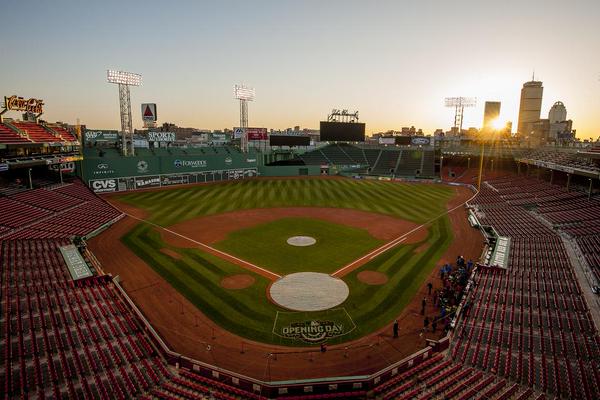
Morning Ethics Warm-Up, 3/29/18: Baseball Opening Day Edition, Plus Earlobes, Insults, And Tampons…

Good Morning, And Play Ball!

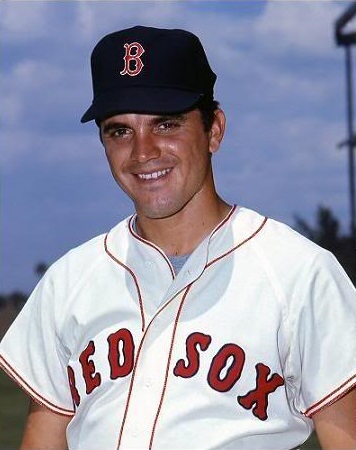
1. To Tony C.  This is always a happy day for me, but I want to mute my joy a bit by dedicating this baseball season to the late Tony Conigliaro. Since my teens, he has been my constant inspiration to live every day to its fullest, because no matter how bright and promising the future seems at any moment, everything can change in the blink of an eye, or an errant pitch from Fate right into your face.

That’s what happened to Tony C. on a cruel August night in 1967. He was playing right field and batting clean-up for his home town baseball team, in a season that would see them win a miracle pennant. He was young, handsome and incredibly talented. He had become the youngest player ever to hit a hundred home runs,  and was in his fourth big league season at the tender age of 22.Then everything changed. Tony’s existence was swept up and placed on a new and dark road that ended with a fluke heart attack and stroke at the age of 37, and a lingering twilight half-death in brain damage until he mercifully passed away eight long years later.

All we can do now is remember a beautiful young man and a brilliant athlete who gave his home town many thrilling moments to savor in the brief time allotted to him, who had everything, and then lost it without reason, warning or justice…and also remember that every day should be lived right, and well, with the determination to be the best we can be, because we may never have a chance to be any better.

Yes, this baseball season is dedicated to you, Tony.

For me, I guess they all are.

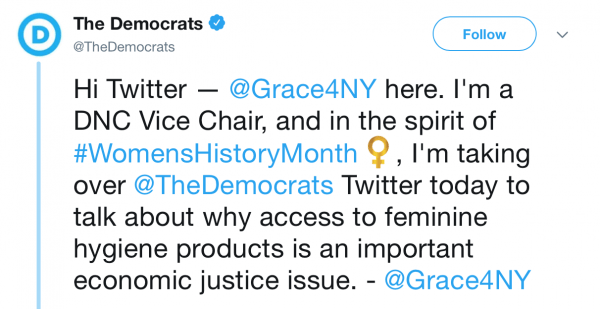
2. No, this isn’t The Onion. This is a real tweet from the Democratic Party, authored by Congresswoman Grace Meng:

She continues

“Women deserve equal access to our economy, not punishment for their gender. That’s why I’ve been working with my fellow women to fight for more access to tampons, pads, and the full range of menstrual products since 2015. …I’ve introduced legislation to make these products more affordable — because leveling the playing field and stopping period-shaming give women, especially low-income women, a better chance to succeed in our economy…What else would give women a better chance to succeed? Electing more women to fight these fights with me — because we need leaders who understand the experiences of those they represent. ..Head to and commit to vote in 2018 and beyond, because women can’t wait for economic fairness any longer.”

I hope I don’t have to explain what is wrong with this, and I eagerly anticipate being able to parry any brain-melted partisan who reads something like this and says, “Hey, what a good idea!” Yet obviously millions of people are in thrall to this kind of slippery slope progressivism: if a gender, or a race, or a nationality or any other tribe has a unique need or problem, then all of society must help pay for it, or life is unjust. Was a virus released into the water system of certain major cities.? What else can account for such abdications of personal responsibility being accepted as fair and reasonable?

Hey! Why doesn’t the government pay for my electric razor? Continue reading

The Brutal Ethics Truth About “7 Brutal Truths That Will Make Your Life Better If You Accept Them”

All looks yellow to the jaundiced eye.

Conservative writer John Hawkins published a post called “7 Brutal Truths That Will Make Your Life Better If You Accept Them.”

If I were as cynical as he is, I might say that a better title would be “How to Rationalize Being a Jerk,” but I’m not.

However, his post does demand some ethical perspective. Most, though not all, of his truths are really constructs to justify unethical conduct. Let’s examine them:

1. The average person cares more about what he eats for lunch than whether you live or die.

Maybe, and so what? That doesn’t mean that you should emulate them.  To begin with, there is no “average person.” There are individual people, good, bad and in-between. Hawkins writes,

“You tell the average person that doesn’t know you very well that you have a fatal disease and he’ll say, “I’m so sorry to hear that.” Then he’ll forget about it in five minutes while he debates with his friends whether they’re going to Chili’s or the Mexican restaurant down the street. What that means is that everything you want out of life, you better prepare to earn without getting a lot of favors on the way. If you fall, you have to be the one to pick yourself up off the ground, brush yourself off and get your life back on track. You care. They don’t. So it’s up to you.”

But the a stranger doesn’t always react that way. Sometimes he gives you his kidney. Hawkins is supplying an excuse to be callous based on a Golden Rule Distortion: “Do Unto Others As They Would Do Unto You.” Don’t listen to him.  Care about other people, and don’t hesitate to ask for help. People are better than you think: they will surprise you. In the meantime, it is your job to be as good as you would like them to be.

2. Life is not and will never be fair

I’ve written about this recently: fairness is a vague and broad concept in ethics. Life isn’t “fair” because life is often random, and nobody is tending the fairness meter. Systems either are fair or are not depending on your point of view. The mainstream conservative view about fairness is that one should play the cards one is dealt and stop complaining about it. It’s facile, though not without some truth: it is better to spend time trying to overcome obstacles than to bitch about them. On the other hand, each of us has an obligation to make the world better for those who follow us. Genuine unfairness, in systems, institutions, the culture and society, should be exposed, attacked, and fixed if possible. Hawkins’ approach would have left the U.S. with slavery, second class citizenship for women, Jim Crow, straight-only marriages, age discrimination, brutal monopolies and unchecked consumer fraud. His #2 is a license to be callous.

3. Most people are shallow

What an elitist and ignorant thing to say. If one has spent any time talking to and getting to know a wide range of people, it becomes clear that the opposite is the case. Again, assuming that most people are shallow provides Hawkins with an excuse to ignore them, or treat them with contempt. Most people will tend to behave as if they are shallow because they are rushed, stressed, distracted and focused on short-term exigencies. Give them time to think, a reason to consider a topic carefully, and the respect they deserve, and frequently unexpected depths will reveal themselves. “Most people are shallow” is a crippling bias for anyone to adopt. Expect the best of people: you will often be disappointed, perhaps, but you will also allow validations of your faith in humanity to bloom.

Writes Hawkins:

“So, use the shallowness of other people to your advantage. Learn to dress like a successful person. Pay attention to how you look. Find ways to give off the appearance that you are doing well. Don’t be a phony—be you, but also take advantage of the fact that a superficial appearance will be the reality to most people.”

Let’s see: pretend to be a successful person, but don’t be a phony; be you, but try to fool people by not revealing who you are. What?

People don’t assume that people who dress well,  speak well,  have manners and behave in a civilized fashion are successful because they are shallow. They assume that because they have learned from experience that certain traits both aid success and result from it.  Hawkins is the one revealing shallowness. Continue reading

Morning Ethics Round-Up, 3/5/2018: An Oscar Hangover, A Panamanian Mess, An Australian Play, And A 7-11 Moment

Hello!

1 Let’s get the Oscars out of the way. I didn’t watch, choosing instead to finish streaming Netflix’s excellent “Seven Seconds.” I have skimmed the transcript and checked the reporting, however, and these items leap out..

  • On the “red carpet,” Ryan Seacrest was snubbed by the majority of the stars he tried to chat with them. Seacrest was accused of sexual harassment by his ex-personal hair stylist last year. His employer hired an independent counsel to investigate, and could not confirm her allegations, so he kept his job.Never mind: he was snubbed like a leprous skunk at a picnic anyway.

This is a flagrant Golden Rule fail. Not one of the over twenty stars who walked by him while he was trying to do his job would feel fairly treated if they had been in his position. It also is as perfect and example as there is of how the #MeToo movement is a witch hunt, not interested in facts, or fairness, just power and the ability to destroy without due process.

If I was going to watch the Oscars, the treatment of Seacrest in the pre-show would have changed my mind. These are awful people. To hell with them.

  • The disgusting and smug Jimmy Kimmel hosted, because he’s “America’s Conscience of America” despite seeking ratings by encouraging parents to be cruel to their own children for his amusement.

He began the night with a penis joke.

  • As I noted in yesterday’s Warm-Up, the Oscars are now part of the effort to divide the nation. Bigotry is good, as long as it’s trendy bigotry:

…Presenting the best director award, Emma Stone introduced the nominees as “these four men and Greta Gerwig.” Nice. Misandry is funny! (Gerwig lost. GOOD.)

Maya Rudolph assured the presumably racist white viewers, “Don’t worry, there are so many more white people to come.” Bite me, Maya.

…And, of course, “Get Out!,” the racist film that I have already written about more than it deserves, won Best Screenplay, because representing all white people as monsters is award-worthy.

  • In the past I have devoted whole posts to the Academy’s snubs in its “In Memoriam” segment, which is supposedly Hollywood’s final salute to film artists who made their final exits. At this point, I really don’t care what the Academy does, but the loved ones and fans of the snubees care, and that should matter to the Academy. Here is the complete list of omissions that at least someone has complained about. I’ve highlighted the ones who really should have been included:

Bill Paxton
Stephen Furst
Powers Boothe
Juanita Quigley
Ty Hardin
Francine York
Miguel Ferrer
Skip Homeier
Anne Jeffreys
Lola Albright
Lorna Gray
Dina Merrill
Conrad Brooks
Robert Guillaume
John Hillerman
Jim Nabors
Rose Marie
Adam West
David Ogden Stiers
Dorothy Malone
Della Reese
Dick Enberg
Tobe Hooper

The names fall into five categories. Bill Paxton is in one of his own: he was left out of the list due to a silly technicality: he died right before last year’s Oscars, so it was too late to include him in 2017, and some jerk decided that since he was a 2017 death, he couldn’t be honored this year either.  The second category is flat-out mistakes: Dorothy Malone won a Best Actress Oscar; if that isn’t enough to be listed, what is? Director Tobe Hooper was responsible for a film that revolutionized horror movies, “The Texas Chain-Saw Massacre,” and also directed “Poltergeist.” He was an important director. When two of your films launched sequels, remakes, sequels to remakes, and endless knock-offs, Hollywood should show some respect: it made millions because of Tobe Hooper.

Category 3: John Hillerman and Powers Boothe were successful and prolific film actors in some major movies, though both are remembered best for their TV work. There is no good argument for omitting them.  In the fourth category are TV actors who made a few mostly  forgettable films: West, Jeffreys, Merrill, Ferrer and Hardin. I can see the argument: they will be honored at the Emmys.

Stephen Furst deserves a category all his own. He played a memorable character in a classic, iconic film: “Flounder” in “Animal House.” That should have been enough to earn a place in the roll call.

That’s it for the 2018 Academy Awards.

Let us never speak of it again. Continue reading

Life Competence, Social Media, And Crisis Situations

Cross the Parkland shooting with the ethical problems created by technology, and you get this..

One of our engaged readers sent me this story, about how real-time texting and tweeting have become standard fare during mass shootings and other crisis situations. The story is full of positive words for the phenomenon….

The texts hit a nerve with people because they’re so gut-wrenching and real, Pamela Rutledge, director of the Media Psychology Research Center, tells Yahoo Lifestyle. “They are highly emotional, and enable people to feel empathy and a connection to what the students were feeling at the time,” she says. Social media in particular is good for sharing these texts, Rutledge adds. “Removing the sense of mediation in connection is what social media does best,” she says. “It transports people into events and allows them to share the feelings more intensely.”

The messages are also stimulating to people and create a horror-story-type feeling — except they’re not made up, clinical psychologist John Mayer, author of Family Fit: Find Your Balance in Life, tells Yahoo Lifestyle. That can also make the experience more real. “They bring the reality of the dangers in the world into one’s life and right into your personal space,” Mayer says. “Therefore, it becomes even more frightening.”

The texts also allow people to experience the events vicariously, albeit from a safe distance, and can prompt feelings of gratitude and appreciation for the safety they do have, Rutledge says.

But these kinds of texts really resonate because they’re authentic and straight from the source. “They are real-time reporting of feelings and events,” Rutledge points out.

Well, it’s certainly nice that vivid reporting comes out of massacres! What would we do without social media and cell phones!

My reaction is completely different: Why are these people texting and tweeting in the middle of a crisis? Continue reading

Afternoon Ethics Warm-Up, 1/29/2018: Alexa, Hillary, The Grammys, And The LED Rocket Copters

Good afternoon.

(Where did the morning go?)

1 Regarding Alexa the Feminist: I had said that I would wait for 20 comment before revealing my own answer to the recent Ethics Quiz, which asked readers whether it was ethical for Amazon to  program its Artificial Intelligence-wielding personal assistant Alexa with the rhetoric and the sensibilities of a feminist. As usual, Ethics Alarms readers covered a full range of considerations, from the fact that consumers weren’t being forced to take a feminist robot into their homes, and could choose a non-woke personal assistant if they pleased, to the pithy,

“My screwdriver should not tell me it is a communist. My toothbrush should not tell me it is a Republican. My lamp should not tell me it is Hindu. My car should not tell me it likes polka music. My sunglasses should not ask me if I’ve heard the good news. My refrigerator should not tell me I should have more meat in my diet, and by no means should it be vegan.”.

I don’t trust the big tech companies, and the more I see them becoming involved in politics and culture, the less I trust them. It is unethical for Amazon to try to indoctrinate its customers into its values and political views, and if that isn’t what the feminist Alexa portends, it certainly opens the door. If there is a market for communist screwdrivers, however, there is nothing unethical about filling it.

As long as consumers have the power to reject AI-imbued tools with a tendency to proselytize, there seems to be no ethics foul in making them available.  It’s creepy, and since these aren’t women but pieces of plastic and metal, it’s absurd, but in the end, so far at least, Alexa’s feminist grandstanding is “ick,” not unethical.

2. If you think that there was nothing wrong with Hillary’s surprise cameo at the Grammys, you’re hopeless. Continue reading