Ethics Quiz: The Ice Cream Sundae Dilemma

ice-cream-pic

It just took me more than 10 hours of assorted travel hell to reach this Colorado resort where I’m giving a keynote speech at the Utah Bar’s annual convention. I arrived in my room close to midnight, and I was parched and annoyed. I decided to indulge myself by ordering a nice, cool treat from the late night menu—a vanilla fudge sundae, with roasted pecans, whipped cream, and a cherry on top.

The young and earnest resort employee arrived 20 minutes after my call, and I signed for the dessert. It wasn’t until I had several spoonsful that I noticed something was missing: no pecans.

Your Ethics Quiz:

Should I have called up room service and demanded the promised nuts? Continue reading

The Cabbie’s Ethics Tale

Back of a cab

A frustrating aspect of my business travel, other than that raw fact that travel itself is inherently frustrating, is that I accumulate a backlog of ethics issues but am often unable to take the time to write about them until I return home, where I am again free of airplane delays, unreliable internet connections, sleepless nights and dimly lit hotel rooms apparently designed for the comfort of Jose Feliciano. The occasional compensation arrives in the form of enlightening conversations with fascinating people.

One of these was a cab driver on my latest trip. We shared the same space on an interminable ride from the airport to the hotel, the last leg of a theoretical ninety minute journey that stretched into 6 horrible hours. He was an educated, articulate, lively minded man whose life story (so far) would make an entertaining, if inherently incredible, movie. An African American son of two wealthy academics, he misbehaved in a ritzy private school and was sent, as punishment, to finish his high school years in an inner city private school. There he encountered drugs, gangs, bullying and racism, and became a strong social conservative. He dropped out of high school, entered the military and ended up in the Special Forces in the Middle East; he returned, graduated from college, went into the financial industry, rose quickly, got rich. He told me that he saw all of the cheating and manipulation in his own company and the industry in general, but did nothing about it (the money was too good, he said). Then came the crash. He lost everything, including his wife and kids, in the carnage. Resolved, he said, to work for justice and ethics, my driver had just graduated from law school and flunked his first try at the bar exam. (So did my dad, who would have liked this guy a lot.)

We got on the topic of the “bystander syndrome” and our duty to intervene and sometimes confront wrongdoers even at some personal risk—-the subject came up in the context of the Brooklyn EMT who has  been cleared of criminal charges arising from her refusal to assist a pregnant woman who had a heart attack (The EMT was on break, you see. I wrote about that terrible incident here. ) My cabdriver was a large, burly man, but he said that every time he intervened to confront a wrong doer in public, he feared that he would be shot. Once, when he stopped a man in a wheelchair from beating the man’s apparent girlfriend, he told me, my cabbie found himself staring down the barrel of a .44. This story, however, had a very different resolution: Continue reading

“Ghosting” Is Unethical

I don't care if you are dead, Marley; when you leave my party, say good-bye.

I don’t care if you are dead, Marley; when you leave my party, say good-bye.

Slate contributor Seth Stevenson has an interesting justification for being rude: good manners are too much trouble.

This is the way the world ends, as T.S. Elliot would say.

Stevenson argues that instead of saying goodbye and thank-you to one’s host at a party, the best way to exit is “the Irish good-bye,” or in its non-ethnic stereotype form (Irish guests are presumed too drunk to say good-bye, you see), “ghosting.” “Yes, I know,” he writes. “You’re going to tell me it’s rude to leave without saying goodbye. This moral judgment is implicit in the culturally derogatory nicknames ghosting has been burdened with over the centuries.” That sentence is signature significance for me: Stevenson is an unethical jerk. I get comments and e-mails all the time accusing Ethics Alarms of “moralizing” or being “sanctimonious” when I write that obviously unethical conduct is obviously unethical. That’s because unethical people who do unethical things feel much better about themselves if nobody calls them on it, so they can maintain, as one recent commenter did here who was, I’m proud to say, chased away by the rest of you (and me) with torches and pitchforks, that ethics is “100% subjective”—Translation: “If I want to do it, it’s ethical.”

That’s essentially Stevenson’s reasoning, too.  “Is it really so bad to bounce without fanfare?,” he asks. Continue reading

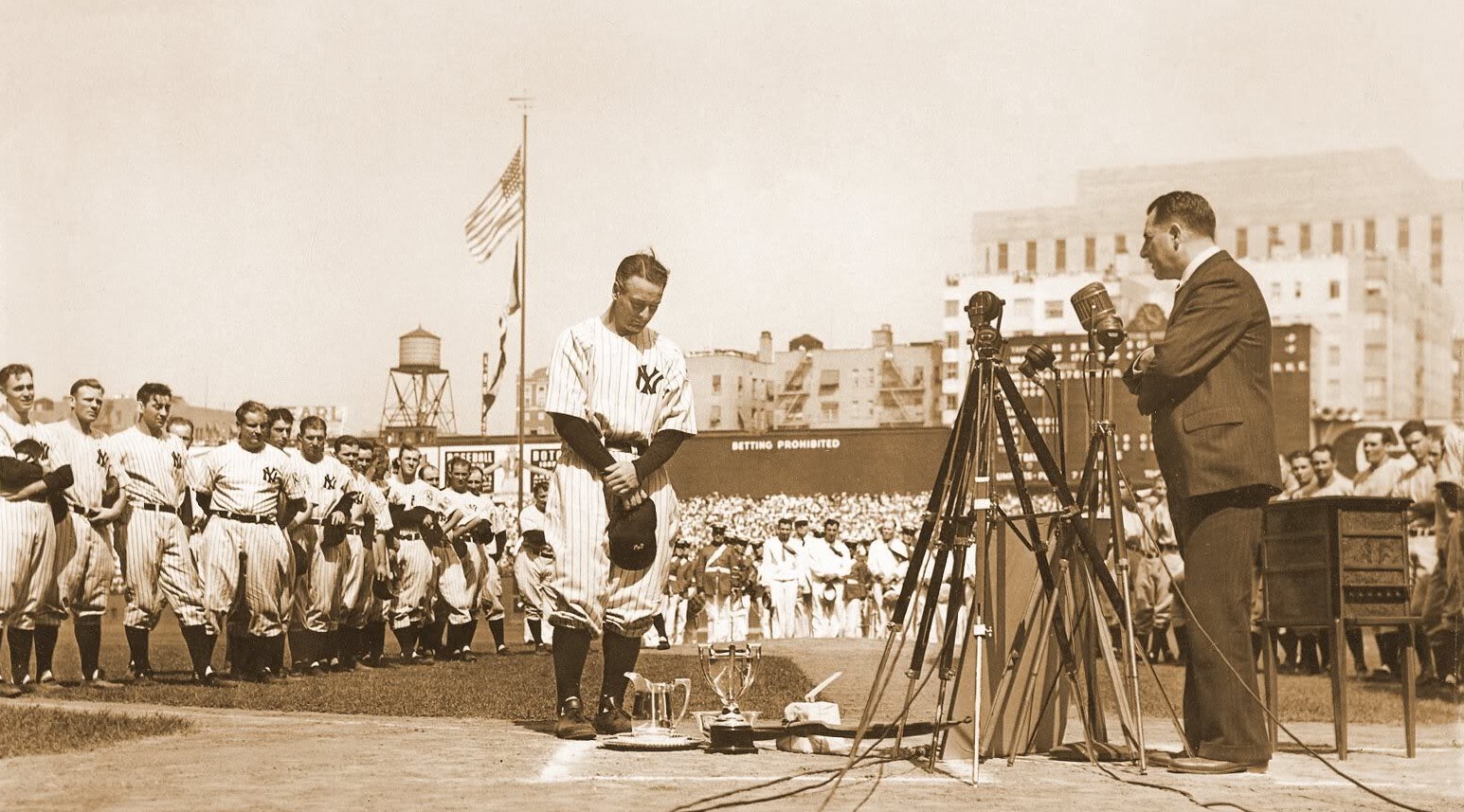
Ethics Quote Of The Day: Lou Gehrig, July 4, 1939

“Fans, for the past two weeks you have been reading about the bad break I got. Yet today I consider myself the luckiest man on the face of this earth.”

—-Baseball great Lou Gehrig, beginning his farewell speech to Yankee fans on July 4, 1939, as they filled Yankee stadium to say farewell to “the Iron Horse,” who was retiring from the game after being diagnosed with the incurable disease, amyotrophic lateral sclerosis (ALS), known forever after as “Lou Gehrig’s Disease.”

Lous Farewell

Lou Gehrig was only 36 years old when he learned that he was dying. ALS is a terrible wasting disease that has no cure, and in 1939 there was little treatment or assistance that could be offered to a victim as his body slowly ceased to function. It is an especially cruel disease for a professional athlete to face, and even more so one, like Gehrig, who was renowned for his endurance and seemingly indestructible body. When the progress of the illness, still then undiagnosed, caused Gehrig to remove himself from the New York Yankees line-up on May 1, 1939, it ended his amazing streak of 2,130 consecutive games, a baseball record that stood until broken by Cal Ripken, 56 years later.

Gehrig’s speech was from his heart. He was an educated and articulate man, but he had not planned on speaking at the moving ceremony to bid him farewell, as current former team mates, some of the greatest players ever to take the field, gathered to pay their respects. But the Yankee Stadium crowd of more than 60,000 began chanting his name, and after initially refusing, Gehrig moved to the microphone. Continue reading

David Foster Wallace (1962-2008) On Being An Ethical Adult

David_Foster_Wallace

The late author David Foster Wallace—who committed suicide in 2008, the victim of depression— gave a wise, inspiring, ethically-astute  commencement address to the graduating class at Kenyon College in 2005. The speech was later published as a book in 2009 under the title “This Is Water.” It was recently made into a vivid video, and has been viral on the internet. You can see it here, at least for a while.

If the video sends anyone to Wallace’s other works, it has done good; if it causes people to ponder what ethics really means, for that is what Wallace was talking about, it had done better. Apparently the David Foster Wallace Literary Trust is in the process of ordering that this video be taken down as copyright infringement, which if his words belong to the Trust, is their right. I wish they wouldn’t; I think letting Wallace’s eloquent life lesson reach as many people as possible, especially young people, would be both ethical and consistent with the values and aspirations of Wallace himself, but it is not my decision to make. I am a little conflicted about sending you to the link, in fact, if the piece was, in effect, stolen. I am applying utilitarian balancing here.

You can also read his speech, presumably legally, here, where it was republished upon his death. The essence of it is in this passage:

“The really important kind of freedom involves attention, and awareness, and discipline, and effort, and being able truly to care about other people and to sacrifice for them, over and over, in myriad petty little unsexy ways, every day. That is real freedom. The alternative is unconsciousness, the default setting, the “rat race” – the constant gnawing sense of having had and lost some infinite thing.”

__________________________

Pointer: Tim LeVier

Sources: Upworthy, The Guardian

Ethics Alarms attempts to give proper attribution and credit to all sources of facts, analysis and other assistance that go into its blog posts. If you are aware of one I missed, or believe your own work was used in any way without proper attribution, please contact me, Jack Marshall, at  jamproethics@verizon.net.

The Dilemma of the Oblivious Questioner

"Where was I? Oh, right...so what you were saying about client perjury reminds me of a trial in the Boer War...well, it wasn't a trial exactly; that was what Churchill's cousin called it---wait, not Churchill's cousin...the other guy, the one who was such a good canasta player. Nobody plays canasta any more..."

“Where was I? Oh, right…so what you were saying about client perjury reminds me of a trial in the Boer War…well, it wasn’t a trial exactly; that was what Churchill’s cousin called it—wait, not Churchill’s cousin…the other guy…no, it was a girl, I misspoke… the one who was such a good canasta player. Nobody plays canasta any more…”

I launched a new legal ethics seminar today. This is always nerve-wracking, because it has to last exactly three hours, has to cover the topics I’ve included in the printed materials, and the programs are interactive, meaning that the degree of attendee participation is unpredictable. After I’ve done a program a couple of times, I usually have a good idea about which segments prompt a lot discussion and which don’t, so I can time my own comments accordingly. The first time, however, it is pure guesswork.

This one, a country-music themed program, was going to be tight, but was close to schedule until an elderly lawyer burdened with various medical paraphernalia raised his hand. I called on him by reflex, and then realized that he was the same attendee who had blathered on earlier in the program, telling an irrelevant and pointless anecdote that ate up five minutes. Sure enough, the second he got his hands on the mic he was off again, this time making an obscure and convoluted comparison between what I had been discussing and Japanese war crime trials, but it was even worse. He went on tangents; he forgot names; he backtracked; he never made any coherent point. Some people got up and left. It was easily a ten minute filibuster, and permanently killed any chance I had of covering all my material. He finally reached the end, never making clear what the story had to do with anything. I went on to the next segment.

Now I wonder if I handled the situation properly and made the right ethical call, which was to tolerate his clueless intrusion and not embarrass him by cutting him off. Continue reading

Unethical Quote of the Week: Ink Tank

“27. No matter how bad your day is going, somewhere in the world a fat man just dropped his ice cream.”

—- The website Ink Tank, in the process of listing “60 of the world’s happiest facts.”

What???

dropped coneInk Tank’s list of “happiest facts” is a trivia-fest of cute, charming, or otherwise amusing factoids, some of dubious reliability ( 25. Rats giggle when you tickle them…), some of historic interest ( “7. On the day of his assassination, Martin Luther King Jr. had a pillow-fight in his motel room”), some with “Awwww!” value (“15. Otters hold hands when sleeping so they don’t drift away from each other”), some with really dubious reliability (“47. Cows produce the most milk when listening to the song “Everybody Hurts” by REM”), some that are older than Methuselah (“31. It takes seventeen muscles to smile and forty-three to frown”), some snarky (“30. The next Star Wars will not be directed by George Lucas.”), and some that are just plain stupid (“46. At the time of your birth, you were, for a few seconds, the youngest person on the planet”).  That’s all par for the course in these kinds of ubiquitous web lists.

#27., however, comes out of the blue like a drive-by shooting. What kind of person gets joy from the thought that somewhere in the world a stranger is suffering through one of life’s stinging tragedies, just as he is about to partake in one of life’s inimitable innocent pleasures? An ice cream cone! An iconic symbol of summer days, childhood, family excursions and fun! Taking the delicate, waffled cone in an eager hand, admiring the substance and swirl of the lovely confection, anticipating the bracing cold on the tongue and lips, the sweet creamy taste and then…plop!—all is ruined. I hate that! Who doesn’t hate that? When I worked for Baskin-Robins, we were told to always replace a fallen scoop of ice cream or a dropped cone gratis, whether the victim was 4 or 40. Since my ice cream shop days, I have bought replacement cones for other people’s children, because that stricken face of shock, hurt and disappointment the second the scoop hits the ground will haunt my nightmares if I don’t. Continue reading

Holiday Ethics Quiz: The Family Stuffing Dilemma

Families can fight about anything.

Further proof that families can fight about anything.

In the category of the kind of ethics controversy only families can devise comes this one, from an old friend from high school, who just e-mailed me for advice:

She is having her sister and her sister’s family, all adults, over for Christmas dinner. She is cooking all of it, turkey, stuffing, chestnuts roasting on a open fire, Andy Williams on a spit—the works. Today her sister tells her that her daughter will be bringing her own turkey stuffing, because she likes her recipe best. My friend said, “Fine,” and hung up. Now she is quietly fuming. She asks, “What kind of behavior is that? I’m inviting them to dinner. Who brings their own private courses because it’s their personal preference?” (She adds that nobody has ever complained about her stuffing. I can personally vouch for that: I’ve eaten it in past years, and it’s excellent.)

My friend thinks the whole idea is an insult and bad manners, and wants to call up her sister to say, oh, lots of possible things, like “You know Christmas Eve when we’re coming over to your house for dinner? Well, my daughter will be bringing hamburgers, because she thinks the food you serve is crap,” or, Tell Phyllis she’s welcome to make her own stuffing and get her ass over here at 6 AM to stuff it in our bird, or she can live with what I’m serving,” or “Why don’t you all just bring your favorite damn dishes and we can just have pot luck?”

So it’s a two-part Christmas Ethics Quiz for the Ethics Alarms faithful:

1. Is the daughter’s conduct inexcusably rude?

2. Should my friend say anything about it? Continue reading

Presenting Rationalizations 28-31: The Altruistic Switcheroo, The Prospective Repeal, The Troublesome Luxury, and The Unethical Role Model

The Ethics Alarms list of rationalizations—the lies and fallacies we seduce ourselves with to make unethical conduct seem reasonable— continues to grow. Here are some worthy additions, bringing the current total to 31. I doubt that we have them all captured yet…not by a longshot.

28. The Altruistic Switcheroo: “It’s for his own good” – This rationalization is a pip, because it allows one to frame self-serving, unethical conduct as an act of good will and generosity. Cheating the young sprout will teach him to be more careful the next time, and it’s just a pleasant coincidence that you benefit from the deception. It is true that misfortune carries many life lessons, that what doesn’t kill us often makes us stronger, and that what hurts today may be the source of valuable wisdom and perspective later, but it really takes a lot of gall to cheat, lie to, steal from or otherwise harm someone else and claim it will be a good thing in the long term. Yet an amazingly large number of people possess this much gall, because the Altruistic Switcheroo is very popular, especially among parents who want to convince themselves that bad parenting is really the opposite. A marker for this rationalization is the statement, “You’ll thank me some day”—the specious theory of the sadistic parent who named his son “Sue” in the famous Shel Silverstein song made famous by Johnny Cash. No, he won’t. Continue reading

The Last Birthday Gift

blown out candles on a birthday cakeThis is my birthday. It’s also the third anniversary of my father’s death, as the two dates collided for all time when I found him dead, as if asleep, in his favorite chair when I went to my parents condo to meet him for a late birthday dinner, December 1, 2009.

I feel no more in the mood to celebrate my birth this day than I did that one, and seriously doubt if I ever will again. I miss my father terribly, every day really, and yet I recall that moment when I realized he was gone with mixed emotions. I knew that the old soldier, 89, fighting cancer, a heart condition and old war wounds, was facing a sharp down-turn in his quality of life; I knew that this was the way he always said he wanted to go out—quickly, without drama, humiliation or excessive expense—and I knew that among the members of his immediate family, I was the one whom he would have wanted to find his abandoned body. I never felt closer to my father, who, like so many of his gender and generation, had trouble expressing affection and intimacy directly, than I did in those last moments before the EMT’s arrived, as I stroked his thin, gray hair and said good-bye.

I have also come to believe that he gave me a great gift three years ago, probably unconsciously, but with my father, you never know.  He detested and rejected all forms of score-keeping, including regrets, accolades, praise and bucket lists. He was proud of many things in his life, especially his military service and his family, but he never felt superior to another human being based on what had happened in the past. My father believed that what mattered in life was going forward—doing one’s duty, helping others, setting a good example, and making every minute of your life count by trying to leave the world, even if it is only your small corner of it, better than it was before you got there. And when you’re done, you’re done. There is nothing to be sad about, or to be afraid of, or to regret; no recriminations for what didn’t happen, what couldn’t be completed, or mistakes made along the way. Just do your best, as you have learned to do it, for as long as you can. It’s not a competition, and you shouldn’t judge yourself by anyone’s standard but your own.

My father’s death reminded me that there is nothing special about being born. Everybody is born. It is how we use whatever time we have, when we use it well, that is truly worth celebrating, and even then, past achievements never justify resting on our laurels as long as we are still capable of doing some good, and have time left to do it.

On the day he died, my father spent loving hours with my mother in her hospital room, gave some needed advice and encouragement to my sister, wished his son a happy birthday, and made him laugh one last time. Good work, right to the end. If the timing of his finale changed for all time the meaning of my birthday for me, it also made vivid the life lessons that were the essence of Jack A. Marshall, Sr. Care about others. Be responsible.  Be fair. Do the best you can for as long as you can. Keep trying to be better. Never give up. Don’t be afraid. If you do all of that, you don’t need celebrations to prove your life has meaning. It just does.

It is true that “Happy Birthday” will never sound right to me again. Still, my father’s life and his way of leaving it gave me ideals good and true to celebrate on every December 1,  the wisdom to cherish whatever birthdays I have remaining, and the sense to never waste precious time regretting what is past and beyond changing. In many ways, his last birthday gift to me was the best one of all.