A Choice, A Doubt, and One of a Million Moments

In the end, a life is made up of more than a million choices, large and small, that we make according to a witch’s brew of factors. There is timing, and how we are feeling at the moment, and there are random factors, our emotions, past experiences and needs, and, just maybe, some ethical analysis involving altruism, the Golden Rule, a careful balancing of outcomes, and solid principles of right and wrong. We hope to make good choices, and yet even a good one can have disastrous effects, leaving us illogically hesitant to make the same choice the next time. We hope, if we strive to be ethical and learn from our mistakes while not learning the wrong lessons—cowardice, fecklessness, self-obsession, fear of responsibility and risk, procrastination—from our failures, to reach the finish line having made existence better for more of our fellow human beings than we made miserable, and having been a net benefit to civilization while we were part of it.

Yet there really are a million or more such choices,  many of them present themselves without any warning, and the results of the choice are often unknown. The only one keeping score is you, most of the time. I was presented with such a choice tonight, and I fear that I chose badly. Continue reading

Lori Stilley And The Deception That Makes Society Cruel

Lookin’ pretty healthy there, Lori!

If you want to identify the opposite of an ethical human being, you need look no farther than New Jersey resident Lori E. Stilley.

Stilley, who is 40, told her family and friends in February of 2011 that she had been diagnosed with Stage III bladder cancer, and that things were looking grim. She had  undergone radiation and chemotherapy treatment, she said, and posted about her dire condition on Facebook and a personal website. Later, she said the cancer had progressed to Stage IV. Alas, she lacked health insurance health insurance, too. So her concerned friends and relatives raised money for Stilley, including a T-shirt sale, a fundraising banquet, a third fundraising event and a raffle. There was a meal calendar organized, so friends could bring the probably mortally ill woman food every day. Continue reading

The Anti-Smoking Zealots Go To A Show

…and it really looks cool in the stage lights!

Once again I am embroiled in a battle with bullies, in this case bullies whose motivation I support, but whose application, attitudes and methods I both oppose and despise. The bullies are the anti-smoking zealots. I am very happy with the culture’s success in discouraging smoking, and most of the government’s efforts to make smoking expensive and difficult, though I would support the U.S. being straightforward and just banning tobacco products. The bullies, however, buy tickets to the theater company that employs me as its artistic director, and that theater produces only written or about the 20th Century, especially the middle of it, when people smoked a lot. This often requires some smoking on stage, at the discretion of the director and the requirements of the plot. Whenever this happens, I catch hell. And I give it right back. Continue reading

Confession of Faithless Fan

The 2012 Red Sox season

I’ve been meaning to write this post for more than a month, almost two., for it has been that long since I have watched a Boston Red Sox game, or indeed any baseball game at all. This, I knew, was complete abdication of everything I believe about loyalty, courage, faithfulness and gratitude, yet I could not force myself to meet my own standards, and I am ashamed.

For I hate sports fans like that, feckless, fair weather, Sunday soldiers who root loudly for their team when things are good, and who defect to the booers and the doubters when the tides of fortune turn. I have been the most loyal and faithful of Boston baseball fans since my childhood. I watched or listened to every game when the team was annually awful, from 1962-1966, and yet got reserved seats for the final series of the 1967 season a year in advance, because I thought, absurdly, that the team might be in a pennant race. (And I was right!) I endured team collapses and disappointments in many seasons since—all the famous ones, and others that only a dedicated lifelong fan would remember.

What happened to me this year? Continue reading

Ethics Quiz: You Now Know That Your Neighbors Are Irredeemable Creeps—Now What?

“Now that you are all grown up, I want to tell you about the Duffs, and you can decide what to do…”

And you think you have rotten neighbors! Meet the Duffs.

Scott and Roxanne Duff of Leechburg, Pennsylvania found their neighbor’s Golden Retriever and new Rottweiler puppy  wandering in their yard. They called the police, who said to describe the dogs and hand them over to a local animal shelter. They finally returned the Golden to the owners, who lived on the same street, but told the police and the owners that the puppy had run away. Actually, the Duffs were in the process of trying to sell the Rotty on Craig’s List.

The next day, the owner of the dogs called police to say he had heard that the puppy was still at the Duffs’ house, as someone reported seeing it in their yard. Police inquired, only to be told, “Puppy? What puppy?”  Eventually the Dastardly Duffs confessed to selling the dog for $50. The puppy was duly retrieved from a Pittsburgh woman who police said was unaware of the theft, and reunited with its owner. Continue reading

A Boy Named Sue, A Woman Named Edward

I think I know where he works…

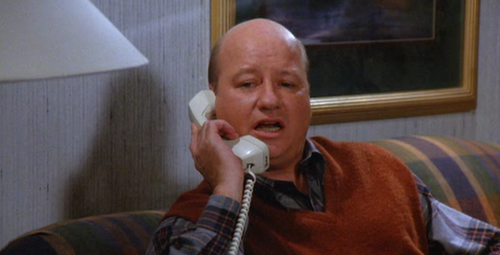
I have no idea what to make of this: I feel like I fell into a “Seinfeld” episode. Remember the “high talker”?

I received an e-mail yesterday from the executive of a large company inquiring about an ethics training. The first name of the executive was Edward, but when I called the listed number, a very high, very female voice answered the phone. I asked to speak to the executive, and received a perky, “I’m Edward! Thanks for calling me back.”

Come on. Edward? What woman goes by Edward? I was about to make a comment like, “That’s an unusual name—how did you come by it?” when I had an image of “Seinfeld’s” high talker, a short, fat, bald guy, becoming irate when callers mistook him for his girlfriend over the phone. This was a potential client, and I didn’t want to annoy her—or him. On the other hand, surely she, assuming it is a she, knows that her masculine  name causes confusion. I searched through her e-mail messages for any hint of her—if she was a her—gender, and found nothing. Wouldn’t it be reasonable and fair to at least confirm that yes, she was a woman, or yes, he was a male counter-tenor, or yes, he was indeed a castrati, or at least do something to clear up what he…or she, dammit… had to know was confusing to anyone meeting her over the phone? Continue reading

Comment of the Day: “Randy Cohen’s Scofflaw Cycling: How Did THIS Guy Ever Get To Be Called ‘The Ethicist’?”

Reader Lance Jacobs, a New York bicycle instructor, was moved by last month’s Ethics Alarms Post “Randy Cohen’s Scofflaw Cycling: How Did THIS Guy Ever Get To Be Called ‘The Ethicist’?” to write the New York Times about their scofflaw, erstwhile “Ethicist,” who had proudly confessed in a an essay that he routinely broke the law while cycling, and believed that he was right to do so. The Times didn’t print Lance’s letter, an open letter to Randy, and sadly, this blog does not (Yet! Yet!) have the circulation of the Times, but it is an excellent rebuff to Cohen, and a most deserving “Comment of the Day.”

Here it is:

“Dear Mr Cohen, Continue reading

Oh! THAT’S What Manners Were For!

A young woman posted a harrowing and depressing personal account on the web, describing the  gauntlet of daily sexual harassment attractive females must endure just going through life. “I decided it was important,” she writes, “because in my own way, I can (unfortunately) point out exactly what is wrong with men when they don’t realize how hard it is to be a woman.  How we do not have equal opportunities and freedoms in everyday life.  How most men, even good caring men, have no clue what we go through on a daily basis just trying to live our lives.”

What follows should make every man angry and every woman angrier, a sickening story of a subway ride that became a nightmare, simply because too many young men think of pretty women as quarry, rather than human beings.

She writes, Continue reading

Movie Ethics: The Disruptive Child, the Weenies, and The Duty To Confront

Over at Consumerist there is a ridiculous post about a woman, “Kelly,” whose recent movie-going experience was ruined by a couple of boorish and irresponsible parents who brought their pre-schooler to the movie and did nothing while he annoyed the woman, talking to her, nudging her, and generally being a nuisance. You can read her account of the whole fiasco here.

Apparently it never occurred to the woman, or her equally passive and impotent brother, who has apparently been writing indignant e-mails to Regal Theaters after the incident, to tell the couple that 1) they have no right to let their child interfere with other audience members trying to enjoy the movie, 2) they either need to control their child or leave, and 3) if they don’t, then she will go make such a fuss in the lobby with the staff that they will be asked to leave. Continue reading

Randy Cohen’s Scofflaw Cycling: How Did THIS Guy Ever Get To Be Called “The Ethicist”?

Stop means “stop,’ unless Randy decides it means “yield”—after all, he knows best.

Randy Cohen was the original author of the New York Times Magazine’s column “The Ethicist.” During his tenure he made a name for himself with lively and sometimes witty prose, and on Ethics Alarms, at least, a disturbing tendency to rationalize clearly unethical conduct when it suited his political agenda, which was unapologetically left of center. In one notorious example, he told a student whose wealthy and famous father was paying her college tuition that it would be ethical for her to cash a partial tuition refund check she received from the university to her mother and stepfather, who believed that the father had not paid his fair share of child support. Cash that check, advised Cohen….“You are entitled to this money not because he is successful while you struggle. Such rough justice would also encourage you to sneak into his house, swipe his sofa and sell it on some kind of furniture black market. That would be stealing; this is merely claiming what he owes you.”  Of course, this is also stealing: cashing a check not intended for you because you believe it should be used to settle a disputed debt between the owner and someone else is not honest or fair, regardless of the merits of that belief. But Randy is a class warrior: as “The Ethicist,” he routinely took the position that it was “ethical” for people to use dubious means to get an edge on the evil rich, which in his world apparently means anyone richer than him.

I don’t know what Cohen has been doing since the Times sacked him; it isn’t practicing ethics, as he didn’t do this before his tenure, and confessed when he left the job that writing about ethics didn’t make him practice ethics while he was “The Ethicist” either, something I found and still find incomprehensible. Now, he tells us in a recent Times piece, the Ex-Ethicist is riding around New York City on his bicycle, running stop signs and red lights.

He tells us, moreover, that this is ethical, though it is certainly illegal. “I roll through a red light if and only if no pedestrian is in the crosswalk and no car is in the intersection — that is, if it will not endanger myself or anybody else, ” Cohen says. “To put it another way, I treat red lights and stop signs as if they were yield signs. A fundamental concern of ethics is the effect of our actions on others. My actions harm no one. This moral reasoning may not sway the police officer writing me a ticket, but it would pass the test of Kant’s categorical imperative: I think all cyclists could — and should — ride like me.”

This is arrogant, fatuous, reckless and wrong. But that’s Randy.

Even Coehn’s reading of Kant is wrong. The categorical imperative says that an action is ethical only if it could be the universal rule without harm, and this, despite Cohen’s rationalizations, could not. Who says the cyclist’s judgment of when it is safe to run a red light or stop sign is correct or reasonable in every instance? Why couldn’t motorists also use this same justification for running red lights at will? Continue reading