Ethics Zugzwang At CVS

I have a lot of pressing ethics posts on the metaphorical EA runway, but I have to get this one down while it is fresh in my mind.

Once again dealing with the pharmacy at CVS (no, the company never did respond to my complaint of rude and abusive treatment from last year; it just kept promising an investigation that never happened and a response that never came), I found myself waiting for prescription that I had been told was ready three days ago. An elderly woman sat down next to me, and started up a conversation: she was black, probably in her seventies, and less than four feet tall, with severely malformed legs.

I wanted so much to talk to her about her life. What was it like? What obstacles she must have overcome! Were most people kind and fair to her growing up? What prejudice and bigotry had she encountered? What was her view of humanity? Of America? Of race? Was she bitter, or did she have a positive view of the world? I would have loved to do an ethics podcast with her.

Yet there is no way, none, within current boundaries of etiquette, consideration, privacy and respect, to have such a conversation. All I could do is share my candy bar with her and chat amicably and emptily. She had, I think, a lot of wisdom to share that would help focus my ethics perception, yet there was no way to ethically unlock it. It was as rude to begin the conversation that I wanted to have as it was irresponsible to pass up the opportunity to have it.

Signature Significance And The Julie Principle Confront “The Ethicist”

Kwame Anthony Appiah, “The Ethicist” of the New York Times Magazine, doesn’t read Ethics Alarms so he isn’t conversant in two core EA concepts: signature significance, the fact that a single example of conduct can be enough to make a definitive judgment about an individual’s unethical nature, and The Julie Principle, which holds that once you recognize an individual’s flaws, you can accept them and continue the relationship, or use them to decide the individual is too flawed to tolerate, but it is pointless to keep complaining about them.A question from a disillusioned wife this week raised both, and “The Ethicist” acquitted himself well without directly acknowledging either.

“Theresa” revealed that her husband had tossed a banana peel out the passenger’s side window while she was driving on a highway. She protested, emphasizing her objection to littering and his setting a bad example for their 13-year-old in the back seat. He rationalized that the banana peel would “biodegrade”, and as if that wasn’t lame enough, defaulted to “I’m an adult, so I’ll do as I want.” After the incident, “Theresa” showed him an article about the dangers of throwing garbage on the street, plus a copy of the Massachusetts law declaring his conduct illegal. Her husband responded with, “Don’t you have anything better to do with your time?”

“He refuses to acknowledge that he made a mistake or change his behavior,” “The Ethicist’s” inquirer wrote, adding that the deadlock on the issue is making her question her marriage.

At the outset, I have to agree that the episode might make me question the character of someone I had just met—not merely question it, in fact, but perhaps make a confident diagnosis: this guy is an asshole, and the sequence is signature significance. The only feature of the story that possibly rescues it from being signature significance is that it can be broken down into components:

Continue reading

Psst! When You’re This Estranged From Human, Societal And Cultural Norms And Standards, No Advice Columnist Can Save You

The New York Times “Ethicist” got a jaw-dropping inquiry this week:

Nearly a year ago, I began dating two friends — I’ll call them Rachel and Dave — who were already themselves in a relationship. We all had no experience with polyamory. The throuple ended fairly quickly, with no one being at fault; the other two continued to date but broke up not too long afterward. Since then, Rachel and Dave have dated on and off, Rachel and I were casually together and Dave and I have been close friends who sleep together occasionally. There have also been relationships with others outside this group. At times, we have all behaved badly, sleeping together behind the other’s back, knowing the knowledge would hurt the other. Strong emotions, love and pain have arisen on all sides.

Throughout the past year, as multiple complex situations arose, we have all wished for a model of behavior. Monogamy-centered media suggests that one should avoid dating a friend’s ex-partner. Is this correct? And if so, can this concept be universalized? Do Rachel and Dave get “priority,” in that they should be together and I should not pursue either, because they dated first? What do we owe to our romantic partners and friends when the situations are complex?

His advice doesn’t interest me; you can read it here if it interests you. My focus is on the inquirer, predictably signed in as “Name Withheld.”

Continue reading

Some “Splainin’ To Do”…

I just returned from my first out-of-D.C. ethics presentation in more than two years. This, and the necessary preparation for it is why Ethics Alarms has been uncharacteristically devoid of new content for about 24 hours, though the commentariat, as usual, have admirably kept the ethics fires burning.

Before I make some ethics-related observations on features of the trip and the engagement, this: Are there really people out there who are primed to complain that references to Desi Arnaz’s famous catch phrase (as Ricky Riccardo on “I Love Lucy”), “Lucy, you have some ‘splainin’ to do!” are markers of bigotry and racism? They can bite me, because these are the individuals who fit Jacques Brel’s description of “them” is his famous quote, cited before here: “If you leave it up to them, they’ll crochet the world the color of goose shit.”

Continue reading

Who ARE These People And Why Don’t I Recognize Them?

Well, this is profoundly depressing.

I work hard at keeping current on all aspects of the culture, including the popular culture. I believe, and have written here frequently, that cultural illiteracy is a crippling problem in a democracy, and that citizens have an ethical obligation to avoid it by proactively informing themselves. I also agree with the thesis of E.D. Hirsch, who posited in his best-seller “Cultural Literacy” that the generations becoming estranged and unable to communicate with each other was a formula for societal disaster.

There has been an explosion of the use of a cheap joke at the expense of rising generations in TV and movie dramas: an older character will use a cultural reference to John Wayne, the Beatles, a Rockefeller or someone similarly significant, and a younger character, usually 20-ish, will reply, “Who’s that?” I managed never to be that kid, even as a preteen. The reverse gag is also common: a teen will mention Taylor Swift at the dinner table and a clueless parent will reply, “Oh, is that one of your new friends in school, dear?” I vowed when my son arrived never to be that boob either.

And yet today I ran one of my periodic spot checks on my pop culture literacy, and flunked. Perusing the stories in WeSmirch, a celebrity gossip aggregator, I found the names of 26 current celebrities, and endeavored to identify them (without cheating, of course). Here they are:

Continue reading

Verdict: “Quiet Quitting” Is Unethical. Next Question?

I had happily never heard of the term “quiet quitting” until last week, and now it is supposedly a hotly-debated ethics topic. There’s nothing to debate about. “Quiet quitting” is not new (the term may be new), nor is there any defense for it. It is un-American to its core. But as so many American values are being eroded by revolutionary fervor of people who simply don’t like the unique history, culture and principles that make the nation the unique entity that it is, it figures that slacking at one’s job and being self-righteous about it would be on the rise.

It is, there is little doubt about that. Ethics Alarms has mentioned the trend of increasingly poor and unaccommodating service in every sector. The usual explanation is the under-staffing that the destructive pandemic lockdown facilitated, but it’s good that focus is falling on the declining belief in seeking excellence in all one does, and putting out one’s best effort at all times. The death throes of American dedication to excellence as a cultural value is what has been newly christened “quiet quitting,” the many ways in which workers reduce the time, energy, and care they commit to their jobs.

Continue reading

On Ghosting, Ducking, Evading, And The Duty To Explain

One of my best and dearest friends is currently distraught because someone he has been very fond of and close to for many years suddenly stopped communicating with him, or in the parlance of the day, has “ghosted him.” All of a sudden, for no reason he can imagine, his vanished friend refused to answer his phone calls, texts, emails or social media entreaties. It’s driving him nuts. No, his friend hasn’t died or been kidnapped. He’s just been cut out, dropped like the proverbial hot potato.

I thought about my friend’s pain during a recent work mystery: I was supposed to review an agreement for ethics issues, and time was supposedly of the essence. The company that had proposed the deal, however, kept stalling in sending the draft. First it was an email with the infuriating missing attachment; next it was the wrong file. Time was ticking: my client wanted to know what was causing the delay on my end.

I called everyone on the conference call that had ended with the document review as being agreed upon as the next step: nobody answered. Nobody answered my emails either. I called the lawyer orchestrating the deal. He was “out” but would call me later that day. He didn’t. I called again, telling his secretary that this was not making me confident about the company’s worth as my client’s business partner. I was told the lawyer’s assistant would call me “quickly.” Two hours later, after receiving no call, I called again. I was, shall we say, sharp. The secretary apologized and connected me to the lawyer’s assistant. She was professional, understanding, cooperative. She said there was no reason for me not to have received the document. “I’m going to storm into his office right now, and you’ll have the agreement to review in five minutes” were her exact words.

I never received the file, and I never heard from the assistant again.

Continue reading

Another CVS Adventure: Observations On A Revealing Juneteenth Encounter

The  CVS on Quaker Lane in Alexandria, scene of many ethics adventures…

I am still at war with CVS, which has so far ducked all of my efforts to seek an appropriate response for our local branch’s unethical treatment of a 30-year regular customer (me) last year. I still haven’t gotten around to moving all of my drug prescriptions to Walgreen’s, Harris Teeter or Safeway, however, so yesterday I was once again involved in a long, complicated mess regarding the filling of one of my more crucial pharmaceutical needs. (My CVS doesn’t do well with its pharmacy service either, especially since it used the Wuhan freakout to justify cutting staff down below a minimum level.)

Luckily, I was dealing with my favorite member of the current staff, a smart, young African-American assistant pharmacist with superb interpersonal skills. In the course of our discussion, I mentioned that most of the stores were closed (this is Northern Virginia) since the state was one of those making the Monday after Juneteenth’s arrival on a Sunday a holiday.

She had no idea what I was talking about.

Continue reading

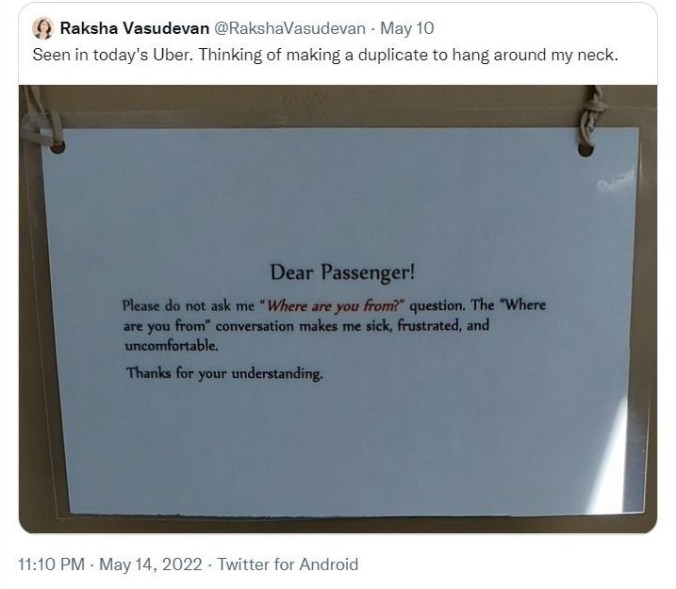
Ethics Quiz: The Uber Driver’s Sign

This is one of those ethics quizzes where I am seeking reactions that might make me question my own. My response to Mr. Vasudevan’s tweet was reflexive: Please do wear that sign around your neck, so everyone is warned that you’re an offense-seeking, paranoid jerk to be avoided at all costs.

Back before the CDC wrecked by business and crippled my livelihood, I was often in taxicabs, and my employing some version of the “Where are you from?” question led to many of the most enlightening and fascinating conversations I have ever had. I never encountered a driver who seemed to resent the question in any way; usually they were pleased by my interest, and they always had amazing stories to tell.

I get asked the question myself in our neighborhood when I am walking Spuds in my Red Sox hat or Boston jacket. I don’t see those markers as different from an accent or a turban. The question shows that the inquirer is interested in me: thanks! When I hear a Greek or Russian accent, I’m interested because those origins relate to my family. If my question that the accent prompts causes discomfort, well, that’s not my problem.

Nevertheless, the Ethics Alarms Ethics Quiz of the Day is…

Is it unethical to ask a stranger “Where are you from?”

Ethics Quiz: The Vulgar Exclamation That Wasn’t

This is a weird ethics quiz, I’ll admit: it involves conduct that didn’t really take place.

In a game between the Cleveland “Guardians” (they are really the Indians) and Chicago White Sox, Cleveland had a runner on second with two outs when Owen Miller lifted an easy fly to right field, where Chicago outfielder Gavin Sheets should have easily made the play. Instead, in what is technically called a “clank,” the ball bounced right off his glove and went past him for an embarrassing error. The runner on second scored, and Cleveland’s radio color commentator, former player Rick Manning, could be heard saying Are you shitting me?” as play-by-play man Tom Hamilton described the error.

Much hilarity ensued on social media.

Your Ethics Alarms Ethics Quiz of the Day is…

What is the fair and responsible consequence for a professional broadcaster who utters a spontaneous vulgarity or obscenity on the air?

Continue reading