Cultural Literacy Note: “Drinking the Kool-Aid”

The Daily Mail headline is beyond stupid—-“People are only just realizing the dark origin of ‘drinking the Kool-Aid’ phrase”—-but sharp-eyed commenter Other Bill was quite astute to draw it to my attention (Thanks, OB) with an email this morning.

Apparently several historically and culturally illiterate whipper-snappers on social media expressed surprise at the “dark origin” of the common phrase “he (or she) drank the Kool-Aid” to describe someone who has been gulled into believing something false or dangerous. Yet this gap in the younger generations’ knowledge shouldn’t be surprising. Oh, there was a movie about the horrible incident and it is one of the best examples of the dangers of cults. But the Jonestown mass suicide of the 918 American followers of cult leader Jim Jones in Guyana occurred almost 50 years ago, in 1978. As unusual and shocking as it was, the poisoned powered drink massacre is not the kind of event likely to be covered in history courses: schools barely cover World War I. How would someone under the age of 50 come to know about the event?

Continue reading

Social Media Doesn’t Make College Kids Act Like Morons—Being Morons Make College Kids Act Like Morons

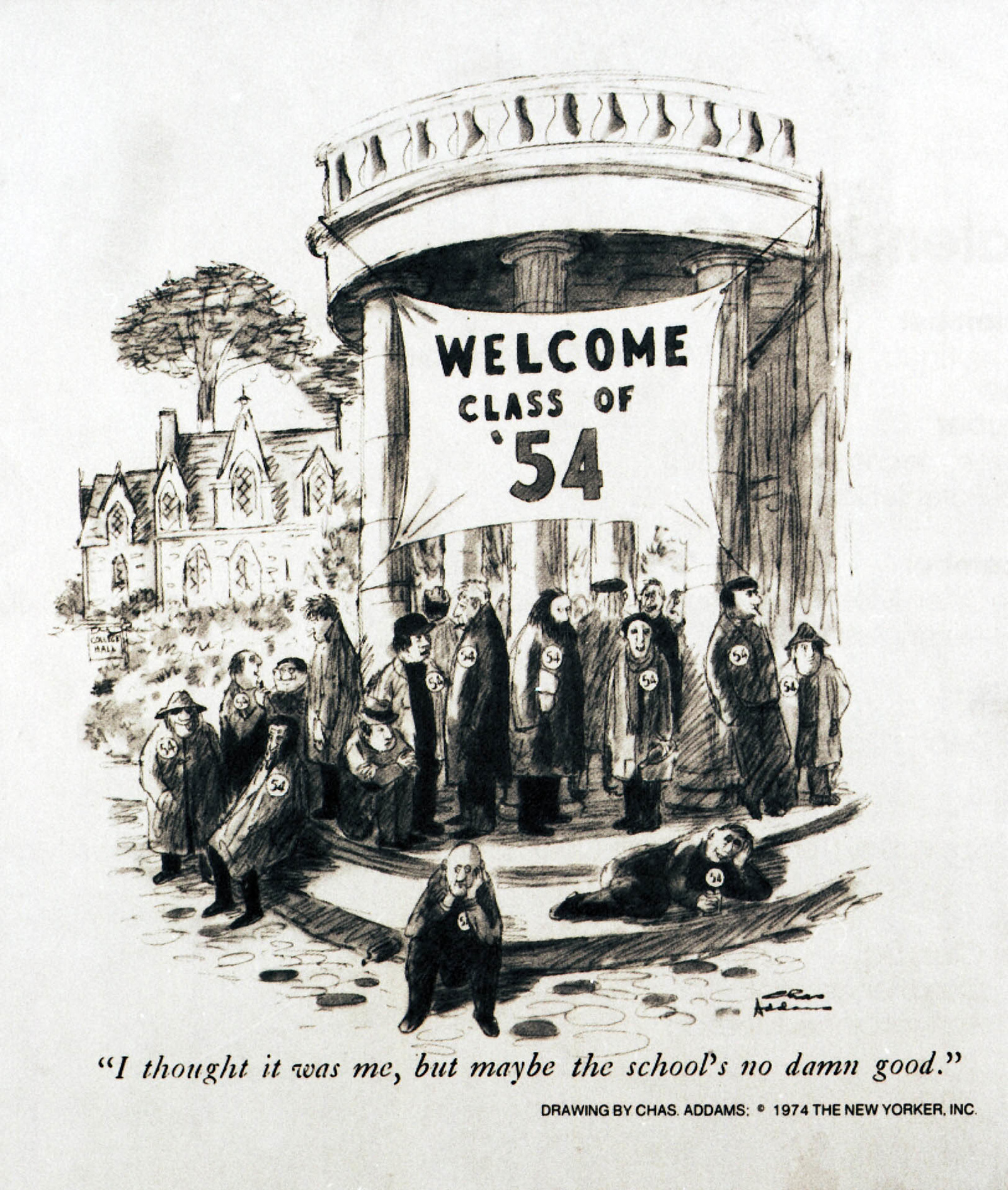
(I’m always happy when I can justify posting a Charles Addams cartoon.)

I’m sure this discouraging episode will somehow make it into the dispute over whether TikTok, which apparently gathers data from millions of Americans to put in the clutches of China’s Dark Masters, should be banned or not. The incident isn’t about TikTok, however.

Apparently there is now a viral TikTok-promoted fad in which people lure suspected sexual predators to some location, lie in wait for them, and either call the police or, for even more fun, beat them up. The “game” is modeled after an unethical vigilante TV reality show on ABC that lasted three seasons; I wrote several posts about it on Ethics Alarms’ now unavailable predecessor, The Ethics Scoreboard. Starring “Dateline” reporter Chris Hanson, the show that aired from 2004-2007 would use the internet and phone calls to lure someone seeking underage sexual companionship to a hidden camera ambush. The entertainment came from watching Hanson walk out from behind a bush and make the sick bastard huminahumina his way into coast-to-coast humiliation. The pre-crime predators who were thus “caught” almost never were convicted of anything.

In Worcester, Massachusetts (that’s pronounced “Wuster,” you Bay State ignoramuses!) students at Assumption University came to the wrong assumption that the “To Catch a Predator” game was a good use of their time. Easton Randall, Kevin Carroll, Isabella Trudeau, Kelsy Brainard, and Joaqin Smith, all 18, decided that a “creepy guy” was a sexual predator, so a female student used dating site Tinder to lure him to where he would think was a meeting place for a hook-up with a 17-year old girl. They had enlisted about 30 other students to lie in wait with them, and the mob chased and assaulted him as the stunt was recorded. Oh, the views it would attract! Randall told police that the idea was to emulate “the Chris Hansen videos where you catch a predator and either call police or kick their ass,” but the incident “got out of hand and went bad.”

Ya think?

Continue reading

I’m Shocked! There Were More Campus Speakers Censored In 2024 Than In Any Previous Year on Record

Now guess what kind of speakers were the ones primarily shut down. Hey, take a shot: you’ve got at least a 50-50 chance of being right! \Wow! You guessed it! In fact, the variety of censored speakers and their censors were more ideologically diverse than I expected.

FIRE maintains a “campus de-platforming database.” The free speech advocacy group explains,

“A deplatforming attempt is a form of intolerance motivated by more than just mere disagreement with, or even protest of, some form of expression. It is an attempt to prevent some form of expression from occurring. Deplatforming attempts include efforts to disinvite speakers from campus speeches or commencement ceremonies, to cancel performances of concerts, plays, or the screenings of movies, or to have controversial artwork removed from public display. An attempt to disrupt a speech or performance that is in progress is also considered a deplatforming attempt, whether it succeeds or fails.”

In 2024, its records indicate, there were 164 attempts at this kind of censorship on American campuses; FIRE has the receipts here. It was a record.

Continue reading

An Eternally Troubling Ethics Conundrum—at Least to Me

Adam Grant, an organizational psychologist who teaches at the Wharton School of the University of Pennsylvania, has authored a guest column for the New York Times that opens up, for the umpteenth time, an ethics topic that makes me uncomfortable. His subject is the cultural delusion shared by many in American society that rewarding effort is just as important as rewarding success, and perhaps moreso. He writes in part:

“….we’ve taken the practice of celebrating industriousness too far. We’ve gone from commending effort to treating it as an end in itself. We’ve taught a generation of kids that their worth is defined primarily by their work ethic. We’ve failed to remind them that working hard doesn’t guarantee doing a good job (let alone being a good person)…..[W]hat worries me most about valuing perseverance above all else: It can motivate people to stick with bad strategies instead of developing better ones…What counts is not sheer effort but the progress and performance that result. Motivation is only one of multiple variables in the achievement equation. Ability, opportunity and luck count, too. Yes, you can get better at anything, but you can’t be great at everything.” 

Continue reading

Comments of the Day (In the Thread of the Month!): “Wait…So Everyone’s Been Lying To Me All These Years About What Angels Look Like?”

s

The commentariate on EA always surprises and delights me, and the response I got to an off the wall post inspired by an AP story about “biblically correct” angels was a perfect example. The resulting thread was a veritable primer on anglelology, with Ryan Harkins weighing in with three substantive posts and several others contributing valuable insight as well.

I don’t deserve you.

One more Christmas tradition that I left fallow this year—like almost all of them—in the absence of my wife was our Christmas Eve reading aloud of the children’s book “The Littlest Angel,” by Charles Tazwell. Grace loved the story so. She would always cry at the place where the Littlest Angel gives his most cherished possession, a simple wooden box where he kept his earthly treasures when he was a child on Earth, as his gift to the soon-to-be-born son of God:

The Littlest Angel trembled as the box was opened, and there, before the Eyes of God and all His Heavenly Host, was what he offered to the Christ Child. And what was his gift to the Blessed Infant?

“Well, there was a butterfly with golden wings, captured one bright summer day on the high hills above Jerusalem, and a sky blue egg from a bird’s nest in the olive tree that stood to shade his mother’s kitchen door. Yes, and two white stones, found on a muddy river bank, where he and his friends had played like small brown beavers. And, at the bottom of the box, a limp, tooth-marked leather strap, once worn as a collar by his mongrel dog, who had died as he had lived, in absolute love and infinite devotion.”

Somehow, it doesn’t work quite as well if one is thinking of the Cherubim as having eyeballs all over his wings or three heads. But that’s just me…

Here are two of the many remarkable comments first from Ryan Harkins, and then from Sara B. on the post, “Wait…So Everyone’s Been Lying To Me All These Years About What Angels Look Like?” :

***

(First, Ryan)

Continue reading

Curmie’s Conjectures: Musings on Returning to the Classroom

by Curmie

[This is Jack: Yikes! I didn’t realize that EA had been Curmie-less for a full four months! The second Ethics Alarms featured columnist has been both busy and seeking respite from politics, which unfortunately has been disproportionately rampant here during the Presidential campaign drama and related horrors. I’m hoping Curmie can leads us out of the dark into the light. Welcome back, Curmie!]

I’m not sure if this is sufficiently ethics-related for this blog, but since Jack posted it, so be it.

I retired from full-time teaching in August of 2021.  It was August instead of May because I was hoping—to no avail, as it turns out—to do one more iteration of a Study Abroad program in Ireland; the trip had already been postponed from the previous summer.  I did teach one course per semester in the 2021-22 academic year, but then not at all for two years.

I assumed that I’d never be in a classroom again except for an occasional guest appearance to be, apparently, the local authority on absurdism.  But then a colleague got a one-semester sabbatical to work on her book.  It would be extremely unlikely to find someone who had both the ability to teach all the courses in question and the willingness to move to small-town East Texas for a one-semester gig at crappy pay.  The powers-that-be then decided to try to staff those courses locally.  I suspect I was the only available qualified person in a 75-mile radius, so I was asked if I’d teach Theatre History I and II this semester.  I agreed.

There were a lot of changes for me, completely apart from the two-year hiatus.  I’d taught both courses numerous times, but never in the same semester, and always on a Monday/Wednesday/Friday schedule; this time it was Tuesday/Thursday.  Back in the days when I was the only person teaching these courses I could insist that one of the research papers be on a certain type of topic; that’s no longer a requirement.  And I ditched the expensive anthology I’d used for years, switching to things that were available online.  This also allowed me to choose the plays I wanted to teach instead of necessarily the ones in the anthology: critics may agree that the The Cherry Orchard is Anton Chekhov’s best play, for example, but there is absolutely no question that The Seagull is far more important to theatre history, so I used that.

Anyway… what caught my attention?

Continue reading

At the University of Michigan, A Controversy Reveals Dishonesty and Hypocrisy Underlying the DEI Fad

If Donald Trump accomplishes nothing more in his next four years than ending the nation’s tolerance to open borders while fawning over “good illegal immigrants” and driving a metaphorical stake through The Great Stupid’s DEI fad, electing him will have been worth all chaos that will come along with it.

DEI thrives as a hypocritical way to discriminate against white men and shift to a society based on rewarding achievement, diligence and ability to one based on group membership. That makes it un-American to the core. At the University of Michigan, the “director of the university’s office of academic multicultural initiatives”—you know, DEI—spoke out at a conference of such officers the university to opine that her university was “controlled by wealthy Jews and that because Jewish students are “wealthy and privileged” the don’t need diversity services. “Jewish people have no genetic DNA that would connect them to the land of Israel,” Rachel Dawson was quoted as saying.

Continue reading

How Do You Solve A Problem Like Alekseyeva?

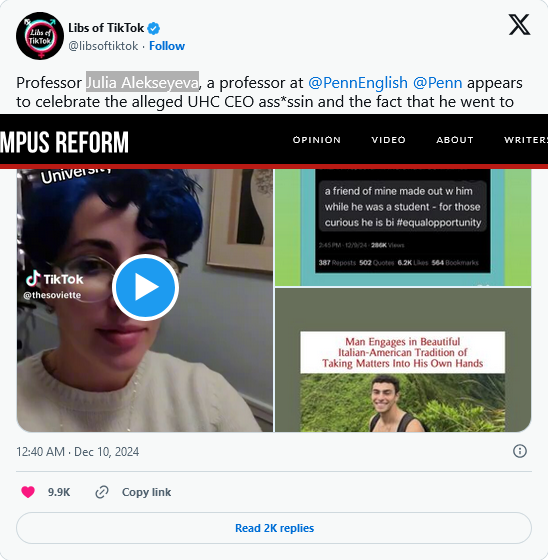
I really tried to write a parody of the “Sound of Music’s” opening ditty “How Do You Solve a Problem Like Maria?” about UPenn’s disgraceful Professor Julia Alekseyeva, but her last name defeated me. Do you know that no English words rhyme with “eva”? Anyway, she proved beyond a shadow of any doubt that she is not fit to be entrusted with young minds.

First the assistant professor indulged in a disgusting outburst of admiration for Luigi Mangione, whom we are supposed to call a suspect in the ambush assassination of UnitedHealthcare CEO Brian Thompson, but who is obviously the killer. Then her absurd Pazuzu Excuse apology proved beyond any doubt that she is a liar. Be proud, University of Pennsylvania alumni! No wonder your alma mater belched up a murderer when it hires faculty like this.

Alekseyeva responded to the arrest of Mangione by posting a video of her smiling and bopping to the “Les Miserable” anthem “Do You Hear the People Sing” with the comment “[I]have never been prouder to be a professor at the University of Pennsylvania,” which Mangione attended. Alekseyeva then called him “The icon we all need and deserve.” To be fair, that part’s a bit ambiguous. If by “we” she means the nation’s deranged progressive assholes, she might have a point.

The University of Pennsylvania knows bad publicity when it sees it, so a spokesperson stated, “Much concern was raised by recent social media posts attributed to Assistant Professor Julia Alekseyeva. Her comments regarding the shooting of Brian Thompson in New York City were antithetical to the values of both the School of Arts and Sciences and the University of Pennsylvania, and they were not condoned by the School or the University.”

Continue reading

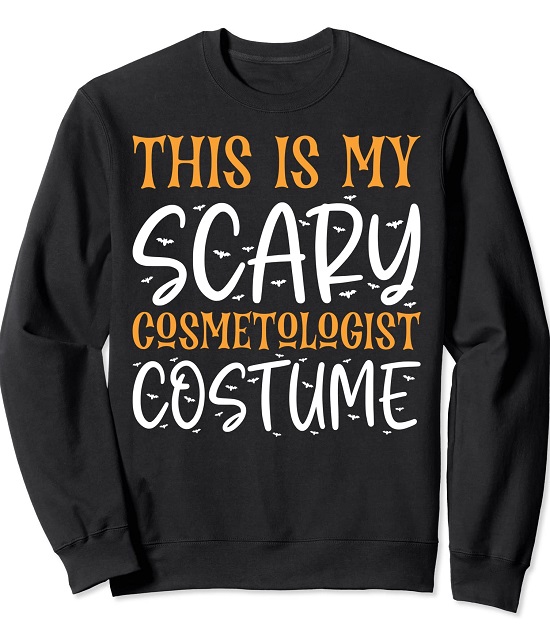
If Trump Is Going To Take The U.S. Out Of ‘The Great Stupid’ He Has His Work Cut Out For Him: The Dangerous Cosmetology Student

I find this story, a Great Stupid phenomenon if there ever was one, almost too stupid to believe.

Leigha Lemoine, a cosmetology student at Horry-Georgetown Technical College in South Carolina, was suspended and banned from the campus after she directed the phrase “get blasted” at someone in a SnapChat group discussion. The object of the term was not a student, but students were participants in the online chat. One of those students complained to the administration, which investigated and determined that Laigha had not seriously threatened anyone. Then an earlier social media post surfaced showing her firing a pistol. Using that as the “context” of her remark, the school suspended her….for a full year!

She is suing. Good.

Continue reading

“Wicked”: A Review (Part 2: Politics and Propaganda)

Gregory Maguire’s “Wicked: The Life and Times of the Wicked Witch of the West” became a critical and financial success by merging the Frank L. Baum children’s series with contemporary issues and values, notably discrimination, prejudice, the abuse of power, and corruption. The still-running Broadway musical “Wicked” softened the preaching and propaganda a bit, but it has come back with full force in the movie adaptation now playing at inflated prices in theater near you. (I purchased a box of Junior Mints and regular size coke. They cost 15 bucks.)

In the novel and the musical, the witch-to-be is born green, leading to a life of being the victim of hate and discrimination. The movie cast not just a black woman in the role, but one with pronounced African features (in contrast to, say, Halle Berry) making it nearly impossible not to experience the plot as a thinly veiled Critical Race Theory brief. Though there are black actors and actresses in Oz here and there, only the white characters are seen to be repulsed or frightened by Elphaba (Maguire gave her a name), because the director correctly calculated that in his film, the character is as much black as green. We see her rejected and cast aside (to be raised by a bear) by her father the moment he sees her skin shade, so it is clear where this is going: Elphaba is going to be forced to fight against the cruel culture that rejected her. Thus we know that she is a personification of the Black Lives Matter riots within the first ten minutes of the movie.

Just as early in the movie we know we are in the grip of sensitive wokism obsessions when we we find ourselves in Munchkinland and the Munchkins pretty much look like anyone you know. The movie “Wicked” is obsessed with, the 1939 classic “The Wizard of Oz,” had the Munchkins played by the Singer Midgets, a little people performing group. In the Baum book that started it all, they are described as being about the same size as Dorothy, who is about 10, but one way or the other, we know the Munchkins are small. Ah, but Disney’s endlessly delayed “Snow White” movie got into trouble after the most famous acting dwarf, Peter Dinklage, declared that the whole idea of portraying the Little People of the familiar fairy tale was offensive, so Disney eliminated the dwarfs entirely. That was also attacked by Little People activists—erasing them, you know. Similarly, Peter Jackson got in trouble for using computer magic to make a full size actor look like he was a a yard or so tall in the “Lord of the Rings series.” So “Wicked” director Jon M. Chu punted and just made the Muchkins normal size and boring. And that wasn’t all: to make sure Dinklage didn’t find some reason to take shots at his movie, the Little Actor was hired to provide the voice of a talking goat.

This is DEI at its silliest. The film gets credit for hiring an “under-represented minority” who was personally responsible for the film not hiring many more members of the same minority. Furthermore, while I like Dinklage (who became famous in “Game of Thrones”) as much as anybody, the only reason he’s a star is because he’s so short. Sure, he plays lawyers, doctors, gangsters, but no matter what he plays, he plays it as a dwarf. That’s the only thing that distinguishes him from hundreds of other equally able actors. It makes no sense at all to hire Peter Dinklage as a voice actor. His unique feature can add nothing to such a gig. The film took away another talented vocal actor’s job so it could be “inclusive” and hire a dwarf for his voice alone.

Continue reading