Ethics Flashback: A Letter From Kurt Vonnegut

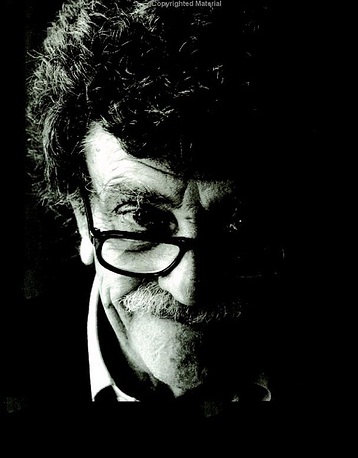
Mr. Vonnegut

[From the lovely website Letters of Note comes the memory  of this, a letter sent on November 16, 1973 to the Chairman of the Drake, North Dakota, School Board by the late author Kurt Vonnegut. The Chairman, Charles McCarthy, (a name evoking, appropriately, both the rights-flattening Senator of “Have you no decency?”  fame and the dummy) had been outraged that a teacher at the high school had used Vonnegut’s classic novel, “Slaughter-House Five,” in class, and with the support of his board, saw that all the copies of the book purchased were burned in the school’s furnace, followed by others that he deemed “obscene.” Vonnegut, whose novels teem with ethical themes, especially the importance of kindness, learned about the book-burning from news reports, and wrote the following correspondence.

Apparently he received no reply.]

“Dear Mr. McCarthy:

I am writing to you in your capacity as chairman of the Drake School Board. I am among those American writers whose books have been destroyed in the now famous furnace of your school.

Certain members of your community have suggested that my work is evil. This is extraordinarily insulting to me. The news from Drake indicates to me that books and writers are very unreal to you people. I am writing this letter to let you know how real I am. Continue reading →

A Journalist’s Integrity: “To Hell With Of Freedom of the Press— MY Interests Are At Risk!”

Andrea, in her alternate "news censorship is bad" persona

Earlier this year, Andrea McCarren, a reporter with D.C.’s WUSA Channel 9 News, did a controversial special report om under-age drinking in the upscale Washington suburb of Bethesda, Maryland, with special focus on how parents excused and facilitated the law-breaking. She was subjected to a deluge of hate mail and online attacks for her story, and her children, who go to a Bethesda high school, were mocked and harassed by other students. The incident and the uproar had finally calmed down, when the school paper at Bethesda-Chevy Chase High, where the McCarren children are enrolled, decided to publish a feature about the episode.

McCarren—journalist, champion of the public’s right to know and the dedicated defender of the First Amendment—called the school’s principal and persuaded her to confiscate issues of the paper that had not yet been distributed, and to demand that students who already had copies return them. Why? Was the story false, libelous, or misleading? No. Was it a legitimate news story with relevance to the school? Of course.

McCarren had the school paper censored because she had the power and influence to do it, and because she felt that the story could have inconvenient and unfortunate consequences for people she cared about. Continue reading →

More Public School Political Indoctrination

Here is what’s scary to me: a teacher considers giving his middle school students the assignment of doing opposition research on the Republican presidential candidates, and no ethics alarms go off for him at all. Fairness? Objectivity? Abuse of power? Prudence? Bias?

Not a ding.

Michael Denman assigned his 8th grade students at Liberty Middle School in Fairfax County the task of researching the weaknesses and vulnerabilities of the four presidential hopefuls looking to challenge President Obama and forward them to the Obama campaign. The students were told to research the backgrounds and positions of each of the candidates ,find their “weaknesses,” and  to prepare strategy papers to exploit them in the campaign. Then they were told to find a contact in the Obama campaign to send them to. Continue reading →

Ethics Corrupters on The Web: Symptoms of a Cheating Culture

I encountered this charming example of high school cheating advice quite by accident. There is a stunning amount of this kind of thing on the web, and perhaps what is most impressive about it is the matter-of-fact way it is received. This example was posted on a Facebook page, and the few posters who registered objections to it as cheating were ridiculed. mocked and insulted by the rest as prudes, fools, judgmental ass-holes, “holier-than thou” bitches, and worse. One commenter couldn’t understand why this would  even be called cheating. “Nobody’s copying any  exam answers!”, he asked, puzzled.

The trick here reminds me of a response I got from a lawyer in an ethics seminar, as I was discussing a hypothetical in which an attorney had promised to review a non-profit client’s by-laws that had to be included in a crucial grant submission. Continue reading →

Anti-Bullying Mis-steps: The Perils of Changing Cultural Norms (Part 2)

If "Hunger Games" should be able to bypass the ratings because kids can learn from it, then why shouldn't a film like "A Clockwork Orange," a better film, should also get a pass?

When society decides makes altering attitudes about any conduct a priority,an immediate danger is that it will destroy other societal safe-guards and damage other valid cultural norms in its tunnel-vision.

“Hunger Games,” a film about the consequences of bullying based on a best-selling novel, is about to hit theaters with an R rating, meaning that teens, the prime target of the nation’s anti-bullying effort, can’t see the film without their parents’ permission. Katy Butler, a young bullying victim, has led a national effort to get the film’s ratings reversed. Predictably, politicians have jumped on the bandwagon.

“Over 13 million American youths will be bullied over the course of this year alone, making it the most common form of violence experienced by young people in our nation,” begins a letter from Rep. Mike Honda (D.- Calif.) to his colleagues, in support of Butler’s campaign. “We cannot hope to control this epidemic … without discussing tough issues publicly and bringing them to the forefront of the consciousness of the American public.”

“YES! RIGHT ON! OF COURSE!” Except that what Butler and Honda are proposing essentially undermines the entire purpose of movie ratings, and if their efforts succeed, there is no way anyone will be able to argue that the system has a shred of integrity at all. Continue reading →

Anti-Bullying Mis-steps: The Perils of Changing Cultural Norms (Part I)

It's a simple rule, really: if they call you a jerk, thy're bullies; if you call them jerks, you're a hero.

The efforts to reduce bullying in schools has already shown the dangers inherent in using the heavy hand and and often empty skull of government authority to adjust social norms. The laudable goal has already led schools to impose their wills where it emphatically does not belong: in the private interactions and communications among student over the internet. This week, HHS Secretary Kathleen Sebelius provided another example of the perils of the government trying to impose a social taboo where it didn’t exist before.

Sebelius was a guest of the Stuart-Hobson Middle School in Washington, D.C., whose students were shown  a new anti-bullying video from the Cartoon Network that among its messages urged children not to call people names like “stupid,” “fat,” and “jerk.”  Immediately after the screening,  CNN’s Don Lemon moderated a panel discussion of the issues raised by “Stop Bullying: Speak Up.”

“What do you think is the best advice for people who are going into watching this film and anyone who is watching?” Lemon asked.

Sebelius answered, in part: “I think, very important, is for kids to understand how powerful you really are. You might feel like you’re not big enough, not strong enough, not–don’t have enough tools. But just saying, ‘Stop it! You know, you’re being a jerk!’–walk away, get away from this person can make a huge amount of difference.” Continue reading →

The Beautiful Lie!

Irony! Stupidity! Symmetry!  Elegance! Chutzpah! Redundancy!

Ahhhhh! Breathtaking!

Yes, this amazing lie, by the California State University System, has it all. This is the Sistine Chapel of lies, the Mona Lisa of mendacity, a true masterpiece of the liar’s art.

Consider…this is “Sunshine Week,” the annual campaign to raise awareness about the essential nature of open, honest and transparent government. So to celebrate,  CSU’s  public affairs office falsely announced on Monday that it had won the 2012 Sunshine Award for most transparent government website in the nation. It had not. It isn’t even eligible to win such an award.

Sunshine Review, the national nonprofit organization that sponsors the annual awards, has confirmed that this would be impossible, since they “do not grade state universities or colleges at this time, so it would be impossible for Cal State to have won an award.” Sure enough, the system is not included on the list of winners available online.

Why would the university system of the Sunshine State lie about receiving the Sunshine Award from the Sunshine Review, and do it on Sunshine Week, no less?  Clearly, this was a once-in-a-lifetime opportunity to good to pass up. It may be unethical, but in the annals of lying, it’s beautiful!

[Thanks to James Taranto for the tip.]

Unethical Quote of the Week: “Brad”

“How much did all these hacks get paid to do this? What a waste of money. Are they bothering somebody? Leave them alone. They obviously want to be together, and who are we to say that they shouldn’t? How much did this judge and all the hacks get paid to issue this decision? Somewhere, somehow this waste has to stop.”

—“Brad,” a commenter on NECN.com’s story about Lisa Lavole, a former teacher who was out of jail on parole after three years for the offense of having sex with her 15-year old student and running away with him. She was taken back into custody when the same student, now 18, was discovered hiding in her closet. One of the conditions of her parole was that she had to stay away from her former victim.

Lisa Lavole, doing her Norman Bates imitation

While perusing the comments to news stories often gives me more insight into the state of our culture’s ethics than reading the stories themselves, there is always the downside that many comments make me want to chuck ethics as a futile and pointless career choice and begin honest work as a bookie or a pimp. “Brad’s” comment is a case in point.

It would be difficult to pack more flawed ethical reasoning and rationalizations into a mere 60 words. The woman was hired to teach, and instead used her authority, age and power to entice a child into a sexual relationship, and then take him away from his parents and his home. By the most charitable interpretation she is a sexual predator and a rapist, as well as the betrayer of the community’s trust. Of course part of her punishment involves keeping her away from her victim, whose mind and emotions she had damaged and warped. To Brad, however, it is a “waste of money” to enforce legitimate laws, protect children from predatory adults, and make certain that at very least adults who prey on the children in their charge don’t benefit from it. She turned a child into a sex object and lover, and Brad thinks it’s a waste of time and money for society to make certain that she can’t keep reaping the benefits of her crime after her prison sentence. Continue reading →

Well THAT Didn’t Take Long: The Next Step in School Censorship of Student Speech

Huh. You know, I just didn't think it would come from the schools! Well, live and learn...

Ethics Alarms has been steadfast in its position from the very first reports of schools presuming to punish students for what they post online, in their own time, in their own homes. That position is, and will forever be, that this is a gross abuse of power that must not be tolerated, much less encouraged. Every time I have written about this, there have been defenders of the practice. This story, from Minnesota, should convince them of how wrong they are. Continue reading →

Ethics Quiz: The Problem of the Buried Video

"He stole my vote!"

The video is meaningless. It shows college student Barry Obama speaking at a 1991 rally for radical college professor Derek Bell. At one point, the future president hugs Bell. So what you say? No kidding. That doesn’t mean that the anti-Obama truth squad wouldn’t try to make something out of it; indeed, they are now. The video has surfaced as Andrew Breitbart’s farewell poke in the eye to Democrats, and it’s not much of a poke.

The only interesting aspect of the tape is that Harvard Law professor Charles Ogletree said that he had the video and buried it during the 2008 campaign.  “I hid this during the 2008 campaign,” Ogletree said. “I don’t care if they find it now.”

Your Ethics Quiz: Is it unethical for an individual to hide theoretically damaging material relating to a presidential candidate he favors until after the election, if the material in fact contains nothing that would affect the vote of any individual with  intelligence superior to that of the average civic-minded horseshoe crab?

My answer: Definitely. I don’t care whether the information is extra-marital affairs, drug use, a DUI or appearing at a frat party in a tutu. No one has the right to withhold information, even stupid and useless information, from the media and electorate.  If the information is relevant, then the public has a right to know about it. If it isn’t, as this tape appears to be, then why hide it? If the tape was intentionally kept from the public, the conduct can’t be defended on the basis that it did no harm—the intent was to do harm. If one person would have changed his vote because he doesn’t want a President who ever hugged Derek Bell, even though that person is probably a fool, no one had no right to take away that vote through deception.

It’s all hypothetical, apparently, because Prof. Ogletree has explained that his “confession” was a joke, and was understood as such when he made it, if not reported that way. [Thanks to Barry Deutch for the link.]

So nobody hid anything, and those those horseshoe crabs who voted for Obama weren’t deceived after all.