Small Victories: Relentless Ridicule Beats Back Ludicrous Wokeness At Brandeis

There is hope!

Brandeis University in Massachusetts published one of those “Oppressive Language” lists, telling students that phrases and words like “ladies and gentlemen,” “policeman,” “picnic,” “people of color,” “rule of thumb” (don’t ask me!) were offensive to somebody, and should be avoided. Also “Take a stab at it,” “trigger warning,” and “beating a dead horse” (Too violent!), and “African-American,” “long time no see,” “lending a deaf ear,” and “handicapped space”.”” (Identity based!) Other examples include “Homeless person, “powwow,” “picnic,” “freshman,”and “mentally ill.”Once the list was publicized, the mockery sent Brandeis’s way was relentless, as well as deserved, even though the taboo list eventually had a disclaimer that the web page “is not a university expectation, requirement or reflection of policy.”

That didn’t help. Making the university look especially silly as well as hypocritical was Campus Reform’s report in June 2021 that Brandeis was still using many of the phrases and terms on the BadSpeak list. “Freshman” and “picnic,” for example, were still turning up in articles, blogs, and department materials. The Brandeis University Teacher Education Program Handbook also used the term “rule of thumb!”

Campus Reform reported last week that Brandeis quietly took down the list.

In Which Your Host Loses His Oldest CLE Organization Client For Telling The Truth

I and my ethics training company just got cancelled by the Continuing Legal Education organization that was my very first client when we started ProEthics over 20 years ago. Our seminars have always received top evaluations from lawyer attendees; nos small achievement in the legal ethics field. They also have made our long-time partners a lot of money. We had never needed to re-negotiate our arrangement, and my state tour with a new legal ethics program was a yearly occurrence every fall. This year, however, we had heard nothing about future dates or requests for possible program ideas (I have introduced most of my musical legal ethics seminars with Mike Messer with this group), and it was getting a little late. Grace sent an inquiry to the long-time contact who has handled our programs, and got back a stunning, “We have decided not to use you this year” letter. One shocking realization was that it was clear from the letter that the decision had been made long ago. After two decades, the organization did not have the courtesy to let us know about their decision, or to discuss their concerns with me before making it.

Even more shocking was the reason given for our dismissal. Last year, as I faced very small in-person groups with most of the attendees watching via Zoom, I made a point of thanking and congratulating those who made the effort to come in person, and urging those who had not to remember that remote training is not as effective as in-person training, and that ethics in particular was a topic in which interaction and engagement were crucial, features that are difficult to impossible using Zoom. This, we were told in the letter, did “not respect those who work diligently within our own Distance Education Department to provide remote options for attorneys.”

I did not denigrate the staff at all; I didn’t even know the organization had a Distance Education Department. What my comments did do, and appropriately so, was to alert lawyers to something they need to know. CLE isn’t just for getting mandatory credits. It is supposed to make lawyers better. Most data indicates that remote training with Zoom or similar methods don’t do the job: they are convenient, and lawyers like them because they can rack up billable hours and write emails while turning off their video and pretending to pay attention. But just as with children whose learning crashed with the substitution of distance learning for live instruction, lawyers are cheating themselves, their clients and the profession by undergoing CLE Lite when they should be challenged in a classroom.

Continue reading

Ethics Zugzwang And High School Theater

I have no idea what can be done about this now, but it is among the saddest consequences of the culture wars and The Great Stupid, and, as is so often the case, the casualties are children….which means that in the long-term, the casualty will be American society itself.

Ethics Alarms has periodically chronicled the sagas of high school theatrical productions halted or distorted by various politics- or ideology-based complaints and protests, but I never focused on what a tightening strangle-hold on cultural education this phenomenon represents. The New York Times examined the problem here, and though the Times slant seeks to blame it all on conservatives (you know, those meanies who also want to “ban books”), the description of the problem is accurate and gloomy. A sample:

Continue reading

Joy Reid, Harvard, Althouse, And Affirmative Action

Straining to engage in her trademark “cruel neutrality,” esteemed blogger Ann Althouse stepped up to defend MSNBC’s Joy Reid and stepped in it, as the idiom goes, in the process. Ann defended Reid, claiming that she never said or implied that she was admitted to Harvard because of affirmative action.

“I think Ramaswamy is distorting (or, less likely, not hearing and understanding),” Ann wrote in part. “…She says she got high grades and test scores in high school, but she wouldn’t have thought to try for Harvard if Harvard hadn’t come out to her small, majority-black town and recruited. She was strongly encouraged to apply. The Supreme Court hasn’t changed the power of schools to recruit in places like hers. Reid never says her scores and grades wouldn’t have been enough if she were not black.”

Uncharacteristically, Althouse didn’t do her homework. In the MSNBC segment, Reid was basically regurgitating her blog post saying the same things, and that was headlined, “I got into Harvard because of affirmative action. Some of my classmates got in for their wealth.”

Continue reading

“Curmie’s Conjectures”: Another Case from Yale, This One with a Twist

by Curmie

I had a post about half-written, talking about the fact that SCOTUS justices are nominated and confirmed (or not) primarily for their adherence to certain political principles rather than for their integrity, judgment, legal expertise, or temperament. 

‘Twas not ever thus.  In my lifetime, five SCOTUS Justices were confirmed by a voice vote and three others received all 100% of the votes. Another seven received at least 80% of the votes.  But of the current members of SCOTUS, only Chief Justice Roberts received majority support from Senators of both parties… and that was by a single vote.  Justice Thomas, who’s been around the longest, is the only currently-serving member of the Supreme Court to have been confirmed by a Senate controlled by the party not in the White House at the time.

This, I was about to argue, makes the process depressingly predictable: liberals over here, conservatives over there, with Roberts as the closest thing to an unreliable vote for “his side.”  I was getting around to talking about the allegations against Justice Alito: did he really do something wrong, or is furor mostly partisan in nature?  Answer to both questions: yes. 

But then, despite the predictable split in the two Affirmative Action cases, we also see Gorsuch writing a scathing dissent on Arizona v. Navajo Nation, Barrett and Kavanaugh voting with the liberal bloc on Moore v. Harper, and Jack saying pretty much what I would have said about the Alito case.  I may want to return to the general outline of my half-written essay at some point in the future… but the timing isn’t right, now.

So let me go off in a different direction and talk about a faculty member dismissed from an elite university for her political statements.  The headline on the FIRE article begins “Yale shreds faculty rights to rid itself of professor…”  Certainly we’ve seen a fair amount of that kind of fare here on Ethics Alarms.  What’s different is what follows in that title: “…who called Trump mentally unstable.”  Well, that sure goes against the whole “universities are cesspools of Woke indoctrination” mantra, doesn’t it?

Continue reading

Ethics Quiz: “Erica Marsh” [Corrected]

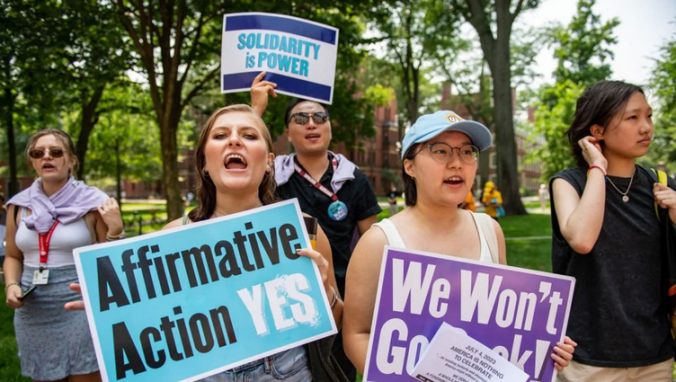
The tweet above has “gone viral” with its seemingly approving statement of the underlying arguments being raised in protest of yesterday’s SCOTUS decision ending affirmative action in universities. Conservative pundits and wags are using it to mock the hypocrisy and racism of progressives, some apparently believing the tweet is sincere, others believing it is satire but treating is as genuine anyway. The low-IQ quadrant of Woke World like the tweet because its denizens can’t detect its glaring idiocy; the smarter segment is outraged at the tweet’s blood-drawing power, and reacting like this:

Before I pose today’s ethics quiz question, here are a few things to consider:

Continue reading

Ethics Quote Of The Month: John W. Jenkins

“The University defends the truth,” says the Harvard logo. ‘The emblem shows respect for science, using only verified facts within the University’s walls and a willingness to defend the truth.’ Yet as it relates to climate change, the University has set aside obvious truths and brought together its five professional schools supporting the new “Save the Planet” religious dogma of the past decade.”

—Harvard M.B.A John W. Jenkins, in a letter to the alumni magazine protesting the University’s complicity in promoting “imprudent policies perpetuated on our populations by Green environmental activists whose view of history is only 20 years deep.”

Jenkins, whom I have thus far not succeeded in contacting, has authored one of the clearest and most persuasive debunking of current climatic change cant, and perfectly chastised our mutual alma mater, Harvard, for its cowardly and irresponsible alliance with an unethical and destructive movement. The author appears to be in his late eighties, and more skilled in communication than graduates half, indeed a quarter his age.

Harvard Magazine published his letter, but I am trying hard to believe it was a coincidence that its second half was difficult to locate due to a pagination error. I hope Mr. Jenkins does not mind Ethics Alarms re-publishing his entire statement. It deserves to be seen by as many people as possible. The whole thing is an Ethics Quote of the Month. Here it is:

Continue reading

A Student Wrongly Accused Of Rape Can Seek Damages From His Accuser, And Rightly So

Maybe this case helped convince Donald Trump that he should sue E. Jean Carroll, the victorious plaintiff in the sexual assault case against him, for defamation.

The Connecticut Supreme Court ruled 7-0 that a former Yale student is not immune from being sued for defamation by the male student she accused of raping her. Saifullah Khan was found not guilty in a criminal trial of raping “Jane Doe” in her dorm room in October 2015 in what Khan insisted, and a jury agreed, was an incident of consensual sex. Yale had expelled Khan using the “preponderance of the evidence” standard forced on educational institutions by the Obama Department of Education.

The court determined that because Khan had fewer rights to defend himself in university proceedings, which, again prompted by the Obama administration, provided limited due process protections, his accuser should not benefit from the civil immunity granted to witnesses in criminal proceedings. “Statements made in sexual misconduct disciplinary proceedings that are offered and accepted without adequate procedural safeguards carry too great a risk of unfair or unreliable outcomes,” the unanimous opinion held.

Continue reading

Ethics Observations On The LaGuardia Community College Graduation Incident

That video above is now the only YouTube available record of last week’s viral TikTok video showing Kadia Iman, a “social media influencer” and OnlyFans model who spiced up her graduation from LaGuardia Community College by forcibly taking the microphone from the school official announcing the graduates and using it to give her own defiant message. The video is also evidence that the representations made by Iman regarding the justifications for her behavior may not be exactly accurate.

In her own TikTok video of her attack, Iman is heard saying into the mic, “I want the mic! Let go! You didn’t let me get my moment!” Then she says “I’m graduating today. I don’t like how you snatched the mic out of my hand, so today is going to be all about me!”before dropping the mic and walking away. Later, she took to social media to explain why her “moment” was justified, saying,

“To everyone saying I should be embarrassed or I’ll never get a job … I’m a black woman in America. I am always in the right … u will not gaslight me into thinking I’m the bad guy. I did it for girls that look like me. Love u.”

She claimed that the white graduating students were given an opportunity to say their names, majors and a few other details while up on stage, but that she and other black students were not granted the same privilege by the white administrator, prompting Iman’s anger and violent reaction.

“Basically, what happened was I was walking on and we had to say our names before we get on the stage,” she said. “So I was saying my name and she literally — my name is long, obviously, I have like three syllables in my name. So, I didn’t even get to finish saying my name, and then the people that went before me, they all got to say their name, their major, and even extras,” Iman continued. “Me and another girl noticed that she was pulling down the mic super fast for some black people.”

“I’m not a problematic person, I don’t want to ruin no ones day, I don’t want to violate anybody, but that is what she did. She didn’t even let me finish speaking, she put the mic down and cut me off and that was the only chance I had to speak. I just feel that wasn’t right,” she concluded.

The school’s version, not surprisingly, is somewhat different.

Continue reading

Where Reporting Ends And Propaganda Takes Over: The NYT On Affirmative Action

Dominating today’s New York Times front page (above) is a report headlined “How It Feels to Have Your Life Changed By Affirmative Action” online and “Inside the Lives Changed by Affirmative Action” in the print version of the Times. The piece is naked and blatant advocacy for the Constitution- and U.S. law-violating policy that has been given temporary pass by a conflicted Supreme Court multiple times despite an unavoidable fact: it’s discrimination, and the Constitution doesn’t distinguish between good discrimination and bad discrimination. By the principles and values this nation was founded upon, all discrimination on the basis of qualities like religion, race, gender and ethnicity is wrong.

The Times approach to the subject is similar to its coverage of the illegal immigration controversy. In that matter, as periodically pointed out by Ethics Alarms, the Times has given readers frequent heart-warming tales of “the good illegal immigrant,” a hard-working immigration law violator who is the salt of the earth, a wonderful parent, and yet cruelly held accountable for his or her law-breaking anyway. The motive of such articles seems clear: use emotions to overcome and blot out law, ethics, fairness and common sense. As the Supreme Court seems poised to finally call college and university affirmative action programs what they are: illegal, the Times is trying to build support for its favorite party’s inevitable accusations of racism and illegitimacy against the five or six justices who will have simply done their jobs.

The headlines tell it all. Affirmative action changed the lives of its beneficiaries for the better, so obviously, affirmative action is good, and ending it would be unethical. What is striking about the article is that none of the affirmative action beneficiaries—all black—interviewed appear to have given a second’s thought to the individual whose opportunity they seized because of their “better” color. Some express regrets because they faced, or felt like they faced, skepticism about their degrees or career accomplishments because they were presumed to be “undeserving” affirmative action beneficiaries. None hint at any regret that someone who deserved to be accepted to an elite school or program was not so they could be.

Continue reading