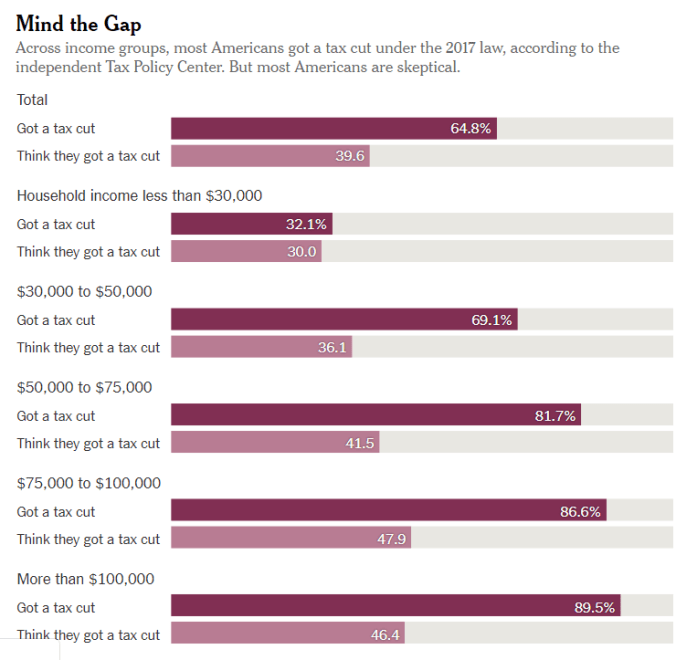
The chart above comes from the New York Times, which apparently decided that it’s safe to spill the beans now: the Trump tax cut really is a tax cut for most Americans. The ironic thing about the Times article, “Face It: You (Probably) Got a Tax Cut”
is that it reveals one of the more effective anti-Trump, anti-Republican Big Lies, this one being that the 2017 tax cut was really a sham, benefiting the rich while soaking the poor. The Times, in many ways, large and small, helped sustain that lie, with the results above. What is this? Is it like the amateur magician who has to reveal how his trick was pulled off? Is it the practical jokester who has to shout “It was all a gag!” so he can see your shock? You can almost feel the Times’s metaphorical chest swell with pride as it writes,
If you’re an American taxpayer, you probably got a tax cut last year. And there’s a good chance you don’t believe it. Ever since President Trump signed the Republican-sponsored tax bill in December 2017, independent analyses have consistently found that a large majority of Americans would owe less because of the law. Preliminary data based on tax filings has shown the same. Yet as the first tax filing season under the new law wraps up on Monday, taxpayers are skeptical. A survey conducted in early April for The New York Times by the online research platform SurveyMonkey found that just 40 percent of Americans believed they had received a tax cut under the law. Just 20 percent were certain they had done so. That’s consistent with previous polls finding that most Americans felt they hadn’t gotten a tax cut, and that a large minority thought their taxes had risen — though not even one in 10 households actually got a tax increase.
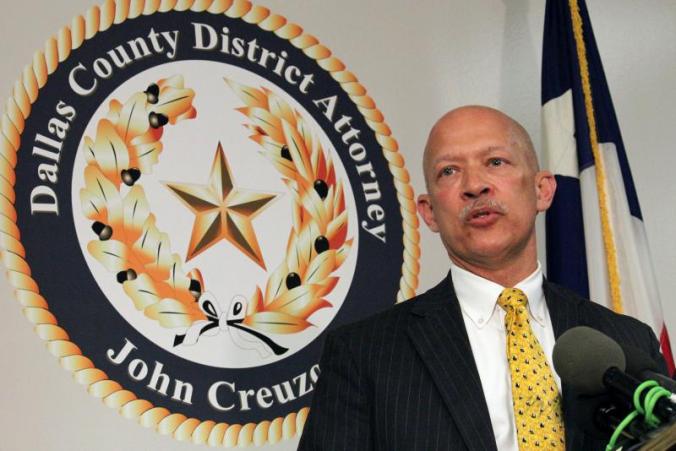
“Should All Thefts Be Prosecuted?” the headline asks rhetorically. Is the Pope Catholic? Does a bear…never mind, you get the point. Of course all thefts should be prosecuted, just like all laws should be enforced. It is a stupid question, and should be immediately recognized as such, yet, that headline goes on tell us, “Dallas County’s District Attorney Says No.”
Really? Then he is unqualified for office, an ethics corrupter, and a carrier of ethics rot. That DA—his name is John Creuzot–should resign, or be impeached. A prosecutor who doesn’t believe in enforcing laws is an unethical prosecutor, an untrustworthy prosecutor, biased and dangerous to society.
Creuzot has announced several measures of varying levels of justification and controversy to reform the justice system, which is certainly not without need to reform. However, one of them is unethical in multiple ways…
Study after study shows that when we arrest, jail, and convict people for non-violent crimes committed out of necessity, we only prevent that person from gaining the stability necessary to lead a law-abiding life. Criminalizing poverty is counter-productive for our community’s health and safety. For that reason, this office will not prosecute theft of personal items less than $750 unless the evidence shows that the alleged theft was for economic gain.
But perhaps a potential Democratic Presidential candidate…or Virginia Lieutenant Governor maybe?
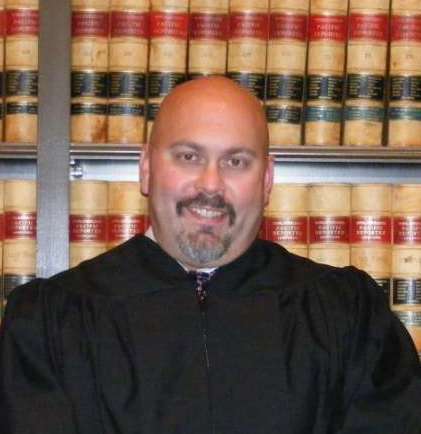
Judge Scott Gallina of Asotin County in Washington was arrested at the courthouse last week and charged with second-degree rape. He was also charged with fourth-degree assault with sexual motivation and indecent liberties, as described by a press release by Washington’s attorney general.
Eleven women claim that Gallina subjected them to varying degrees of sexual misconduct including unwanted touching and inappropriate comments. The women even adopted a buddy system so that no one would risk being alone with the judge in his chambers.
The rape charge involves a woman who told investigators that she didn’t report Gallina’s alleged conduct because she feared she wouldn’t be believed. She did complain to Judge Gallina, who said he “could not help it because he liked beautiful women.”
It’s funny: over at Ann Althouse’s blog, she’s complaining about how there’s nothing to write about. From an ethics perspective, I am finding too much to write about, especially since, unlike Ann, I still have to work for a living.
1. Quick: what does Patriots Day commemorate (and no, it’s not Tom Brady)? My home state of Massachusetts, Connecticut, Maine (which was once part of the Bay State), and Wisconsin observe the holiday, which honors the twin battles of Lexington and Concord, the confrontations with the British (on April 19, 1775, the day after “The Midnight Ride of Paul Revere”) that launched the Revolutionary War. I visited both battlefields more times than I could count when I was living in Arlington, Mass., right next to Lexington. That battlefield, what’s left of it, is in the middle of busy streets on all sides; it’s hard to imagine the scene as described in the song above from “1776.” Concord’s battlefield, in contrast, is almost exactly as it was in 1775.
All the publicity, even in Boston, about today will be dominated by the running of the Boston Marathon, but attention should be paid to the inspiring story of how ragtag groups of volunteers faced off against the trained soldiers of the most powerful country on Earth, sending the message that this rebellion would not be so easy to put down. 49 Colonists died, 39 were wounded, and five were unaccounted for. The British lost 73, while 174 were wounded,and 26 were missing.
2. It’s also Jackie Robinson Day. In every MLB game today, every player will wear Jackie’s number 42. The best way to honor Jackie for the rest of us is to tell his story to someone who doesn’t know who Jackie Robinson was, and it is shocking how many such people there are. The film “42” does an excellent job of dramatizing how Jackie broke the color barrier in baseball, simultaneously weakening segregation everywhere. The Ethics Alarms post about Robinson is here.Continue reading →
Pop quiz, Ethics Alarmers: if you worked for Nike, and learned that it was about to launch a new campaign promoting the brand’s Trail Running collection with this—“The Lost Cause…Because the lost cause will always be a cause worth supporting”—what would you do? I assume that most of you would immediately recognize that the Lost Cause, in American historical context, refers to the sentimental, romantic and troubling interpretation of the Confederacy’s defeat, in which slavery is recalled as a benevolent institution and the Civil War as a noble effort by the South to protect a civilization now “gone with the wind”—the title of the film which, coincidentally, I am watching as I type this.
The Boston Globe is the first newspaper I ever read, admittedly because it long had (no more, alas) the best sports section in the country. Even after fate took me away from my beloved home town and deposited me, apparently forever, in Washington, D.C., I continued to subscribe. Many times, notably when the paper’s special investigative unit blew the top off of the city’s deep and long-rotting child molestation scandal among its Catholic priests, leading to the exposure of the unimaginable world-wide scandal that went all the way to the Vatican, the paper validated my loyalty and admiration.
But political bias was always the Globe’s Achilles Heel. The editorial staff was a Kennedy family lapdog, and this metastasized into knee-jerk Democratic Party support even when it could not be logically justified. Eventually, it was obvious that the paper’s ethics alarms, if not dead, were barely pinging. in April of 2016, the paper suffered a crippling Donald Trump-sparked nervous breakdown, turning itself into a print version of Orson Welles’ “War of the Worlds.” It featured a phony front page —a portent of the fake news to come, but not just at the Globe—showing the dystopian future that awaited in the hopefully alternate dystopian universe where Trump was elected President:
So disturbed is the editorial staff of the Boston Globe over the nauseating threat of a Donald Trump presidency that it has jettisoned all established principles of journalism ethics in an embarrassing, self-destructive effort to “stop” him. Mark this down as one more wound on the culture that Trump has inflicted with his luxury ego trip, with the assistance of his irrational supporters, of course….
“This is Donald Trump’s America. What you read on this page is what might happen if the GOP frontrunner can put his ideas into practice, his words into action. Many Americans might find this vision appealing, but the Globe’s editorial board finds it deeply troubling,” the editor’s note reads. Then follows an editorial urging the GOP to stop Trump.
The editorial is fine. The Globe could have even chosen to place it on its real front page instead of creating a National Lampoon imitation and been well within journalism ethics standards. Publishing fake news stories about what a theoretical President Trump might do? This is a spectacular failure of professionalism and a journalistic disgrace. A newspaper is pledged to report the news, not imagine it. It is not ethically entitled to morph into Saturday Night Live or the Onion because it really, really, really feels strongly about an issue.
(Gee, I really called the news media’s eventual total abandonment of journalism ethics, didn’t I? Where are my bouquets? My Pulitzer?)
That was the end of my regular reading of the Boston Globe. This is the end of my regarding it as a newspaper. The correct term is “rag.” Come to think of it, that may be an insult to rags. Continue reading →
This is a Comment of the Day by Michael R. on what amounts to a provocative stand-alone post by JimHodgson. He wrote,
Yesterday I taught an ethics course for a group of thirty corrections officers at a local sheriff’s office detention facility, and will teach the same class tomorrow for a second group. The attendees ranged from veteran staff, with ten or more years of service, to recent hires just out of basic training. Ages ranged from early 20s to mid 50s. Due to medical/surgical issues I have recently been “out of the saddle” as a trainer for two years and had not taught this particular course for nearly four years. As we discussed ethical considerations in the corrections context, I was struck repeatedly by one thing: The older, more experienced officers, who one might have expected to be quite jaded about their role, duties, and in their outlook toward professional / occupational ethical issues, were instead the most thoughtful and consistent in their ethical logic as we dissected various scenarios and case studies involving the application of ethics -or the lack thereof, and they displayed the greatest understanding of ethical concepts and principles. Conversely, the younger and less experienced officers’ reasoning was tilted toward ethical contingencies and excuse-making, and in some cases the idea that “what is acceptable to my peers is ethical.” As I always do, I posed Michael Josephson’s somewhat rhetorical question, “How many times do you get to lie before you are a liar?” To my consternation, some of the younger people seemed to think that the answer could be quantified!
Of course, I have no delusions that any instruction by me can correct an adult’s ethical deficiencies, but I always endeavor to at least provide a fairly comprehensive summary of ethical decision-making principles and processes, the legal and ethical duties of the job, the standards of the institution, and the likely consequences for failing to meet those ethical and legal standards. Based on their responses, I was not encouraged about the future of many of those younger officers. I recalled my own daughter’s experiences with “character education” in school, and our many related discussions about character and ethics, and wondered if these young officers hadn’t shared that educational experience, being of about the same age. If so, I saw little residual evidence of it.
This particular detention facility is seriously overcrowded (nearly 25% over designed capacity), chronically understaffed (no staff positions added since the facility was at 60% of capacity), and has about a 40% annual staff turnover (mainly newer hires leaving for better-paying, less stressful jobs). A round of retirements about five years ago decimated the ranks of the most experienced staff. Over 50% of staff have less than four years experience. The corrections officer’s duties include a multitude of low-visibility discretionary decisions that often involve the use of coercive authority, and making ethical decisions is essential.
Here was Michael R.’s Comment of the Day in response: Continue reading →
Just took a post-seminar nap—one of the bennies of a hime business– counted philosophers jumping over a fence, and now I’m awake and ready to rumble…
1. Wow. The quality of posts on this morning’s Open Forum is off the charts. Now my self-esteem is crushed , since it’s obvious that I’m keep the group back with my mundane commentary. If you haven’t dropped in on the colloquy yet, I recommend it highly.
2. This is why we can’t have nice things, and will have fewer and fewer of them as time goes on…Related to a thread in the Open Forum, about a controversy over the way artificial intelligence screens job applicants is this news from a week ago. Google announced that it was dissolving a newly established panel. called the Advanced Technology External Advisory Council (ATEAC). which was founded to guide “responsible development of AI” at the tech giant (colossus/ behemoth/monster). The group was to have eight members and meet four times over the course of 2019 to consider issues and recommendation regarding Google’s AI program. The idea was to have an intellectually and ideologically diverse group to avoid “group think” and narrow perspectives.
I know something about such enterprises. I once had the job of running independent scholarly research within the U.S. Chamber of Commerce on contentious policy matters. My methodology was to invite experts from all sides of the issue, the political divide, and spectrum of professions and occupations. The method worked. Oh, we had arguments, minority reports, everything you might expect, but the committee meeting were civil, stimulating and often surprising. This, of course, requires an open mind and mutual respect from all involved. Continue reading →
(That’s Jimmy’s old vaudeville partner Eddie Jackson singing with Jimmy. Eddie was a one-trick pony and never destined for stardom, though he did appear in the Zigfield Follies. After Jimmy became a big star, he still kept Eddie on his payroll, well into Eddie’s old age. Introduced by Durante as his “partner,” Jackson would come strutting out midway through the live or TV show, singing “Won’t You Come Home Bill Bailey?” in his unremarkable voice. Sometimes Jimmy joined in, sometimes Eddie just strutted off stage to end the number. This courtesy went on for decades, until Eddie was too feeble to perform.)
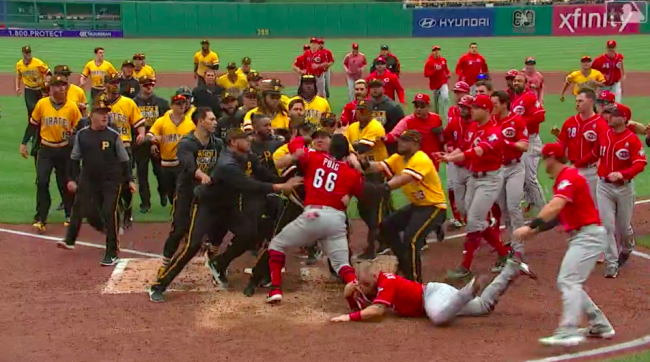
1. Baseball ethics: showboating. This happened yesterday…
Why? Well, Chris Archer, the Pirates pitcher, was peeved because the Cincinnati Reds’ Derek Dietrich hit a home run, dropped the bat, and stood stock still and stared at it as it left the field. This is known as showboating and showing up the pitcher; it’s a fuck you move. Archer retaliated in Dietrich’s next at bat by throwing a fastball behind Dietrich near his head, widely considered to be taboo as unacceptably dangerous. The fight ensued.
The episode raised questions about MLB’s controversial PR campaign with the slogan “Let the Kids Play!”, endorsing the flamboyant on-field celebrating and styling brought to the game by Latin players, Archer is one of the prime “playing” players, famous (or infamous) for dancing off the mound after a strikeout, kissing his arms, and other displays of self-admiration. Since that is his act, many, including me, feel that it is the height of hypocrisy for this pitcher to take offense when a batter treats him the same way he treats batters when he wins their duels.
On the other hand, what Dietrich did was the equivalent of taunting.
Exuberance is one thing, bad sportsmanship is another, and that’s what this was. The “kids”can play as long as they remember that real kids are watching and learning. I don’t think Roy Hobbs’ pennant-winning home run in “The Natural” was any less dramatic because he didn’t flip his bat, watch the ball go and pump his fist going around the bases.
2. Who’s the most unethical New York Times op-ed columnist? There are so many to choose from, but Michelle Goldberg is climbing fast. I highlighted her indefensible op-ed on the Mueller report recently, but I just stumbled an older column that was worse. In this one, Goldberg bemoans that Freedom House only give the United States an “86” score in ranking how democratic a nation is, dropping the US behind such places you wouldn’t want to live in like Croatia, Latvia, and Greece (Sorry, Yaya), and it’s all Trump’s fault. The score is down from 94 in 2009, when every international organization was hailing anyone and anything connected to Barack Obama, and using numerical scoring to measure something like democracy is obviously nonsense, unless the score furthers your agenda. This is similar to journalists calling organizations “hate groups” because the Southern Poverty Law center say so. It’s pure appeal to authority with an authority that has no credibility: a logical fallacy.
Does Goldberg persuasively explain why the U.S. is suddenly less democratic? Oddly, she doesn’t mention the collapse of a responsible, trustworthy press—sure that’s worth subtracting at least 12.38 points. She also doesn’t mention how the American Left has been trying for three years to undermine elections and the elected President , or as Victor Davis Hanson writes,
“Are such efforts in the future to be institutionalized? Will the Left nod and keep still, if Republicans attempt to remove an elected Democratic President before his tenure is up? Are appeals to impeachment, the 25th Amendment, the Emoluments Clause, the Logan Act, and a Special Counsel the now normal cargo of political opposition to any future elected president? Is it now permissible in 2020 for Trump’s FBI director to insert an informant into the campaign of the Democratic presidential nominee?”
What do you think, another—let’s see—18.47 points down? Goldberg doesn’t think so: she focuses on such things as Russiagate, though she nods that there have been some positive developments on that front: “Several of the criminals who helped Trump get elected either have gone to prison or soon will.”
Love it. Later Goldberg says that Trump’s attack on fake news somehow made other nations start censoring the news media there. That statement above is an outright lie. None of the individuals Mueller indicted had any role in “helping Trump get elected,” as we now know. But she writes that the report gives us two reasons to worry:
“The first is that it usually takes more than two years for a democracy to collapse. “Elsewhere in the world, in places like Hungary, Venezuela or Turkey, Freedom House has watched as democratic institutions gradually succumbed to sustained pressure from an antidemocratic leadership, often after a halting start,” the report said— an increase in corruption and a decrease in transparency — both hallmarks of this administration — are “often early warning indicators of problems in a democracy,” undermining public faith in the legitimacy of the system.”
What corruption is she talking about? The Secretary of State selling influence to foreign power through her fake non-profit? No, it can’t be that. An administration using its Justice Department to illegally try to sabotage an opposing party’s Presidential candidate? What about transparency? Even many liberal commentators say that Trump’s administration is more transparent than Obama’s. And who is undermining faith in the legitimacy of the system more than people like Goldberg, who support baseless Democratic conspiracy theories about a traitorous President and a stolen election?
And reason #2:
“Second, if Americans increasingly ignore Trump’s words, foreign leaders don’t. Authoritarianism is on the rise all over the globe — according to the Freedom House report, this is the 13th consecutive year that global freedom has declined. Trump’s presidency is a consequence of this trend, but it’s also become an accelerant of it.”
It’s the 13th consecutive year according to Goldberg’s dubious source, but Trump’s tweets the past two and a half years are really at fault.
Why is this “fit to print”?
3. If our democracy is failing, here’s one of the real reasons:
In Long Island, 11-year-old Bella Moscato said that she was going to choose the President for a sixth-grade assignment at Samoset Middle School to write about a personal hero. The teacher told her that President Trump was not an appropriate choice, and suggested–guess who!—Barack Obama instead.
Bella’s mother, Valerie Moscato says what the teacher did amounts to intimidation and censorship. Yes, and also indoctrination.
Sachem Central School District Superintendent Dr. Kenneth Graham issued a denial, saying,
It is not accurate that this student was told that they were not allowed to conduct research or report on any individual for a school assignment, including President Trump. To the best of our knowledge, by choice the student is still conducting their project of President Trump.
The school board is supposedly looking into the matter. The Moscatos want an apology, and if he is smart, the Superintendent will grab the chance to get off easy. That teacher, however, should be fired.




 Ethics Alarms
Here was Michael R.’s Comment of the Day in response: Continue reading →