Morning Ethics Warm-Up, 11/9/2018: Twitter Revelations

Good Morning!

I know I’ve been belly-aching about the decline in views on Ethics Alarms this year. There are a lot of theories, but one certainty: I’ve written fewer posts.  Beginning in July, I’ve had an unavoidable two-hour commitment during the work week that has compressed my schedule, and removed crucial time that would normally be used, in part, to create one or two additional blog commentaries. The task also left me fatigued and frequently caused time crunches with other projects. That commitment finally ends after today. I would celebrate, but I don’t have the energy.

1. Twitter bites Bill James. James, the free-thinking, courageous baseball iconoclast often credited with creating the discipline of sabermetrics, has been an inspiration to me for decades in his relentless commitment to banishing bias, majority beliefs and conventional wisdom from his analysis. (“Signature significance,” often mentioned here, is Bill’s term.) Yesterday, I learned that Bill was once again the target of fury within the baseball establishment (it doesn’t “get” Bill, and never will), this time because of a series of tweets he issued in discussing baseball with some followers.  Inspired by Washington Nationals free-agent outfielder Bryce Harper’s rejection of a 300 million dollar offer from his club, Bill was musing about the conventional wisdom that players. especially stars, are the reason people watch baseball. Among other tweets, he wrote,

“If the players all retired tomorrow, we would replace them, the game would go on; in three years it would make no difference whatsoever. The players are NOT the game, any more than the beer vendors are…The entire GAME is the product…We’re all replaceable, the players as much as the beer vendors. If they’re unhappy about that, talk to God about it; I don’t make these rules.”

This attracted the ire of the Players Association, which deliberately or  foolishly misconstrued what James was trying to convey. As a long-time reader of James’ work, I have seen this theme before. It’s a simple (but too complex for most players and broadcasters, essentially) proposition: even if the over-all quality of the players was reduced, the game being played would look and feel the same, its thrills, strange bounces and dramatic turns would be unchanged, the new, lesser players would yield new stars, and the popularity of the sport would not be significantly diminished. James makes such observations to jolt people out of comfortable assumptions, and force them to think. Too many people in baseball don’t want to think, or don’t know how. James also suggested that for a baseball player who was paid $3,000,000 a year to feel underpaid was ridiculous in some respects. Of course the Players Association and the players themselves couldn’t let that go without objection.

James is a consultant to the Boston Red Sox, and the team felt it had to reject James’ theories in this matter…mustn’t make the union mad, after all. The team wrote:

“Bill James is a consultant to the Red Sox. He is not an employee, nor does he speak for the club. His comments on Twitter were inappropriate and do not reflect the opinions of the Red Sox front office or its ownership group. Our Championships (sic) would not have been possible without our incredibly talented players — they are the backbone of our franchise and our industry. To insinuate otherwise is absurd.”

Of course, James never said that the game could be played without players.

To his credit, and typical of him, James took full responsibility for the mess. “I understand that the Red Sox are not in business to offend people, and certainly regret that I gave offense to anyone,” he wrote. That was clearly not an apology, nor was it intended as one. James has not retracted his statements. He has said that he should have been clearer. Speaking of his rebuke from the Red Sox, he said,

“I’m not offended. None of us in the organization — or, like me, sort of attached to the organization although not exactly in the organization — none of us should give offense unnecessarily. If I did that — and obviously I must have — it isn’t their fault; it’s mine. I do think that my remarks, taken in context, could not be misunderstood in the way that they have been. But it is pathetic for a writer to say ‘I’ve been misunderstood.’ Our job is to make ourselves understood.”

Yesterday, I heard one of the Sirius-XM Major League Baseball hosts ridicule the idea that a millionaire player shouldn’t feel underpaid, citing the salaries move and TV stars get. But James point, if anything, is more valid in reference to that industry. In my tiny corner of professional theater, I have encountered literally dozens of actors, actresses and artists who are as talented and accomplished as many, indeed most, of the stars who get paid multiple millions for their performances. If every film actor alive decided to emigrate to Denmark, it would take less than three years to replenish the talent pool. It would not even take one.  For the most part, he public goes to see good movies, not stars. Movies, not actors, are the product.

2. Just so you know that I’m a nice guy...A lawyer representing someone I criticized in a post from several years ago contacted me and asked if I would take the post down. His client, he told me, has been periodically contacted on social media by individuals who have read my post, and she is embarrassed by the episode I was writing about. The lawyer did not demand that I remove the post. He did not claim that I had defamed anyone; he conceded that I had published an opinion within my range of expertise, and that he had no grounds to force me to do anything. He just said that his client would be very grateful if I took down the post.

I checked the statistics. I rather liked the essay, but it had attracted few comments, no more than a hundred or so people had read it, and the topic was now moot. I took it down.

3. The Bad Guys (cont.) Matt Yglesias is an infamous left-wing pundit, and not a very bright one, in my experience. Naturally, he writes for Vox. In the wake of another leftist mob setting out to intimidate those with whom they disagree (Note: I will NOT take down a post if a mob outside my house demands it) Yglesias tweeted,

I think the idea behind terrorizing his family, like it or not as a strategy, is to make them feel some of the fear that the victims of MAGA-inspired violence feel thanks to the non-stop racial incitement coming from Tucker, Trump, etc….I agree that this is probably not tactically sound but if your instinct is to empathize with the fear of the Carlson family rather than with the fear of his victims then you should take a moment to reflect on why that is….I met a woman who didn’t leave the house for months because she was afraid of being picked up by ICE and never seeing her US citizen kids and husband again. What sense was there in terrorizing her family?…I honestly cannot empathize with Tucker Carlson’s wife at all — I agree that protesting at her house was tactically unwise and shouldn’t be done — but I am utterly unable to identify with her plight on any level.

The entire series is signature significance for someone with no ethical comprehension or bearings whatsoever. There is nothing here but bias and rationalizations, and no news  organization who employs such an ethically-handicapped writer can be trusted or taken seriously. Because an illegal immigrant is frightened of the fair and legal consequences of her own actions and choices, it is legitimate for a mob to terrify the family of conservative news commentator. Allow me to add intellectual bankruptcy to Yglesias’s undeniable maladies.

Now he’s deleted all of his tweets. Too late! We know you’re a vicious, biased idiot, Matt.

Evening Ethics Leftovers, 11/8/2018: Acosta, Beto, Tucker, And Claire

Good evening…

1.  The Jim Acosta Affair. I suppose my analysis of this hypocritical flap will surprise no one. No White House reporter who behaved as Jim Acosta did at the press conference yesterday would have been defended by his employers or other journalists. Dan Rather (with Nixon) and Sam Donaldson (with Reagan) were rude and confrontational (Funny how the only examples of journalists being disrespectful to Presidents involve Republicans–nah, there’s no mainstream media bias!), but nothing like Acosta was and has been. Imagine a journalist defying President Obama like that! It wouldn’t happen, but as with so much else, the rules are somehow different for President Trump.  This news media’s reporters have decided, consistent with the attitude of progressives and the “resistance,” to withhold even minimum respect and deference to the Presidency as long as Donald Trump occupies the office.

Acosta was not asking questions, but arguing his position with the President. That’s not his job, or his privilege. When the President told him repeatedly “That’s enough,” Acosta did not stop. That, all by itself, justified pulling Acosta’s credentials. The White House was foolish to concentrate on Acosta pushing the intern away. He had crossed the line before that; indeed, he had crossed the line of what the White House should require from a journalist many times before.

If Acosta apologizes to the intern and the President, and promises not to abuse his opportunity to ask questions at press briefings and press conferences, to exhibit a minimal level of respect, then the White House should give him another chance.

Commentators calling Acosta’s punishment a First Amendment violation should be ridiculed for the hypocrites they are. Ann Althouse points out that journalists were up in arms when  Trump’s campaign manager Corey Lewandowski was charged with battery for grabbing Michelle Fields, a reporter. The level of contact in the two cases is similar. “Either both instances of battery matter or neither does. Pick one,” says Ann. But there’s a problem that Ann somehow doesn’t see. She writes, “I found myself thinking that Trump and Acosta are both in control and choosing to do this theater of mutual hate.” Acosta and Trump are not equals, however. Acosta is obligated to give due respect to the President of the United States, but the converse does not apply. Continue reading

Ethics Observations On The Sessions Resignation And Reaction

In ethical, legal and Constitutional terms, there isn’t really very much legitimate controversy here. The key word here is “legitimate.” “The resistance” is trying its best to spin the issues and confuse the public—yet again. The news media wants to help. They have nothing.

—Attorney General Sessions should have resigned long, long ago. He debased himself by remaining in office. His boss, the President, was publicly abusive, and obviously did not want him to continue in the job.

—I cannot begin to express sufficiently my contempt for the dishonest and absurd argument that Sessions leaving office constitutes an “obstruction of justice” under even the most tortured interpretation of the term. A President can fire and replace his own Cabinet members; this was the issue that technically led to Andrew Johnson’s impeachment. Congress had passed a law (later ruled unconstitutional) that prohibited firing a Cabinet member without Congressional consent. The current theory is even more crack-brained than the claim that Trump firing James Comey, who was incompetent, devious and untrustworthy was obstruction. The “theory,” if you can call it that, is that replacing an AG who had a conflict of interest and had to recuse himself from an investigation is somehow sinister, because the new AG will actually be able to do his job, and supervise a Justice Department investigation.

—The investigation is officially about Russian interference with the 2016 election. Because the Trump campaign and its participants (not the Trump administration: this occurred before the election) might have been implicated or drawn into the investigation, Sessions, who was part of the campaign organization, had to recuse himself as a potential target, witness, or otherwise involved person, both for potential conflicts reasons and to avoid any appearance of impropriety. However, these do not apply to Sessions’ successor, much as Democrats and “the resistance” would want Mueller’s investigation to be completely without supervision by anyone approved by the President.

—There is no reason in the world why the acting AG, Matt Whitaker, should recuse himself from involvement in the Mueller matter. Claims to the contrary are made without grounding in law or ethics. Continue reading

The Unethical And Deliberately Misleading”Senate Popular Vote” Talking Point, Or “Why Is The Left Trying To Make The Public More Ignorant Than They Already Are? Oh, Come On! You Know Why…”

Look at those crazy shapes! GERRYMANDERING!!!!!

Progressives and the news media have decided that they don’t like the Constitution, so they are actively trying to confuse the public, which is depressingly easy.

We know Democrats and the mainstream news media hate the Electoral College and don’t view it as “legitimate.” The latest anti-Constitutional spin is that there is a national “popular vote” that should rigidly dictate the party representation in Congress. Vox’s Ezra Klein suggested that a revolution was coming if the imaginary Congressional “popular vote favored Democrats and Republicans held the House, but that’s Ezra and Vox—I assumed that this was an aberration. No! The same wacked-out theory was all over social media. The concept is based on regarding the Democratic and Republican Parties as Borg-like hives, with there being no legitimate distinction between on party candidate or another, as if no voter actually cares about experience, character, the record, skills, or any of those minor matters. Party is All.

I hate to keep pointing out that the Left is behaving, speaking and thinking increasingly like totalitarians, but the Left is behaving, speaking and thinking increasingly like totalitarians. Here’s what one of my Facebook friends, a lawyer and pretty openly a militant socialist, wrote yesterday (in part):

If you are on the left, fight for your ideal candidate in the Democratic primary and then vote Democrat in the general. The primary is the time for “who should represent the left in this election.”The general is the time to support the left over the right.

I don’t care if that nominee is “too far left” (Gillum) or “too centrist” (Sinema or McCaskill) or just “not exciting enough.” In every general election in the United States there are two candidates who have a chance to win. The Democrat is on the left, the Republican is on the right.

There is never a situation in which the agenda of any self-identified progressive or liberal or marxist or socialist or lefty or whatever is advanced by a win by the Republican. Never.

As anyone who has read Ethics Alarms for any length of time knows, I reject that argument absolutely. It is unethical, flat out. The agenda of our representative democracy is to have qualified, dedicated representatives and leaders whose judgment we can trust. It is, however, a nice summary of how someone can rationalize voting for people like Hillary Clinton, Bob Menendez, Nancy Pelosi and Maxine Waters. Or Jack the Ripper, as long as he ran as a Democrat.

But I digress. Totalitarians can only prevail by misleading the public, and so the “popular vote” confusion is apparently deemed worth promoting. ABC’s News’s Matthew Dowd brought up the fact that more ballots were cast in favor of the total number of Democratic candidates than Republican candidates running for U.S. Senate. That’s a nice piece of meaningless trivia, but he raised it as if it meant something. It doesn’t, but “The View’s” Joy Behar—remember, this woman has a daily platform to spout her analysis of news and politics—finished Dowd’s thought by saying, “Because of gerrymandering.” Continue reading

Question: You Are Offered 300 Million Dollars To Do What You Want To Do Where You Say You Want To Do It For The Next Ten Years. Why Would You Say, “No”?

This, we recently learned, is exactly what Washington Nationals outfielder Bryce Harper, 25, did when his team, the Washington Nationals, made him such an offer at the end of the 2018 season.

Harper has frequently stated that he loves playing in Washington, and would like to continue his career there. He is also regarded as the most valuable baseball free agent since Alex Rodriguez entered free agency almost 20 years ago and received a record contract. (You know what happened to him, right?) His agent, Scott Boras, has said in the past that a realistic target for Harper on the open market is $400,000,000, and most experts thinks Boras is nuts.

I see only three possible explanations for Harper turning down the Nationals offer: 1) He’s an idiot, 2) he is getting irresponsible and conflicted advice from his agent, or 3) he was lying when he said he wanted to play in D.C.

If your answer is “4) He’s greedy,” I submit that this is indistinguishable from #1. I defy anyone to explain how their life is enhanced in any way  by making 40 million a year rather than 30 million. Harper has no children, but since “I’m doing this for my kids” is the default rationalization used by players when they accept the highest bid,  I also defy anyone to explain how his theoretical children would have significantly better or different lives if Daddy makes an extra 100 million over the next 10 years—especially since another mega-million dollar contract will probably come into play after that. Continue reading

Election Day Ethics Warm-Up, But Mostly What Yesterday’s Warm-Up Would Have Been If My Whole Day Hadn’t Spun Wildly Out Of Control…

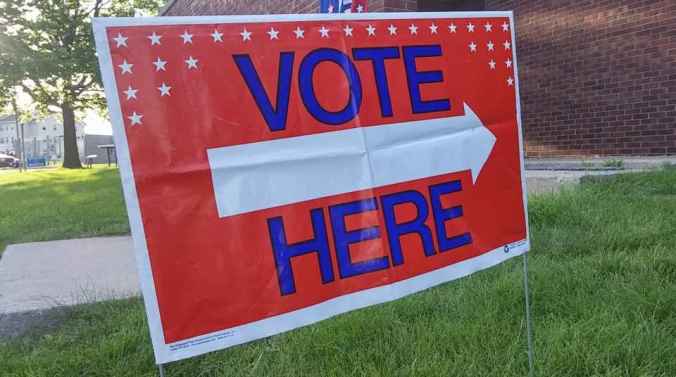
Good Morning, Voters!

1. From the “bias makes you stupid” files. Yesterday two smart, once reasonable Massachusetts lawyers of the female persuasion debated me regarding the appropriateness of Dr. Blasey Ford’s late and unsubstantiated hit on Brett Kavanaugh. They were obnoxious about it, too, rolling their eyes and giggling to each other at my position, with one saying that I sounded like her “Southern friends.” I like them both, but a better example of how bias makes you stupid could hardly be devised. Their primary reason why Blasey Ford’s suddenly recalled trauma from the distant past should have been allowed to smear a qualified nominee for the Supreme Court in nationally televised hearings was this: women and girls in those les-enlightened days had good reason not to report rape and sexual assault, as they often were not believed and because a “boys will be boys” attitude prevailed in the culture. Moreover, they said, almost in unison, women still have good reasons not to report sexual assault. “Do you have daughters?” they asked, “gotcha!”-style.

To anyone whose ethics alarms are in good working order and who recognizes the difference between an emotional argument born of gender and partisan alliances and a good one, the rebuttal is obvious and comprises a general ethics principle:

One person’s misfortune, no matter how tragic or unjust, never justifies being unfair or unjust to somebody else.

Accusing anyone of anything three decades after the alleged incident is unfair.

Publicizing an allegation that cannot be verified and for which there is no supporting evidence is unfair.

Using alleged misconduct as a minor to impugn the character  of an adult and a professional with an unblemished record of good conduct is unfair.

Dispensing with a presumption of innocence under any circumstances is unfair.

Dispensing with due process under any circumstances is unfair, because due process is itself fairness. (The two lawyers kept saying that this was not a trail so due process was not involved. The argument is either disingenuous or ignorant. Due process just means procedural fairness, in any context.)

Punishing one individual male for the fact that other males have escaped accountability for sexual misconduct is unfair-–and illogical.

Giving special considerations to one individual female because other females have been unfairly treated regarding their allegations is unfair—and illogical.

The two female lawyers kept saying that my position is a conservative one. It is not. It is not an ideological position in any way, though their position certainly is. May they regain intellectual integrity soon. And I forgive them for being so utterly insulting during our debate.

2. This is essentially a Big Lie argument from Vox: Ezra Klein, Vox creator, tweeted,

I don’t think people are ready for the crisis that will follow if Democrats win the House popular vote but not the majority. After Kavanaugh, Trump, Garland, Citizens United, Bush v. Gore, etc, the party is on the edge of losing faith in the system (and reasonably so).

An esteemed commenter recently accused me of being unfairly dismissive and insulting when a commenter dissents. That’s occasionally true but not generally true, and one circumstance where I may become dismissive and insulting is when a position is indefensible, like this one. It is either dishonest or so obtuse that no one capable of writing it down should be trusted again. Continue reading

Sunday Ethics Warm-Up, 11/4/2018 (Part II): Halloween Leftovers, Hot Yoga, And Polls

Today’s extended Warm-Up continues…

5. Halloween ethics left-overs:

  • Nah, there’s no Trump Derangement…In Hastings, Michigan, young Benny Drake wore a Donald Trump mask and costume around the neighborhood to solicit candy. At one house, the woman who answered the door threw candy at him and “asked me if she could slap me,” Drake said.

Benny should build a wall around her house.

  • Confession: I once wore a KKK-themed costume to a party. In Fort Smith, Arkansas, a Ku Klux Klan costume won a Halloween contest and a prize at the Lil’ Dude Tavern. After the photo of the costume “went viral,” the bar was attacked on social media and condemned by the local NAACP. A few points:

a) Many of the news media reports discussed the costume but wouldn’t share the photo with readers or TV viewers, presumably out of fear of upsetting some of them. This is incompetent and cowardly journalism, in the same category as writing about the Danish anti-Muhammad cartoons without showing them, or writing that an “epithet” set off a controversy without stating what the epithet was.

b) I assume the ethics issues here are the same as in the Hitler costume controversy, correct?

c) When I wore a KKK-themed costume decades ago, it was after a prominent white supremacist had been killed in a plane crash. KKK costumes always looked a lot like ghosts to me,  so I made a hybrid ghost-KKK costume and carried a travel case with the victim’s name on it and the airline’s sticker.  And I won a prize, too: for Costume in the Worst Taste.

  • I don’t understand this one at ALL.  In Vermont, a trick-or-treater received a bag of poop deposited in his candy bag. According to police, who investigated, it was just a mistake. How could something like that be a mistake? If the bag contained rat poison or an “explosive device,” would “Oops! Silly me!” still be an effective explanation? What if the kid ate the poop, and got violently ill? Same result?

Continue reading

Comment Of The Day: “Ethics Quiz: The Good Hoax?” (2)

rape-on-campus


I still can’t sleep.

This is the second Comment of the Day on this October 18 post, a surprise one for Pennagain, since I didn’t even flag it at the time. Again, I’m sorry. I don’t know what was up in October; it also ended with the worst traffic here of any week for more than two years. Obviously, it was a protest over my dilatory posting of the fine work by my commenters.

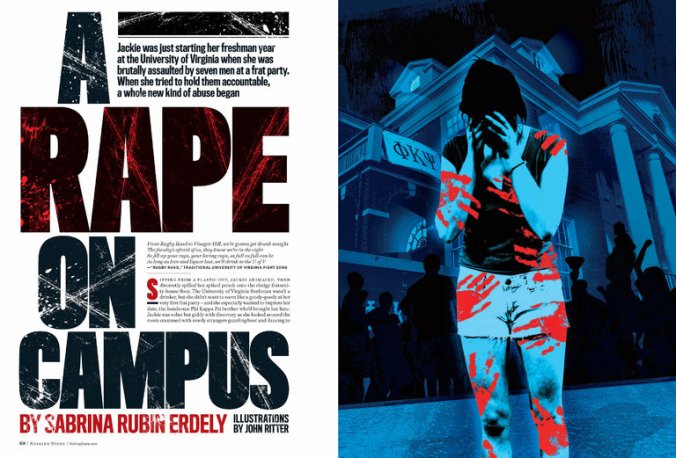
This one is a triple COTD, made up of three by Penn, who properly raised the specter of Samantha Erdly in the context of hoax research. Erdley is the Rolling Stone journalist who inflicted the “Jackie” tale of an imaginary gang rape at the University of Virginia, an earlier assault of truth and due process by the “believe all women” crowd. (Ethics Alarms covered the episode in a series of posts.). I just re-read Pennagain’s comments, made in a discussion with Alizia Tyler, who earns an assist. Excellent observations, and a valuable assist in making sure this journalistic outrage is never slipped down the memory hole, as so many would love it to be.

Here is Pennagain’s Comment of the Day on Ethics Quiz: The Good Hoax?:

As far as hoax articles appearing in either reputable journals or popular publications (rarely the same thing), if I weren’t an atheist, I would damn them all to hell. What I have in mind as an example that should need no further elucidation here is the piece knowingly published by Rolling Stone that included the false rape stories and statistics responsible for poisoning much of a culture, not to mention its politics….

“In November 2016, a federal court jury found Samantha Erdely was liable for defamation with actual malice” and that “Erdely and Rolling Stone failed to engage in “basic, even routine journalistic practice”

Her background reveals a start in college, when her colleague Stephen Glass ‘threw a righteous fit’ after she and a another student “concocted a funny and obviously made-up travel story” for the school magazine.” [Glass, you may not know, later became nationally notorious for inventing false stories published as factual journalism in the highly respected The New Republic, seriously harming its reputation.] Erdely was obviously already toxic before she left school. If you’re curious, her Wikipedia bio contains descriptions of six other major rape stories she invented out of whole cloth and used to smear real people and institutions, articles that in at least two cases went up for major journalism awards. As a self-appointed expert in rape and bullying, her work went into GQ, The New Yorker, Mother Jones, Glamour, Men’s Health, Philadelphia, among other lesser magazines. She was believed. The more she got away with, the greater the lies she invented … until, after twenty wonderful years of conning millions of people, she got over-confident and lazy, and plagiarized a previous article of her own. Until someone finally noticed that the Rolling Stone piece bore too many similarities to another one to be coincidental.

For twenty years, from Philadelphia to Los Angeles, Seattle to Florida, she built a reputation for being the go-to journalist on the subject of rape. No one doubted her. Witnesses later spoke out using her writing as statistical evidence — women (and so many men who had been falsely accused) and feminists in particular — had absorbed every precious word – even against the evidence of their own knowledge and experience in the times and places Erdely was writing about.

A month ago, September 21, 2018, Rolling Stone was also found “liable for defamation.” It was noted in the case against Erdely that the magazine hadn’t been doing too well before they glommed onto that gem of Samantha, aka “Jackie,” the fictional rapee.

Last week’s headline: WaPo Reporter Is Tired of Being Reminded He Fell for Sabrina Rubin Erdely’s Hate Hoax So Badly He Called for Burning Down UVA Frat Houses

I now amend my description of the poisonous piece: It is a “hate hoax.”

No, Alizia, poisons do not, in general, lead to death. They lead to minor discomfort in some, and major permanent damage in others; some knock you on your ass right away, and some creep insidiously into your brain over months or years. The public remembers things they read and hear. They (I won’t say “we” because I became skeptical reader at the age of 12 after a defamatory article was published in a local newspaper concerning a friend of my family concerning something that happened while I was present and knew to be a lie. I had been visiting one of their children, a classmate, at the time the incident took place, or rather, didn’t take place. My testimony was taken down, along with his, not discounted, but the editor of the paper would not print a retraction because, he said, “we don’t want to confuse our readers; they expect the truth, and that is what we give them.” Our parents wanted that in writing; naturally, he refused.

I am convinced that what is presented in a plausible manner from an authoritative source (which could be the 10 o’clock news or a magazine with a reputation for having its journalistic thumb on the pulse of young America) is frequently taken in without the auditor, viewer or reader later recalling the source. If they didn’t question it in the first place, they not only don’t question it later, but, when challenged, they will deny or dismiss any correction out of sheer embarrassment, egotism, mental laziness or, in the case under discussion, because they want to believe it.

As has been pointed out in Ethics Alarms before, the left, on the whole, has taken the anomalous position of being at once both victim and dictator. Thus, the concept of a Rape Culture is heaven for them: they are, collectively, the injured parties … and the ones who injure, including any who are capable of doing injury, are now at their mercy — via 30-year-old wisps of memory, anonymous join-the-conga-line #MeToo-ers, a casual touch on the shoulder, or a dirty-dirty word in their ears. They feed on lies more than on facts – the truths are painful, but the lies are more … emotional, memorable, dramatic, arousing . . . . They need to feed the addiction even when they know it is poison…

The fact in this matter is that Erdely, falsely or idiotically or crazily or not, believed she was doing something fine and high-minded “for women,” and to alert a deaf public (and via that route influence authorities) that there was “a rape problem” that needed to be addressed. In her mind, the ruining of a single man (or a whole college fraternity) was insignificant in terms of getting her message “out there.”

In other words, her cover (if you will) was in presenting these gross exaggerations as hoaxes. I may have taken you in the wrong direction by quoting the court decisions concerning malicious intent. The articles undoubtedly did “malicious” damage. So where am I? What Erdely believed (and apparently still does) has been shown to be shared by much of the public touched by it — including a proportion of men who don’t understand they are simply seeing themselves as heroic exceptions, or else thinking they are disguising themselves to live in the midst of an Amazonian tribe that wants to cut their balls off (that was an irrelevant side-bar, sorry, I do that a lot, letting off steam). Here’s what happens when someone with a cause and a vague concept of how bad the situation is gets hold of what she thinks are solid statistics, intended as a righteous hoax: https://www.realclearpolitics.com/video/2014/12/06/msnbc_panelist_we_live_in_a_culture_that_hates_women.html

I rest my case.

Comment Of The Day: “Ethics Quiz: The Good Hoax?” (1)

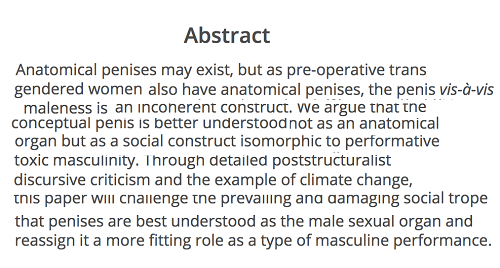
It’s 2:04 am…3:04, really but Daylight Savings Time has fallen…and I can’t sleep. I decided that it must be a guilty conscience for falling so far behind in posting Comments of the Day, so here is one of the more recent ones, Ryan Harkins on the question of whether deliberately fooling academic journals to show how vulnerable they are to  bogus research is ethically defensible. Another COTD will be along on the same post, but this one is by Ryan, on Ethics Quiz: The Good Hoax?:

Other professionals read the articles, and surveys of results are typical to show that there is a body of evidence supporting a particular conclusion. If a bunch of bunk is being passed off as good science, that feeds into further papers and can eventually influence public policy. This is especially true in softer sciences, where results are much murkier than than in the hard sciences, but even the hard sciences suffer from the problem.

The question is, how do you show that there is a problem in the peer review process, and that articles are being discarded because they don’t toe a party line, and articles are being accepted not on their merits but because they do toe the party line? You can’t write a good paper and show bias by having it rejected, because the rejection is supposed to be proof that the paper is bad. But you can deliberately write a bad paper, and if it is accepted, you can call foul because you can show you deliberately put together a bunch of garbage.

Is this ethical? I think it would certainly be ethical if the system were intentionally built so that some people were tasked with creating bogus papers to keep peer-reviewers on their toes. It is sort of like secret shoppers in the service industry. But we don’t currently have this built into the system. Is playing vigilante in this effort unethical, then? Continue reading

College Indoctrination: Like Water To A Fish

Over at Campus Reform, the conservative site dedicated to spotlighting left-wing bias on college campuses, reporter Grace Gottschling has been issuing some provocative, if not exactly surprising, reports on the partisan tilt of some schools’ administration and staff. There have been three so far. Most recently, she determined that 98.4 % of University of Missouri administrators and 97.6% of faculty donated to Democratic Party candidates or causes. Previously, her research covered the University of Oregon, where 100% of administrators, and 99.95%  of faculty have donated to Democrats—she found that a grand total $35.17, .0005% of the political contributions of 201 faculty members, went to Republicans—and the University of Texas, where the numbers were 96.1% of administrators, and 93.5% of faculty supporting Democrats.

Gottschling doesn’t say it–her reports just lay out the facts—so I will. It is impossible, literally impossible, for students to receive a balanced, objective and responsible education in institutions with such unbalanced and ideologically uniform campus cultures as these. Culture’s power over human beings has been accurately described as resembling water’s relationship to a fish: it influences everything in the lives of the people in it, often with their never being aware that they are dependent on it and controlled by its limitations. You can choose your own analogies, but active indoctrination into political beliefs and partisan values is hardly necessary when uniform attitudes are all around students, displayed in subtle and not-so subtle ways, every day, all day, in class and out. Continue reading