Morning Ethics Warm-Up, 2/21/18: Good Bye Billy Graham, Wise Words From Mike Rowe, And Learning To Say No To Children…

GOOD MORNING!

1 Billy Graham has died. Graham is one of those towering figures who outlived his fame, and now most Americans neither remember nor understand what he was and what he did. I will be doing a thorough post on Graham and his cultural impact, I hope. (Note that I haven’t even finished the 2017 Ethics Alarms Awards posts.) Like most of you, I bet, I had forgotten that Billy Graham was still alive until an episode of “The Crown” on Netflix prompted me to check recently. In that episode, based on a real event, a troubled Queen Elizabeth was inspired by hearing Graham in one of his speaking tours in Great Britain, and invited him to Buckingham Palace to advise her.

It was not Graham’s fault that his remarkable and broad popularity sparked the deplorable TV evangelist fad that created mega-churches, Jerry Falwell, Jimmy Swaggart, Pat Robertson, The Moral Majority, Jim and Tammy Faye Bakker, Jessica Hahn, and other frauds and swine that made much of America cynical about all religion.  On Google, Graham’s photo is lumped in with many of these if you search for “evangelist.” He deserves better.  In the high-profile evangelical world, Billy Graham was, as one article put it today,“an exception – a leader who valued integrity over ego, a husband who lived in a full and thriving marriage, a man who offered not only words to learn by, but a life to admire.”

2. Updates:

  • By almost a 2-1 margin, readers voted that accusing Wes Anderson’s animated comedy “Isle of Dogs” of cultural appropriation was even stupider than Joan Walsh’s repeated use of the politically correct  and hilarious “strawpersons” on CNN. I thought it would be a lot closer.
  • Michael West gets his name on a Comment of the Day the very first time it appeared on an Ethics Alarms comment, with such a thorough examination of the rationalizations and logical fallacies exhibited in the Times op-ed defending the Nashville mayor’s unethical conduct that I won’t have to write one. I thank him, and Billy Graham thanks him. The Comment will be posted later today, but you can also read it here.
  • However,  if you haven’t gone through the exercise of reading Margaret Renkl unforgivable Times op-ed with the Ethics Alarms handy-dandy list of rationalizations by your side, you really should. Stupidly, I forgot that the Times is behind a paywall, frustrating many of you. I posted half the op-ed on the post last night. Posting the whole thing would have been unethical, but half, with a link, is fair use.

3. “Children’s Crusade” news and commentary

  • I almost made the Florida legislature an Ethics Hero for voting down an “assault weapons ban” with a throng of students from Marjory Stoneman Douglas High School, who had lobbied for te measure, in the chamber. I don’t have strong feelings about the measure one way or the other, but it is crucial that all lawmakers resist this organized effort at emotional blackmail. I don’t care what the kids are advocating. Parents spend years explaining to their children that they can’t go through life believing that demanding what they want is going to magically succeed, and now adults and the news media are telling adults that if these students shout, curse and cry enough, they should capitulate. Naturally, the news media tugged at our heartstrings by showing high school girls weeping after the vote. There’s no crying in politics, kids, and the most emotional advocates don’t always win, because, as Abe said, you can’t fool all the people all of the time.

Get serious, or get out.

If I were a legislator, I would announce that I would automatically vote against any measure where children are used as lobbyists, spokespersons, advocates, or props. Continue reading

Morning Ethics Warm-Up, 2/3/18: On The Nunes Memo, The Times Flunks (Another) Integrity Check.

Cold Morning! I mean, Good Morning!

Anne Frank would still read The New York Times, I guess…

(Anne Frank belongs in the Ethics Alarms Heroes Hall of Honor. I will fix that with a post this month–she probably dies in February, 1945. Don’t let me forget.)

1 “But you know what I sometimes think? I think the world may be going through a phase… It’ll pass. – I still believe, in spite of everything, that people are really good at heart.” Or maybe not. I gathered up all my idealism and hope, and thought that maybe, just maybe, after the ugly and destructive lynch mob it has constituted for over a year to try to destroy the elected President, the mainstream news media, faced with incontrovertible evidence of frightening lawlessness and an attack on democracy by the previous administration in the midst of a Presidential campaign, would finally show some integrity and do its duty.

Then I read today’s New York Times.

The headline: GOP MEMO LEADS TO FRESH JOUSTING ON RUSSIA INQUIRY.

Unbelievable. That’s the news? That there is “fresh jousting”? The memo, as I accurately explained in the previous post, shows that the Obama administration’s Justice Department knowingly used opposition research, funded by Obama’s party and its Presidential candidate, that has substantially been discredited  by the FBI, the same agency that represented it to the court, as evidence justifying a FISA warrant against an American citizen and a member of the opposing party’s Presidential campaign and the Republican Presidential campaign itself.

I don’t see any mention of the Russian collusion investigation in that sentence, but that sentence still suggests a serious scandal involving abuse of civil rights and tampering with the election by law enforcement and a partisan Justice Department. If the so-called “newspaper of record” was objective and trustworthy, some version of that sentence would have been its headline, not an intentionally misleading headline stating that the “news” just is more political “jousting.”

Think about it: the Times is using a less interesting and provocative headline that the one that is justified by the facts. The only reason it would do this is misdirection born of a political agenda. No, Hanlon’s Razon does not apply here. This is not incompetence. This is malice.

2. “It’s really a wonder that I haven’t dropped all my ideals, because they seem so absurd and impossible to carry out. ” Then there the Times editorials. Two days ago, the Times editors wrote this:

“In a demonstration of unbridled self-interest and bottomless bad faith, the Trump White House and its Republican minions in Congress are on the cusp of releasing a “memo” that purports to document the biggest political scandal since Watergate. To pull it off, they are undermining the credibility of the law enforcement community that Republicans once defended so ardently, on the noble-sounding claim that the American public must know the truth.”

Again, unbelievable and yet too believable. Let’s parse this one:

“In a demonstration of unbridled self-interest and bottomless bad faith,”

The Times thinks it is bad faith to inform the American public of undeniable misconduct by the FBI and the Justice Department regarding civil rights and the Presidential election. Sure.

“…the Trump White House and its Republican minions in Congress are on the cusp of releasing a ‘memo'”

An ad hominem attack (“minions”), a partisan bias-based innuendo of dishonesty ( “purports to document”) and a dishonest use of scare quotes around “memo,” as if this wasn’t a memo. It is a memo.

“…the biggest political scandal since Watergate.”

A straw man trick, exploding an assertion into its most extreme form to knock it down. The facts are the facts, and how they are characterized by some is irrelevant to what the facts show. it may not be  “the biggest political scandal since Watergate” when a Democratic administration uses opposition research its party paid to have done to defeat a Republican Presidential candidate  to get court authorization to spy on that campaign during the campaign. You have to admit, though, that at least sounds a little like Watergate—Presidential campaign, administration interfering with the opposition campaign, dirt tricks, misuse of government power—no? Even a little bit like Watergate is bad enough, when government and law enforcement interference with Presidential campaigns is the issue.

“To pull it off, they are undermining the credibility of the law enforcement community that Republicans once defended so ardently, on the noble-sounding claim that the American public must know the truth.”

Pull what off? That’s another bit of rhetorical dishonesty implying wrongdoing by transparency, when  transparency is not wrongdoing unless it is illegal (Wikileaks, James Snowden). Then we have the cynical tack I just wrote about:

“The argument against the memo and the issues it raises, that the public revelations demoralizes our intelligence community and undermines the public’s support and trust is the same invalid logic being used to condemn criticism of the biased news media. If these institutions are not trustworthy and acting against the interests they are pledged to protect, then the public must know. If the conduct of the intelligence community shows that it isn’t trustworthy, there is nothing wrong, and everything right, about exposing it.”

How does the fact that the Republicans once defended the law enforcement community “ardently” change the appropriateness and necessity of  revealing wrongdoing they were not previously aware of? Finally, did I really read the New York Times editors mocking the proposition (“noble-sounding”) that “the American public must know the truth”?

What a disgraceful, shocking, self-indicting paragraph. Continue reading

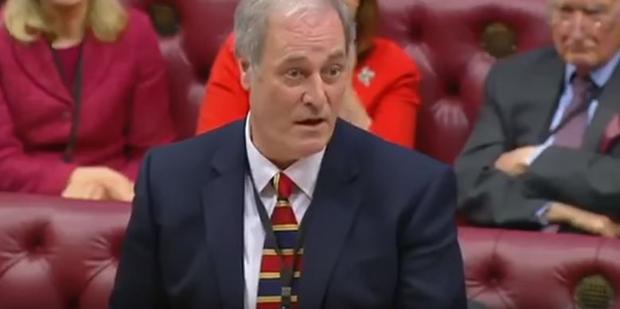
Ethics Hero: Lord Michael Bates

Lord Michael Bates, Britain’s international development minister, was set to answer questions before the British House of Lords on yesterday, but arrived to the session a few minutes late for his scheduled Q and A session. When it concluded, Lord Bates rushed  up to the lectern,  and said,

“It’s been my privilege to answer questions from this despatch box on behalf of the government. I’ve always believed we should rise to the highest possible standards of courtesy and respect in responding on behalf of the government to the legitimate questions of the legislature. I’m thoroughly ashamed of not being in my place and therefore I shall be offering my resignation to the prime minister with immediate effect.”

With that, he walked out of the chamber .

Bravo. Promptness and punctuality demonstrates respect for one’s colleagues and professional duties, and holding oneself to the highest standards of conduct is the epitome of ethical public service.

Afterwards, a spokesman for the Prime Minister said:

“With typical sincerity, Lord Bates today offered to tender his resignation, but his resignation was refused as it was judged this was unnecessary.As a hard-working and diligent minister, it is typical of his approach that he takes his responsibilities to Parliament so seriously. He has received support from across the House and we are pleased he has decided to continue in his important roles at the Department for International Development and HM Treasury.”

Dear Lord Bates: please come to America and run for Congress, They need you. We need you.


Morning Ethics Warm-Up,1/28/2018: Looking For The Silver Lining

Good Morning!

1 Phooey. This was one of those annoying weeks where the blog covered a lot of diverse topics (28 posts in the last 7 days), featured excellent comments, and was rewarded by a kick in the teeth. There was a big drop in followers, especially after the post about the Larry Nassar sentencing fiasco (I got slammed on Facebook, too.) That one is not open to legitimate controversy: the judge was unethical, the manner of sentencing did breach the Judicial Canons in Michigan and elsewhere, the length of the sentence was  disproportionate, and the parade of victims was a disgrace to the system. Never mind, though: he’s a monster and didn’t deserved to be treated any better by the judge, so good for her. No wonder trying to get people to reason using ethics tools and systems is so difficult. Most people default to emotion; some lawyers on Facebook even expressed that sentiment—“You go girl!”

It is such basic ethics, and so core to the justice system, that even the worst human beings deserve to be treated with the same respect and fairness as anyone else in the justice system. It is the bedrock of professional ethics that those with the job of protecting the public’s health, safety and welfare must be role models and eschew the passions and indulgences of the public they are pledged to serve. Yet people are frustratingly resistant to both concepts, giving lip service, pretending to understand, then  regularly bouncing back to rationalizations and mob reasoning like their values were on a bungee cord.

Silver Lining: It is satisfying to be 100% sure you are right in principle, even when, indeed especially when, you are getting beaten up for it.

2. And speaking of bitches…Contemporaneously with Hillary Clinton’s transparently cynical and damning response to the revelation that she responded to a campaign staffer’s complaint about sexual abuse by Hillary’s “spiritual survivor” in 2008 by transferring the accuser while keeping her advisor around (to harass others, it seems), she released a video…

…that began with the words, “And let me just say, this is directed to the activist bitches supporting bitches.” And thus we see how the Nation of Assholes is progressing. Somehow, I didn’t see the coarsening of the culture as Americans, as they always so, emulate the conduct of the President, extending to  Hillary Clinton, but why not? She has no integrity or ethics alarms. If she thinks going potty mouth will bring her money and power, why wouldn’t she ditch civility? The woman is first and always an ethics corrupter. Continue reading

Two Ethics Heroes : Media Critics Jeff Greenfield And Howard Kurtz


Maybe there are some cracks in the wall. God, I hope so.

Two media critics affiliated with major news organizations have recently come right out and stated what we have been talking about here on Ethics Alarms regarding the failure of journalists to observe core ethical standards in their commitment to bring down a President who horrifies them, and who has not taken his abuse lying down, as Presidential norms previously required.

The sharp contrast with Greenfield and Kurtz’s remarkable candor that marks most of their industry was on display today, as The Washington Post held a series of panel discussions and aired live video around the theme “Americans & The Media: Sorting Fact from Fake News.” One  segment featured Post political reporter Dan Balz, one of the Post reporters I would categorize as a straight-shooter most of the time, talking to PBS NewsHour anchor Judy Woodruff and Fox Special Report host Bret Baier. Woodruff’s comments were obtuse and depressing, but typical of most journalists and their defenders.

 BALZ: Judy you said something recently  I want to read to people: “You shouldn’t go into journalism if you want to win a popularity contest. If you’re doing your job, there are always going to be people who criticize your reporting. But we’ve never been at a place like we are today where there’s practically an entire industry around criticizing the media and holding the mainstream media up as suspect [ Balz didn’t read, but she also wrote, “and out to destroy an entire political philosophy in this country.” Well I said “most of the time.”]. I think the term ‘fake news’ has done a lot of damage to the media.” Describe the damage.

WOODRUFF: The damage is in the minds and the eyes of people who are consumers all across the country. And you see it in the polls. You see it in this [Knight Foundation] poll, a lessening of trust in the news media. I believe – it sounds corny, but I believe so passionately that a free press, free media, the role that we play, news media in our democracy, is part of what holds democracy together. And if enough Americans start thinking the press is not to be believed, that we are to be shoved to the side, regulated, or treated, controlled in some way, then I think we’ve got real problems. Even if it doesn’t get to that point, and they just don’t believe what we’re doing, then I think our democracy is weakened, and I think that’s what’s happening.

Got that? It’s the critics who are undermining the news media, not the unethical news media conduct that justifies the criticism! This quote is astounding. Journalists like Woodruff don’t see anything wrong with how they are doing their job, or rather not doing it. What harms democracy, Judy, is journalists behaving so unethically that the the public loses trust in them, not the criticism.

Now here are the two Ethics Heroes that do not parrot Woodruff’s defensive spin: Continue reading

The Unknown Ethics Hero Of The Hawaii False Alarm Fiasco

The story of the day was that this…

went out to cellphones across Hawaii on Saturday, setting off widespread panic .

Oopsie!  Nearly 40 minutes after it was issued, the Hawaii Emergency Management Agency cancelled the alert, which was a false alarm. The explanation was that somebody pushed the wrong button during a shift changeover.

“The public must have confidence in our emergency alert system,” the Aloha State’s governor, David Y. Ige, said. “I am working to get to the bottom of this so we can prevent an error of this type in the future.” Then, as he appeared on live TV answering questions from a reporter, a small, thin, middle-aged man standing with the governor said (I am quoting from memory),

“This was my responsibility. It should not have happened,  and we will be making sure this cannot happen again, and will make certain that a new system is installed that requires two separate human verifications before a warning is sent out.”

WOW! Continue reading

Grace In Disaster: Daniel Bard, Ethics Hero

It’s freezing, and I’m sick, so naturally my thoughts travel to warm summer nights at Fenway Park. Daniel Bard just retired. It gives me something different, and inspiring, to think about.

If you’re not a Red Sox fan or a dedicated baseball follower, you have no idea who Bard is. He was a relief pitcher, a set-up man, who could throw nearly 100 mph in the days, not long ago, when almost no pitchers did. Through August of 2011, his third major league season with Boston, Bard had appeared in 181 games with  a 2.42 ERA, and .186 batting average against him. The Red Sox went 123-58 in the games in which he pitched. In 186 innings, Bard struck out 202 of the batters he faced. A young man in his mid-20s, Daniel Bard could look forward to stardom, glory, celebrity, and millions and millions of dollars.  Then, suddenly in September of that year, he lost it all.

Nobody took special note, even though his ineffectiveness down the stretch was major reason for the epic Red Sox collapse that shook the franchise and led to the exodus of the team’s popular manager Terry Francona (now the very successful manager of the Cleveland Indians) and its boy genius GM, Theo Epstein, now the architect of the suddenly championship caliber Chicago Cubs. Bard was just tired, everyone assumed. There was no apparent injury; nothing had changed. But the next season, Daniel Bard couldn’t throw as hard consistently as before, and more alarming still, he couldn’t get the ball over the plate. Suddenly, he wasn’t a good or even a barely acceptable major league pitcher any more; indeed, he was a dangerous one, hitting a batter or two almost every inning, along with lots of wild pitches and walks.  By June, he was back in the minor leagues. Bard’s control got worse, and he sunk lower and lower into the low minors. Boston papers would report outings with unbelievable line scores: 2 innings, eight walks, four hit batters, five wild pitches, or worse. Bard tried surgery, meditation, mental coaches,, psychologists, changing his delivery.  He was still young, so team after team gambled that they could get him back to his All-Star form–Texas, the Mets, Pittsburgh, St. Louis and the Cubs. Bard kept trying, and failing. Continue reading

Ethics Hero: Orrin Hatch

Our political culture has come to a sad state when the simple act of retiring before obvious disability intervenes is an act of rare responsibility and courage. We are at that sad state, however, so the announcement by 83-year-old Utah Senator Orrin Hatch, the longest-serving Republican senator in American history, that he will not run for re-election in 2018 is worthy of salute. Hatch will leave the Senate at the end of his current term, after 42 years in office. He is giving up power, something so many find difficult to do.

Hatch has power now: he is the chairman of the powerful Senate Finance Committee.  He played a pivotal role in passing the Trump tax reform bill that passed  before Christmas, and decided that it was a fitting way to crown his historic Senate career. It isn’t exactly Ted Williams hitting a home run in his final at bat; for one thing, there is another year to go before Hatch’s term is up. Nonetheless, he is doing one of the hardest things for a p0werful figure to do, especially, it seems, today’s Senators in both parties,

More than half of the 18 Senators up for reelection in 2018 will be over the age of 65.  If they win, another six years in office would put Senators Feinstein, Nelson, and Sanders well into their 80s. By the 2020 elections, 21 of the 33 Senators running for reelection will be 65 or older. This is neither healthy for the country nor responsible, and the problem extends beyond the Senate. Over the past three decades,  the average age of a member of Congress has steadily increased. In 1981, the average age of a Representative was 49 and the average of a Senator was 53. Today, the average age of a Representative is 57 and the average of a Senator is 61.  House Democrats are especially antediluvian:  the average age of the Democratic House leadership is 72 years old, in contrast to the average age of Republican House leadership, 48 years. Continue reading

Ethics Hero: Texas Ranger Pitcher Cole Hamels

This has been a terrible year for Ethics Heroes. No, I don’t consider a sexual harassment or sexual abuse victim who comes out and accuses a man ten years after the alleged incident a hero. A hero would risk her own interests and welfare to protect all the potential victims over those ten years, by blowing the whistle before the harm to others, not after it. No, millionaire football players who engage in pointless and incoherent protests to turn what should be a unifying public event into a divisive one aren’t heroes either.

Maybe I need to do a post on all the phony “heroes” of 2017. There were a lot of them.

Cole Hamels, however, is a real ethics hero.  The 33-year-old Texas Ranger pitcher and his wife Heidi are donating  their 32,000-square-foot mansion and 100 acres of land in southwest Missouri to Camp Barnabas, a charity that provides camps for children with special needs and chronic illnesses. The Hamels’ gift is valued at $9,418,400.

In the statement,  the athlete said that he became committed to the mission of  Camp Barnabas as he learned about the charity. “Seeing the faces, hearing the laughter, reading the stories of the kids they serve; there is truly nothing like it,” he said. “Barnabas makes dreams come true, and we felt called to help them in a big way.” Continue reading

Ethics Hero: C. J. Hopkins

Imagine a hard-left satirist with the perspective, courage, integrity and skill to perfectly skewer the outrageous conduct of Democrats, progressives and “the resistance” since Nov. 8, 2016, accurately explain what’s so foolish and dangerous about it, and to still be funny in the process. You have just imagined C.J. Hopkins, an expatriate American writer who deserves a round of Hallelujahs from anyone who doubted that there were still clear thinkers on the left end of the ideological spectrum, and that the only kind of satire that could survive the Trump Presidency involved Alec Baldwin.

I read Hopkins’ essay “The Year of the Headless Chicken” out loud to my wife, and we were both sick with laughter mid-way through. Congratulations and gratitude are also due Counterpunch, a progressive website that ran it.

Just a sample to whet your interest… Continue reading