Ethics Night on “American Idol,” As An Ethics Hero Is Born

Ethics Hero, Scotty McCreery

“American Idol’s” group portion of its winnowing process always is the most fascinating chapter of its yearly saga, as the singing competition briefly shifts into full reality show mode. I’ve never been convinced that it was a fair method to judge aspiring singers who were competing as solo acts, as it frequently results in superior vocalists being dumped because they couldn’t sing harmony, learn choreography and lyrics under pressure, or play well with others. I know you have to get that mass of ambition and ego reduced to 24 people somehow, but group day is the equivalent of throwing darts at a dartboard.

It makes for great ethics scenarios, though. The format guarantees it, as the contestants have to form groups of four or five in a cruel process reminiscent of choosing sides for pick-up baseball games, guaranteeing that some people will end up feeling like the fat kid who always gets chosen last, if at all.

Last night there were several featured ethics dramas, with the judges, as they have been all season, being less than consistent in their responses to them. Continue reading
Comment of the Day: Ethics Quiz: “The Cabbie and the Jewelry”…Ethics or Pragmatism?

Karl Penny puts the perfect topping on this post, about the praise being heaped on the NYC cabbie who returned $100,000 in jewels to an absent-minded fare, when he could have made a dash for the Bahamas. I obviously couldn’t say it better myself, because I didn’t.

Here is Karl, a long-time and cherished reader, on Ethics Quiz: “The Cabbie and the Jewelry”…Ethics or Pragmatism?

“Well, it would be a pretty swell world if everyone did the right thing in cases like these, simply because it never occurred to them to do it any other way.  But that’s not the world we live in.  But, in either type of world, people like Mr. Jalloh should be highly praised:  in the world as it is, because he becomes an exemplar of the way things should be; and in the better world, because virtue never goes out of style and should be reaffirmed whenever an example of it occurs.”

Ethics Quiz: “The Cabbie and the Jewelry”…Ethics or Pragmatism?

Cable news, the New york press and the blogosphere are singing the praises of Big Apple cabbie Zubiru Jalloh, who, when he discovered that an absent-minded passenger, John James, had left a bag containing about $100,000 worth of jewelry in his back seat (“Doh!”) of his cab, rescued the bag from the next passenger, took it home for safekeeping, and eventually got it back to its rightful owner. Continue reading

Ethics Hero: New York Courts

Bravo!

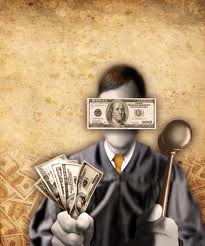
New York’s court officials have decided to bar New York’s elected judges from hearing cases involving lawyers and others who make major financial contributions to their campaigns. The New York Times reports that the new rule of the state court system will be announced this week by Jonathan Lippman, the state’s chief judge. “It is believed to be the most restrictive in the country, bluntly tackling an issue — money in judicial politics — that has drawn widespread attention,” said the paper.

The new rule decrees that “no case shall be assigned” by court administrators to a judge when the lawyers or any of the participants involved donated $2,500 or more in the preceding two years. Continue reading

Ethics Hero:Wake Forest Baseball Coach Tom Walter

Kevin Jordan and his kidney donor

Athletic team coaches habitually refer to their teams as “families”, but in the inspiring case of Wake Forest baseball coach Tom Walter, he meant it. When he found out that one of his players, freshman Kevin Jordan, was in serious peril because of failing kidneys, and that the student’s family couldn’t supply a safe match for a life-saving transplant, Morgan gave the young man one of his own.

You can read about Walter’s gift at Baseball America here and on Ethics Bob here.

Ethics Scoreboard Flashback: “Death on Everest”, a Real Life “What Would You Do?”

[ The discussion in the earlier post today regarding ABC’s revolting “What Would You Do?” convinced me that I should re-post this essay about a real-life “What Would You Do?”tragedy, which originally appeared on The Ethics Scoreboard in 2006.  Entitled “Death on Everest,” It has been lightly edited to bring it up to date.]

As 34-year-old mountaineer David Sharp lay near death on Mount Everest, over 40 other climbers trudged past him on their march to the peak. All had oxygen with them, and a few even stopped briefly to give Sharp a few breaths. But still they climbed on, and Sharp perished. His demise on May 15, 2006 has gone into ethics lore alongside the infamous death of Kitty Genovese on March 13, 1964. Genovese was murdered outside her apartment building in Queens while thirty-eight neighbors watched and did nothing.
The two incidents stem from very different causes, however. While Genovese’s death was fueled by urban fear and apathy, a mass failure of courage and the willingness to assume responsibility in a crisis, Sharp was the victim of that universal ethics-suppressant, the powerful non-ethical consideration. Continue reading

Ethics Hero: Marvin Kalb

The so-called mainstream media have an obvious leftward political bias, and have had for decades. Either disingenuously or naively, publishers, editors, network heads and reporters deny this, although the evidence is overwhelming. Sometimes, as when supposedly objective reporters are openly adversarial to conservatives while covering news events and there is no discipline by their bosses, the evidence is also embarrassing.

Fox News, which was launched to counter balance this tendency, has at least been relatively open about its conservative slant: “fair and balanced” was always intended to convey Fox’s efforts to balance the scales, not to suggest that Fox News by itself was balanced.

Nonetheless, it is rare to see any of the liberal-oriented news organizations, even the most undeniably biased of them, like NPR, admit its objectivity problem—never mind surveys that show that journalists are far more liberal than the U.S. population, and regardless of the media’s repeated tardiness in covering legitimate “conservative news stories” like the New Black Panthers controversy and the ACORN “sting”( CNN, ABC, CBS and NBC are in the process of ignoring the similar Planned Parenthood videotapes). The journalistic establishment has closed ranks on this issue, consistently arguing that the “myth” of liberal bias arises from a right-biased perspective.

Thus it was striking and refreshing to see Marvin Kalb, a member-in-good-standing of the liberal journalists’ club confronting the most prestigious and perhaps the most egregious of left-biased media, The New York Times, with the truth it routinely denies. Continue reading

Ethics Hero: Gil Meche

[ Finally reduced to hunt-and-pecking blog posts from an Arlington, VA. Starbucks as the result of a still-ongoing power outage at the Marshall home-office, I apologize for an uncharacteristically quiet day.]

All Kansas City pitcher Gil Meche needed to do to collect $12 million in 2011 was to show up, do his best to pitch—which his ailing right arm would no longer permit him to do—and cash the checks. But despite having an iron-clad contract (the last in a long-term deal he signed as a free agent), Meche decided to retire, thus ending the contract and forfeiting the money. Continue reading

Blood Libel Ethics and the U.S. News Media’s Integrity Dead End

First you make a baseless, inflammatory accusation–the Big Lie. Then you attack your victim for how she responds to it.

The news media’s self-destructive obsession with discrediting Sarah Palin has reached its ethical nadir, and with it any reasonable hope that U.S. journalism, as currently practiced, will be returning to credibility and respectability within the foreseeable future. Continue reading

Ethics Hero: John Green

Appearing on the Today Show, John Green and his wife Roxanna were asked about their feelings about the tragic death of their daughter Christina, age nine, at the hands of Tucson shooter Jared Loughner.

John Green, grieving father, replied:

“This shouldn’t happen in this country, or anywhere else, but in a free society, we’re going to be subject to people like this. I prefer this to the alternative.”

With his last six words, he established himself as superior in mind, principles and character to all of the unscrupulous commentators and devious politicians who have attempted to use this terrible tragedy to stifle dissent.

John Green leaves all of us wondering if we could summon such perspective, rationality and nobility under similar circumstances.