Ethics Lyrics of the Year: “Is a Puzzlement” From “The King and I”

Lyricist Oscar Hammerstein Jr. had many moments of great ethical clarity, as did his pupil and protege, Stephen Sondheim. I don’t think either topped this song, however, from the 1951 Rodgers and Hammerstein musical, “The King and I.” I’ve highlighted the key sections.

When I was a boy,
World was better spot.
What was so was so,
What was not was not.

Now I am a man—
World have change a lot:
Some things nearly so,
Others nearly not.

There are times I almost think
I am not sure of what I absolutely know.
Very often find confusion
In conclusion I concluded long ago.

In my head are many facts
That, as a student, I have studied to procure.
In my head are many facts
Of which I wish I was more certain I was sure!

[spoken]
Is a puzzlement. What to tell a growing son?

[sung]
What, for instance, shall I say to him of women?
Shall I educate him on the ancient lines?
Shall I tell the boy, as far as he is able,
To respect his wives and love his concubines?

Shall I tell him every one is like the other,
And the better one of two is really neither?
If I tell him this, I think he won’t believe it—
And I nearly think I don’t believe it either!

When my father was a king,
He was a king who knew exactly what he knew,
And his brain was not a thing
Forever swinging to and fro and fro and to.
Shall I then be like my father
And be willfully unmovable and strong?
Or is better to be right?
Or am I right when I believe I may be wrong?

Shall I join with other nations in alliance?
If allies are weak, am I not best alone?
If allies are strong with power to protect me,
Might they not protect me out of all I own?

Is a danger to be trusting one another,
One will seldom want to do what other wishes…
But unless someday somebody trust somebody,
There’ll be nothing left on earth excepting fishes!

There are times I almost think
Nobody sure of what he absolutely know.
Ev’rybody find confusion
In conclusion he concluded long ago,

And it puzzle me to learn
That though a man may be in doubt of what he know,
Very quickly will he fight,
He’ll fight to prove that what he does not know is so!

Oh-h-h, oh-h-h!
Sometimes I think that people going mad!
Ah-h-h, ah-h-h!
Sometimes I think that people not so bad!

But no matter what I think
I must go on living life.
As leader of my kingdom I must go forth,
Be father to my children,
And husband to each wife—
Et cetera, et cetera, and so forth.

If my Lord in Heaven, Buddha, show the way,
Ev’ry day I try to live another day.
If my Lord in Heaven, Buddha, show the way,
Ev’ry day I do my best for one more day,
But…
Is a puzzlement!

It sure is.

Random thoughts:

Unethical Quote of the Week: Miriam Pawel

“What has made the University of California exceptional is its commitment to increase access without sacrificing excellence. In recent years, California has proudly defied a national trend: On average, about 40 percent of its students are the first in their families to attend a four-year college. More than half qualify for free tuition. The percentages of underrepresented students have crept up, through a variety of initiatives. The California Dream Act gave undocumented students access to financial aid, as well as in-state tuition. Students on University of California campuses may struggle with basic math, but they are graduating at record rates.”

—-Woke book author and writer Miriam Pawel, in a gobsmacking op-ed (gift link) in the New York Times.

You might think that I am being unfair, that the quote above is obviously taken out of context. Surely, surely, such a paragraph must be preceded by a convincing set of statistics proving that indeed the University of California system has not sacrificed excellence in its quest for “access” [Translation: “Diversity, Equity and Inclusion”].

Nope. There is nothing. This woman, marinated in progressive cant her whole adult life, truly believes that DEI is excellence. Not knowing how to read, add, reason or write. The diploma is the sole benefit and the sole objective. That the diploma falsely conveys the belief that its holder actually is competent, responsible, knowledgeable, skilled and accomplished doesn’t matter to Pawel. “Students on University of California campuses may struggle with basic math, but they are graduating at record rates,” she writes. “The percentages of underrepresented students have crept up, through a variety of initiatives. The California Dream Act gave undocumented students access to financial aid, as well as in-state tuition.”

Yay.

Esteemed Progressive Law School Dean Boasts About His School’s Illegal “Good Discrimination” In Faculty Hiring. Surprised?

Ethics Observations:

1. These people cheat. They are proud of their cheating: it’s “the ends justifies the means” exemplified. This is a law school dean—at a prestige law school!— openly admitting and rationalizing violating the law.

2. He also says that he’ll lie under oath to deny what he said.

3.Dean Erwin Chemerinsky has a long and disgusting EA dossier (at the link) but is always—always, no exceptions—represented in the mainstream media as respected legal scholar. I don’t respect him: he’s an Ethics Villain, and undeniably so.

4. Notice that he says “diversity is important” but he never says why it’s important. This is just an article of faith with the Left. It is important because it just is, that’s all, and they say it is, so there.

5. I’m playing the Learned Judge tonight in a law school production of Gilbert and Sullivan’s “Trial by Jury” (1875, and as funny and sharp now as it was on opening night.) The Foreman of the Jury, a bass-baritone role, is being played by tiny female student, a soprano, who is inaudible and who can’t remember her entrances. She is easily the least able member of the chorus. Why was she cast in that role? She is the only “student of color” who auditioned, and the student organization has by-laws requiring “diversity” in casts. As a result, the show sounds worse, looks worse, all of the cast members who are qualified for their roles will get fewer benefits from their work and dedication as a result, the audience will enjoy the show less, and the exploited student, who is a very nice young woman, will be embarrassed in public. If I had to describe a perfect example of what’s wrong with DEI logic, I doubt that I could come up with a better one. Yet ideologues like Chemerinsky still use their authority to assure the world that discriminating against white males in pursuit of diversity is an “unalloyed virtue, as Gilbert might say.

6. Our cast—all of them (but me!) list their “pronouns” in their program bios— had a rehearsal in the faculty lounge. There are only two newspapers there for faculty perusal: The New York Times and the Washington Post. Nah, U.S. law schools aren’t Leftist indoctrination centers! What a ridiculous conspiracy theory…

7. Do let me know if any Axis news media outlet breathes a word of this incident. My bet: there won’t be any.

What Does AI Have To Do With President Trump? Oh, Just Nothing, But Don’t Ask The Trump Deranged…

I must credit Ann Althouse for pointing me to an August opinion piece by the New York Times’s NeverTrump fake conservative Bret Stephens (who wants to repeal the Second Amendment!). I guess I should check out the Times more often; it’s just that it is an enemy of the people, one of the worst, and I resent what the paper has done to American journalism and, as a consequence, our nation.

But I digress. The subject of Stephens’ August column, “I’m Begging You: Never Write With A.I.,” is that learning to write clearly and well is an essential human skill, and one that has important feedback. In addition to making communication between human beings better (more effective, more persuasive, more rational) writing also clarifies the writer’s thoughts, requires close examination of arguments, biases and assumptions, and, essentially, the more one writes, the more adept one becomes at life competence.

I agree with the theory, with a blazing caveat. Stephens is speaking from the biased perspective of one whose associates are all in the upper echelons of educated society, are well above average intelligence, and who work, play and live among the minority of Americans who read, have articulate conversations, and place a high priority on verbal interaction. My late wife and I would sometimes change our table at a restaurant because the conversation at a table next to us was so banal and inarticulate that we wanted to scream.

Military analysts have noted that one of the reason Ulysses S. Grant was such a successful general during the civil war was that his written orders were masterpieces of clarity, telling subordinate exactly what they had to do in straightforward prose. You can see that same skill in his autobiography, which Grant wrote in his final days while dying of throat cancer so his family could pay off his debts with the income from its sale. (Which it did. Mark Twain published Grant’s story.) Today, most students graduate from high school unable to write well, or even coherently. You learn to write by reading and writing; I had to compose five-page essays in the 5th grade, ten-page essays in the sixth grade, and up to 20-page compositions, (with footnotes!) in high school. I wrote a 116 page honors thesis as a senior in college. Later, when I was an administrator at Georgetown University Law Center, I was stunned to learn that GULC was admitting students who had never written a substantive paper at all.

I’m digressing again, but my point is that for, tragically, the majority of Americans, being able to let a chatbot turn their jumbled thoughts, flawed logic and infantile vocabularies into clear prose is a major boon for them and the people they are trying to communicate with. Is it likely to be great writing or even good writing? Not right now, it isn’t. I am working on a project that requires a clear web page to describe it, and the content I have seen was heavily dependent on AI. Nobody had to tell me that; it was obvious, and bot-writing usually is. And it’s bad.

However. the theme of this post is that Stephens felt that he had to somehow virtue-signal to the Trump Deranged. Here is how he ended the column:

Ethics Observations on the GOP Mid-Term Convention

I could write full posts about many of these, and if I had time, I would. The networks and the Axis want to ignore it and are trying to bury it in negatives, but the event is obviously news, and attention should be paid….

Observations:

1. Competence! If this was the President’s idea, it was a great one. The GOP has to get voters to the polls (or to mailboxes, if he can’t stem mail-in balloting). If the event picks up just one or two percentage points in Republican voter participation, it will have been a success. If Republicans hold Congress, I guarantee both parties will make this tactic a tradition.

Incidentally, adding a mid-term convention is another so-called “democratic norm” that Trump is violating. The Horror.

2. Fetterman! One of the two biggest stories to come out of last night’s opening of the convention was Senator John Fetterman’s surprise video appearance, shot in front of a steel mill. Fetterman praised and endorsed his fellow Pennsylvania Senator David McCormick, a Republican, and said that they would work together “and work with President Trump and defend the steel way of life.” This makes Fetterman the Ethics Hero of the convention thus far. It also tells Democrats that if they are going to try convict Trump after a House impeachment and try to pack the Supreme Court, they will need to flip an extra Senate seat to their side.

Unethical Quote of the Month: Lindsay Clancy Trial Juror Kellie Farina

“He had the hardest time getting off the fact that Lindsay viciously killed her children.”

—Kellie Farina, one of the three jurors interviewed following the mistrial called in the Lindsay Clancy murder case, after the jury deadlocked 11-1 with a single hold-out male juror refusing to vote for acquittal.

That may end up being an iconic unethical quote, one that echoes through the years as America comes to realize how shattered the values of American women have become in the wake of the Supreme Court’s overturning of Roe v. Wade.

The especially nice touch is the use of “viciously,” don’t you think? ‘Imagine, this idiot was somehow stuck on the fact that a mother murdered her three small children viciously! What’s the matter with him?’

I’d like to know what’s the matter with anyone who can “get over” the fact that three children were murdered by their own mother “viciously.”

Ethics Dunce: Sports Reporter Dianna Russini

I could teach a conflicts of interest course based on lessons spewing out from the recently-canned NFL reporter’s certitude that she did nothing wrong despite being caught canoodling with one of the sports figures she was charged with covering….objectively, independently. You know. Like all the other journalists do. <cough!>

Dianna Russini was the senior NFL reporter for The Athletic, which serves as the New York Times’ sports pages. She resigned last week after photographs “surfaced” of her hand-holding with and embracing Mike Vrabel, the head coach of the New England Patriots.

“While I can’t share the details of our investigation into Dianna’s conduct,” Steven Ginsberg, executive editor of The Athletic wrote to his staff, “I want to emphasize that the leadership of The Athletic has taken this matter seriously from the moment we learned about it.”

The publication’s editorial guidelines demand that its journalists avoid conflicts of interest or the appearance of a conflict. This is standard stuff, even though such prohibitions are too often weakly enforced, if at all. Remember Nina Totenberg reporting on Supreme Court decisions while she socialized with her pal, Justice Ginsberg? That violated NPR’s ethics code. Naturally, the brass ignored the breach.

This is Russini’s resignation letter:

More Ethics Notes On The Lindsay Clancy Case…

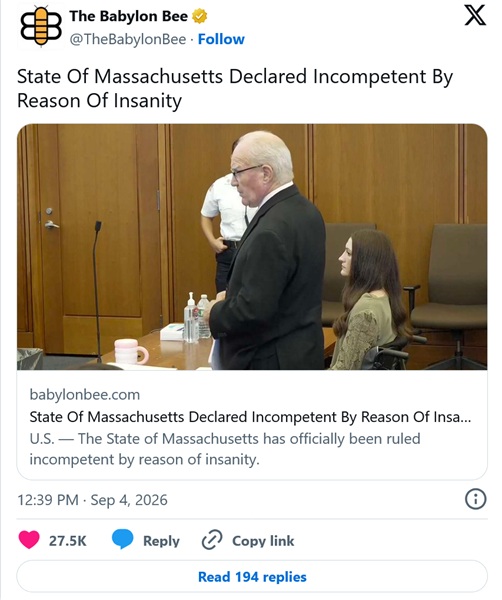
Things are not as simple as the Babylon Bee would have us think. Ethics Alarms already posted two essays on this case, here and here. The latter, a Comment of the Day by Tim Levier, concluded by describing the protesters and demonstrators thusly:

The Protestors / Defenders / Supporters – Providing financial and material support to someone with whom they have no prior connection.

These people are deranged and one has to question where they came from and who has time to commit to such folly at a time when everyone and their mother is complaining about the cost of things. Why would anyone protest due process? She’s making her case in a court of law and the fair process will play out resulting in a judgment. This isn’t an area for “opinions” and to influence an outcome. Its meddlesome and the act of a narcissist that believes in one’s own “greatness” or “importance” over that of an impartial judicial institution.

Clancy’s trial, presumably the first of two (at least), ended in a mistrial yesterday due to a hung jury. A single juror, widely believed to be one of the three men on the 12 juror panel, was apparently refusing to budge from his unshakable belief that the woman who has confessed to murdering her three children is guilty of murder. I dunno, that seems like a defensible verdict to me, but I wasn’t in the courtroom during the trial.

But I digress. Here are recent ethics-related developments and observations:

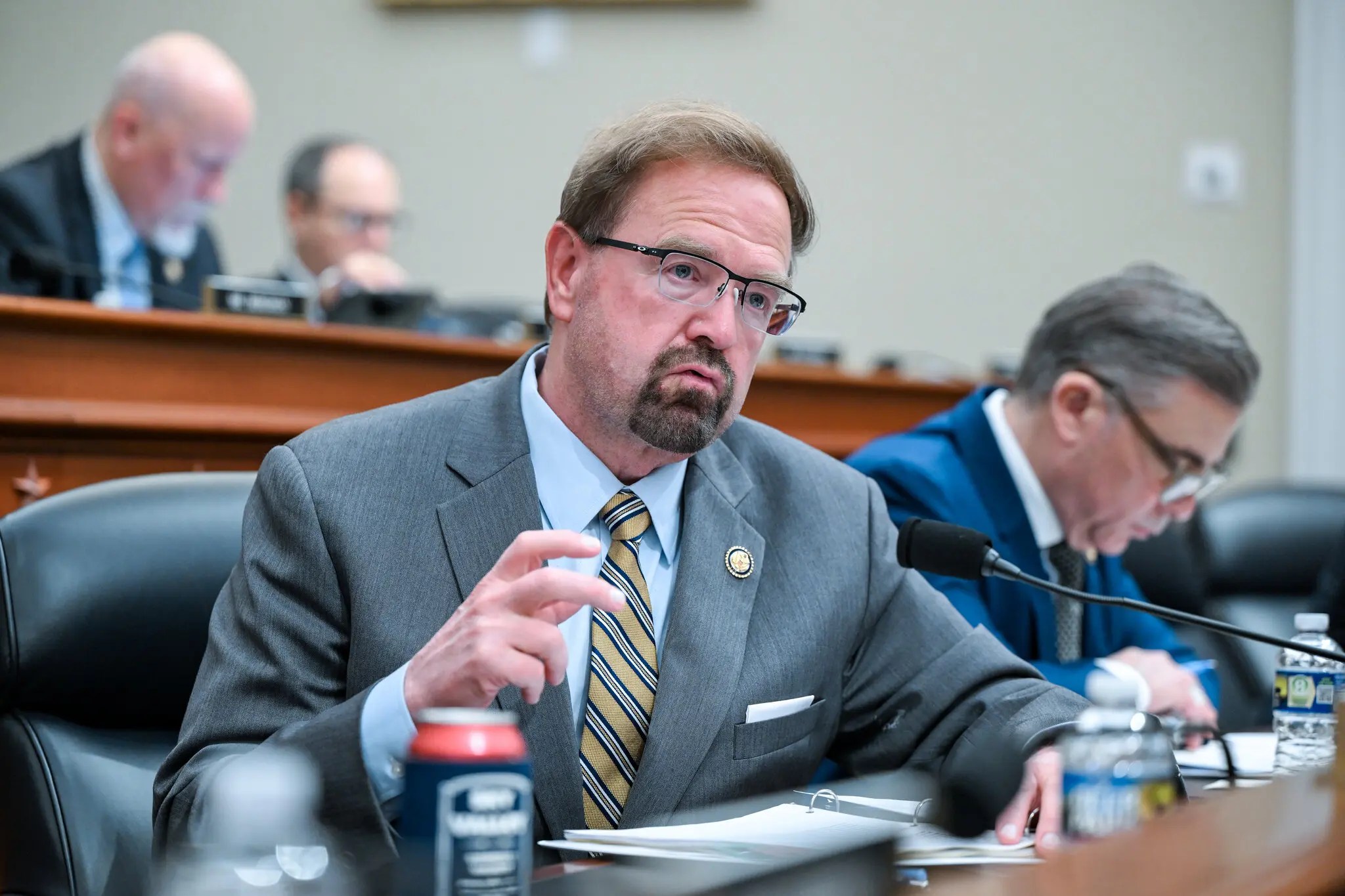
Incompetent Elected Official of the Month REDUX & Unethical Apology of the Month Too: Rep.Chuck Edwards (R-N.C.)

Wow, it takes some impressive ineptitude to get two “Incompetent Elected Official of the Month” designations in less than 30 days, but this creep was up to the challenge.

Yesterday the House voted 413-2 to censure Edwards. The House Ethics Committee recommended the action after it found last month that he had engaged in unprofessional and inappropriate behavior with two former female staffers. EA wrote about that stage of this episode here.

Edwards then stood up and sort-of-kind-of apologized, but not really, saying,

“I want to say something directly and publicly to the two women who have been at the center of all of this. I am sorry. I’m sorry that my actions, my judgement or the way that I expressed a friendship ever put either of you in an uncomfortable position. My intentions were only grounded in what I understood our friendship to be and in genuine admiration and respect that I had for each of you. Not only as professionals, but as people. I ask each of you, Republican and Democrat alike, to look beyond the headlines and examine what the committee actually found. I am not asking for special treatment, I am asking for fair treatment. I am asking you to decide if the punishment before you is supported by the evidence proportional to the conduct actually established.”

Ethics Quote of the Month: New Mexico Supreme Court Justice C. Shannon Bacon

“Do you watch the news? Do you listen to the radio? Do you read anything about what’s going on in the world? Because the problem with lawyers relying on AI hallucinations is an above-the-fold story every single day.So either you have buried your head in the sand … and that’s an intentional choice to be uninformed, or you took a gamble, and neither of those are consistent with the code of conduct.”

—-New Mexico Supreme Court Justice C. Shannon Bacon excoriating lawyer Stephen Aarons for submitting a brief riddled with ChatGPT “hallucinations.”

Good for her, but still not strong enough.

Aarons’ brief included references to imaginary witnesses and fake testimony from at least one real witness. That AI bots are likely to make up case cites and even statutory language has been recognized and publicized widely, not just in legal publications but in the general news media since early 2024. Lawyers, including those with large national law firms like Morgan & Morgan and even the Justice Department continuing to file these bogus bot-authored court documents is amazing to me. And they are too stupid, ignorant and lazy to even proof-read what the bots wrote! One judge recently railed specifically at using ChatGPT for legal work, which he compared to using Mad Magazine as a legal reference.

Bacon threw the metaphorical book at Aarons, removing him as attorney from the case of a 60-year-old man convicted last year of murdering his wife, found him in contempt of court, ordered him to pay $5,000 to a client protection fund, and referred him to the bar for potential discipline. The murder appeal will be handled now by a public defender.

It isn’t just lawyers, of course, who deserve tongue-lashings like this. Teachers, professors, newspaper editors, legislators, politicians, screenwriters, and, yes, judges to name just a few of the affected groups have an obligation to keep up-to-date on the AI revolution, and a disturbing number of them are not even close, which is inexcusable.

Two veteran members of Congress, Sen. Ed Markey of Massachusetts and Rep. James Clyburn recently indicated that they were ill-informed regarding AI. That this is, frighteningly, not unusual shouldn’t give us any comfort. Lawmakers are notorious for taking an inordinate amount of time to understand new developing technology, as when the late Senator Ted Stevens, while chairman of the Senate Committee on Commerce, Science and Transportation, described the internet as a “series of tubes.” Like the internet but perhaps even more so, however, artificial intelligence is a civilization-altering (and perhaps -threatening) phenomenon moving at the speed of light. Those who are too dim, indolent, unimaginative and irresponsible to keep up need to get out of the way and retire to some nice, safe, quiet pursuit like beachcombing or golf.

Oh…it’s the Rules of Professional Conduct, Your Honor, not the “code.” Judges have ethics codes. Lawyers haven’t been governed by a “code” for 40 years.

Try to keep up.