So far, there have been only 28 Wuhan virus deaths in Austria…
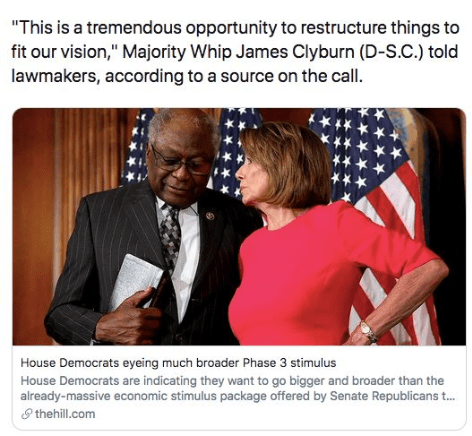
1. There is nothing strictly unethical about the Democrats attempting to use the current crisis to get some of their non-pandemic agenda items, like them or not, passed. That’s politics. They would be remiss if they didn’t try that. It will be unethical if their efforts materially interfere with the efforts to assist individual and business victims of the Wuhan virus, and if that is what they do, there is ample evidence to hang them, like this:
…if, that is, the facts are reported fairly. Speaker Pelosi’s House bill including such pork as support for the Kennedy Center For The Performing Arts is also a “smoking gun.”
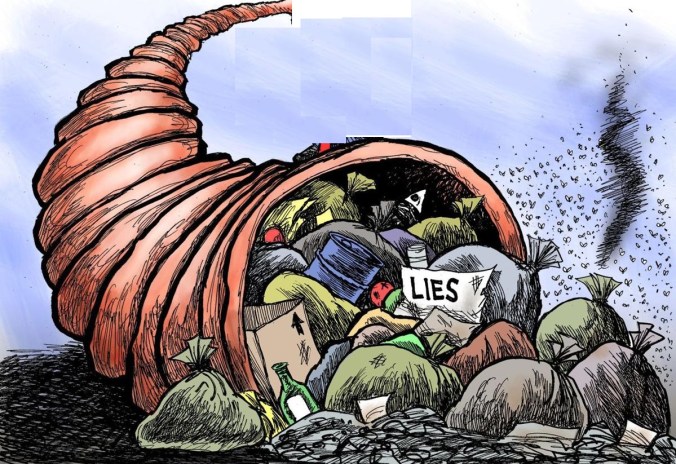
So many people are saying so many irresponsible, dishonest and stupid things in the throes of the Wuhan Virus freakout that I can’t possibly run all of them, or even a representative percentage, but I can’t let these pass.
“This is a pandemic. I felt it was a pandemic long before it was called a pandemic.”
Sometimes I think the President is actively trying to make people’s heads explode. As the New Yor Times quickly documented (on the front page), this is historical revisionism, gaslighting, or insanity.
On Jan. 22, asked by a CNBC reporter whether there were “worries about a pandemic,” President Trump replied: “No, not at all. We have it totally under control. It’s one person coming in from China, and we have it under control. It’s going to be just fine.”
On Feb. 26, at a White House news conference, he said, “We’re going to be pretty soon at only five people. And we could be at just one or two people over the next short period of time. So we’ve had very good luck.”
On Feb. 27: “It’s going to disappear. One day — it’s like a miracle — it will disappear.”
On March 7, when asked if he was concerned that the virus was spreading closer to Washington: “No, I’m not concerned at all. No, I’m not. No, we’ve done a great job.”
As I have written here before, I refuse to make a big deal out of Trump being Trump, and those who do are simply being self indulgent. Some irresponsible statements are worse than others, and yesterday’s was especially outrageous. It’s in the category of lies that are almost not lies because no one could possibly believe them, like if the President said he was a Stegosaurus. However, if the public knows that whatever he says might be a temporary fantasy, his leadership ability is seriously handicapped. The problem with this kind of statement isn’t that it’s so obviously untrue, but that saying it is so spectacularly self-destructive and stupid.
Not for the first time, a commenter has done a more thorough job fisking a problematical statement that I have. Actually, I didn’t even try to dissect the memed screed below…
…I asked whether it was truly unethical, or just signature significance for an arrogant political correctness junkie. Ryan Harkins took on the greater challenge, and as usual, did a superb job.
Inconceivable. Adj. 1. Not capable of being imagined or grasped. 2. Not what you think it means.
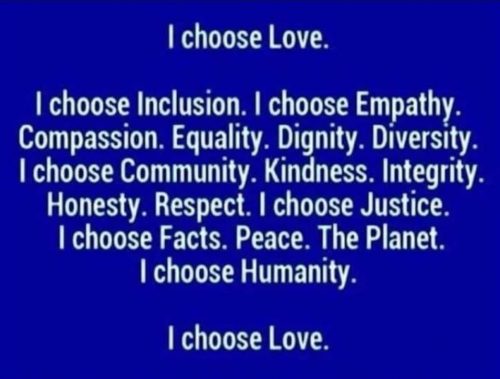
The problem with memes like the above is that it is disingenuous. What do you mean by love? Do you mean philia? Eros? Caritas? Squishy feel-goodness, for which I don’t know a Latin equivalent? In general, especially given what I’ve observed of the people who post such memes, I don’t think “love” means what they think it means. I certainly don’t think they see love as selflessly willing the good of the other, but maybe that’s because I’m cynical and see this meme as not willing the good of someone else, but trying to proclaim one’s own virtue.
What is meant by inclusion? Is there nothing someone could ever do to warrant exclusion? Or is there a little asterisk pointing one to the fine print, where we don’t include the scum of the earth, like religious white men, sex offenders, and Trump supporters?
I don’t have much to say about empathy or compassion. Equality always begs the question: “Equal how?” Because again, people keep using that word, and I do not think it means what they think it means. Equal before the law? Equal in dignity? Equal in socioeconomic status? Equal in success? Or how about created equally, and endowed by their creator with certain unalienable rights, including (but not limited to) life, liberty, and the pursuit of happiness?
I have no problem with dignity, but what about diversity and community? There is unavoidable tension in the community when there is diversity. We might not like that fact, but it is there. As soon as you have two people of different opinions in the room, there is tension, and by and large what we’ve seen is that people are less and less tolerant of tension. I wouldn’t say they are less tolerant of differences of opinion, as long as those opinions keep to themselves and don’t bother other people. It is the tension that people are finding unbearable. Maybe it is because we are no longer equipped to have our opinions or viewpoints challenged. But I also have a hard time believing anyone believes in community, when so many are nose down I electronics (as I am as I write this) and all my friends belong to the same echo chamber as myself. Continue reading →
“Several Madison alders are sponsoring the resolution creating the LGBTQ+ Rainbow Murals and Crossings Art Pilot Program, which would install LGBTQ+ inclusive rainbow flag markings… at pedestrian crossings on the Capital City Trail and near the Capitol Square…. ‘…It would be a reminder to residents who see it that the LGBTQ community is an important part of the fabric of Madison, especially given that we have a lesbian mayor and many other queer people in positions of power’.”
This prompted her Ethical Quote of the Month:
“Why should the street be painted to remind us of who’s in a position of power? I would not paint anything political on the street. Let the street be a street. It doesn’t need to talk to us, especially not to nudge us about what we should believe or value.”
Why indeed.
This is why the Carly Simon song came to mind, but with slightly altered lyrics:
We can never know about the days to come But the right side of history Is clear.. wondering if you’re on board with me Or just going through the motions now
Indoctrination, indoctrination Is making me woke I’m in the right crowd now
And I tell you how easy it feels to be so good How right to have the mob around But I, I rehearsed these words just late last night When I was thinking about how washed your brain could be.
Indoctrination, indoctrination Is keeping me safe, Safe from the antifa..
And tomorrow we might not be agreeing That would mean that we cannot associate So let us program your brain for good Repeat this phrase, ‘cause we’ll tell you what to think We’ll tell you what to think And stay right here, ‘cause we’ll tell you what to think.
We’ll tell you what to think. We’ll tell you what to think. We’ll tell you what to think. We’ll tell you what to think…
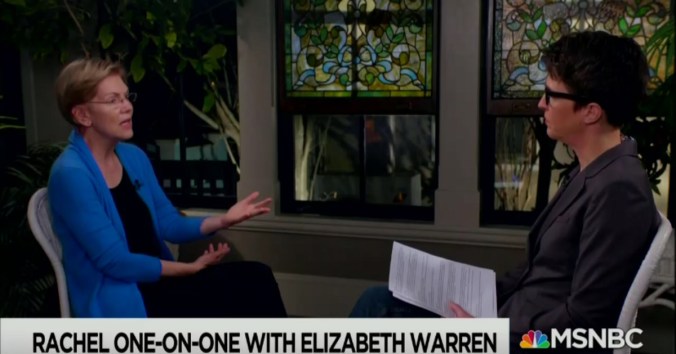
“If Hillary Clinton can’t win when she gets the nomination and you can’t get the nomination and neither can Kamala Harris, and neither can Amy Klobuchar, and neither can Kirsten Gillibrand. I mean, I think part of what’s going on today is women around the country are like, ‘OK, honestly!’ If it’s not going to be any of them, let’s get real. Is it just that it can’t be any woman ever?”
——The allegedly intelligent MSNBC host Rachel Maddow, making a statement with stunning disregard of facts and logic, indeed reality, in order to advance a divisive and false narrative.
This was an irresponsible argument in the midst of a generally irresponsible and dishonest discourse by Maddow while interviewing Elizabeth Warren following the end of her campaign. She was attempting to bolster Warren’s ethically bankrupt claims that it was sexism that doomed her campaign, just as Hillary Clinton claimed the same, among all the excuses and rationalizations she assembled (and is still assembling) to duck accountability for her own upset loss to Donald Trump, who was generally dismissed as a pushover.
If she wanted to educate her viewers, which Maddow does not—she wants to push an ideological agenda—she would explain that none of the women she mentioned were successful state governors, and that state houses and military command, not Congress, have been the launching pad for the majority of Presidents. She could explain that the failed candidates she mentioned all had thin resumes for a White House run, including Warren, who is a former university professor and lawyer barely into her second term as a U.S. Senator.
Hillary had the most impressive experience of the group, but there is no avoiding the conclusion that the only reason she was in a position to get the nomination was by coasting on her husband’s resilient popularity. She had not been an especially outstanding Senator, and her tenure as Secretary of State was marred by many dubious episodes, not the least of which was the email scandal that she persisted in lying about. Moreover, Clinton disproved Maddow’s theory by getting a plurality of votes cast in 2016, an achievement that will elect a candidate President approximately 90% of the time. She was unlucky, that’s all. Hillary nearly won despite more adverse baggage and dubious character than any Presidential candidate other than Richard Nixon. Continue reading →
Active Ethics Alarms reader/commenter Steve Witherspoon tracked down the transcript on Senator Schumer’s remarks in response to Mitch McConnell’s accurate attack on the senate Minority Leader’s unconscionable comments at the Supreme Court, thuggishly threatening Justices Gorsuch and Kavanaugh over decisions they haven’t made yet.
I’ll interlineate the text—I’m sorry it’s all in caps, but that’s how C-SPAN’s transcripts are—pointing the astounding number of rationalizations Schumer nicked while trying to justify the unjustifiable.
THANK YOU, MADAM PRESIDENT. NOW, MADAM PRESIDENT, I JUST LISTENED TO THE REPUBLICAN LEADER, AND THERE WAS A GLARING OMISSION IN HIS SPEECH. HE DID NOT MENTION WHAT THE RALLY YESTERDAY, MY SPEECH, OR THE CASE BEFORE THE COURT WAS ABOUT.
The issue at hand is the Minority Leader of the Senate threatening, by name, two Supreme Court justices. The context of such threats is absolutely irrelevant, because such threats, as McConnell correctly made clear, are indefensible. Schumer is signalling that his defense will be based on Rationalization2 A. Sicilian Ethics, or “They had it coming.““This argues that wrongdoing toward a party isn’t really wrong when the aggrieved party has aggrieved the avenger. The victim of the unethical conduct no longer deserves ethical treatment because of the victim’s own misconduct. But the misconduct of a victim never justifies unethical conduct directed against that victim.”
A WOMAN’S CONSTITUTIONAL RIGHT TO CHOOSE. TO THE WOMEN OF AMERICA, WHAT WE’RE TALKING ABOUT HERE, WHAT I AM FIGHTING FOR HERE IS YOUR RIGHT TO CHOOSE.
At least three rationalizations are implied here:
25. The Coercion Myth: “I have no choice!” “The unethical option involved less sacrifice, less controversy, less criticism, less effort…in short, less courage, than doing the right thing. … But you still had a choice, and you are still accountable for the choice you made.”
25A. Frederick’s Compulsion or “It’s My Duty!” “We all have competing duties; that’s what makes ethics difficult…Ethics requires that when performing a duty will unquestionably result in injustice and harm to others, some consideration and balancing must be applied, followed by making one or more difficult choices. Duty itself is not enough to dictate those choices, and ethics may, and often does, dictate that a duty must be superseded by other priorities.”
28. The Revolutionary’s Excuse: “These are not ordinary times.” “An argument for those who embrace “the ends justify the means”—but only temporarily, mind you!—the Revolutionary’s excuse has as long and frightening a pedigree as any of the rationalizations here….This rationalization suggests that standards of right and wrong can and should be suspended under “special” circumstances, always defined, naturally, by those who defy laws, rules, and societal values. ..Unethical conduct has become ordinary, the new normal. This is, it is fair to say, the current state of American politics.
“It is almost unbelievable how ignorant and ill-educated America’s college students are. They are well below average in every material way. For all my life I have been an advocate for higher education, but I have reluctantly come to the conclusion that college is generally a mistake, as young people are mostly misinformed there, rather than educated. There are a few technical fields–medicine, engineering, possibly law–where such education is actually useful. Otherwise, we and our young people would be better off if they eschewed institutions like Colgate in favor of trade and technical schools, or immediate entry into the labor market. They couldn’t possibly do worse than to pursue the typical four-year liberal arts degree.”
—-Attorney-blogger John Hinderaker, in a Powerline post about thehostile treatment conservative author Heather McDonald received from Colgate students when she was invited to speak there.
The reason this seems almost unbelievable to Hinderaker, and the reason I chose this as an ethics quote, is that his painful conclusion that nobody wants to admit is true. I don’t want to admit it, and I was becoming convinced of this decades ago, when I was part of the administration of Georgetown Law Center and discovered that we had Yale graduates who couldn’t write a coherent sentence, and later, when I had Stanford interns who thought Jane Fonda was an aerobics instructor and who looked at me blankly when I mentioned the 1968 Democratic National Convention, and still later, when a smart young woman who had graduated from Hofsta didn’t know who Jackie Robinson was, and when a Skadden Arps attorney with a Cornell degree guessed that the Civil War was fought sometime in the 1930s.
This is why I was not disappointed when my son, scion of a family with three Harvard graduates and a career Harvard employee, announced that he saw no point in going to college. Continue reading →
“My name’s Joe Biden, I’m a Democratic candidate for the United States senate—if you like what you see, help out, if not, vote for the other Biden”
Democratic candidate and gaffe grandmaster Joe Biden, speaking today, before tonight’s South Carolina debate, to a South Carolina campaign crowd.
It isn’t that Biden’s statement has anything to do with ethics, whatever he was saying. It’s that his bizarre pronouncement raises an immediate ethics issue. If we were playing “Ethics Password,” the announcer would say in hushed tones, “The password is fairness.” What is fair to Biden here, and how can I get past my biases to decide? I have believed for more than a decade that Biden is an idiot-savant with surprising political skills; I don’t believe you can say ridiculous and nonsensical things as often as he has for so long and not be inherently untrustworthy and more than a little addled. I also have found his demeanor, appearance and increasing tendency to speak in gibberish of late evidence of precipitously declining faculties from a height that was never all that impressive to begin with.
And yet I am in favor of giving any politician, disk jockey or improv comic the benefit of the doubt, because I know the perils of speaking extemporaneously from first-hand experience. Thus the question is, how eager should we be to shrug off this latest jaw-dropper from Biden as the natural and forgivable result of flying around the country and its inevitable “If this is Tuesday, it must be Saginaw” confusion? Is it just a particularly egregious example of wacky old Joe being wacky old Joe, and thus an occurrence where the Julie Principle is in play, or, in the worst case, is this latest head-scratcher so close to the former VP showing up nude with a duck on his head that an intervention is called for?
Theodore Roosevelt wasn’t still President when he gave his speech, “Citizenship In A Republic”, at the Sorbonne, in Paris, France on April 23,, 1910. He was a President, though, and getting ready to run for the office again; moreover, you can have a speech be any more pure Teddy than this one.
It is his most quoted speech as well as the one which describes his essence. I wonder if President Trump has read it? Teddy wouldn’t approve of Trump, I think, but he would have to admire the President’s determination to spit in the eyes of his critics, and “whose face is marred by dust and sweat and blood; who strives valiantly; who errs, who comes short again and again, because there is no effort without error and shortcoming; but who does actually strive to do the deeds; who knows great enthusiasms, the great devotions; who spends himself in a worthy cause; who at the best knows in the end the triumph of high achievement, and who at the worst, if he fails, at least fails while daring greatly, so that his place shall never be with those cold and timid souls who neither know victory nor defeat.”
That describes Donald Trump these past three years as much as any President, including Teddy Roosevelt.
Strange and impressive associations rise in the mind of a man from the New World who speaks before this august body in this ancient institution of learning. Before his eyes pass the shadows of mighty kings and war-like nobles, of great masters of law and theology; through the shining dust of the dead centuries he sees crowded figures that tell of the power and learning and splendor of times gone by; and he sees also the innumerable host of humble students to whom clerkship meant emancipation, to whom it was well-nigh the only outlet from the dark thraldom of the Middle Ages.
This was the most famous university of mediaeval Europe at a time when no one dreamed that there was a New World to discover. Its services to the cause of human knowledge already stretched far back into the remote past at a time when my forefathers, three centuries ago, were among the sparse bands of traders, ploughmen, wood-choppers, and fisherfolk who, in hard struggle with the iron unfriendliness of the Indian-haunted land, were laying the foundations of what has now become the giant republic of the West. To conquer a continent, to tame the shaggy roughness of wild nature, means grim warfare; and the generations engaged in it cannot keep, still less add to, the stores of garnered wisdom which where once theirs, and which are still in the hands of their brethren who dwell in the old land. To conquer the wilderness means to wrest victory from the same hostile forces with which mankind struggled on the immemorial infancy of our race. The primaeval conditions must be met by the primaeval qualities which are incompatible with the retention of much that has been painfully acquired by humanity as through the ages it has striven upward toward civilization. In conditions so primitive there can be but a primitive culture. At first only the rudest school can be established, for no others would meet the needs of the hard-driven, sinewy folk who thrust forward the frontier in the teeth of savage men and savage nature; and many years elapse before any of these schools can develop into seats of higher learning and broader culture.
The pioneer days pass; the stump-dotted clearings expand into vast stretches of fertile farm land; the stockaded clusters of log cabins change into towns; the hunters of game, the fellers of trees, the rude frontier traders and tillers of the soil, the men who wander all their lives long through the wilderness as the heralds and harbingers of an oncoming civilization, themselves vanish before the civilization for which they have prepared the way. The children of their successors and supplanters, and then their children and their children and children’s children, change and develop with extraordinary rapidity. The conditions accentuate vices and virtues, energy and ruthlessness, all the good qualities and all the defects of an intense individualism, self-reliant, self-centered, far more conscious of its rights than of its duties, and blind to its own shortcomings. To the hard materialism of the frontier days succeeds the hard materialism of an industrialism even more intense and absorbing than that of the older nations; although these themselves have likewise already entered on the age of a complex and predominantly industrial civilization. Continue reading →
In some ways, Jack Kennedy was the anti-matter Donald Trump.
He unified the country with optimistic words and soaring idealism, and was treated by the media and much of the public as if appearances and substance were the same thing. Like Trump, he was rich and the son of a ruthless business man; unlike with our current President, few seemed to care. JFK was young and vigorous (or as he would say, “vigahrous”), and nobody accused him of hyperbole and lies. The press loved him; his press conferences were all laughs and smiles. Yet Kennedy was every bit the narcisisist that Donald Trump is, and at least as much of a misogynist. He engaged in open nepotism, having his brother as his Attorney General and chief advisor, but nobody suggested he was hving incestuous relations with Bobby. Both had glamorous wives, but while Melania has been effectively banned from the covers of women’s magazines, Jackie was on a cover every month, if not every week. Kennedy committed impeachable offenses, like having a secret sexual liaison with an Israeli spy (and Mafia moll), but it was Trump who was impeached. Meanwhile, President Trump’s accomplishments in his first term far exceed those of Kennedy, who also managed to prompt East Germany to erect the Berlin Wall, and to nearly trigger World War III.
His inaugural address, however, marked his Presidency as the gateway to a new era, when anything was possible. Kennedy was not a great orator—all the Kennedys had and have a tendency to shout—but he was a a passionate one, and he had charisma, that indefinable magic that makes strangers love and trust a politician. Though he had barely received 50% of the votes in the 1960 election, nearly seventy-five percent of Americans expressed approval of President Kennedy after this speech.
Mostly crafted by Kennedy aide Ted Sorenson, it is undeniably a masterpiece.
Vice President Johnson, Mr. Speaker, Mr. Chief Justice, President Eisenhower, Vice President Nixon, President Truman, Reverend Clergy, fellow citizens:
We observe today not a victory of party but a celebration of freedom–symbolizing an end as well as a beginning–signifying renewal as well as change. For I have sworn before you and Almighty God the same solemn oath our forbears prescribed nearly a century and three-quarters ago.
The world is very different now. For man holds in his mortal hands the power to abolish all forms of human poverty and all forms of human life. And yet the same revolutionary beliefs for which our forebears fought are still at issue around the globe–the belief that the rights of man come not from the generosity of the state but from the hand of God.
We dare not forget today that we are the heirs of that first revolution. Let the word go forth from this time and place, to friend and foe alike, that the torch has been passed to a new generation of Americans–born in this century, tempered by war, disciplined by a hard and bitter peace, proud of our ancient heritage–and unwilling to witness or permit the slow undoing of those human rights to which this nation has always been committed, and to which we are committed today at home and around the world.
Let every nation know, whether it wishes us well or ill, that we shall pay any price, bear any burden, meet any hardship, support any friend, oppose any foe to assure the survival and the success of liberty.
This much we pledge–and more.
To those old allies whose cultural and spiritual origins we share, we pledge the loyalty of faithful friends. United there is little we cannot do in a host of cooperative ventures. Divided there is little we can do–for we dare not meet a powerful challenge at odds and split asunder.
To those new states whom we welcome to the ranks of the free, we pledge our word that one form of colonial control shall not have passed away merely to be replaced by a far more iron tyranny. We shall not always expect to find them supporting our view. But we shall always hope to find them strongly supporting their own freedom–and to remember that, in the past, those who foolishly sought power by riding the back of the tiger ended up inside.
To those people in the huts and villages of half the globe struggling to break the bonds of mass misery, we pledge our best efforts to help them help themselves, for whatever period is required–not because the communists may be doing it, not because we seek their votes, but because it is right. If a free society cannot help the many who are poor, it cannot save the few who are rich.
To our sister republics south of our border, we offer a special pledge–to convert our good words into good deeds–in a new alliance for progress–to assist free men and free governments in casting off the chains of poverty. But this peaceful revolution of hope cannot become the prey of hostile powers. Let all our neighbors know that we shall join with them to oppose aggression or subversion anywhere in the Americas. And let every other power know that this Hemisphere intends to remain the master of its own house. Continue reading →

 Ethics Alarms