Ethics Dunce: Christine O’Donnell

Like ham and eggs, Abbott and Costello, or motherhood and apple pie, “dunce” and Christine O’Donnell will forever be paired. Why her embarrassing run for the U.S. Senate didn’t consign her to permanent obscurity I do not know, but she was back in the public eye again tonight, on an apparently slow day for getting guests for Piers Morgan, to talk about her new book. When the host dared to stray into subject matter O’Donnell didn’t want to talk about, however, she quit the interview, leaving Morgan with dead time and an empty chair.

There is no excuse for this abominable behavior. Morgan was not being rude, nor was he straying from ethical interview practices. An interviewee does not have the right to control an interview, and a public figure who is asked about public statements and the contents of a book bearing her name may not call “foul” with any justification. As for walking out in the middle of a televised interview, O’Donnell conduct is indefensible–unfair to her host, disrespectful of her audience,  uncivil, and cowardly

Morgan deserves some of the blame for agreeing to waste airtime on someone who has proven beyond any question that she possesses neither the skills, talent, intelligence, character or judgment to even qualify for D -list celebrity status, much less to be taken seriously as a political figure.

She is, in short, a dunce–ethically, socially, and intellectually. After this performance, anyone who books her for anything other than a “Dunk the Witch” carnival attraction deserves whatever they get.

To the Pro-Obama Race-Baiters: “Have You No Sense of Decency at All?”

Ah, if only Joseph Welch and his well-aimed indignation were here today!

We knew, way back when President Obama was running for his first term, that the temptation to paint any opposition to his leadership or his policies as proof of racism would be irresistible  for the less ethical among his supporters in the Democratic Party and among the media. This came to pass, but we should prepare for much worse.  Now that the President has a thoroughly wretched record and is, to an extent I personally haven’t seen since the paranoid days of Richard Nixon, attempting to avoid accountability by blaming everyone in sight—a thoroughly unleaderly display—the race-baiters have served notice that they will be out in force this time as well, more shameless than ever. Continue reading

The Folly and Threat of the Pew 13%

From the just-released Pew survey about American attitudes and practices regarding their mobile phones:

“Cell phones can help prevent unwanted personal interactions – 13% of cell owners pretended to be using their phone in order to avoid interacting with the people around them.”

For information and education of those 13% of cell phone owners, here is what I know about you because you engage in this practice:

  • You are rude.
  • You are disrespectful.
  • You are cowardly.
  • You are ignorant
  • You are a liar.

I am sure these same people will happily enter their opinions on blogs about what is and isn’t right about America, despite having avoided all but the most sanitized interaction with it—using pseudonyms to hide their identities, of course. They don’t want interaction, the mutual exchange of  opinions, or to have to deal with anyone who might shatter their ossified, unshakable view of the world with a different perspective. Continue reading

Do Nicer People Earn Less Money? Of Course They Do. And That’s the Way it Should be.

Leo Durocher figured out that "nice guys finish last" 60 years ago, and he never went to college. Now three academics, after extensive research, have "discovered" the same thing. Ah, scholarship!

A study by Cornell professor Beth A. Livingston,  Timothy A. Judge of the University of Notre Dame and Charlice Hurst of the University of Western Ontario study used survey data to examine “agreeableness” and found that disagreeable men made 18%, or $9,772 annually, more in salary than those who are more accommodating. The salary disparity was  less among women, with disagreeable females making 5% or $1,828, more than those who are easier to get along with. Does this shock you? It shouldn’t.

As is depressingly often the case, the academics who come up with such crack-brain studies—I read this one, and will want that wasted hour back when I’m on my death-bed so I can watch one last re-run of “Magnum, P.I.”—have so little experience with the working world and the reality of non-academic cultures that they don’t even comprehend their own research and draw absurd conclusions from it.

“The problem is, many managers often don’t realize they reward disagreeableness,” Livingston told the Wall Street Journal. “You can say this is what you value as a company, but your compensation system may not really reflect that, especially if you leave compensation decisions to individual managers.”

Oh brother. Continue reading

Would Dennis Rodman Qualify for the Baseball Hall of Fame?

Dennis Rodman, out of uniform

Of course not. Dennis Rodman didn’t play baseball. He was a pro basketball player, and as of yesterday, an inductee into the NBA Hall of Fame for his exploits on a basketball court. There is no question that he is eminently qualified for admission to the NBA Hall of Fame, because the NBA Hall of Fame doesn’t care if players are thugs, drunks, scofflaws, deadbeat dads and couldn’t define sportsmanship with a dictionary as long as they can shoot, score, pass, dribble and block shots.

The Major League Baseball Hall of Fame at Cooperstown, however, requires that its members demonstrate “integrity, sportsmanship, (and) character,” in addition to outstanding achievements and a remarkable career record.  Because of the steroid era that has rendered a whole generation of players suspect for cheating, an expanding number of baseball greats face being excluded from the Hall because cheating by using substances that are illegal and banned in the sport while implicitly deceiving the public about the use is, by any rational definition, a material breach of integrity and sportsmanship.  The natural reaction by many sportswriters, as in other fields when reasonable standards are routinely violated, is to attack the standards. Why should a sport care about matters like integrity and character? Isn’t it the performance that counts, and winning? Continue reading

A Pause To Spew My Hatred of Spam

A typical day at Ethics Alarms!

One reason, not the only one, but one of them, that I was foiled trying to respond to a series of critical posts on an online forum was that fear of spam had caused the administrators to make it insanely difficult for me to post there—just another way for online spam to plague me. According to Akismet, WordPress’s excellent spam detection service, I now have reviewed and deleted over 45,000 pieces of spam since Ethics Alarms began. (I have to check the spam because occasionally it traps a genuine comment, kind of like dolphins getting caught in tuna nets.)

Let me be clear: I hate these people. I hate the people who send spam, the people who employ spam services, the people who write the deceitful, stupid spam messages, and the spamming outfits that make their grimy living off of it. There is no such thing as an ethical spammer or an ethical company that assists in spamming. By definition, spam is dishonest, as it pretends to offer content when there is none, and purports to represent genuine interest in the site, when it is only interesting in planting a link that will maximize a commercial site’s SEO.

Spam is not only dishonest, but it is insultingly dishonest, because it is so obvious. Continue reading

Web Ethics Complaint File: Rotten Etiquette in “Etiquette Hell”

The topic: rude behavior in public dining

There is nothing quite as exquisitely frustrating as having one’s commentary misrepresented elsewhere by a sloppy blogger, and then watching the nasty comments pile up by posters who never bother to read the original post. That is what is happening to Ethics Alarms, and thus me, over at an otherwise virtuous site called Etiquette Hell.

The site, or blog, or forum, or whatever the hell it is commented on the Starbucks post, with the inept headline: “Hogging all the tables in a crowded establishment.” That’s not what the post was about. That is a misrepresentation. The post was specifically about coffee shops that provide free wi-fi, and how customers abuse the privilege and benefit by camping out with their laptops for unreasonable amounts of time,  forcing patrons who need to use the tables for the primary purpose they exist to provide—allowing someone to eat and drink comfortably—to go elsewhere, or to stand. Continue reading

The Starbucks Principles

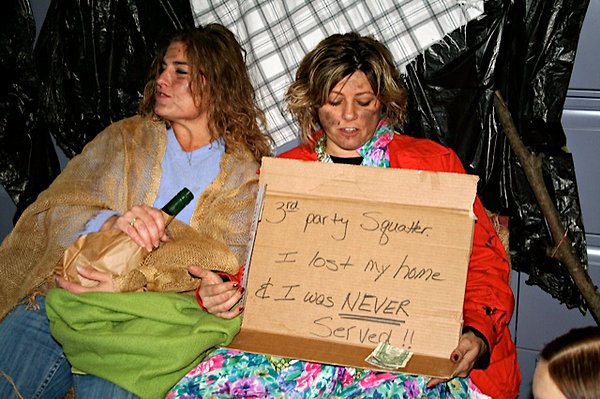
Hey you squatters! I'm coming over!

The First Starbucks Principle: If you create a free and open public benefit, the use of which is contingent on mutually understood conditions of fairness and reasonableness, eventually the utility of the benefit will be destroyed by individuals who refuse to be either fair or reasonable.

The Second Starbucks Principle: Once this occurs, there will necessarily  be rules and enforcement, conflict leading to consensus and a new social norm, or the elimination of the benefit.

Starbucks is in the midst of the First Starbucks Principle, but the Second is on the way. The nice, absurdly expensive coffee shops that created a culture where coffee-lovers could drink their lattes at leisure while working at their laptops or perusing  books and newspapers, are being choked to death by arrogant and cheapskate squatters who stake out the tables and remain for hours on end, often driving out customers who just want to sit down briefly and sip.

I had read about Starbucks’ New York City shops covering up outlets at the store, limiting the squatters to the battery storage limits of their laptops, a pretty mild reform. Then, last week, I saw the problem up close: a companion and I purchased coffee at a Starbucks clone, Caribou Coffee, and found that every table was occupied by one squatter with a laptop. Out of eight tables, only one had a cup or food of any kind. We had to go outside and find a bench; I guarantee that Caribou lost some business, because I would have purchased another drink. Continue reading

American Lessons from the English Riots

I am going to refrain from joining the ranks of amateur psychologists trying to identify the “root cause” of the English riots. People of any age or economic status who riot are, it is fair to say, assholes, like lesser social miscreants such as vandals, computer virus inventors, Leroy Fick and Pastor Terry Jones. If I were convinced that these riots were in response to necessary government cutbacks in social programs, I would have something arguably useful to say, but that doesn’t seem to be the case.

There is no question, however, that in allowing the riots to go on so long and harm so many citizens, businesses and homes, the British government has failed one of its most basic duties. Great Britain has been the anti-gun zealot’s Nirvana for a long time: not only can’t citizens own guns for their personal protection, neither can the police. That can work, if the culture is reliably non-violent, and if social and community institutions do a good job making sure that the culture of non-violence is strong, self-reenforced, and deep.

Well, it isn’t, is it?

Continue reading

Ethics Quiz: Is It Wrong For A Rescuer To Sue The Victim He Rescued?

"OK, Princess, you'll get my bill for this rescue in five to seven business days."

On March 11, 2009, Mark Kinkaid and David Kelley were riding in Kinkaid’s truck when they saw a detached bumper, headlights and all, lying in the middle of Rt. 23.  Smoke was rising up from the highway embankment,  and the two men concluded that someone was in trouble. The truck stopped, and they got out, hopped a barbed-wire fence, made their way down the steep highway embankment, where they saw a flaming Hummer. Theresa Tanner was trapped inside, screaming for help. They forced their way into the vehicle, pried a door open and pulled Tanner out. She was injured and burned, but after weeks in intensive care, survived.

Now Kinkaid and David Kelley are suing Tanner, claiming that the crash was her fault and that she is liable for the injuries they sustained in rescuing her. They have filed a lawsuit asking for damages of at least $25,000 each. “All I know is that I am not the same man I used to be,” says Kelley, a 39-year-old truck driver and father of five, who says the heavy smoke and fire that day damaged his lungs so that he can’t carry a laundry basket up the three flights of stairs in his home.

The law provides a rationale for such a lawsuit. “The precedent is clear: danger invites rescue … and if you’ve acted recklessly or negligently and someone gets hurt rescuing you, you could be in trouble,” says Stan Darling, a tort law specialist. A well-established principle known as “the Rescue Doctrine” holds that if someone is in peril because of their own negligence or recklessness, an injured rescuer can recover damages if he acted reasonably and can prove that his injuries were caused by the rescue attempt.

That’s the law, however. This is ethics, and your Ethics Quiz today is:

Is it ethical for a rescuer to sue the person he rescued? Continue reading