Comment Of The Day: “From The ‘Stop Making Me Defend Lawrence O’Donnell!’ Files: The Golden Rule”

A commenter on the post on the studio tantrum thrown by MSNBC host Lawrence O’Donnell going viral on YouTube after it was leaked said that such a leak was “predictable.” I asked,

“Why should it be “predictable”? Why shouldn’t we be able to trust co-workers not to try to hurt us, e-mail correspondents not to send out our messages to strangers and on social media? Was it predictable that Donald Sterling’s mistress/beard would tape his comments in his bedroom to destroy his reputation?”

This prompted Crella’s  Comment of the Day on the post, From The “Stop Making Me Defend Lawrence O’Donnell!” Files: The Golden Rule:

Exactly. It shouldn’t be predictable. However, it seems that for a lot of people, their first instinct with anything they come across is to put it on the net, no matter the consequences. It’s so easy ( and I assume, extremely satisfying to bully types) to shame and humiliate on a scale previously unknown in human history. It’s irresistible to too many.

The ability to find thousands of like-minded people in a relatively short period of time on social media, and the sheer volume of encouraging positive feedback you can receive ( ‘if so many people agree with me, I must be right!’) has brought grade-school level cliques and meanness to the fore in a great deal of adult communication. It’s the same mechanism on a large scale. People rarely step back and see themselves, but I read and just wonder at it daily…the people most stridently against fat shaming, objectification, being leered at, and other ‘lookist’ offenses on social media are routinely ridiculing Trump on his hair, weight, skin color, and posture while playing golf, comments on appearance are very common. Continue reading

Ethics Observations On The Trump-Deranged Prof’s 2016 Post-Election Freak-Out

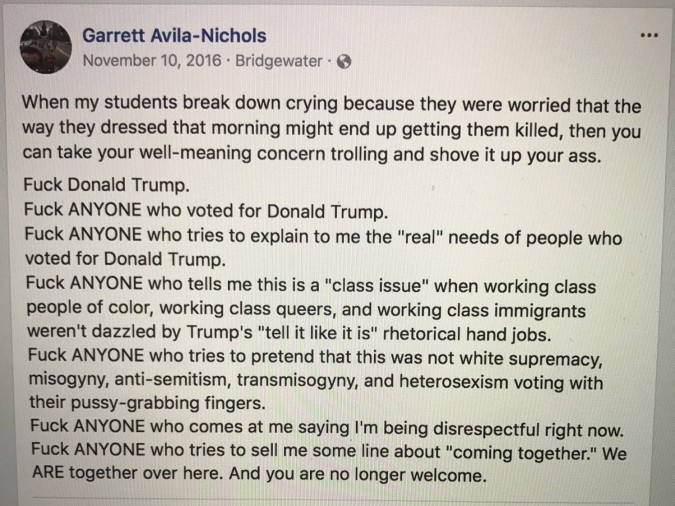
Bridgewater State University professor Garrett Avila-Nichols wrote the Facebook screed above shortly after the November 8 defeat of Hillary Clinton by President Anti-Christ. Somehow the post didn’t become known to students—at least the ones he hate—and apparently even the university’s administration until this week.

Observations:

1 We are seeing one example after another of college professors making tweets and other social media posts denigrating conservatives, Republicans, whites, men and Trump voters in emotional, vicious and frequently obscene rhetoric. Can anyone recall any similar conduct from professors directed against liberals, conservatives, minorities, women, or Obama, Clinton or Carter voters? I know that there was no social media to abuse for much of those periods, but still: when did professors get the idea that attacking large segments of the population and the student body was tolerable? Why do they think it is acceptable conduct now?

2. Is it because they see, hear and read so much similar hate and fury in the mainstream media, social media, and mouth-foaming  anti-Trump fanatics like Maxine Waters, Keith Olberman, and Stephen Colbert, and see them get away with it relatively unscathed?

3. Professor Turley is almost an absolutist on the matter of professors being able to exercise their First Amendment rights on social media. Would he defend this? Really? How can someone teach students when he has declared in print and online that some of them aren’t welcome? How could such students trust such a professor to grade them objectively and fairly? Teachers are supposed to be mentors and allies: how can someone who hates you perform those roles? How can a school trust a professor who writes something like that?

4.  Does it matter that this is an old post? I don’t think so. Emotions that intense and judgement that terrible are signature significance. Rational, reasonable, trustworthy professionals don’t make public outbursts like that. Ever. Continue reading

Morning Ethics Warm-Up, 9/17/17: Boy Scouts, “Will and Grace,” An Actress Whines, Wedding Cakes, And (I’m Sorry!) More Hillary

Good Morning!

1 I’m giving an ethics talk to a Boy Scout troop this afternoon. Figuring out how to use example that are appropriate to ages 11-14 while avoiding hot-button issues like race, sexual orientation, police, guns and politics in general is a lot more difficult than I thought it would be. What pop culture reference points will work is also a conundrum. What movies are they likely to have seen? In the Sixties, I could have referred to Westerns, many of which routinely embodied ethics lessons. But they also often involved shooting people, and kids don’t see Westerns now. In the Eighties, I might have sent Boy Scouts to episodes of “Star Trek: The Next Generation,” which was virtually all about ethics. But Patrick Stewart is just an old guy doing commercials now, and there have been four TV incarnations of the franchise since Data packed it in, not counting the movies. Pixar movies are usually ethics-rich, but a lot of kids will bristle at being presumed to be cartoon fans. Superhero movies? The ones that raise ethics issues usually do so badly, or the issues are too complex—or too dark– for a Boy Scout Troop. Here we see the serious cultural problem of declining cultural literacy and deteriorating cross-generational communications as a result of the loss of common experience. and interests.

Well, it’s early. I’ll figure out something.

One approach I considered was to suggest they practice ethical analysis by reading the newspaper, picking out the ethics dilemmas and controversies that appear, thinking about them and arguing about them. Of course, that was foolish: they would probably ask, “What’s a newspaper?” However this morning’s Sunday Times is a perfect example. I could teach a four hour ethics seminar based on the stories in this edition alone. Look…

2. The baker who refused to sell a cake to a gay couple is back on the front page, thanks to the case winding its way to the Supreme Court. This time, the focus isn’t on Freedom of Religion (in this case, freedom to act like a jackass using your religion as an excuse), but Freedom of Speech. The government cannot compel speech, nor will the law compel specific performance of an artistic nature. The baker claims that his cakes are artistic creations, and he doesn’t have to make them for anyone or anything if he doesn’t want to.  The gay couple says that they weren’t asking for him to create an artwork, just to sell them a wedding cake. If the cake is a commodity, then the bake shop should be a public accommodation, and subject to applicable laws. Then the baker has to sell his cakes to anyone. If the cake is an “artistic creation” made specifically for the couple, then the law cannot force the baker to make it, or punish him if he refuses. Art is speech.

I hate these kinds of cases, and I’m sure the SCOTUS justices do too. A cake is sometimes just a cake, and sometimes a work of art. The confrontation should have been handled with ethics rather than law. The baker is a bigoted jerk, that’s all. I think he has a right not to make a cake for a gay couple, but exercising that right is cruel and insulting. Continue reading

Portrait Of An Ethics Train Wreck:The Race-Baiting ESPN Commentator

The recent still-rolling ethics train wreck launched by ESPN “SportsCenter” co-host Jemele Hill is a perfect example of how such cultural fiascos occur.

Hill, a young African American woman, went on a Twitter rant against President Trump  this week.

“Trump is the most ignorant, offensive president of my lifetime,” Hill tweeted Monday night. “His rise is a direct result of white supremacy. Period. He is unqualified and unfit to be president. He is not a leader. And if he were not white, he never would have been elected.”

Factors, Stage I:  The Instigator

A. An ethics alarms doesn’t  ring.

Why in the world would Hill think that the face of a national broadcast network could publicly call the President of the United States a white supremacist without causing a problem for her employer? The key ethics values being breached  are trust and responsibility. She has a responsibility to ESPN, which should be able to trust her not to harm it or upset viewers.

B. An instigator has an inflated view of his or her own importance, indispensability, wisdom, expertise or authority.

We are living in an age where narcissism is epidemic, but even so, a sports anchor has to be able to comprehend that once he or she is outside the realm of sports, her opinion on the President or anyone else cannot possibly have a positive effect on public discourse unless it is carefully crafted, thought out, and expressed.

The key ethics values being breached are competence and  humility.

C. Social media.

Any public figure, including TV personalities, should not use social media until they recognize that a flamboyant post is the equivalent of a press release. Attacking the President, especially in personal terms, is stupid, even when the attack itself isn’t as stupid as Hill’s. (Uh,  Jemele ?  President Obama would never have gotten to within a baseball throw (remember, we saw him throw a baseball) of the White House, or even the nomination, if he were not black. Before him, no candidate, successful or not, for President would have been elected if wasn’t white, or male for that matter. Or Jewish. The accusation if Trump were  “not white, he never would have been elected” is really, really stupid.

The key ethics value being breached is competence.

D. Corrupting cultural influences.

Too many of Hill’s likely peer groups and those around her have, since last November 8, engaged in nearly continuous disrespect of the President’s person, his office, and the process that elected him. This continues to be divisive, destructive, and dangerous for the nation. It is wrong. The culture is giving her terrible role models, like Maxine Waters, celebrities on Hollywood award shows, and Stephen Colbert, who, for example, thought that it was a appropriate and hilarious to repeatedly give the “Heil!” salute on his show as an insult to the President. CBS (unethically) lets him get away with this kind of thing, because it embraces the Star Syndrome, or the King’s Pass, rather than ethical principles.

The key ethics value being breached is citizenship.  Hill has been misled into thinking that amplified hateful conduct and rhetoric toward a President is appropriate conduct for any U.S. citizen. it isn’t. It is even more inappropriate for prominent Americans in the media.

Stage Two: Failed Containment

ESPN’s response was this: “The comments on Twitter from Jemele Hill regarding the President do not represent the position of ESPN. We have addressed this with Jemele and she recognizes her actions were inappropriate.”

This made the problem worse. Why? Because ESPN had, more than once, suspended or fired prominent personnel for far less “inappropriate” public comments than what Hill said. Thus it appeared to shrug off a personal attack on the President, including accusations of racism.

Factors, Stage Two

A. Inept Ethics Chess

How could ESPN, already under fire for politicizing its sports reporting (and losing viewers as a result) not realize that an ethics train wreck was starting to roll, and that it could either stop it, or accelerate it? Hill had made sure that no matter what it did, it would be attacked, but no valid attacks would land if it said, “As we have in the past when on-air personnel have made inflammatory statements about public figures and issues unrelated to sports, ESPN has suspended Jamele Hill for her comments about President Trump.”

The key ethics values being breached are  competence and fairness.

B. Bias makes you stupid.

ESPN and its parent company Disney is largely run and populated by Democrats, progressives and liberals who detest President Trump, and thus have their values paralyzed by bias in everything related to him. Echo chamber or no, they should recognize this by now, and adjust accordingly. Everyone has to recognize the biases that lead to bad decision-making. In addition, one is in immediate peril of unethical conduct when one refused to respect the choices and views of fellow citizens, especially when you purport to provide services and products to all

The key ethics values being breached are trust, competence and fairness.

C. Unethical messaging

As a business, employer and a prominent presence in the culture, ESPN has an obligation to send clear, positive, responsible messages to its employees, audience and the public at large. Ugh. Here are some of the messages a reasonable person could derive from the networks bland reaction to Hill’s rant:

If you are female and black, you can pretty much get away with saying controversial stuff that a white man can’t. (See: Curt Schilling)

ESPN thinks the President and half the population and probably more than half its audience is racist, but would prefer employees not broadcast that fact, because it is inappropriate.

ESPN hires self-righteous political grandstanders rather than competent sports commentators.

ESPN has double standards.

ESPN has no standards.

ESPN is run by a confederacy of gerbils.

Here is the message that ESPN, if it were responsible, trustworthy, fair and competent while respecting its viewers, should have sent with whatever action it chose to take regarding Hill: Continue reading

Morning Ethics Warm-Up, 9/13/17: Mansplaining, More Climate Change Hype, And Shut Up And Sing, Stevie…

Good Morning!

1 Keep it up, you ignorant exaggerators, liars and hypers. Keep it up. Eventually people of good will and functioning brains will figure out that you and whatever movements you crave lack integrity and decency, and rely on manipulation and fake news from a news media that decries fake news.

2. Yesterday, Stevie Wonder began yesterday’s Hand In Hand Telethon to raise money for hurricane recovery by  by saying, “Anyone who believes that there’s no such thing as global warming must be blind or unintelligent.”

Good-bye, Hand In Hand Telethon! In fact, good-bye all such telethons, forever. The last one featured professional asshole Kanye West announcing that President Bush was deliberately leaving blacks unrescued, while weenie Mike Myers stood there next to the rapper like gutless tool he is. I switched off Stevie and his ignorant pals and watched the Red Sox slaughter the Oakland As and reruns of “Criminal Minds.”

I know you aren’t especially educated or astute beyond your musical genius, Stevie, but that means that you should keep your half-baked opinions off national live TV and out of the ears of people who admire you and are as ignorant as you are (See here). Since global warming cannot credibly or definitively be blamed for any single weather event, Stevie’s inappropriate outburst was a complete non sequitur. The existence of two big hurricanes isn’t evidence of climate change. We could have experienced two hurricanes of the same or greater power if there were no climate change, or if the world were cooling. We know this because we have experienced stronger hurricanes long, long before anyone was arguing about global warming. Thus it would have been equally appropriate for Stevie to declare, “Anyone who doesn’t think Barry Bonds belongs in the Hall of Fame is an idiot,” or “Anyone who doesn’t think Brussels sprouts are yummy is an idiot.” Thanks for sharing, but what exactly does it have to do with helping hurricane victims?

Sensing an opportunity, many celebrities, elected officials and pundits have been  acting like blind, under-educated pop singers. The proper analogy would be the periodic attempts to use mass shootings by unstable people who obtained guns in ways that wouldn’t be blocked in any way by proposed gun policy changes to create a wave of emotion, polls and blind (sorry, Stevie, but you started it) anger that would force new restrictions on individual rights.

When this happens, my personal reaction, as it was to gun control mania after the Sandy Hook shooting, is to say, “OK, that’s it. I was generally in favor of some reasonable policy measures to respond to this problem, but since you advocates for them keep lying, spinning, and using misleading statistics and false arguments, I’m out. I don’t trust you to draft or implement such policies, and as long as liars, cheaters and fools like you are on that side, I’m on the other. Get back to me when you stop lying.” Continue reading

Unethical Quote Of The Month: Simon Radecki

“You probably haven’t seen the news. Can you confirm whether or not your daughter Bridget has been kidnapped?”

–Pennsylvanian Simon Radecki of Northampton County, asking Senator Pat Toomey a question at a public town hall relating to the President’s decision to suspend the DACA.

It’s seldom one sees a deliberate breach of question and answer ethics from a member of the public (journalists breach these all the time, but they also are held to higher standards).Radecki’s question to the Senator qualifies, and is about as odious as the breed gets.

To begin with, the question was framed as a lie, suggesting that there was any report to confirm. It was also vicious, an intentional infliction of emotional distress (a tort), a plausible threat, and a direct Golden Rule breach. Nobody would want to have someone falsely report that his daughter was the victim of a crime or in mortal danger, yet this is exactly what Radecki did to Toomey. To add to the question’s unethical pedigree, Radecki dragged Toomey’s innocent 16-year-old daughter ( Ivanka Trump-hate  notwithstanding, being the child of a Republican is not yet a crime)  into a political controversy, exploiting her and employing her as a tool of partisan attack.

Nice. Continue reading

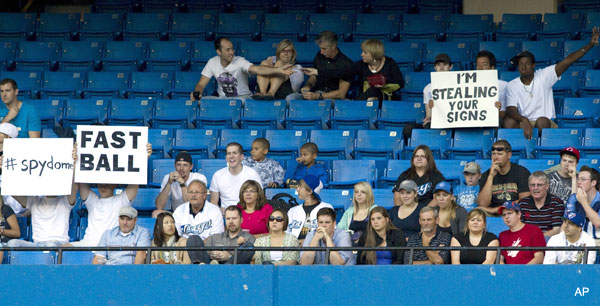
Ethics Alarms Baseball Ethics Special Report: The Boston Red Sox, Sign Stealing, Technology, And Cheating [UPDATED]

[I got the news about Major League Baseball’s announcement that the Boston Red Sox had admitted that some of the team’s employers and players had engaged in illegal sign-stealing about an hour before the Sox-Blue Jays game was scheduled. My intent was to write the post about it last night after the game. The game, however, went 19 innings and lasted 6 hours. (The Sox won, and absent this scandal, it would have been a big news story itself, one of the most important victories of the year and one that set several team records.) So the post didn’t get written, and believe it or not, I have occasional priorities and commitments that take precedent over my profit and income free ethics blog. Thus I consider the multiple e-mails and Facebook messages I have received accusing me of ducking the issue less than amusing, an unwarranted attack on my integrity. To all of those individuals, most of whom barely read the news reports, I say, “Bite me.”]

Yesterday afternoon the New York Times broke the following story, which reads in part:

Investigators for Major League Baseball have determined that the Red Sox, who are in first place in the American League East and very likely headed to the playoffs, executed a scheme to illicitly steal hand signals from opponents’ catchers in games against the second-place Yankees and other teams, according to several people briefed on the matter.

The baseball inquiry began about two weeks ago, after the Yankees’ general manager, Brian Cashman, filed a detailed complaint with the commissioner’s office that included video the Yankees shot of the Red Sox dugout during a three-game series between the two teams in Boston last month.

The Yankees, who had long been suspicious of the Red Sox’ stealing catchers’ signs in Fenway Park, contended the video showed a member of the Red Sox training staff looking at his Apple Watch in the dugout. The trainer then relayed a message to other players in the dugout, who, in turn, would signal teammates on the field about the type of pitch that was about to be thrown, according to the people familiar with the case.

Baseball investigators corroborated the Yankees’ claims based on video the commissioner’s office uses for instant replay and broadcasts, the people said. The commissioner’s office then confronted the Red Sox, who admitted that their trainers had received signals from video replay personnel and then relayed that information to Red Sox players — an operation that had been in place for at least several weeks.

As reported by ESPN, Baseball Commissioner Rob Manfred said in a statement,

“We actually do not have a rule against sign-stealing. It has been a part of the game for a very, very long time. To the extent that there was a violation of the rule here, it was a violation by one or the other [team] that involved the use of electronic equipment. It’s the electronic equipment that creates the violation. I think the rule against electronic equipment has a number of policy reasons behind it, but one of them is we don’t want to escalate attempts to figure out what a pitcher is going to throw by introducing electronics into that mix.To the extent there was a violation on either side, we are 100 percent comfortable that it’s not an ongoing issue, that if it happened, it is no longer. I think that’s important from an integrity perspective going forward.”

This is a complicated story, and part of not one complicated ethics category, but several: technology ethics, baseball ethics, cheating, and general ethics. In the interests of clarity, I’m going to cover the story in a series of short observations, each with a heading. At the end of this post, I have posted a long published essay I authored about baseball ethics within the culture of the game. Those who are not familiar with these issues, which are fascinating, might want to read that first. it is helpful background information.

Points and Observations:

  • Traditional sign-stealing in baseball is not regarded as cheating. This seems counter intuitive because of the word “stealing.” Sign-stealing refers to teams decoding the signals given by the catcher to the pitcher (regarding what kind of pitches to throw and where ), and the coach or the dugout to a batter or baserunner (in bunt and hit-and run plays). Theoretically, knowing the other team’s signals provides an advantage, as to a batter who knows that the next pitch will be a curve rather than a fastball. Usually, signs from the catcher to the pitcher are in jeopardy when there is a runner on second base. He can see the catcher’s signs as well as the pitcher can. Catchers use finger-signs in various combinations to ask for various pitches, and position their gloves to indicate where they want the balls thrown. If the runner at second can signal to the batter what the catcher has told the pitcher to throw, the batter may have an advantage.

This is why catchers often go to the pitching mound when a runner is on second base. They change the signs. The second baseman will often join them, because it is his job to know what pitch is being thrown so he can signal (usually behind his back, using his hand) to his team’s outfielders. An outside fastball makes it unlikely that the batter will pull the ball, for example.

Sign-stealing on the field, using just eyesight and hands, is what players call “the game within the game.” Joe Girardi, the Yankee manager, said in an interview yesterday that he just assumes every team is trying to steal signs, whether they are or not. Continue reading

Morning Ethics Warm-Up, 9/6/17: Comey’s Premature Draft, Obama’s Golden Rule Breach, Newspapers “Protecting Us,”And Thank-You, Boston Red Sox


1 I want to sincerely thank the Boston Red Sox for giving me, the sole baseball ethicist on the web who also devotes a disturbing amount of his time, energy and passion to following the team, the challenge and opportunity to address a major cheating scandal involving the organization and institution I love. Seriously, guys, thank you. This is exactly what I needed to face after staying up past 1 AM watching the Sox pull out a 19 inning, 6 hour game on Hanley Ramirez’s bloop single to center.

I’ll cover the issue in the next post. Ugh.

2. Ironically, just as the anti-Trump news media was hyperventilating over the fact that the Special Counsel was examining a draft letter by the President regarding his reasons for firing James Comey (draft letters have minimal probative value if any, but you know: Trump), it came to light that in May of 2016, Comey had drafted a statement declining to charge Hillary Clinton or her staff in the State Department e-mail scandal, months before key witnesses (like Clinton herself) had been interviewed or much of the evidence had been reviewed. President Trump, of course, tweeted that this proved there was a “rigged process,” but Comey’s draft is no more incriminating that Trump’s draft. (Now, Loretta Lynch’s meeting with Bill Clinton might suggest a rigged process, but that’s another story.)

Supreme Court Justices have drafted opinions before oral argument; that doesn’t mean they can’t change their minds. It is certainly odd that Comey would have drafted a statement that Clinton would not be indicted so long before the investigation was completed. It is odder still that Hillary’s interview was not under oath, that it wasn’t videotaped, that there was no transcript, and that she was allowed to have representing her as an attorney at the session a top aide who was also a potential witness.

Professor Turley, in a column at The Hill, agrees that the early draft doesn’t implicate the integrity of the investigation, but raises a related issue:

While I am inclined to accept assurances from Comey that he did not finally decide on charges until after reviewing all of the evidence, the details from the Clinton investigation hardly support a view of a robust and dogged effort in comparison to the type of investigation of people like Paul Manafort.

In pursuing Manafort, special counsel Robert Mueller has now enlisted an army of investigators, reached a cooperative relationship with staunch Trump critic New York Attorney General Eric Schneiderman, and actively pursued tax and financial dealings far afield of the original Russian collusion allegations. He also ordered a heavy-handed (and unnecessary) “no knock” search in the middle of the night on Manafort’s home.

The Clinton investigation looks like Club Fed in comparison. Clinton and her staff refused to cooperate with State Department investigators seeking confirm any damage to national security. Key laptops were withheld and only turned over after Comey’s staff agreed to destroy the computers after their review, despite the relevance of the evidence to congressional investigations. Comey then cut five immunity deals with key Clinton staff members, including former State Department staffer, Bryan Pagliano, who set up a server in Clinton’s home in Chappaqua, N.Y., and worked for her at the State Department.

Pagliano refused to cooperate after invoking his Fifth Amendment right against self-incrimination and destroyed evidence after being given a preservation order. Those deals raised the concern over a type of prosecutorial planned obsolescence, making a viable case less likely.

The amusing part is that all of this circles back to Comey’s firing, which was justified by his handling of the Clinton investigation regardless of any other factors.

3. The New York Times today reviews a festival play called “___hole.” That’s not really the title, however, although “___hole” was printed twice as the play title before the Times made this clear. A comment by the reviewer noted that the real title couldn’t “get past the editors.” Continue reading

How To Get Fired And Deserve It, By Washington Post Writer Fredrick Kunkle

I’m sure some will consider Washington Post writer  Fredrick Kunkle some kind of a hero, a whistleblower and a truth-teller. He isn’t.

Kunkle authored a frontal attack on his boss, Post owner and Amazon gazillionaire Jeff Bezos, in another publication, the Huffington Post. He doesn’t allege any illegal activity or genuine abuse. he just doesn’t like the way Bezos runs his business. His screed, and it is a screed, comes down to a labor vs management, anti-capitalist, crypto-Marxist bill of particulars arguing that Bezos has so much money he should spread more of it around to his employees.  Probably he should, but an employee who is being paid by such an individual is not ethically situated to make that accusation in public. This is disloyalty, and an intentional effort to harm his employer.

‘Bye!

What seems to have set Kunkle off was Bezos asking his Twitter follower how he should expand his philanthropic efforts:

But as Bezos, whose worth now exceeds $80 billion, loosens his pockets, it’s important to put his charitable giving — and the philanthropy of the super-rich — into perspective: Many people worked hard for Bezos to help make him so rich, and he has a record of treating them poorly. Amazon’s history of dodging taxes, its mistreatment of workers, and its ruthlessness toward even the smallest competitors have been well documented. It put ambulances outside distribution centers rather than install adequate air conditioning. It broke up a union organizing effort by closing the call center and dismissing everyone who worked there. The New York Times documented its punishing work environment in a front-page exposé. The company’s actions, as Forbes put it, hark back to an earlier time when workers were treated as “replaceable cogs in the machine.”  

“Replaceable cogs in the machine” means “if you don’t like it here, there are many equally qualified people who would love to have your job.” That is certainly true of the struggling newspaper industry. He calls his boss a tax dodger (if you avoid taxes using legally available means and laws, you aren’t “dodging” anything); ruthless, an abuser of workers, and most questionable of all, uses a New York Times  exposé as gospel. The Times is the Post’s rival. Its hit pieces on Bezos are hardly objective; heck, almost nothing the Times writes is objective (nor the Post, for that matter.) Continue reading

Morning Ethics Warm-Up, 9/2/17: Keith Olbermann Tweet, The Rifleman On The Melting Pot, and What The Editors Of the New York Sun REALLY Wanted to Tell Little Virginia…

GOOOOOD MORNING!

1. For some strange reason AMC and the Sundance movie channel alternate showing multiple episodes of “The Rifleman” every Saturday morning. Like most of the old TV Westerns, but even more than the rest, the Chuck Connors half-hour drama about a single-father rancher who doubled as part-time lawman was about ethics, despite the fact that Chuck as Lucas McCain killed over almost tw0-hundred men over the course of the show. In one of today’s episodes, young Mark, Rifleman Jr., played by the excellent child star Johnny Crawford, fought off some bullies who were abusing a young Chinese boy who was dressed in his native clothes and wearing long hair. As the boy’s father thanked Lucas and  Mark, the Rifelman pointed out that the boy would be tormented as long as he wore his hair “like that.” “His hair is worn in the manner accepted in my country,” the father replied.

“Yes, but you’re not living in China, you’re living in the United States,” Chuck said, wrinkling his brow.

That message was not a controversial one in 1880, or in 1960, but it would be today. Still, The Rifleman was right. There is cultural pressure on immigrants to accept and adapt to U.S. culture and values, and that is for the benefit of everyone involved.  Mark made it clear that he would keep fighting for the right of the young Chinese boy to wear his hair as he chose and Chuck endorsed that, because it’s another American core value. Still, being an American citizen should mean more than just an address. Our culture used to send that message powerfully and regularly, in TV dramas and elsewhere. Now it sends the opposite message most of the time. That’s a tragic change, and the results are becoming apparent.

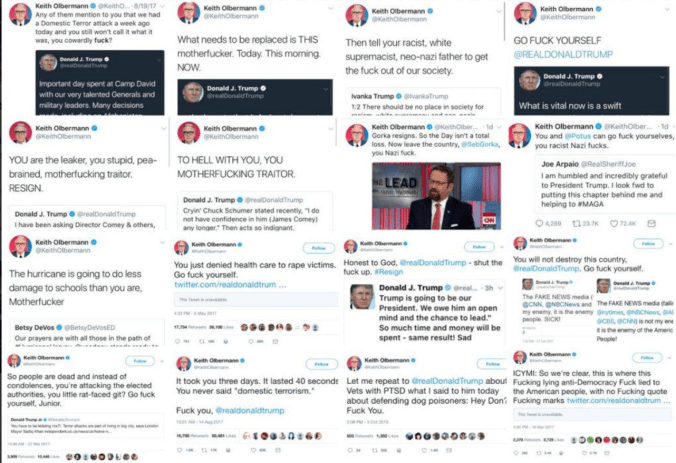
2. Now THIS is an uncivil tweet: The degree to which the unhinging of the Trump-hating left has reached frightening proportions was illustrated last week by a tweetstorm meltdown by onetime MSNBC star Keith Olbermann, who is still anchoring a public affairs commentary show somewhere, I think. It reached its apotheosis with this masterpiece or reason, nuance, and civility:


Olbermann finally took down the tweet, but the rest remained:

I don’t think Olbermann is significantly more addled by blind rage at Trump’s election than a large number of prominent journalists, editors, academics, professionals and others, or more emotional in his hate.  He  just has less restraint than most in giving vent to it, that’s all. Continue reading