1 Derangement test! As I write this, Washington, D.C. is on high anxiety alert over whether there will be a government shutdown due to Senate Democrats staging a tantrum over DACA. Previous shutdowns, stupid all, and all ultimately a disaster for the party that triggered them, the Republicans, at least involved a dispute over the budget, which we call a “nexus.” In this one, however, the triggering party is the Democrats, who are grandstanding to their increasingly radical base, declaring the interests of about 800,000 illegal immigrants as a higher priority than the interests of the law-abiding citizens of this country who are not obsessed with “Think of the children!” and the imaginary right of foreigners to cross into the country illegally and stay here as long as they don’t rape someone and blow their “good illegal immigrant” status.
Essentially the Democratic leadership has decided to test the question of how many Americans have had their brains and values scrambled by the emotion-based pro-illegal immigration argument battered into their heads by the progressive/maintsteam news media coalition. Oh…there’s also their collateral justification of “We can’t make a deal with the President because he used a bad word in a private meeting, or so some say.”
Since both Nancy Pelosi and Senate Minority Leader Chuck Schumer have their unequivocal condemnation of the very same tactic they are now engaging in on videotape, they must really be convinced that social justice warrior cant now infests the population. Well, maybe they are right. Maybe they aren’t as incompetent as I think they are, and their flip-flop won’t strike anyone else as cynical and proof of an integrity deficit.
If a party is successful, even once, using this extortion tactic to pass legislation, then the legislative process will have officially collapsed. Democrats—this shut-down is a unilateral offense, not another “everyone is to blame” fiasco—signaled their emergence as a protest organization rather than a responsible party in 2016 when they held a sit-down strike in the House to try to force the unconstitutional measure of banning gun ownership for citizens placed without due process on FBI no-fly lists. If Republicans allow such a tactic to succeed now, however, they will share the Ethics Dunce honors.
And, of course, will use the tactic themselves when the time is ripe.
Let’s see if sufficient numbers of Democrats have their brain cells and values in sufficient good health to tell their representative that those DACA kids have their sentimental support, but not THAT much support, you idiots, don’t be ridiculous!
1 Golden Globes hangover I. Following up on a point made in yesterday’s Golden Globes post, presenter Natalie Portman’s much-praised but unfair innuendo that the directors nominated in the “best director” category were there because of gender bias rather than the quality of their work was an example of shooting the bystander rather than the villain. The fact that women don’t get the opportunities to direct major films that men do–as a result of many factors, none of which relate to the relative directing abilities of the two pools–is not the fault of the male directors who get the jobs, nor does the fact of discrimination make the films that women do get to direct inherently better and more award-worthy than they are.
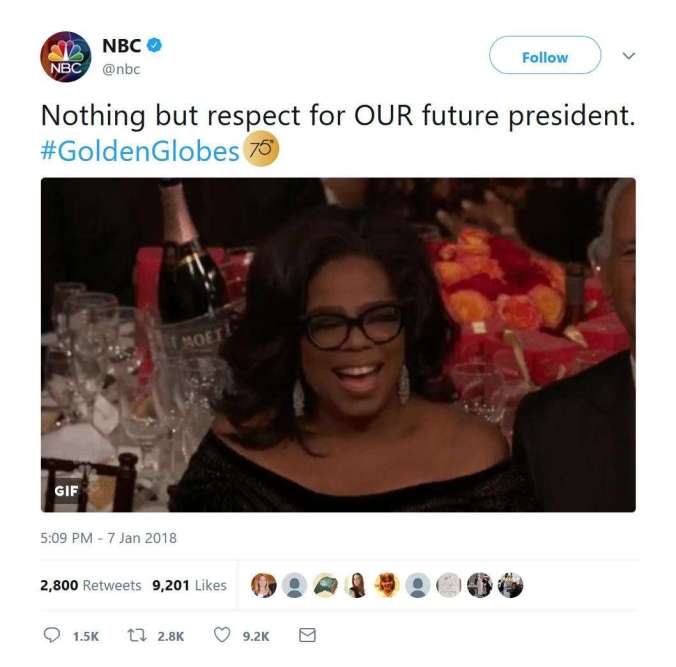
2. A Nation of Silly People. I warned that electing Donald Trump as President would eventually turn us into a Nation of Assholes, and that has come to pass with unexpected rapidity. I did not see the development resulting in the US becoming a nation of silly people, though that process was well underway already. The rush to anoint Oprah Winfrey as the savior of the Republic based on a speech at an entertainment awards show, however, is new evidence of the damage done to the nation’s values by the Trump trauma. Oprah is a cult, pop culture figure; a democracy deteriorating into a society where celebrities and cult leaders become political leaders was one of the fears expressed by our Founders. For the Left to embrace Oprah is stunning hypocrisy, after more than a year of (correctly) accusing Republicans of nominating a Presidential candidate with none of the qualifications traditionally required to be taken seriously as a contender for the office. Many unhealthy trends of long standing pointed to this eventuality,it is true: celebrity obsession, poor civic education, ignorance of history, and new age gibberish, plus the stunning absence of legitimate leaders in both political parties. Having followed O for a long time, since her days in Baltimore as a rising life-style reporter, I recognize a lot of warning signs regarding her ethical instincts, such as her addiction to talking about “personal truths,” which is just a sneaky way of endorsing “alternate facts,” her troubling anti-vaxx statements, her promotion of fake experts like Dr. Oz and Dr. Phil, her race-baiting, and more. There will be plenty of time to elaborate on these if and when her candidacy becomes more than a twinkle in E!’s eye. I doubt that we’ll get there, but as President Trump proved, you never know in the United States of America.
3. A “Nah, there’s no media bias against Trump” note: During the Golden Globes broadcast, NBC, that paragon of journalism integrity, tweeted this:
4. Fake news in irresponsible punditry. I have been meaning to write about this op-ed by New York Times “contributing opinion writer” Kashana Cauley for more than a week now, and the task has seemed so odious that I have avoided it. It is as bad an op-ed as I have ever seen, full of false assertions, misrepresentations , rationalizations and racial hate. I wonder when the New York Times editors reached the point where they would regard such trash as fit to be published under its banner. Rather than dissect the ugly thing as I originally intended, I’ll let you do the work, with me just pointing out some, but far from all, of the features that make this such unethical op-ed page content. Continue reading →
1 A solution to a perpetual problem. I do the mandatory introduction to legal ethics for two jurisdictions. Both are early in the morning,and both have courts monitoring them, insisting that to get credit, attendees must be present for every second of the course. The problem: late arrivals. One of my jurisdictions had a tendency to let late-comers in if it’s just a few minutes, but sometimes it gets ridiculous. Once the line is blurred, when does it get hard again? I have sen the administrators tell a lawyer that she is absolutely the last one who will get a break, only to see another late comer burst through the door panicked, upset, and with a doozy of an excuse…and then another, and another. This is especially ironic because lawyers are ethically required to be on time to court, or else.
In my other jurisdiction, they deal with the problem by absolute enforcement. 30 seconds late, and you have to come back next month. It doesn’t matter why, it doesn’t matter where the lawyer came from (one had flown in from Seoul and was two minutes late). If you arrive after the doors are closed at 9 am sharp, you can’t get credit. This, as you might imagine, often sparks tantrums, tears, threats, and “Do you know who I am?” One furious attendee actually cast a curse on every bar employee in sight. I’m talking about a real curse, right out of the movies, pointing and chanting. Some months we have had more than ten latecomers in the lobby, acting like an angry mob, and threatening a riot.
This jurisdiction has solved the problem by recently telling all who need the course on the bar website and in email messages that the program begins at 8:30 am, when it really doesn’t. In other words, the solution is a lie: if someone arrives at 8:59, there’s no problem.
Is this ethical?
2. Oh, this was obviously going to be an ethics rain wreck long ago. AG Sessions announced that the Justice Department would not be following the Obama Administration’s policy regarding federal anti-pot laws—which is to say, it would not signal that it wouldn’t enforce the law. As a result, Corey Gardner, Republican Senator from happily stoned Colorado, announced that he would block any appointments to Justice until the Department charged with enforcing laws agrees to stop enforcing laws. What Sessions did is not the draconian reversal it has been represented as by the Angry Trump Hate Mob, Stoner Chapter. Read the order from Sessions here.
Never mind. Following the lead of California, which has officially announced that it will encourage breaches of the immigration laws, now Colorado wants to impede the functioning of national law enforcement to force the federal government to let another state veto drug laws. This is what we call “a dangerous and irresponsible trend.”
3. The Tragedy of Joanie Cunnningham. The New York Times Magazine ended the year with biographical sketches, including the sad story of Erin Moran, aka Joanie Cunningham on “Happy Days,” who died of cancer in 2017. It’s an all-too-typical story of a child star with a dysfunctional family who grew up on a set without ever receiving the parenting and support she needed to be able to become a functioning adult. I knew about Moran’s problems after the show ended; I did not know that her bitterness about her fellow cast members stemmed from her feelings as a child that her TV family was a substitute her real family, and that they failed her. Of course, the Cunninghams, Fonzie, Ralph and Potsie had no duty to become Moran’s surrogate family, but I am not surprised that a child actor would feel this way, especially one who was being neglected and mistreated at home the way Erin Moran apparently was. Interestingly, child actor advocate Paul Petersen has said that his TV mom and dad, Donna Reed and Carl Betz, did act as his surrogate parents in important and beneficial ways.
I continue to believe that using child performers before the age of informed consent is unethical. Continue reading →
1 Again I ask: how does democracy survive this? It is so discouraging to read about facts that “the public has a right to know,” that are”fit to print,” or that must be revealed if democracy is not to “die in darkness,” and know, know, that they will not be honestly or properly covered by the mainstream news media for purely partisan and ideological purposes. It is doubly discouraging to know that so many Americans are either so brainwashed or without integrity to begin with that they will defend this betrayal…and even attack those who try to let the truth out.
There was a story published earlier this week by Politico, which is largely left-leaning but a major source of political news on the web. It was thoroughly sourced, and thoroughly shocking.
It described how Obama administration secretly quashed efforts to stop Hezbollah from funding its operations through criminal enterprises in the United States, deliberately sabotaging US law enforcement’s efforts to fight terrorist drug and money laundering operations, by curtailing long-standing efforts to interdict cocaine shipments in the U.S. by Hezbollah, the terrorist organization closely allied with Iran.
The federal and international effort to root out Hezbollah’s crime network predated the Obama administration:
The campaign, dubbed Project Cassandra, was launched in 2008 after the Drug Enforcement Administration amassed evidence that Hezbollah had transformed itself from a Middle East-focused military and political organization into an international crime syndicate that some investigators believed was collecting $1 billion a year from drug and weapons trafficking, money laundering and other criminal activities.
But President Obama was determined to get his nuclear deal with Iran done in his second term, so this effort was suspended by executive directive. “This was a policy decision, it was a systematic decision,” said Politico’s on-the-record source David Asher, a Defense Department official charged with tracking Hezbollah’s worldwide criminal enterprise “They serially ripped apart this entire effort that was very well supported and resourced, and it was done from the top down.” Continue reading →
Studies show that although women have been entering the law in equal numbers to men for more than a decade, they make up just 23 percent of partners and 19 percent of equity partners. Why do so many women leave the legal profession at what should be the height of their careers? Last month, more than 160 lawyers gathered at Harvard Law School in November for the ABA National Summit on Achieving Long-Term Careers for Women in Law to identify answers and plot a course to change the trends.
Sharon Rowen, a lawyer from Atlanta, said her research showed three reasons women leave the practice of law: work/life balance, unconscious bias, and the pay gap. I wish I could have attended the discussion. I hope someone pointed out that seeking work/life balance is the major reason for the pay gap, and that it is not unreasonable to view that as a trade-off that is both fair and reasonable. Rowan’s list also leaves off conscious bias that pervades society and clients regarding female lawyers, as well as law firm partners.
Iris Bohnet, professor of public policy at Harvard Kennedy School, said some women suffer from “success fatigue,” and leave “because of a work culture that forces them to minimize important parts of their lives.” They ask themselves, “Can I bring my whole self to work?” and “Is this a place where I can thrive?” What she is saying is that a lot of women don’t find the law enjoyable, and that its stresses, patterns and requirements are more accommodating to men than women. In other words, law isn’t fun for a lot of women, while men, because of the nature of males, are more tolerant of it than women tend to be. I wonder if any panelist had the guts to come right out and say that? I doubt it. I bet most of them would deny it, because it’s politically incorrect to admit any gender differences, unless they involve female superiority. Continue reading →
This the second of the Comments of the Day on the post about the Great Cake Controversy; a third arrived last night, which will appear shortly. It was authored by the always provocative Mrs. Q—you can tell because she always uses ampersands. I used to turn them back into “and,” and then decided that this was a signature feature.
The three Comments of the Day on this topic are as different as they could be. I detest the Colorado baker controversy, because three people could have and should have avoided the whole thing, saved a lot of time, money, and ink, and just exhibited some empathy and proportion rather than avoiding the Golden Rule so emphatically. I detest it, but it certainly is a rich ethics subject.
When my wife & I were looking for wedding rings we stopped at a place where the owner after talking to us went on a strange rant about some NFL player who came out gay. The owner went so far as to physically mimic kissing another guy in telling his story, and shivering with wide toothed disgust at the thought. He didn’t say he wouldn’t sell us a ring, but obviously we didn’t want one from his store & the feeling was mutual.
We could have gone on Yelp and given the store a bad review or complain to someone who could “go after” him politically, but at the end of the day our relationship didn’t (doesn’t) need others affirmation. We were certainly hurt – not by his thoughts but the manner in which he shared his thoughts. Yet we picked our proverbial battle and let it go. Why? because we too are Christian and know no one person can ever really give us what we need. Hurt feelings can be gotten over and forgiveness heals wounds far faster than enacting revenge because someone doesn’t agree with us or what we do.
We have to ask what will be next. I don’t believe suddenly we’ll see “No Homo’s Allowed” signs on shops. And ultimately that’s not what I believe this case is about. Also I’m not convinced that these bakers are bigots either. Instead I suspect what this case is ultimately about religion and thought police. Orthodox Muslims having to make non-Halal foods, Jewish deli’s selling pork, Christians making Satanic themed confections. I’d rather see a few victim-minded SJW’s get butt-hurt than force others to sign off on what are ultimately another persons *private* beliefs. Forcing business owners to think as we wish sets a dangerous precedent while walking away from a shop not being affirmed only requires one to find another place to go. And honestly it’s fairly easy to find smug leftist affirmation at businesses. Yes…even in small towns too. Continue reading →
1 It’s a tradition, but still an embarrassment to democracy...Why isn’t this res ipsa loquitur, as in “so indisputable it ought to be embarrassing”? Rep. John Conyers, whose proclivity to engage in sexual harassment in full confidence that neither left-leaning reporters in the know (like Cokie Roberts ) nor his party’s leaders nor the victims themselves, would blow a whistle on a “civil rights icon” like him, is finally announcing a forced retirement. But he is attempting to anoint his oldest son, John Conyers III, as his successor. III has no special qualifications for elected office. He is a hedge fund manager and a business consultant whose famous father is part of his appeal to clients. The original John Conyers was used as a stepping stone to power by another unqualified family member using his name, III’s’ mother, former Detroit City Councilwoman Monica Conyers, was sentenced to 37 months in prison for bribery. She was released in 2013.
In a profanity and vulgarity-laced video III posted last year, he said in part,
“Third and fourth generations of Conyers running for office. It’s really crazy. My grandfather did an incredible job, man. Fuck. A lot of people stand on the sidelines of their own lives. It’s like you just watch that shit go by like, no, I don’t think I’m going to get in the game – that shit is short, man. Whatever you do, make sure you vote….Voting feels so good, like even if your person doesn’t win, like, it feels good. The craziest part about it all is that my dad really walked with Martin Luther King and got arrested for this shit, like, damn this shit is deep fam. I casted my vote and I was hype as shit, like, I voted, like, this is awesome and I am really thankful for people that died for that for me. Any race, whatever, it’s important to vote but I mean, like, especially African-Americans man, go vote because people really died for this shit. If you don’t know shit about a candidate, man, and you just want to vote like you can write your own name in there, but like the action of going to vote is so important.”
Or just vote for someone with a last name you recognize! He sounds like a winner to me! One hurdle: Democratic Michigan State Sen. Ian Conyers, the congressman’s great-nephew, announced his intention to run for the open seat.
This is a long, long blight on American democracy that makes me wonder if we’re really up to it. The number of voters in both parties who are so shallow, lazy, and foolish as to assume that merely being related to a famous or popular leader is sufficient reason to elect him or her is disgraceful, but it has always been thus. Among those who never would have made it into a high office without this factor are Mary Bono, Jesse Jacskon, Jr. (currently in prison), Lindy Boggs, Lurleen Wallace, Margaret Chase Smith, Robert Taft, George W. Bush, Bobby Kennedy, Ted Kennedy, Robert Kennedy Jr, Joseph Kennedy III, Joe Kennedy II, Kathleen Kennedy Townsend—anyone named Kennedy, really—current Rep. Doris Matsui (D-Cal.), Al Gore, and Hillary Clinton. There are many, many more.
A last name is not a qualification for office. Why should that even have to be pointed out in a nation founded upon the rejection of royalty?
The topic of the evening was fake news and government manipulation of it, as the Clinton era film about a phony war being launched by a President to distract from a scandal is a fascinating one to ponder through the rear view mirror. Hoffman, one of the stars of the film, recently became one of the few dubious victims of a #MeToo-er, as he was accused of groping and sexually harassing a 17-year old woman on the set of another film in 1985. Unlike most of the celebrities and power-brokers run over by the Harvey Weinstein Ethics Train Wreck, Hoffman has not had other accusers surface. He denies the woman’s characterization of what happened, and so have others, like the director of the movie in question, the filmed version of Hoffman’s Broadway turn as Willie Loman in “Death of Salesman.”
I have read fans of Oliver saying that Hoffman should have assumed that Oliver would grill him on the allegations, to which I say, “Only if Hoffman realized what a knee-jerk progressive creep Oliver is.” I think the actor assumed that Oliver was an honorable professional, and as a moderator wouldn’t hijack the discussion to embarrass Hoffman and burnish his feminist creds.
To Hoffman’s credit, he stood up to the abuse of position by Oliver and defended himself. At one point, there was this exchange:
HOFFMAN: “Do you believe this stuff you read?
OLIVER: Yes. Because there’s no point in (the accuser) lying.”
HOFFMAN: Well, there’s a point in her not bringing it up for 40 years.
OLIVER: Oh Dustin…
I would have said,
“Don’t “Oh, Dustin” me, you arrogant, posturing ass. The fact that a complaint isn’t made for that much time automatically makes it dubious. It places the accused in an impossible position; evidence has evaporated, and memories have faded. There are many reasons to lie. To get publicity, To get revenge for some real or imagined slight. To bring down someone famous or powerful. To join a mob—and regardless of the fact that the post-Weinstein focus on legitimate sexual misconduct in the workplace has created needed awareness and exposed long-time abusers, it is a mob, with all of the capacity a mob has to harm the innocent in its self-righteousness. You are playing to the mob right now, and willing to unjustly smear me to do it. You’re a disgrace.”
John Ziegler quoted a Hollywood writer who knows Hoffman and is convinced he is innocent, who said,
“Someone should tell John Oliver he’s the true heir to Joe McCarthy!Sex abuse baiting has replaced red-baiting. The ‘Sexual Blacklist’ reigns supreme. Guilty until ruined!”
Let me also remind readers that my hypothetical illustrating how a woman might retroactively decide that what she did not regard as sexual harassment years ago was harassment now was mocked by both the moderator and a Georgetown law professor during the NPR panel I participated in last week.
I am right, they are biased.
The more I think about that exchange, the more ticked off I get….
1 This is weird…The Wisconsin Supreme Court has upheld a mother’s conviction for swearing at her son. Ginger Breitzman had been found guilty of child abuse, including one count was for profanely berating and insulting her 14-year-old son after he burned some popcorn. The boy had been talking to a friend at the time, who heard the tirade over the phone and reported it. The mother was sentenced to six months in jail. Apparently the First Amendment was never raised as a defense, and an issue is whether it should have been and had to be.
I don’t see how a parent or anyone can be convicted of a crime based on the content of her speech, especially private speech, but it is a gray area in ten context of child abuse. In sexual harassment, the content of one’s speech can create a hostile work environment, but the civil violation is for the act of creating the hostility, not the speech itself. In many cases, that’s a distinction without a difference, though. A supervisor using the term “cunt” in the workplace is probably harassment, no matter how or to whom he uses it.
Check the link and the mother’s mug shot. I wouldn’t want to have her mad at me…
2. Joy Reid being hateful? I’m shocked—shocked! MSNBC’s serial race-baiting, hate-spewing host Joy Reid found herself huminahumina-ing after someone tracked down her old blog and found multiple examples of gay-bashing on it. Notably, she mocked GOP Florida Governor Charlie Criss, a married man who has been rumored to be a closeted gay, as “Miss Charlie.” What do you think of her apology?
This note is my apology to all who are disappointed by the content of blogs I wrote a decade ago, for which my choice of words and tone have legitimately been criticized.As a writer, I pride myself on a facility with language — an economy of words or at least some wisdom in the selection. However, that clearly has not always been the case.In 2007 I was a morning talk radio host and blogger, writing about Florida politics (a blog I maintained until 2011.) Among the frequent subjects of my posts was then-governor Charlie Crist, at the time a conservative Republican, whose positions on issues like gay marriage and adoption by same-sex couples in Florida shared headlines with widely rumored reports that he was hiding his sexual orientation. Those reports were the subject of lots of scrutiny: by LGBTQ bloggers, writers and journalists, conservative blogs, a controversial documentary film called “Outrage,” and even by the comedic writers at South Park. But it was my own attempt at challenging Crist on my blog that has now raised the issue of not just my choice of words, but what was and is in my heart.
Let me be clear: at no time have I intentionally sought to demean or harm the LGBT community, which includes people whom I deeply love. My goal, in my ham-handed way, was to call out potential hypocrisy. Nonetheless, as someone who is not a member of the LGBT community, I regret the way I addressed the complex issue of the closet and speculation on a person’s sexual orientation with a mocking tone and sarcasm. It was insensitive, tone-deaf and dumb. There is no excusing it – not based on the taste-skewing mores of talk radio or the then-blogosphere, and not based on my intentions.
In addition to friends and coworkers and viewers, I deeply apologize to Congressman Crist, who was the target of my thoughtlessness. My critique of anti-LGBT positions he once held but has since abandoned was legitimate in my view. My means of critiquing were not. In the years since I went from blogger to opinion journalist, I have also learned, through brilliant friends and allies in the LGBT activist community, how to better frame my critiques of those who challenge people’s right to love who they want, marry them, and walk in the world as fully free people.
Re-reading those old blog posts, I am disappointed in myself. I apologize to those who also are disappointed in me. Life can be humbling. It often is. But I hope that you know where my heart is, and that I will always strive to use my words for good. I know better and I will do better.
It’s not terrible. I’ll give her a #6 on the Apology Scale: ” A forced or compelled [apology], when the individual (or organization) apologizing knows that an apology is appropriate but would have avoided making one if he or she could have gotten away with it.” I doubt that it’s sincere, because of lots of clues in the text. She says she deeply apologizes to Christ, then says her criticism was legitimate. She was presuming hypocrisy on the basis of rumors: how is that legitimate? She sucks up to the LGBT community; she says that at “no time have I intentionally sought to demean or harm the LGBT community,” when her rhetoric obviously was intended to demean Crist based on his presumed homosexuality; she sneaks in an “everybody was doing it” excuse. Continue reading →
1 Self promotion Dept. I’m going to be back on NPR (WBUR, D.C.) in what I think is a live panel discussion (“Barbershop” is the show—I wonder what a ‘barbershop” is? ) hosted at 5: 30 pm, EST by the estimable Michel Martin. The topic is The Harvey Weinstein Ethics Train Wreck, though that’s not what they’ll be calling it.
2. “For every time, Spin Spin Spin, there is a season..” I may mention this New Republic article, or at least be ready to torch a fellow panelist who cites it favorably. The tortured reasoning of writer David Dayen led him to assert that the “sexual harassment crisis” resulted from ” a broken justice system.” Let me summarize it for you: men harass women in the workplace because it’s too hard to convict people and put them in jail. When did liberals start being the ones who want to dispense with civil rights protections and due process assurances in court?
“But we should identify the real culprit for this state of affairs: the long, slow abandonment of the rule of law in America. The reason adjudicating sexual misconduct claims has been left to the media and the crowd is that people have no expectation that the legal system will adjudicate those claims fairly. How can anyone blame them? They have witnessed endless instances of powerful people, mostly wealthy men, getting away with criminality and deception, in every context imaginable. When you don’t have a working justice system, you get a kind of vigilantism as a result. The problem isn’t the vigilantism—it’s the broken framework that leads desperate people to take matters into their own hands. That powerful people face little sanction for misbehavior is an old story, as true in gender as it is in class. But brazen impunity for the powerful is a hallmark of our era. The worst financial crisis in America in nearly a century led to practically no convictions for those whose actions facilitated the meltdown. The Catholic Church shuttled around sex-abusing priests for decades with little reckoning. Cops shoot black people and go back on the job….”
None of this has much to do with sexual harassment, which isn’t a crime, and the three examples cherry-picked by Dayen don’t support his stated argument. The Wall Street wheeler-dealers operated primarily within loopholes and gray areas in the laws and regulations. There were few convictions because it was hard to prove that laws were broken. When the molesting priests were identified, still living, and in the U.S., many were sent to prison. (That the Catholic Church behaved abysmally doesn’t show that the U.S. justice system is broken, obviously). And “Cops shoot black people and go back on the job” is deceitful, simple-minded agitprop. Colin Kaepernick, is that you?
The article is a desperate and clumsy attempt at ethics jujitsu, with the recent exposure of progressive hypocrites as sexual predators being flipped to pivot to the talking point that “everything is rigged against the poor, blacks and women.” What Dayen ends up arguing is that we need to make it easier to prove criminal guilt when we just know the defendants are bad dudes (white, male and rich) —shouldn’t that be enough?— and all the “beyond a reasonable doubt” stuff should be junked…except when black “non-violent drug offenders” are involved.
3. It’s still illegal. Fark.com called this story “a woman being arrested for mothering while black.” Nice. David Dayen, is that you? Continue reading →
Yesterday, faced with the prospect of a tiny Thanksgiving, which I find only reminds me of the former table-mates lost forever, and having the extra excuse of our wedding anniversary, Grace and I decided to take our increasingly otherwise occupied son and have Thanksgiving dinner at the Prime Rib, a ridiculously expensive restaurant. The meal was lovely and low stress for a holiday dinner, a feature especially welcome right now.
The restaurant was filled with family groups without kids, many in gowns and formal wear. Also filling the air was happy banter of the sort that holidays typically inspire. Over to my right, however, sat a well-dressed man in his late 60s or seventies, dining alone. I found myself thinking about him throughout the meal. What a lonely, solitary, depressing way to celebrate Thanksgiving, I thought. If I get to the state where I am so bereft of family and friends that I find myself in a five-star restaurant dining alone on Thanksgiving, just hit me over the head with cinder block. He looked a little like Alan Greenspan, and I still felt terrible for him.
After dinner, and he had left the restaurant, I mentioned all of this to my wife.
“I was thinking the same thing,” she said. “We should have invited him to join us.”
Ugh. I had considered that. But our family gets the opportunity to eat together so seldom, and this was an anniversary celebration too. My son also has a tendency to clam up around strangers, and he seemed relaxed and happy for a change. I had quickly talked myself out of even raising the possibility of inviting a fourth to our Thanksgiving/ 37th Anniversary table.
Yet of course that’s what we should have done, isn’t it? Isn’t it? Maybe the man was having a great time by himself. Maybe we would have embarrassed him. Heck, I don’t know. It’s also possible that he would have jumped at the chance. Who knows? All I do know is that I would have appreciated the offer, and will, unless someone gets behind me with the cinder block before I have the chance. It was still the kind, considerate, compassionate, ethical thing to do.
“Next time, let’s make sure we invite someone like that,” Grace said. I agreed.