Comment of the Day: “Important Note on the News Media’s War on President Trump”

Yesterday was another Axis media freak-out day over Trump Administration II. The first hundred days were officially over, thus it was a fine time for the Trump Deranged pimping for a socialist future and trying to pretend that they hadn’t propped up a fake President for four looooong years to tell us the nation is doomed because this time we know who is President and he is orange Hitler-Satan. It was really quite a spectacle, almost screaming-at-the-sky-level nuts. I regret not posting Chris Marschners excellent Comment of the Day on tariffs then for contrast. It’s clear that the vast, vast, vast number of your progressive friends and mine literally don’t know what the hell they are talking about regarding tariffs, and the news media most people are likely to read as well as broadcast news regard the topic as the equivalent of a public reading of Proust. So all the whiners in the echo chamber know is that tariffs are bad. Then again, today’s doomsday chorus is almost as vocal as yesterday. Let’s see…there are at least eleven “Trump is a monster and going to destroy us” headlines on the New York Times home page if you count cleverly deceptive ones like In an Uncertain Economy, McDonald’s Sees Spending Decline. (McDonald’s has been charging obscenely high prices for crummy food since Democrats inflicted higher minimum wages on their unskilled workforce and inflation spiked during Biden’s presidency, so the “spending decline” has nothing to do with Trump. I’ve declined to go to a nearby Mickey D’s when I want a quick semi-edible meal since in 2022…)

Here is Chris’s Comment of the Day on the post, “Important Note on the Newsmedia’s War on President Trump”:

***

Americans in general have become spoiled. They do not seem to want to look beyond the immediate present to consider what is best for the nation in the long term.

[Commenter] Marrissa said “Everyone including people who love Trump want a good economy, low prices, and not have our important information leaked by someone who knows better.”

The question is at what cost? Low prices come at a cost to someone. Every dollar we give to China is one more they use to advance their Belt and Road strategy of global dominance. We fought a war here over the issue of slavery because it was at our doorstep but today we turn a blind eye to factory farms of China on which people are virtually imprisoned so we can get low prices on all sorts of products. I suppose it is not that we are against slavery we just don’t want to see it.

Just ten years ago the MXN Peso was worth about a dime and it is now worth less than a Nickel which means goods produced there cost half as much in terms of dollars. How is that possible if the US trade deficit with Mexico has exploded in that time frame? Demand for Mexican goods drive the value of a countries currency. The answer is foreign government manipulation.

What exactly does a good economy look like? Does it mean full employment even if that employment means part time work in multiple jobs or does it mean a balance between temporal value creation in service work and long term value creation in manufacturing. I say it means the latter even if it requires periodic realignments of resources between industrial production.

[Commenter Extradimensional Cephalopod] stated “People don’t like Trump because he seems almost actively hostile to the idea of demonstrating foresight and conscientiousness, even when it would work out better for his actual goals and his public image.”

How can EC say this? Is EC privy to the President’s deliberations? Trump had four years to develop a strategy and the say that he is hostile to demonstrating foresight and conscientiousness comes only from what he is able to glean from news reports. The exact same argument can be turned around on Trump’s critics because they are only looking toward the next election and not the impact on future generations.

EC questions the use of tariffs but there are few other tools in a presidential arsenal to limit the amount of American wealth being transferred to the CCP. How effective would moral suasion work on the American people with a fireside chat by Trump explaining the need to buy American products to protect our industries? It wouldn’t. Every country believes its consumers are an economic asset. Every dollar they spend on domestic goods and services directly benefits the domestic economy. Imports are treated as wealth leakages. We try to offset our wealth leakages with our exports that brings new wealth to our economy.

Much ink has been spilled condemning the tariffs but very little on some of the positive effects.

U.S.-based investments in President Trump’s second term:

Source: TRUMP EFFECT: A Running List of New U.S. Investment in President Trump’s Second Term – The White House

  • Project Stargate, led by Japan-based Softbank and U.S.-based OpenAI and Oracle, announced a $500 billion private investment in U.S.-based artificial intelligence infrastructure.
  • Apple announced a $500 billion investment in U.S. manufacturing and training.
  • NVIDIA, a global chipmaking giant, announced it will invest $500 billion in U.S.-based AI infrastructure over the next four years amid its pledge to manufacture AI supercomputers entirely in the U.S. for the first time.
  • IBM announced a $150 billion investment over the next five years in its U.S.-based growth and manufacturing operations.
  • Taiwan Semiconductor Manufacturing Company (TSMC) announced a $100 billion investment in U.S.-based chips manufacturing.
  • Johnson & Johnson announced a $55 billion investment over the next four years in manufacturing, research and development, and technology.
  • Roche, a Swiss drug and diagnostics company, announced a $50 billion investment in U.S.-based manufacturing and research and development, which is expected to create more than 1,000 full-time jobs and more than 12,000 jobs including construction.
  • Eli Lilly and Company announced a $27 billion investment to more than double its domestic manufacturing capacity.
  • United Arab Emirates-based ADQ and U.S.-based Energy Capital Partners announced a $25 billion investment in U.S. data centers and energy infrastructure.
  • Novartis, a Swiss drugmaker, announced a $23 billion investment to build or expand ten manufacturing facilities across the U.S., which will create 4,000 new jobs.
  • Hyundaiannounced a $21 billion U.S.-based investment — including $5.8 billion for a new steel plant in Louisiana, which will create nearly 1,500 jobs.
    • Hyundai also secured an equity investment and agreement from Posco Holdings, South Korea’s top steel maker.
  • United Arab Emirates-based DAMAC Properties announced a $20 billion investment in new U.S.-based data centers.
  • France-based CMA CGM, a global shipping giant, announced a $20 billion investment in U.S. shipping and logistics, creating 10,000 new jobs.
  • Merck announced it will invest $8 billion in the U.S. over the next several years after opening a new $1 billion North Carolina manufacturing facility.
  • Clarios announced a $6 billion plan to expand its domestic manufacturing operations.
  • Stellantis announced a $5 billion investment in its U.S. manufacturing network, including re-opening its Belvidere, Illinois, manufacturing plant.
  • Regeneron Pharmaceuticals, Inc., a leader in biotechnology, announced a $3 billion agreement with Fujifilm Diosynth Biotechnologies to produce drugs at its North Carolina manufacturing facility.
  • NorthMark Strategies, a multi-strategy investment firm, announced a $2.8 billion investment to build a supercomputing facility in South Carolina.
  • Chobani, a Greek yogurt giant, announced a $1.2 billion investment to build its third U.S. dairy processing plant in New York, which is expected to create more than 1,000 new full-time jobs — adding to the company’s earlier announcement that it will invest $500 million to expand its Idaho manufacturing plant.
  • GE Aerospace announced a $1 billion investment in manufacturing across 16 states — creating 5,000 new jobs.
  • Amgen announced a $900 million investment in its Ohio-based manufacturing operation.
  • Schneider Electric announced it will invest $700 million over the next four years in U.S. energy infrastructure.
  • GE Vernova announced it will invest nearly $600 million in U.S. manufacturing over the next two years, which will create more than 1,500 new jobs.
  • Abbott Laboratories announced a $500 million investment in its Illinois and Texas facilities.
  • AIP Management, a European infrastructure investor, announced a $500 million investment to solar developer Silicon Ranch.
  • London-based Diageo announced a $415 million investment in a new Alabama manufacturing facility.
  • Dublin-based Eaton Corporation announced a $340 million investment in a new South Carolina-based manufacturing facility for its three-phase transformers.
  • Germany-based Siemens announced a $285 million investment in U.S. manufacturing and AI data centers, which will create more than 900 new skilled manufacturing jobs.
  • Clasen Quality Chocolate announced a $230 million investment to build a new production facility in Virginia, which will create 250 new jobs.
  • Fiserv, Inc., a financial technology provider, announced a $175 million investment to open a new strategic fintech hub in Kansas, which is expected to create 2,000 new high-paying jobs.
  • Paris Baguette announced a $160 million investment to construct a manufacturing plant in Texas.
  • TS Conductor announced a $134 million investment to build an advanced conductor manufacturing facility in South Carolina, which will create nearly 500 new jobs.
  • Switzerland-based ABB announced a $120 million investment to expand production of its low-voltage electrification products in Tennessee and Mississippi.
  • Saica Group, a Spain-based corrugated packaging maker, announced plans to build a $110 million new manufacturing facility in Anderson, Indiana.
  • Charms, LLC, a subsidiary of candymaker Tootsie Roll Industries, announced a $97.7 million investment to expand its production plant and distribution center in Tennessee.
  • Toyota Motor Corporation announced an $88 million investment to boost hybrid vehicle production at its West Virginia factory, securing employment for the 2,000 workers at the factory.
  • AeroVironment, a defense contractor, announced a $42.3 million investment to build a new manufacturing facility in Utah.
  • Paris-based Saint-Gobain announced a new $40 million NorPro manufacturing facility in Wheatfield, New York.
  • India-based Sygene International announced a $36.5 million acquisition of a Baltimore biologics manufacturing facility.
  • Asahi Group Holdings, one of the largest Japanese beverage makers, announced a $35 million investment to boost production at its Wisconsin plant.
  • Cyclic Materials, a Canadian advanced recycling company for rare earth elements, announced a $20 million investment in its first U.S.-based commercial facility, located in Mesa, Arizona.
  • Guardian Bikes announced a $19 million investment to build the first U.S.-based large-scale bicycle frame manufacturing operation in Indiana.
  • Amsterdam-based AMG Critical Minerals announced a $15 million investment to build a chrome manufacturing facility in Pennsylvania.
  • NOVONIX Limited, an Australia-based battery technology company, announced a $4.6 million investment to build a synthetic graphite manufacturing facility in Tennessee.
  • LGM Pharma announced a $6 million investment to expand its manufacturing facility in Rosenberg, Texas.
  • ViDARR Inc., a defense optical equipment manufacturer, announced a $2.69 million investment to open a new facility in Virginia.

That doesn’t even include the U.S. investments pledged by foreign countries:

  • United Arab Emirates announced a $1.4 trillion investment in the U.S. over the next decade.
  • Saudi Arabia announced it intends to invest $600 billion in the U.S. over the next four years.
  • Japan announced a $1 trillion investment in the U.S.
  • Taiwan announced a pledge to boost its U.S.-based investment.

I don’t recall the media making much about this at all.

I challenge those who believe that Trump is leading us down a road to ruin with tariffs to put forth an alternative. If we would have recommended that all goods imported into the United States meet our stricter environmental and workplace safety standards in lieu of tariffs it would mean that virtually no Chinese goods could enter our consumption stream. Electric vehicles would become impossible to produce because the costs of extracting the raw materials would be prohibitively expensive without the child labor employed. Global workers would have to be paid in accordance to our minimum wage laws. We can’t have that either because we all want more stuff at the lowest possible price. Our grandkids be damned. Let them pay the bill.


How Dishonest Is Harvard? Here’s a Clue…

My Spring edition of the Harvard alumni magazine just arrived. It was clearly written before Trump’s assault on the school had reached its current zenith, but the magazine’s spinning away of Harvard’s various ethical transgressions was still in evidence, as it always is.

I found one feature more head-exploding than the rest. An alum of recent vintage mocked a previous issue essay warning that Harvard’s “financial foundations” were “at risk” of being “shattered” because of Trump’s barbarians in Washington breaching the metaphorical gates. Pointing to his alma mater’s approximately 53 billion dollar endowment, the contrarian grad wrote, “Given the general Harvard ethos that taxing the rich is a virtue, you would think that taxing the richest—-Harvard—would be embraced, not cause for alarm. What hypocrisy.”

The editor tit-tutted that the writer was mistaken, because Harvard’s endowment per student was less than some other institutions, such as Princeton. Oh. What a neat way to minimize the size of an massive endowment! Amusingly, another letter in the same issue suggested that Harvard use that device, endowment dollars per student, to combat attacks, stating the endowment as “X dollars per student” rather than cumulatively.

Obviously, the staff adopted the suggestion immediately.

The YouGov. Poll: Maybe Americans Are Just Too Stupid and Unethical For Democracy to Survive After All…

All research indicates that the majority of Americans, not having the IQ’s of Pet Rocks, recognize that our bloated government is corrupt, inept and wasteful. Pew Research polling concluded that 56% of Americans felt that way last year. “Nearly 2/3 of Americans fear that our government is run by corrupt officials, stated another survey. In January, A.P.-NORC researchers found that 70% of Americans believe corruption in the federal government is a serious problem.

Despite these beliefs, only 39 % of Americans polled gave DOGE a “favorable” rating in the latest The Economist/YouGov poll, with”unfavorable” at 36%, and the human slugs who chose “don’t know” came in at a whopping 25%. Another poll this month found only 49% approving DOGE’s cost-cutting efforts.

Continue reading

Surprise ! Open Forum!

September and October 2024 are going down in the ProEthics annals as the busiest months since the pandemic freakout and among the busiest months of ethics consulting I’ve had ever. What this means, I do not know, but today, once again, I have legal training session that will occupy my attentions this morning. Thus I am opening the weekly free-for-all a day early.

The big news, but with no details yet, is that New York City Mayor Eric Adams is about to be indicted. I expected this, not necessarily with Adams but with one or more of the horrible crop of arrogant, autocratic Democrat mayors who run so many of our major cities. They have a collective chip on their shoulders the size of El Capitan, most of them are “of color” and determined to make up for lost time and opportunity. I expect more of this: the Democratic Party has spawned a culture of corruption that is dangerous and increasingly difficult to hide.

Speaking of a culture of corruption, Paul Pelosi once again read tea leaves or something and guessed what the Feds were about to do to Visa, so he dumped $500,000 in the company’s stock two months before the company was sued for anti-competitive business practices. He has done a lot of this investment management magic since his wife has been a power in Congress. The X account “Nancy Pelosi Stock Tracker” flagged the trade when the Department of Justice filed its lawsuit against Visa, alleging that the company maintained an illegal monopoly over the U.S. debit card market.

Nothing to see here, move along…

But I digress. The ethics topics are up to you.

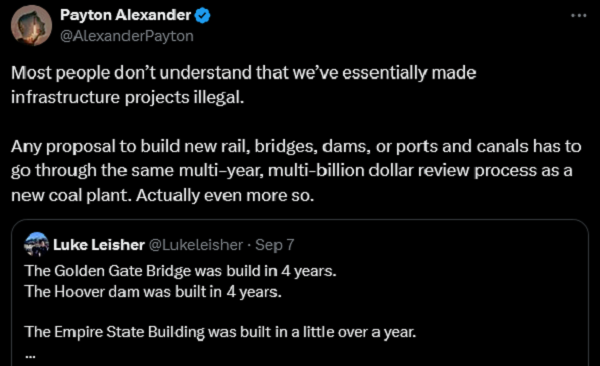
THIS Is Ethics Zugzwang: The Infrastructure Problem

The tweet above illustrates a modern ethics zugzwang phenomenon. I was struck by the tweet because I had recently had an argument with my relentlessly Democratic sister about the Supreme Court’s decision in Relentless v. Department of Commerce and Loper Bright Enterprises v. Raimondo, striking down the landmark 1984 decision in Chevron v. Natural Resources Defense Council that made federal agencies the presumptive lawmakers in matters Congress had not specifically addressed if an agency rule was “reasonable.” She believes that Chevron’s fall will be a disaster.

Continue reading

Reminder to California: Doing the “Right Thing” When It Can’t Possibly Have a Positive Outcome Isn’t Ethical


It’s amazing what a flat learning curve ideologues have.

Certain laws of economics are immutable: if someone’s skills and the value of their labor are not worth the amount they demand in compensation for it, then eventually no one will be willing to hire them. Way back in my foggy history, the U.S. Chamber of Commerce charged me with examining just this issue in my role as head of the National Chamber Foundation, the Chambers public policy research arm. I hired an independent economist to examine the issue, and he concluded that indeed, raising the minimum wage cost the most vulnerable American workers jobs every…single…time. He also explained that the political pressure for raising the minimum wage came from unions, which used a ride in the bottom wages as justification for demanding higher wages in their definitely un-minimum wage compensated fields. Unfortunately for me, my scholar, being independent, also disputed the Chamber’s position that minimum wage increases were automatically inflationary across the board. The President of the Chamber had my foundation’s study pulled out by a Democratic Party minimum wage hike advocate and used to refuse his position on a Sunday morning public affairs show. (My ultimate boss had neglected to read the document.) This, as you might imagine, did not help my status in the organization.

If anything, the advances in technology have made that old study at NCF more accurate than ever. Never mind, though: 21st Century progressives seem to care about virtue-signalling and fealty to socialist cant more than actual results or, to put it another way, reality. Naturally California, one of our extreme leftist kamikaze states, arguably the most reckless one, has adopted this attitude. And thus it came to pass that last fall, Governor Newsom signed into law a $20 an hour minimum wage hike on the fast food sector for the “benefit” of fast food workers, even as the segment of the public that most often consume fast food has been slammed by inflation and higher food prices particularly.

Everything we have learned about minimum wage hikes indicated that this would be a disaster, but advocates of the move in the Democratic party pooh-poohed the objections as more proof that conservatives are cruel and greedy. Do these people ever get tired of being embarrassingly, absurdly wrong? As a Washington Times headline put it, “Fast food chains find a way around $20 minimum wage: Get rid of the workers.”

Continue reading

Comment of the Day: “The Deceitful January Jobs Report”

This epic and must-read Comment of the Day by Chris Marschner—which he had to battle to get posted because of the WordPress glitches that have been plaguing EA commenters (and me, of course) for months, had me rejoicing in the wide range of expertise and experience the Ethics Alarms readers bring to the mission here. Then it caused me to become frustrated and depressed. The media makes no effort to explain these issues and enlighten the public with similar clear exposition, and if it did, I wonder how many Americans would take the time to read it. I also wonder how many Americans would understand such an explanation even if they tried.

Meanwhile, I despair of any politician or candidate for office having the clarity of thought and speech to bring what Chris is talking about into the political campaigns this year—-and there are no more crucial matters than these for voters to understand. In the 1992 presidential campaign, rogue candidate Ross Perot bought time on network TV to explain the national debt and why it was dangerous. He used humble tools: paper charts and a pointer. But Perot understood what he was describing, pulled no punches, and spoke clearly and simply. It was a national service: I voted for him as my gesture of gratitude.

If only Donald Trump could explain and debunk the lies being used to misrepresent the economy as clearly as Ross Perot explained the debt…but Trump couldn’t explain that the square of the hypotenuse in a right triangle is equal to the sum of the square of the other two sides without descending into stream-of-consciousness blather.

Isn’t there some way we could draft Chris Marschner to run for President?

Here is his Comment of the Day, supplemented by his subsequent comment expanding on his original post, on “The Deceitful January Jobs Report”…

***

I was hoping you would address this issue of misleading economic data. The jobs report is one that is always subject to deceit. Beyond the absolute numbers and hours worked we should mention that the growth sectors of jobs were health care, low wage hospitality and government. Many of these jobs are driven in large part by the massive numbers (about 7.5 million) of illegal “migrants” who have been given parole by the Biden administration and dispersed throughout the country.

When I taught first year Economics I would tell my students that numerical values do not tell the whole story and you must dig into the numbers to draw any real conclusions. For example, a higher investment value does not mean our capital stock is increasing which would lead to more output at lower costs. I see the Biden administration as the proverbial glazer who breaks windows to increase business. That activity will increase nominal GDP but we are wasting resources unnecessarily.

Continue reading

The Deceitful January Jobs Report

It seems increasingly apparent that the Democrats and Joe Biden’s election strategy, besides trying to convince the public that Donald Trump is the spawn of Hitler and Satan, is to lie, deceive and gaslight voters into believing that down is up, bad is good, and that Biden has done a wonderful job even though by all visible markers his administration has been a disastrous failure.

In the latest example, the January jobs report was hailed by Joe and his minions as more proof that the economy was not just good, but spectacular. Naturally, the news media carried the message. “January Jobs Report Was a Blowout. Disregard the Seasonal Noise” proclaimed Barrons. NPR, our Democratic Party mouthpiece, crowed, “The U.S. created an extraordinary number of jobs in January. Here’s a deeper look.” “U.S. employment soars by 353,000, stunning Wall Street,” said an obviously stunned MarketWatch. “Another shockingly good jobs report shows America’s economy is booming” said CNN. The New York Times joined the parade, as expected: “Blockbuster Jobs Report Backs Up Fed’s Patience as It Waits to Cut Rates.” NBC News was positively giddy: “The great American jobs machine keeps revving in an election year.”

My son, an auto mechanic who is, as far as I can tell, completely apolitical, had just recently conveyed a completely different picture. He says that everyone he knows is struggling financially, and that he personally had a disastrous month because he is largely paid by the hour. Few Northern Virginians were bringing their cars in to be serviced. “Nobody has any money,” he told me. He worked the fewest hours last month than any time since the pandemic lockdown. Apparently he wasn’t the only one.

Continue reading

Ethics And The 700 Million Dollar Baseball Player

In Mike Flanagan’s latest horror epic, the Poe mash-up in which “The Fall of the House of Usher” is repurposed into a nightmare scenario for the Sackler family of Oxycontin infamy, the avenging demon named Verna, who sometimes appears as a raven, lectures a soon-to-be victim on the evils of greed:

So much money. One of my favorite things about human beings. Starvation, poverty, disease, you could fix all that, just with money. And you don’t. I mean, if you took just a little bit of time off the vanity voyages, pleasure cruising, billionaire space race, hell, you stopped making movies and TV for one year and you spent that money on what you really need, you could solve it all. With some to spare.

Yes, Verna is a communist and deluded, but it was impossible to read about the $700 million ten-year contract the Los Angeles Dodgers just gave baseball free agent Shohei Ohtani without that speech creeping into my thoughts. $700 million dollars?

Continue reading