High school wrestler and football player Logan Michael Osborn, then 18, met a 14-year-old girl at a high school play in April 2017. After the curtain fell, they went for a walk down a secluded path, where Osborn overcame the young woman, tied a belt around her neck and hands, and performed a sex act. Osborn’s defense attorneys argued that it all was consensual, but consensual or not, she was still only 14, making this statutory rape.
In September 2017, Osborn pleaded guilty to sexual assault, saying that his conduct was the result of “poor judgement.” The judge sentenced Osborn to 10 years in prison with eight years suspended on his conviction of having carnal knowledge of the girl without use of force, a felony. Osborn also had to register as a sex offender. In January, however, Chesterfield (Virginia) Circuit Judge T.J. Hauler stayed the two-year term, saying he wanted to review the case further,and this week, he revealed the result of his review. The entire 10-year sentence is now stayed, meaning that Osborn will receive no prison time at all.
At last week’s hearing, Judge Hauler asked to hear “some positive things” about Osborn so James Trent, a foreman at an electrical company where he now works, commended Osborn’s work ethic and performance, saying that “sky’s the limit” for his future. The negative things? Well, he does appear to be a habitual sexual predator, if that counts. He has been accused of engaging in inappropriate sexual conduct with girls seven previous times, including when he was 12. In that case, Osborn was charged with grabbing the genitals of another student. (The case was dismissed.) Continue reading →
Tippy Scales, the Ethics Alarms’ commentariat resident working journalist, was moved to comment on the ongoing controversy over the New York Times hiring a documented anti-white racist as one of its editors. I welcome the development, as it is signature significance for the mindset of the Times and its management: no ethical or trustworthy news publication would do such a thing. The rest of the mainstream news media has tried to bury the story, but this is one more time when Americans should feel grateful for our conservative media, with all of its own biases and flaws. I doubt that the Times will avoid the consequences of its arrogant and unprofessional act, and I think we will be hearing more about Sarah Jeong.
Shortly after screen grabs of this woman’s tweets began circulating on the net, I posted them to my Facebook feed, where I have a ton of fellow journalists as friends.
Under the screen grabs I wrote: “This is why Americans don’t trust the media. People aren’t stupid. They see there’s no media outrage over these hateful tweets, after seeing all the controversy over Roseanne’s solitary tweet. How are we as reporters supposed to look people in the eye and tell them there’s no bias?”
As you may have guessed, I got attacked. Again, I posted this before this issue had really hit the airwaves, so nobody who responded to me had heard of this. One guy, a fairly well-known author who has since unfriended me, at first chided me for getting duped by a parody account. When I proved to him it was legitimate, his answer was a snippy: “ok, you got me the NYT wants all white people to die.”
Another reporter for a national organization, who once worked for my newspaper, took the stance that’s become the official leftist talking point on this matter: What this woman tweeted wasn’t so bad, because minorities have been oppressed, and white people are evil, and blah blah blah. Continue reading →
Hi, White America! I want you dead! And now, the technology news…
Are you already sick of the controversy over the New York Times hiring Sarah Jeong? Don’t be. The mainstream media and the now officially-derailed progressive establishment want you to move on, as in Move-On.Org’s definition, meaning …
… but there is a lot to see, and it is important to see it clearly.
Are these…
…racist tweets? Of course they are. Denying that they are is Orwellian, but progressives have been tending to 1984 for quite a while now, and denying it all the while. Would any journalist tweeting the equivalent sentiments about any other race have a career left in anything but wreckage? No. Rosanne Barr, a comic, not a journalist, was fired, branded a pariah and non-person, and had her hit ABC show cancelled for a single racist tweet about one woman. These are but a sample of many tweets from Jeong about an entire race (and often an entire gender). Not only is her career not in tatters, it is advancing.
What this means is that the Left, including the mainstream news media that is represented by the New York Times, the traditional exemplar, the role model, the standard-setter, now unapologetically and openly endorses an unethical, dangerous and divisive double standard. Non-whites can engage in hateful, racist speech against whites, and women can use sexist, misandrous rhetoric against men, and that’s not only acceptable, but deserved. Continue reading →
Yes, I couldn’t get this up before noon again. Mornings have been crazy lately. And no, I’m not at the beach…I just WISH I was at the beach.
1. A legal ethics “Kaboom!“ From the New York Times account of the litigation surrounding New York Yankee great Thurmon Munson’s death when his private plane crashed in 1979:
James Wiles, one of FlightSafety International’s lawyers at the time, still contends there was no culpability in Munson’s death on the part of either company. But a trial, he said, was just too risky…. Wiles, who was present for all the depositions…said that when Yogi Berra testified, he put a box of 24 baseballs in front of him and requested he sign them. Berra, who was a Yankees coach when Munson died, grudgingly obliged, but at one point asked if Wiles was authorized to make such a demand.
“It’s my deposition,” Wiles said he told Berra.
My head exploded after reading that. There is no rule I can find that declares such a blatant professional abuse unethical, unless it is the deceitful “It’s my deposition” response, which is literally true but falsely implies that the lawyer has the power to force a witness in a deposition to do something completely unrelated to the case for the lawyer’s personal benefit. Rule or no rule, this was incredibly unethical, and a perfect example of how lawyers will come up with ways to be unethical that they can’t be sanctioned for.
2. More on the New York Times’ new editor: Yesterday, I covered the astounding—but maybe not so astounding—appointment of far-left journalist Sarah Jeong as its technology editor despite a huge archive of explicitly racist and sexist tweets. The Times’ defiant explanation, a rationalization, really, stated:
“We hired Sarah Jeong because of the exceptional work she has done … her journalism and the fact that she is a young Asian woman have made her a subject of frequent online harassment. For a period of time she responded to that harassment by imitating the rhetoric of her harassers. She regrets it, and The Times does not condone it.”
Jeong’s statement was simply dishonest:
“I engaged in what I thought of at the time as counter-trolling. While it was intended as satire, I deeply regret that I mimicked the language of my harassers. These comments were not aimed at a general audience, because general audiences do not engage in harassment campaigns. I can understand how hurtful these posts are out of context, and would not do it again.”
The issue is not whether she will “do it again”—presumably even the Times wouldn’t stand for that, but whether her many racist outbursts online do not raise the rebuttable presumption that she is, in fact, a racist. Nothing in her statement tells us that she doesn’t believe such things as “white men are fucking bullshit,” only that she didn’t aim these comments at the general public.
I find it hard to believe that the even Times is so stupid and arrogant that it will dig in its metaphorical heels and refuse to admit its gross mistake. As Glenn Reynolds writes today,Continue reading →
Well, I think this is an Ethics Alarms record, and not a good one: this Comment of the Day, by prolific commenter Pennagain, is more than a month old. I have no defense, only a possible explanation: the subject of the comment is an unpleasant one, and was more than a little tangential to the main post. It was prompted by a commenter’s reference to comic Eddie Murphy’s anti-gay rants that would have pretty surely ended his career had he been rising in the social media mob-dominated environment of today rather than the still largely-closeted 80’s. That would have been a shame, because Murphy is–was?–a great talent when he wasn’t being a complete jerk, which, unfortunately, was far too often.
What reminded me that I had whiffed after more than a month? An article about Murphy’s “Delirious” was published today in “The Advocate.” So this is timely despite my ineptitude.
Moral luck.
I apologize to Pennagain. This wasn’t just a well-written ethics comment, but an important, educational and disturbing one. Maybe it can spark some discussion anew.
For the rest of you, respectfully, please understand that Eddie Murphy IS indeed unwelcome by queers everywhere. His so-called “humor,” brought to San Francisco in the mid-80s at the height of the AIDS crisis, was a no comedy show at all. It was a diatribe against gay white men in particular … but also a scarcely disguised order-from-On-High for black women (at that time finding partners in the big gay dance clubs) to get back in line behind black men … all based on perverted facts and misrepresentations – such as ‘if you go out dancing with a (gay) man, you will die a horrible death; you can never have children if you touch one of those (^!>?!)’ and assuring all black men in the audience that no black man in history had ever been, or ever could be queerhomofag, etc. The rant was preached to black audiences as gospel (Murphy was then at the height of his popularity; his every word came straight from the pulpit) and — god help them all, they believed him. His lies spread to the Hispanic/Latino community as well.
The results were apparent shortly after Murphy began his stint in the city. They are still tragically with us. The public health outreach had started to be effective across the board (including black communities) just before Murphy’s regrettable visit. Immediately afterward, AIDS/HIV education shut down wherever black people congregated: churches, groups, school speakers, distribution guidelines, and most disastrously, with many black physicians. Eddie Murphy said black men could not be gay, therefore could not get AIDS, therefore could not infect their partners (male or female … By extension meaning black children were safe from the “gay plague.” This is what happened: Continue reading →
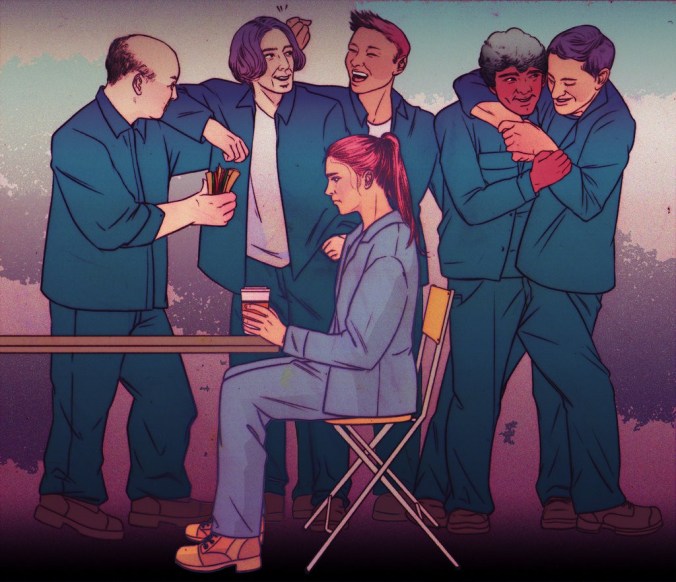
A recent question to the New York Times workplace column “The Workologist” perfectly illustrates a permanent flaw in sexual harassment law. Believe it or not, I have no recommendation regarding how to fix it. I don’t think it can be fixed.
I work at a blue-collar job, and I am one of four women in a crew of 40. The guys never touch or harass me, or any of the women, as far as I know.They do, however, constantly hug and grab and bump each other in a friendly way. It’s not unusual for one of the guys to go through a whole short meeting (a stand-up “huddle”) with an arm around another guy’s shoulder. No one ever touches me, and it’s not that I want them to. That would be weird. But I almost feel left out. Should I let this “bro contact” bother me?
I love it. Perfect. This is what using the law to dictate ethics can result in, and does result in frequently: hypocrisy, confusion, and a double-bind.
Let’s begin with the last sentence: “Should I let this “bro contact” bother me?” The whole point of “hostile work environment” sexual harassment law is to make sure no woman has to ask this question. A boss who responds to a female employee’s complaint of a hostile work environment-creating unwanted sexual attention in the office with “Don’t let it bother you!” has breached his or her duty under the law.
So what’s going on here? The men in the company have adopted the current fad (Yechhh.) of hugging each other to express a range of things—support, congratulation, sympathy, platonic affection—and quite properly do not hug the few women in their midst, lest one of the females, reasonably or not (or perhaps intentionally, to grab some power or cash) be made “uncomfortable,” take the physical contact as unwanted and sexual in intent, complain, and perhaps sue. By not hugging them, however, the men isolate the women, exclude them from the social fabric of the “team,” and, in essence, discriminate against them by signalling that they are “the other,” thus creating a hostile work environment.
Even if some of the women announced their consent to be treated as “one of the guys,” it would not solve the dilemma. One of those bro-hugs could still turn into a copped feel, or be perceived as crossing lines by the female huggee. Then there is the looming third party harassment problem: a woman who has not consented to being hugged might see her female colleagues being man-handled (but completely innocently, of course) and assume that consenting to unwanted physical contact was a condition of employment, or that they would be adversely affected if they did not agree to participate enthusiastically in the hug-fest. Not treating the women in the company like the men is discrimination; treating them the same is an open invitation to a sexual harassment lawsuit. Continue reading →
I love “Onward Christian Soldiers,” of course, but this is my favorite Arthur Sullivan-composed hymn…
1. Reminding me of the basic unethical and cynical nature of state lotteries...A middle-aged African American woman sits outside of our local 7-11 pretty much all day, seven days a week. I’ve written about her before, most recently when she let the door slam in my face despite our family occasionally giving her food, cigarettes and a ten-dollar bill now and then. This morning she bought 40 dollars worth of lottery tickets.
And if she hit the jackpot, she’d be back sitting out front and begging for money in a year or less.
2. My Facebook. theory. You noticed, I’m sure, that Facebook took a 100 billion dollar hit to its paper value in less than 48 hours last week. It all could have been avoided by honesty, transparency, humility, avoidance of virtue-signaling, and fealty to free speech.
Users should have been told, in automatic emails and in big, bold letters in disclaimers on the site, since too many of them are too dumb to figure it out, that anything they put on the free platform was fair game to be harvested, sliced, diced, used, sold, analyzed and exploited for any legal purpose, by any group, party, nation or organization, and if potential users didn’t like the terms, nobody was making them post.
Facebook should have avoided pretenses of virtue. It provides a useful means of networking and communication as well as cost-free mini-blogs to people unwilling to maintain real ones. It does so to make money, not to make a better world…especially since social media arguably makes a worse one.
It should have denied responsibility, in court if necessary, for “fake news” regardless of who created it. Any ad or “sponsored story” should have been so labelled, with Facebook’s position being “read and believe at your own risk. Check “facts” before you spread them around. It’s your responsibility, not ours.”
Facebook should have had faith and belief in the freedom of expression and speech, and not attempted to censor “hate speech” or “fake news,” neither of which are subject to precise identification and analysis without the corrupting influence of bias. Indeed, Facebook was obligated to support the First Amendment, as a major cultural force.
Facebook should have stayed apolitical. Instead, it joined the “resistance” freakout over Hillary Clinton’s loss, and signaled its virtue by agreeing with absurd and unsupported claims regarding the importance of fake and risible news stories on Hillary Clinton’s defeat.
Mark Zuckerberg is a classic example of a narrow, limited, juvenile savant whose one big idea gave him more power and influence than he was qualified to handle. Maybe losing all of that money will make him appropriately humble, but I doubt it. Such people almost never learn.
3. Is the U.S. State Department intentionally hassling trans women?This story makes a prima facie case that it is, and if that’s really what is going on, it is petty and wrong. It also is a classic Rashomon situation. Government bureaucracies are inherently inefficient, incompetent, and screwed up beyond all reason or toleration. (Oddly, progressives want more such agencies, with more employees. Go figure.) The story linked appears to show the system trying to make things difficult for a particular group, but the individual targeted only sees how she is being treated, so it appears like obvious discrimination. That, however, is a very subjective assessment.
A member of my family is in jail for a few months, and had been granted work-release privileges so he could continue his job and career. However, those in charge of the program were openly hostile to his efforts to complete the paperwork and arrangements. They kept changing the rules, increasing requirements, threatening him, and delaying the process. When he contacted his lawyer, he was told, “these people can do anything they want to, and get their satisfaction from boring, low-paying jobs by abusing people like you, meaning anyone who would normally be their equals or better, but who is now under their thumbs. You have no choice. Do what they want, or you will suffer. Simple as that.”
My jailed family member is white, male, educated, well-spoken and polite. Eventually, after he grovelled enough, everything was straightened out. “You know,” he said ,”It I were black, there is no way you could have convinced me that I wasn’t the victim of racism.”
It could be the same with the alleged trans discrimination in the passport system. When one of the alleged victims says, “Make no mistake, this was an intentional action by the State Department to withhold recognizing my gender,” she is being sincere and perhaps naive. It may have been an intentional action by low level State Department employees to be assholes because they could be. [Pointer: valkgrrl] Continue reading →
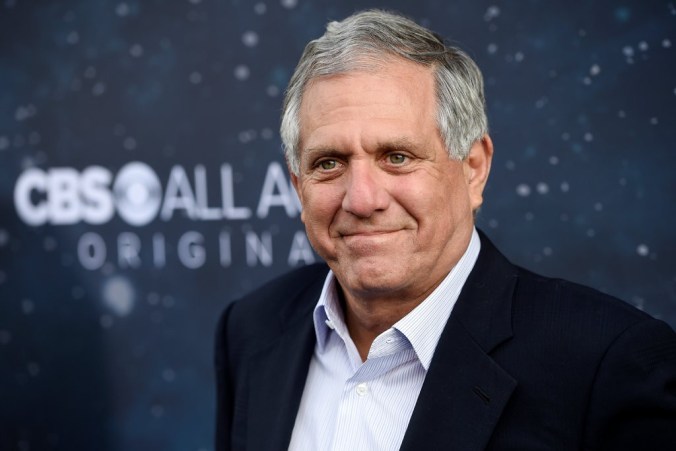
In a new investigative reporting piece, the journalist who revealed that New York State Attorney General Eric Schneiderman was a sexual abuser and who also added to the documentation of Harvey Weinstein’s horrific workplace conduct, revealed in his latest investigative article in The New Yorker that clear sexual harassment was alleged by six women in the entertainment business against Les Moonves, and that, as usual, his fish, CBS, and especially CBS News, had rotted from the head down.
Moonves is as long-established, respected and powerful a figure as there is in the media. He became the president of CBS Entertainment in 1995 and the chief executive of the company in 2006, and is paid $69.3 million a year.
You can close your eyes now and imagine everything that follows from here—it will just be a summer re-run of the Fox News debacle that eventually toppled Roger Ailes. We will need a pool to determine who will play the role of Bill O’Reilly, unless Charlie Rose qualifies. The account of actress Illeana Douglas—you know her face if not her name: she played the woman raped and mutilated by Robert DeNiro in “Cape Fear” and appears in several other Martin Scorcese films–is particularly disturbing, if familiar-sounding.
She describes Moonves grabbing her and violently kissing her during a business meeting in 1997. “What it feels like to have someone hold you down—you can’t breathe, you can’t move,” she said. “The physicality of it was horrendous.” She made a joke and fled, she says, and soon after the episode Moonves fired Douglas from the CBS sitcom she had been cast in and told her that she would “never work at this network again.” Continue reading →
Hear me out, for I am, as regular readers here know, far from a Brady fan, despite my Boston bona fides. In fact, I think he shares the atrocious ethics values of his coach, which can be fairly summed up as “the ends justify the means” and “it ain’t cheating if you can get away with it.”
This, however, is a completely different area, the toxic, values-rotting narcissism and obsession with surface beauty and impossible ideals in appearance that has made the nation sillier, more trivial, meaner, neurotic, insecure and less productive.
After the above photo of the 40 year-old quarterback with his model wife, Gisele Bundchen, surfaced online last week, the Patriots super-star was beset with social media snark attacking his “dad bod” and declaring him out of shape.
Whether it is intentional or not, Brady is to be thanked, admired and praised for appearing in public absent ripped abs and bulging muscles, and even some healthy fat visible in moderation, and doing so without shame. This is how normal people look, and should be allowed to look without comment or criticism. Once upon a time, not so long ago, before Nautilus and health club chains, celebrity athletes and he-men were judged on what they did, and not how chiselled and bulked-up they looked off the field or between films. This now extinct attitude was known as rationality and proportionality. Thus Joe Louis, the greatest heavyweight boxer of all time.. Continue reading →
1. Confirmation bias test? The big news today was that the U.S. Department of Justice and FBI have released the 412 page FISA application used to gain a Title I surveillance warrant against Carter Page in 2016 while he was working as a low-level unpaid adviser for the Trump campaign. The document is heavily redacted in its more than 400 pages. Carter Page himself—he was never charged or interviewed , which seems rather damning in itself–said today,
“‘You talk about misleading the courts, it’s just so misleading… It’s literally a complete joke.'”
Once again, it is impossible to tell what is going on by following the news media’s reports. It sure seems, however that once you block out the spinning by the mainstream media, this post regarding Devon Nunes’ much attacked memo on the topic was verified. Still, I have a low rate of patience for these things, and am not the best interpreter of documents like this, so I am only relying on second hand opinions by others who have plowed through the damn thing. I’ll wait to get some reliable readings.
It seems like the critics of the Mueller investigation and the conduct of Justice and the FBI feel confident that the materials show that indeed the warrants were acquired deceptively, meaning illegally, with the unsubstantiated Steele dossier being the crux of the justification for the warrants, also considering the fact that the Clinton campaign was behind the dossier was never revealed to the judges. [Here’s a recent example of the spin being applied to that argument. The judges were told that the dossier was paid for by a person with political motives, and the claim is that this was enough, that they could figure out that it was a tool of the Clinton campaign. I’ve never understood this argument. Why weren’t the judges informed directly, then? ] Ann Althouse commenter named Yancy Ward wrote,Continue reading →


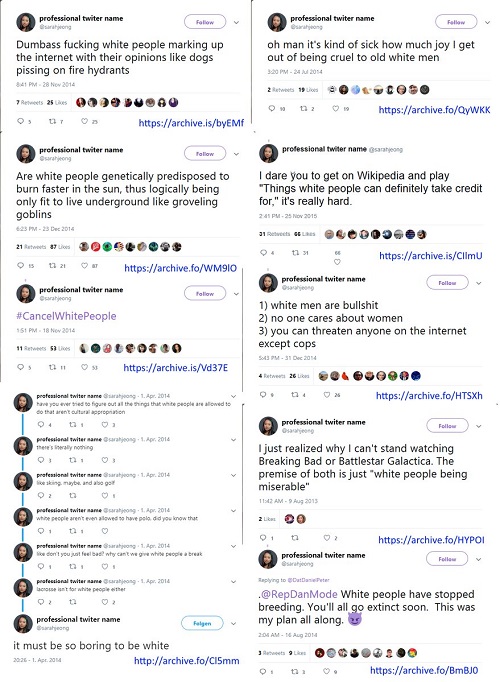






Tippy Scales, the Ethics Alarms’ commentariat resident working journalist, was moved to comment on the ongoing controversy over the New York Times hiring a documented anti-white racist as one of its editors. I welcome the development, as it is signature significance for the mindset of the Times and its management: no ethical or trustworthy news publication would do such a thing. The rest of the mainstream news media has tried to bury the story, but this is one more time when Americans should feel grateful for our conservative media, with all of its own biases and flaws. I doubt that the Times will avoid the consequences of its arrogant and unprofessional act, and I think we will be hearing more about Sarah Jeong.
Here is Tippy Scales’ Comment of the Day on the post, Afternoon Ethics Jolt, 8/3/2018: A Lawyer Finds A New Way To Be Unethical, Verizon Makes Our Kids Obnoxious And Ignorant, And The Times Decides To Show Its Colors…