Comment of the Day: “Let’s Have An Open Debate on Both Sides …”

Blameblakeart’s comment to my post about the school district that condemned a student’s high school newspaper anti-gay adoption column, part of a “pro vs. con” feature approved by the editors and faculty advisor, illustrates a point that was the subtext of my post but never explicitly stated.  It should have been, but blameblakeart shows how it’s done. The productive, educational, fair and persuasive way to rebut any argument is by using facts and logic, not to just condemn it as “offensive” or “bullying,” or to discourage future expressions of unpopular points of view. That is true in school and out of it.

Here is his Comment of the Day on the post, “Let’s Have An Open Debate on Both Sides of This Controversial Issue. Wait…Your Side Offends Me. Shut Up. You’re A Bully.”  I’ll have a comment at the end: Continue reading

“Let’s Have An Open Debate on Both Sides of This Controversial Issue. Wait…Your Side Offends Me. Shut Up. You’re A Bully.”

The Shawano (Wisconsin) High School’s student newspaper decided to publish a “Pro vs. Con” feature on the contentious issue of gay couples adopting children. A student wrote a column advocating each position.

In his column headlined “Should Gay Couples Be Allowed To Adopt?” student Brandon Wegner catalogued various arguments against gay adoption, and included this:

“If one is a practicing Christian, Jesus states in the Bible that homosexuality is (a) detestable act and sin which makes adopting wrong for homosexuals because you would be raising the child in a sin-filled environment….A child adopted into homosexuality will get confused because everyone else will have two different-gendered parents that can give them the correct amount of motherly nurturing and fatherly structure. In a Christian society, allowing homosexual couples to adopt is an abomination.”

A male couple raising a child who goes to the school saw the paper, and strenuously objected to school administrators, saying that the piece was hateful and would encourage bullying. Naturally, the school district immediately caved and threw the student, the paper and the column under a metaphorical bus, because that’s what school administrators do. If an anti-gay bigot had objected to the pro-gay adoption feature, it is even money that the school would have done the same.

An official mea culpa was immediately released: Continue reading

The Marianne Gingrich Ethics Train Wreck

Ugh. What a mess.

The ethics miscreants:

Marianne Gingrich: Seething with hate for Newt, she decided to try to metaphorically stick a shiv in his back by airing dirty laundry from their marriage right before the South Carolina primary, a do-or-die for him. Her interview with ABC was unfair and an act of pure revenge. You couldn’t call it whistle-blowing, since anyone who doesn’t already know what a likely sociopath Gingrich is has been watching too many re-runs of “NCIS.” Gingrich’s character, or lack of it, was established and in the books by 1998. Marianne should have not had to say a word, but everything she did say, she had said before, in an interview in 2010 in Esquire. Continue reading

Republican Nomination Ethics Points, 1/18/2012

I’m sitting here watching the GOP Final Four debate. Here are some brief ethics observation on a lively day in the race:

  • At the opening gun, Newt Gingrich gave a bravura performance of indignation personified when moderator John King asked him about the looming ABC interview of his ex-wife, Marianne, in which she impugns Newt’s character and claims that he asked her to agree to an “open marriage.” He told King it was a despicable question and said that the issue was not worthy of mention. Good act, but of course the question of character is relevant, and of course Gingrich, who has none, wouldn’t think so. Continue reading

Ethics Dunce: Greta Van Susteren

Newt: ” Honey, I’m divorcing you to marry the woman I’ve been cheating on you with for the last 6 years.” Marianne: “Fine. Just wait til you run for President. I’ll be ready.”

Newt Gingrich’s second (of three) wife, Marianne Gingrich, has said in the past that she had it within her power to  end her ex-husband’s career with a single interview. This is not as remarkable as it sounds; just consider how many political spouses past and present have or had that power regarding their own power partners. Let’s see: Eleanor Roosevelt…Jackie Kennedy…Coretta Scott King…Lady Bird Johnson….Pat Nixon…Hillery Clinton, of course…Bill Clinton…Laura Bush…Tipper Gore. That’s just for starters. I have no doubt that Marianne Gingrich might be able to tell tales that would make any of these women feel fortunate by comparison, but on the other hand, what could she say that would be a surprise? Anyone who doesn’t know by now that Newt is about as miserable an excuse for a human being as one can be and avoid being shot or imprisoned hasn’t been paying attention.

This is the problem, however. People don’t pay attention, and have the memories of Eric Holder under Congressional questioning about Fast and Furious. After Gingrich’s deft response to Juan Williams’ accusatory race-baiting question at the last South Carolina debate sparked a standing ovation, you would have thought that he was the new star on the scene to hear callers on conservative talk-radio rave.* Yes, yes, Gingrich is smart and articulate. So were Richard Nixon, Tom DeLay, Huey Long and Joe McCarthy. So were Professor Moriarty and Goldfinger. We know Newt is smart; we also should know other things about him by now, like the fact that he’s an untrustworthy narcissist and a cur.

Apparently Marianne Gingrich has decided to do America a favor and to remind amnesiac Republicans once and for all who they were cheering this week. She has taped a two-hour spill-the-dirt interview with ABC News. The Gingrich camp is in a panic, and supposedly there is an ethics debate at ABC about whether the interview should air before the critical South Carolina primary, possibly Newt’s last chance to stop the Mitt Romney juggernaut, or after. Fox host and legal analyst Greta Van Susteren comes down on the side of holding the interview in the can until Monday. On her blog, she writes: Continue reading

Recent Race Card Rankings: Trying Out The Knight Scale

I can see Michael Moore from here!

Ethics Alarms recently proposed the Knight Scale, a way to rank attempts to play the race card or otherwise accuse politicians, satirists, writers, pundits and others of racism in order to silence them, ruin their credibility, or score cheap political points in the media. The Knight Scale was made possible by blogger Christopher Knight, who somehow managed to find a cartoonist’s substitution of Michelle Obama for Marie Antoinette ( as a commentary on the First Lady’s ill-timed–some say—taste for lavish parties and social activities) in a famous painting. Despite the fact that the French queen was not, to my knowledge, black, Knight somehow found this to be blatant racism, thereby establishing the tippity-top of the Knight Scale: you just can’t come up with a more far-fetched, unfair, factually indefensible accusation of racism than that. With that outrageous complaint as a 10, the most outrageous, where would other, necessarily lesser bogus racism claims rank?

Let’s look at last week. From here on, we can count on an ever-increasing number of Knight Scale candidates, since an African-American President  presents such an irresistible temptation for unscrupulous race-baiters, and the entire Obama Administration is seemingly conditioned to cry race bias whenever criticism get hot, so consider this a trial run: Continue reading

“Ask Amy” Tackles A Classic—And Misses

Advice columnist Amy (of the syndicated column “Ask Amy”), was just asked one of those questions that every advice maven has to have in their files, with the perfect answer ready to go. If Amy had her answer prepared, it was  the wrong one.

The question was the deathless classic, “I just found out my husband has been having an affair with a married co-worker. Should I tell the other spouse?”

Amy gets it half right: she tells the reader that the other spouse has a right to know; that this is not a case of meddling because the reader is directly involved in the betrayal; and that not to make sure the other spouse learns the truth would now be abetting the deception. All true. BUT…

…Amy forgets the Golden Rule as it applies to the reader’s husband’s adulterous lover (yes, the rule still applies to busted wrongdoers) and the whistleblowers obligation to minimize needless harm. She tells the victimized wife to spill the beans to the victimized husband.

Wrong.

The adulterous wife deserves the opportunity to tell her husband herself. That would allow her to reveal the affair to her spouse with the least damage to the marriage, and providing that opportunity to her is kind and fair. Amy should have told her reader to contact her husband’s paramour and say this: “I will be calling your husband and telling him about your relationship with my husband in three days. You should tell him the truth yourself, and then all he needs to say to me when I call is, ‘Yes, she told me.’ But if you haven’t told him, he’ll hear it all from me.

File it away, Amy, and get it right the next time.

Standards of Decency: Where Ethics Belongs, and Law Does Not

If this is the Super Bowl half-time show, will the FCC fine the network?

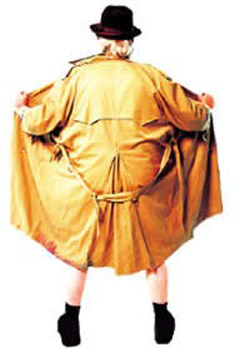
Slate legal columnist Dahlia Lithwick drives me crazy on a regular basis, but she hit a home run with her tongue-in-cheek account of the oral argument before the Supreme Court regarding the constitutionality of the Federal Communications Commission’s indecency policy, which has broadcast networks shivering in their boots over the possibility of another “wardrobe malfunction” at the Super Bowl or another trash-mouth star saying “fuck” as she picks up an Academy Award. The particular topic before SCOTUS was momentary nudity in TV drama, such as walrus-like actor Dennis Franz’s mega-butt flashing by our horrified eyes on “NYPD Blue.” In an Ethics Hero-worthy moment, attorney Seth Waxman, representing ABC, showed the Court how absurd and arbitrary it is to try to regulate taste and decorum in art. Lithwick writes: Continue reading

Ethics Quiz: Sydney’s Expressive Yearbook Photo

My high school was never like this.

The photo above, believe it or not, was submitted to the Durango (Colorado) High School Yearbook as the senior photo of one Sydney Spies. The yearbook staff rejected it as inappropriate, and young Sydney is crying foul, saying that her First Amendment rights have been violated. Opinions differ on what message her photo was intended to convey. Suffice it to say that “Well, it’s late! I think I’ll go finish my algebra homework, read the Wall Street Journal and turn in!” is not one of the popular options.

Your Question in this week’s Ethics Quiz: Which party is in the wrong here? Continue reading

The Admirable Mr. Sondheim

And an ethical hat it is, too!

Readers who are not interested in the art of lyric writing and the mechanics of constructing a Broadway musical should probably avoid the second and final installment of Stephen Sondheim’s chronicle of his creative life, “Look, I Made a Hat.”  They will be missing something important nonetheless: a rare example of truly ethical memoirs.

As in his first volume, “Finishing the Hat,” America’s pre-eminent composer-lyricist for the stage reveals himself as a gentleman, an adult, and a thoroughly ethical human being, and does so not by proclaiming his virtues, but by demonstrating them in his writing. He is not uncritical, but always fair and kind. He accepts personal responsibility for projects that failed, and is generous with giving credit for projects that were successful. There is no false modesty in Sondheim about his own skills and achievements, but neither does he seem to overvalue them or seek his reader’s admiration by blowing his own horn.

The line Sondheim walks in both books is fine, and he walks it finely. For example, I initially thought his decision to only criticize the techniques of other lyricists who are dead was a cowardly one, but upon reading both books it is clear that the decision was motivated by kindness. Sondheim takes the craft of lyric-writing very seriously, and his integrity would not allow him to censor a critical observation regarding a colleague’s work when he believed the criticism was illuminating and had merit. Realizing how hurtful a critique from someone of his reputation and accomplishments could be, Sondheim restricted his frank and (mostly)  fair assessments to writers beyond wounding. If Jerry Herman isn’t grateful, he should be. Continue reading