Ethics Dunce: Thalia Rodriguez

"Anything to make you happy, dear!"

Thalia Rodriguez seems to have decided to push her fiance, William Mancera, to conquer his lifetime fear of heights by going on a carnival bungee ride with her. Predictably, the plan went horribly wrong when the Irving Texas love bird got stuck 50 feet off the ground for three hours because cables got tangled. Dallas firefighters used an aerial ladder truck to help get the couple safely to the ground.

Mancera said afterwards, reasonably,  that he is “never riding anything of that sort ever again.” Not so reasonably, he says the ordeal has brought him and his fiancée closer together, and their February wedding is still on. Continue reading →

We Know Enough about Ethics Already

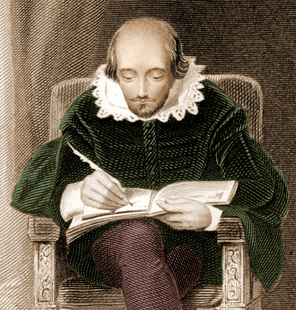
If Shakespeare understood ethics so well, why are we still pretending to be ignorant about it?

I awoke to read about a breathlessly announced new work on ethics, a book called “Blind Spots: Why We Fail to do What’s Right and What to do About it.” Business Professor  Ann Tenbrunsel and co-author Max Bazerman write that we are unaware of the “ethical blind spots” that keep us from recognizing how we engage in unethical actions. The book cites tests and new research showing behavior that the authors call “ethical fading” and “motivated blindness.” They examine such case studies as Enron and the Madoff scam to show how people “believe they will behave ethically in a given situation, but they don’t. Then they believe they behaved ethically when they didn’t. It’s no surprise, then, that most individuals erroneously believe they are more ethical than the majority of their peers.”

Stop the presses! Conflicts of interest make us ignore core values and act in our own best interests, and we rationalize our actions to avoid confronting the true nature of our conduct!

Oops! I just stated the entire thesis of the book. I’m sorry, Ann! Apologies, Max! Continue reading →

Conservatives, Rotting Children’s Brains On Principle

Why can't today's TV pass on good taste like this to our children?

Perhaps I am over-reacting, but I was recently horrified. Sometimes conservatives allow their ideology to lead them into places that make it impossible to take them seriously, or  to view them as rational and responsible. This is especially true when it comes to the arts.

Yesterday, radio talk show host Laura Ingraham was bemoaning the coarsening of the culture, and the way she feels that television is poisoning the minds of children. She spoke nostalgically about how entertainment in the golden past was family-friendly, and reliably conveyed the values of humor and wit that enriched children’s minds, their taste, and their understanding of “good entertainment.” Those days are no more, Ingraham said. Television is vast slime-pool, and concerned parents can only look to past gems of the comic arts to teach their children “humor and wit.”

So what show did Laura Ingraham, accomplished writer, former Supreme Court law clerk, and author of political satire extol as epitomizing these lost values? What classic TV show’s complete set of DVDs did she reveal that she had given to a colleague so he could save the minds and souls of his children?

“Gilligan’s Island.”

“GILLIGAN’S ISLAND!” Continue reading →

Ethics, Stereotypes, and Holly Golightly

"Andy Hardy, the Asian Years"

A Bronx woman, Ursula Liang, has started a petition against Brooklyn Bridge Park’s “Movies With A View” series showing “Breakfast at Tiffany’s,” the 1961 Audrey Hepburn classic that gave us “Moon River” and one of actress Hepburn’s most endearing performances. Why? Well, the movie, which has long been popular for summer screenings in New York City and elsewhere, also contains a pre-political correctness performance by Mickey Rooney as Holly Golightly’s comic Japanese neighbor, “Mr. Yunioshi.”

Rooney’s performance, in my opinion, was cringe-worthy even in 1961, one of director Blake Edwards’ not uncommon excesses in vaudeville humor, placed in a context where it didn’t belong. It is a scar on an otherwise marvelous film, but there is nothing inherently wrong with comic stereotypes. Stereotypes are a staple of comedy, and have been forever; the question is whether a particular stereotype is cruel, gratuitous, harmful, or funny. Some stereotypes are cruel and funny. Continue reading →

Wanted, Desperately Needed, and Lacking: Professionals, Adults and Values in the Media

What? Is there something wrong?

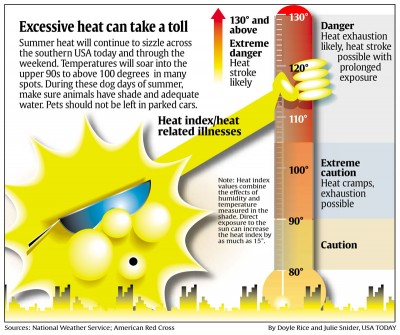
There is not a lot to say about the graphic above, other than:

  1. It is crude.
  2. It is funny.
  3. It is intentional.
  4. It is inappropriate for a general audience newspaper
  5. A competent editor should have caught it, and
  6. The graphic artist needs a warning and a reprimand.

The media, its staff, celebrities and assorted vulgarians and boors seem to be determined to make public square America as uncivil as a locker room, as crude as a peep show, and as juvenile as a junior high school farting contest. Professionals, including USA Today editors and publishers, can either do their duty and discourage this intentional rudeness in their products and services, or shrug it away. Similarly, our culture needs to decide if we are going to just define our deviancy down some more, and accept gratuitous sexual innuendo that will gradually make the whole population into a bunch of snickering Beavises. Continue reading →

What Today’s Broadcast News Regards As “Credentials”

"Yes, yes...journalism degree, experience at a local affiliate, blah, blah...but no rapes? Arrests? Scandals? Sexual abuse? Miss, you have NO credentials that make you valuable as a network reporter! Wait--what's your bra size?"

Good for media ethics pundit Howard Kurtz for blowing the whistle, however gently, on ABC News’s hiring of Elizabeth Smart as a contributing on-air expert on missing children cases. “Does that strike anyone as odd?” he writes.

Well, it depends what you mean by “odd,” Howard.

If you mean, does it surprise me that a broadcast media outlet, one of the journalistic mutations that hired Eliot Spitzer, fresh off his prostitution disgrace, to headline a current events show on CNN, that puts a giggly fold-out-come-to-life  like Robin Meade in charge of Headline News’ morning, and that, like Fox News, chooses its female newsreaders and guest pundits according to their degree of resemblance to Mamie Van Doren or Raquel Welch, would hire a young, attractive blond woman with no credentials other than her role as the victim of kidnapping, sexual abuse and rape, as a correspondent, why no, I don’t find it odd at all.

If you mean, do I find it odd that a supposedly professional news network would so blatantly abandon professional standards  just to cash in on the Casey Anthony uproar, however, then…wait, no, I don’t find that odd either. Revolting, but not odd. Continue reading →

“Professionalism?” What’s THAT? Julie Chen, CBS and the Descent of Broadcast Journalism

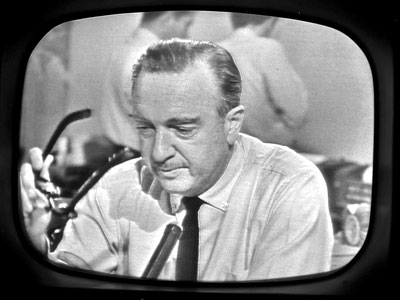
Walter could keep it together. Not Julie Chen.

The Casey Anthony verdict is doing some good: it is exposing the awful deficit in objectivity and professionalism in the broadcast media.

The latest example: while CBS’ “The View” rip-off, “The Talk,” was underway,  viewers saw co-host Julie Chen break down as she tried to read the news that Casey  Anthony had been found not guilty of killing her daughter Caylee. Chen attempted to read the verdict, but was overcome with emotion  and was unable to continue, asking her co-hosts,  “Help me out here.”

In 1937, radio broadcaster Herbert Morrison was correctly criticized for being unable to keep his composure and report the flaming destruction of the zeppelin The Hindenburg without weeping and becoming unintelligible. In 2011, a woman described in her official bio as a “news anchor; reporter; and journalist” couldn’t compose herself to read the news of a not guilty verdict. Continue reading →

Ethics Dunce: Mercedes Colwin

It's a mystery: why would Fox News choose her as a legal analyst?

Attorney Mercedes Colwin, an attorney and Fox News commentator, just committed pundit malpractice while discussing the Casey Anthony verdict on Sean Hannity’s radio show. Her professional biography says that she has practiced criminal defense law. If so, she has done so laboring under some serious legal ethics misconceptions.

Said Colwin, in response to Hannity’s query about her past representation of guilty defendants:

“If my client says he did it, then I can’t defend him. I can’t then go into court and say he’s innocent; I’m an officer of the court, Sean!”

What??? Wrong, wrong, outrageously wrong, inexcusably wrong! And also: ARRRRRGHHHHH! Continue reading →

Ethics, Porn, and the Creepy Professor

The Ronald Ayers saga raises the intriguing, Weiner-esque ethical issue of whether a college professor being creepy is sufficient reason to fire him.

The former economics professor was fired by the University of Texas for viewing pornography on an office computer, which the University’s policies forbade. The chain of facts has the ring of Kafka: 1) a student claims he hears “sexual noises” emanating from Ayers’ office, which 2) is considered sufficient provocation (the professor denied the accusation that he was not “master of his domain” at work) for the school to search his computer, which 3) uncovers evidence that he looked at some pornographic sites, and 4) also that he searched for the term “teen,” which 5) the university deems sufficient to indicate that he was searching for child pornography, so 6) they fired him, after three decades and tenure on the faculty.

University records say Ayers at first denied the allegations that he viewed pornography, but when confronted with a printout of his computer records, admitted that it may have happened “at the end of a long work day.” Ayers later told administrators seeing the porn was for “academic research.”

Uh-huh… Continue reading →

Strauss-Kahn and His Accuser, Victims of The Postman

The accuser of Dominique Strauss-Kahn, the former IMF head who has been devastated by her sensational rape charge, now admits that parts of her original account of the incident and an earlier accusation of rape she made to seek asylum in the U.S. were false.

The Altantic’s Megan McArdle sums up the Ethics Train Wreck thusly:

“There are two possibilities here, neither of them good:

1) A woman with an unsavory past, who has done desperate things to get out of terrible economic conditions, was raped by a prominent figure, and he’s going to get away with it because of her history.
2) A serial cad had consensual sex with a chambermaid, and she attempted to destroy him with a false rape allegation for personal gain. And because of the presumption that women don’t lie about rape, she has succeeded in destroying him . . . though not so much in the personal gain part. To quote Ray Donovan, ‘Where do I go to get my reputation back?'” Continue reading →