1. Is it me, or is this TV commercial indefensibly gross, and signals the impending end of civilization?
2. Reasons not to duck the New York Times op-ed pages…Yale student Kathryn Hu contributed a sane and thoughtful essay on the topic of classic operas with characters and plot elements that seem sexist or racist to today’s more enlightened audiences. As we know, today’s “woke” censors of the arts and arbiters of what we are allowed to watch and hear have their own solution: never do the piece again, despite its obvious virtues, or interpret and rewrite it out of existance or into nausea, like John Legend injecting “It’s your body and your choice” into the lyrics of “Baby It’s Cold Outside.” I had to suppress my gorge from rising while reading this article, for example, that described the current production of J.M Barry’s 1904 classic “Peter Pan” in Washington D.C:
In [Playwright Lauren Gunderson’s] version now playing at Shakespeare Theatre Company (retitled Peter Pan and Wendy…), the character of Tiger Lily has been completely reconceived. No more the helpless princess in distress, Tiger Lily is now a spirited and fearless Native rights activist whose people thrived in Neverland long before Captain Hook’s pirate ship dropped anchor and Peter showed up with the Lost Boys.
Because as we know, there were so many Native American activists in 1904. To anyone with brain cells and cultural perspective that haven’t been woked to death, it is obvious that Barry’s Neverland is a child’s fanciful impression of Indians, pirates, and friendly wild animals. It has nothing to do with reality , so imposing current day adult political views on the and characters is neither fair nor necessary.
Hu’s solution to the supposed horrors of 19th Century biases and social mores in opera: Continue reading →
To be open and honest, for the longest time I thought the name referred to the fact that on the say after Christmas, houses tended to be littered with opened boxes that had previously contained Christmas gifts. The name really refers to the British tradition on the 26th, when postmen, milk men, and servants expected to receive gratuities or a “Christmas box” in appreciation for their labor during the year. It is still celebrated as a holiday in parts of the old United Kingdom, but “Gratitude Day” never caught on in the U.S. Here “Boxing Day,” if anything, refers to the all the boxes mad shoppers are buying in post-Christmas sales.
1.Law suit update! Well, the plaintiff’s latest motion to reconsider the appellate court’s rejection of the plaintiff’s defamation suit against me (for bouncing him off of Ethics Alarms and being mean to him in the process) was rejected. New motion to reconsider the reconsideration coming in 10…9….8…7…
I refuse to participate in post-racial America. I refuse to say because we elected Obama that suddenly that means everything is ok, white people have changed. White people have not changed.
Two-thirds of all white guys voted for Trump. That means anytime you see three white guys walking at you, down the street towards you, two of them voted for Trump. You need to move over to the other sidewalk because these are not good people that are walking toward you. You should be afraid of them.
1. The Canadian Broadcast Companyedited Donald Trump’s cameo out of “Home Alone II” when the Christmas-themed family film was aired this week. That sets some kind of record for pettiness, don’t you think? The CBC lamely denies that they meant anything by it, responding to an inquiry, “As is often the case with features adapted for television, Home Alone 2 was edited to allow for commercial time within the format.” Sure. I believe that! Don’t you believe that? Continue reading →
I’m not a big Sinatra fan, but I’ve always thought it a shame that the two Christmas songs he “owns” are both mediocre: “The Christmas Waltz” and “Mistletoe and Holly (which he co-wrote.) Frank sang the whole canon, of course, and well, but still, Judy Garland owns “Have Yourself A Merry Little Christmas,” Nat King Cole owns “The Christmas Song” (even though Mel Torme wrote it), Bing has “White Christmas” (and others,), Gene Autry has “Rudolph…” and “Here Comes Santa Claus” even after Bruce Springstein stole “Santa Claus Is Coming To Town” away from him, but Ol’ Blue Eyes is second or third best to lesser singers on the really great songs, leaving him with those two wan ditties to call his own. It’s unfair.
1. The social media mobs are after J.K Rowling. Her offense? British Researcher Maya Forstater was fired last year by a London think tank for her “gender critical” views, including the position that “it is impossible to change sex.” Forstater filed a lawsuit earlier this year alleging discrimination, but an employment tribunal in London ruled against her this week, holding that her views were “not a philosophical belief protected” by British law but were instead “incompatible with human dignity and fundamental rights of others. It is also a slight of hand to suggest that the claimant merely does not hold the belief that trans women are women. She positively believes that they are men and will say so whenever she wishes.” The court added that Forsater held beliefs that are “not worthy of respect in a democratic society.”
No, they don’t believe in freedom of speech or thought in the UK. Remind people of this when they make one of those fatuous “the U.S. is the only developed country in the world that doesn’t do X” arguments. We are special.
Harry Potter’s mom criticized that ruling and said she supported Forstater: “Dress however you please,” Rowling tweeted to her more than 14 million followers (this makes me want to hurl myself into a shredder, as I desperately try to recover the lost Ethic Alarms followers since 2016). “Call yourself whatever you like. Sleep with any consenting adult who’ll have you. Live your best life in peace and security. But force women out of their jobs for stating that sex is real? #IStandWithMaya.”
Oh, sex, gender, whatever. I know that to trans individuals the distinctions are a matter of honor, identity and self-esteem, and as far as I’m concerned, if an XY individual has changed everything but her chromosomes and wants to be regarded as, treated as and referred to as a woman, I will accommodate her in the interests of comity, kindness, and the Golden Rule. However, if someone as a matter of linguistic or biological rigor (or pedantry) wants to insist that such an individual is still technically female, that’s a legitimate, if unpopular, position. This is a dispute about manners and definitions, not facts.
The researcher should not have been fired, and Rowling’s tweet was not “transphobic.” Continue reading →
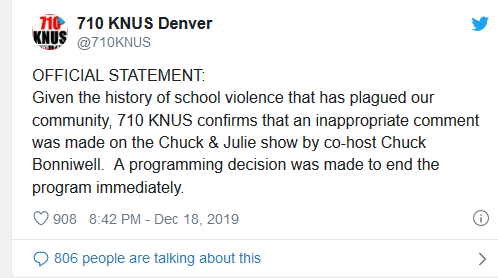
Chuck Bonniwell and Julie Hayden, a husband and wife team, co-hosted the “Chuck and Julie “show on KNUS AM TalkRadio in Denver. Riffing about the impeachment this week, Bonniwell said, “All right, here, a little after 1:30, talking about the never-ending impeachment of Donald Trump. Then he added, chuckling, ” You know, you wish for a nice school shooting to interrupt the impeachment news….” Julie quickly jumped in, saying, “No! No! Don’t even — don’t even say tha!. No, don’t even say that! Don’t call us. Chuck didn’t say that!”Still laughing, Bonniwell tried a save, finishing his handing sentence with “in which no one would be hurt.”
Jason Salzman of the Colorado Times Recorder, who said that after hearing Hayden’s plea for listeners not to call their complaints about her husband’s joke, he “called anyway.” Sandy Phillips, who lost her daughter in the Aurora theater shooting, posted on Twitter: “This guy should be fired. Total ignorance. Shootings hurt us all … just ask witnesses and first responders. You don’t have to be shot to be wounded.”
Bonniwell isued an apology the next evening after 24 hours of criticism on the “Chuck & Julie” Twitter feed, saying, “I made an inappropriate comment meant as a joke. I’m sorry it was not received that way.” Too late. KNUS fired Chuck and Julie later that evening:
Was this a fair decision?
I’m not sure it was. As I have held here on other occasions, those who take extemporaneously for a living, especially when they are expected to be amusing, are constantly walking a high wire. Occasional gaffes, including moments when certain metaphorical landmines are tread-upon or lines are crossed, are inevitable, and the more creative and bold the talent, the more likely such events are. A no-tolerance policy is unreasonable, and it is virtually always the ethical approach to treat the first such error with a warning or punishment short of dismissal. Virtually, because there may always be single gaffes that are so terrible and potentially destructive to the talent’s employer that firing is the only response.
Thus the question here is whether Chuck Bonniwell’s comment falls in the latter category. My view si that it does not:Continue reading →
The headline in the New York Times last month read, “Indiana University Admits That Professor’s Views Are Vile, And That It Can’t Fire Him.”Nice. First, another party can’t “admit” someone else’s opinions are vile, as if there is a universal standard for “vile.” Second, the headline assumes that the professor is the villain in this controversy, but then, that’s the Times for you: taking sides instead of reporting the facts.
I apologize for missing this chapter in the ongoing effort to intimidate and persecute anyone whose views do not align neatly with the mandated progressive orthodoxy. The Times piece in question is dated November 23; not only was that my wedding anniversary, but I was also on an ethics training road trip without a functioning laptop. (I have one now.) I’m pretty sure I would have perceived the need for Ethics Alarms to bring some fairness to the assault on Professor Eric Rasmusen, though, as you will see, he is very capable of defending himself, if he could get a fair hearing (or reading).
The reason he can’t is because the news media has already decided that he should be shunned, as students try to run him out of academia and the marketplace of ideas.
To be clear, Professor Rasmusen is the victim of unethical conduct here, not the perpetrator of it. His “crime,” and it is not supposed to be a crime in the United States or academia, is asserting non-conforming views on his personal blog. The news media framed the story to undermine Rasmusen by stating as fact that he “used his social media accounts to denigrate women, people of color and gay men.” That is a false and unfair characterization, Rasmusen uses his blog and social media accounts to cover a wide range of topics, often brilliantly, from the perspective of a Christian conservative. Continue reading →
In Part I, I said I was glad that Clint Eastwood’s latest film “Richard Jewell” was bombing, because the film impugns the integrity of a now-deceased reporter simply to spice up its story. After I read some of Clint’s comments yesterday in response to the controversy, I’m even more glad. Clint said that nobody knows how reporter Kathy Scruggs got a crucial leak from the FBI, but that it could have occurred because she traded sex for information. That’s despicable.
Nevertheless, the other dud among the Hollywood releases over the weekend, “Black Christmas,” deserved to flop even more than Eastwood’s epic.
The original “Black Christmas” (1974) was released under the name “Silent Night, Evil Night.” I saw it with my sister a few days after its opening (I was amused at the ad’s catchline, “If this movie doesn’t make your skin crawl, IT’S ON TOO TIGHT!!!”) and it scared the bejesus out of both of us, but especially her: she slept with the light on for weeks, and to this day my uncanny imitations of the maniac’s phone calls upset her (so I keep doing them, of course.)
Arriving before John Carpenter’s “Halloween” and its later, cheesier rip-off “Friday the 13th,” what was soon re-titled “Black Christmas” anticipated many of the themes and techniques of the slasher genre, perhaps too well. Blessed with a much better cast than any subsequent movie of the type (Olivia Hussey, Keir Dullea, Andrea Martin, John Saxon, and Margot Kidder) and clever and gutsy director Bob Clark (“A Christmas Story,” “Porky’s”), the film was declared too disturbing by many critics. I thought it was easily the best horror movie I had ever seen, and recommended it to many friends, some of whom were not grateful after spending the following night jumping at every sound. It was very gratifying to see “Black Christmas” finally emerge as a cult film and the acknowledged inspiration for the slasher film genre (along with “Psycho,” of course.)
I saw the 2006 “sequel,” which was terrible, and had a sense of dread when I learned that Hollywood would try again. It was clear that the new film was already off to an unethical start when I saw the trailer: this was another example of producers hijacking a familiar title while making a movie barely connected to the older film it was evoking. That trick, essentially a bait and switch, always ticks me off. In the trailer for the new film, we could see that the killer wears a black robe and uses a longbow. Clark’s original famously never shows the maniac murderer at all: much of the movie is shot from his perspective (I assume it’s a he), though we see his shadow, one mad eye, and his arm at various times. We also hear him, and a more crazy-sounding killer has never been recorded.
The new “Black Christmas” takes place in a sorority house around Christmas, and there’s someone knocking off the girls. That’s about the extent of the similarity. To be fair, the advent of cell phones ruined the original film’s most iconic scare: it was the first movie in which we heard the chilling words, “The phone calls are coming from inside the house!”
The promotion of more female film directors is a feminist cause right now. There’s even a Christmas commercial where a little girl tells her parents who have just bought Disney princess toys to put under the tree for her, “I don’t want to be a princess any more. I want to be a film director!” I have always championed female directors for the stage; there is no question that there are multiple biases against them in theater, and I assume the same bias afflicts them in Hollywood. However, I do not want to see more female directors because they bring a special, feminine perspective to their work, and I really don’t want to see more female directors so they can use their plays and films as feminist propaganda vehicles. Just make a good movie, kid: if your work only stands for the proposition that women can’t just make entertaining and effective films, but have to clobber the audience with feminist tropes, you will have created a legitimate reason for the industry to be wary of female directors. Continue reading →
Oh, the world is your snowball, see how it grows That’s how it goes, whenever it snows The world is your snowball just for a song Get out and roll it along
1. That this kind of thing could happen at a major bank in 2019 is inexplicable and disgusting. Jimmy Kennedy, a nine-year NFL veteran, earned $13 million during his nine-year career and had been told that he would be accepted as a “private client” at JPMorgan Chase, an elite designation with perks like travel discounts, exclusive event invitations and better deals on loans. When he went to his local JPMorgan branch in Arizona to determine why he had not been accepted into the cataegory, he was told by his representative, who is black, “You’re bigger than the average person, period. And you’re also an African-American. We’re in Arizona. I don’t have to tell you about what the demographics are in Arizona. They don’t see people like you a lot.”
Kennedy recorded the conversation, and after pulling most of his money out of JPMorgan, complained to the bank as well as an industry watchdog agency. The bank sent him a letter saying, “You stated that Mr. Belton informed you that our firm was prejudiced against you and intimidated by you because of your race. We found no evidence to substantiate your allegations.”
He also sent the recording to the New York Times, which wrote about Kennedy’s experience. A few days later, Jamie Dimon, the chairman and chief executive of JPMorgan Chase, sent a memo telling employees that such behavior “does not reflect who we are as a company and how we serve our clients and communities every day.”
That’s the Pazuzu Excuse: “It wasn’t me!” Sorry, chief, but if you have employees treating African Americans like Kennedy was treated, that is who you are as a company, and as CEO, you’re responsible. Continue reading →
The two big flops among movies that opened last weekend were director Clint Eastwood’s “Richard Jewell” and “Black Christmas,” the second attempt to re-boot the 1976 slasher cult film. Both disasters have ethics lessons to teach, or not teach. Let’s look at Clint’s movie first.
“Richard Jewell” made lass that $4.5 million in its first weekend, and has also been snubbed by the various year-end awards. It is based on the now mostly forgotten story of how Jewell, initially hailed as a hero for his part in foiling the 1996 Atlanta Olympics bombing plot, was falsely accused of complicity by local law enforcement, the FBI, and the news media. Conservative outlets loved the film, but the other side of the divide focused on a subplot, as the film’s screenplay suggested that a named Atlanta Journal Constitution reporter, now deceased, used sex to persuade a source to break the story. The Journal Constitution has been attacking the film, denying that Kathy Scruggs would ever used he body to get a scoop. Her colleagues, friends and family all insist that she would not have slept with a source, and reporters around the country circled the metaphorical wagons to proclaim they were shocked–shocked!—that anyone would even suggest such a thing. Jeffrey Young, senior reporter for HuffPost tweeted, “The lazy, offensive, shitty way screenwriters so often treat female journalists infuriates me. Depicting women using sex to get stories is disgusting and disrespectful. It’s also hacky as hell. I was planning to see this movie but not anymore.’ Melissa Gomez of the Los Angeles Times wrote, “Hollywood has, for a long time, portrayed female journalists as sleeping with sources to do their job. It’s so deeply wrong, yet they continue to do it. Disappointing that they would apply this tired and sexist trope about Kathy Scruggs, a real reporter.’ Susan Fowler, an opinion editor at the New York Times tweeted “The whole “female journalist sleeps with a source for a scoop” trope doesn’t even make any sense…”
This would be damning, except that while it may not be standard practice, there are plenty of examples of female journalists doing exactly what Eastwood’s film suggests. Last year the Times—yes, Susan Fowler’s paper—reported on the three-year affair between Times reporter Ali Watkins and James Wolfe, senior aide to the Senate Intelligence Committee, and a regular source for her stories. In October, an employee of the United States Defense Intelligence Agency was arrested for leaking classified material to two reporters, and he was involved in a romantic relationship with one of them. Both reporters are still employed by their respective news organizations, the Times and CNBC, so its hard to argue that sex-for-scoops is being strongly discouraged.
To begin with, it’s a misleading headline. The real subject of the piece, in Military.com, is the alleged hostility being fostered toward female recruits because of their disparate and less demanding physical requirements, including pull-ups. I was sure that I had written about the Marine pull-up controversy before, and sure enough I had, in 2013, (My, how time flies.) Re-reading it now, I felt that the Ethics Alarms post was relevant background to evaluating the article, which includes this…
The idea that female Marines can do fewer pull-ups than their male counterparts and get an equal score “did not sit well” with men, researchers wrote. “Are [women] required to meet equal physical standards? No, it doesn’t take a scientist to study that,” one gunnery sergeant said. “They need to do this many pull-ups, and I need to do this many. Is that equal? No. Four and four is equal. 20 and 20 is equal. That’s equal. So either we’re equal, or we’re not.”
Somehow, the author spins the findings into a rationalization for allowing the unequal standards to continue, writing at the beginning of the article,
Marines are putting an “extreme emphasis” on the number of pull-ups leathernecks can do, a recently published internal study found. And that, some fear, could result in other important qualities that are vital to the Corps’ mission being overlooked. Participants in a study on Marine Corps culture were often focused on pull-ups as a best measure of a person’s value and worth, researchers found. Marines’ ability to lift their own body weight on a pull-up bar was “routinely what Marines referenced when discussing physical standards, a Marine’s value, and physical readiness,” the report’s authors wrote.
I hadn’t checked the name of the author until after I read the article and was struck by how the title and first paragraphs attempted to ignore the ethics issue involved. Guess the writer’s gender. Yup, you’re right.
Here was my article in 2013, (and I wouldn’t change a word); I’ll have some final comments at the end: Continue reading →




 Ethics Alarms