Ethics Hero: Sen. John McCain

waterboard1

While other Republicans are attacking the Senate report on torture as a political hit piece by Democrats—which, in part, it is, but that doesn’t diminish its significance—the one Senator who has experienced torture is supporting the report’s conclusions and criticism, saying…

I know from personal experience that the abuse of prisoners will produce more bad than good. Most of all, I know the use of torture compromises that which most distinguished us from our enemies.”

Exactly.

My position on this topic is unchanged from what I wrote in 2006, which you can read here.

Comment of the Day on “Comment of the Day on ‘The Perils Of Over-Regulating The Police: A Case Study'”

Robocop

Stephen Mark Pilling contributes the second consecutive Comment of the Day providing perspective on the issue of police militarization, in response to the first. Here is his Comment of the Day to the post (by dragin_dragon, which you should read first if you haven’t yet), Comment of the Day on “The Perils Of Over-Regulating The Police: A Case Study”

When critics speak of the “militarization” of the police, not all are looking at it from the same viewpoint. Some are, of course, sociopathic or are conspiracy theorists. Some have swallowed the loudly flaunted concept that policemen are evil racists, corrupt ward healers in uniform or just about anything heinous, as they represent law as an absolute, not a relative.

There is a rational based distrust, however. Many of us grew up in a time where the police still walked a beat or patrolled his neighborhood in a squad car, armed with nothing more than a revolver. We’re also the product of an old tradition of law enforcement that stems from the British mold. Unlike the continental European system of paramilitary gendarmes, we adapted a system of localized lawmen, run by an elected county sheriff. The metropolitan police department is still a relatively new phenomenon, started in late 19th Century London.

To many citizens, police who are unaccountable to a directly elected chief and who sport automatic weapons strike a sour note. But recently, people have been seeing them acquiring armored vehicles, military assault training and a tendency to wearing black uniforms. They’ve also noted an increased likelihood of these tactics and weapons being utilized and the increased incidence of “no knock entries”. Likewise, citizens have been imaging police making arrogant idiots out of themselves and caused other cops to become ever more touchy about cell phones, whether they’re right or wrong.

These and other factors have been serving to create a gap between the citizens and the police. That’s never a good thing, of course, because that trust is vital in a free society. Citizen distrust only deepens when they perceive policemen in whom this sense of civil mastery is full blown. As a former military cop, as a private citizen and as a friend or relative of a lot of civilian cops, I’ve seen all this from different angles. I’ve also seen the divide deepen in recent days.

One small note. The funding of police units on all levels directly from federal sources coincides with the worry by many that state and local police units may be more or less within the pocket of federal departments. The actual militarization of once innocuous federal police units and the memory of Obama’s projected National Civilian Defense Force has resulted in fear that this is an intentional part of a program to create an instrument of oppression. For myself, I highly doubt that any street cops would lend themselves to some “martial law” based takeover of the homeland of America. What I’m not sure of, though, is how many in higher authority have not conceived of the notion and would execute it if they could.

Again; it’s vital that the bonds of trust be strengthened between the police departments and those law abiding citizens whom they “serve and protect”. They must never- ever- be heard to make disparaging remarks about “civilians”, as that only deepens the gulf. In the Army Military Police Corps, the official motto is “Of the troops and for the troops”. It’s a good motto. It should also carry over to every local police or sheriff’s department in America. “Of the citizens and for the citizens”. Policemen who embrace that attitude will seldom go wrong. Both they and the communities they serve will benefit.

Continue reading →

Transparency, Causation, Eggshells, Trust : Seven More Ethics Issues In The Eric Garner Case

jigsaw-puzzle-record

1. There is near unanimity in the response to the non-indictment by the Staten Island jury in the Eric Garner case. In light of the graphic video, it is hard to see how there wasn’t probable cause to indict. The coroner verdict of “homicide” would see to provide sufficient evidence all by itself. However, in the absence of the complete record of what the grand jury heard and saw, nobody can be certain that this was a miscarriage of justice. However, given the context of the case and its deleterious impact on faith in the justice system, that is no solace and scant mitigation. As in Ferguson, it is prudent and essential that the public see what the decision was based upon. It is true that those who are determined to see injustice, bias and racism will do so regardless of what the evidence shows–again, as in Ferguson—but the only evidence that has been made public, the various videos and the officer’s testimony–only makes the non-prosecution more suspicious.

2. Can the non-prosecution be justified? If so, the only reason I can see would be lack of proof of causation. Causation is tricky, and  juries get confused about how to analyze it. Since it is fair to assume Daniel Pantaleo did not intend to kill Eric Garner, the issues are a) whether his actions during the arrest were negligent, and b) whether they were the proximate cause of Garner’s death. That his conduct was negligent is not enough to sustain and indictment—that negligence had to be the reason Garner died. Remember, he was not choked to death. The medical examiner ruled that Garner died from a collection of factors: compression on his chest and throat, the position he was forced into, his obesity, weak heart, and asthma, all causing asphyxia.

  • If Pantaleo’s actions alone would not have caused Garner’s death, then it could be legitimately argued that he was not guilty of a crime. The other officers were given immunity for their testimony, which seems like either a bad decision by the district attorney, or intentional sabotage of the case against Pantaleo’s. If it was the collective action of the police that caused Garner’s death, it would be unjust to make Pantaleo the sole officer punished. If some of the testimony from the unchargeable cops made the case that it was another officer, or several, who really caused Garner’s death, that would explain the no indictment result.

In the widely seen video of the arrest, Pantaleo can be seen with his arm around Garner’s neck as Garner is taken to the ground and for some time thereafter, but in watching the video it’s difficult to determine whether Garner was in fact choked. And if he was, it did not appear it was long enough even to render him unconscious, much less kill him…I saw nothing excessive in the manner in which the officers subdued Garner. He was neither beaten with batons nor even punched. To me, it appeared to be a fairly typical scuffle with a large man who had clearly demonstrated his unwillingness to be arrested peacefully.

He misses the point. The question is whether the take-down was excessive for Garner, not some theoretical average arrestee. It is true that with a normal, healthy subject, what the officers did would not typically cause death….but Garner was obviously not normal, nor healthy. He was morbidly obese, and 350 pound middle-aged people tend to have the kinds of heath issues Garner in fact had. Nobody would argue that an elderly woman or a ten-year old girl or someone in a wheelchair should be manhandled like that. Such treatment was negligent for Eric Garner, and the deadly result could and should have been anticipated.

It is true that the officers couldn’t know that Garner had a weak heart and suffered from asthma, but it doesn’t matter: the rule in negligence is that “you take your victim as you find him.” If your negligence is the proximate cause of someone’s death, the fact that it wouldn’t have caused anyone else’s death is no defense. This is the so-called “Egg-shell Skull” rule.

Garner was an egg-shell perp. Continue reading →

The Perils Of Over-Regulating The Police: A Case Study

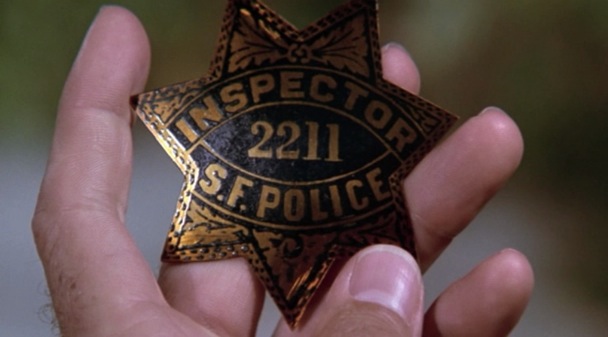
This is Dirt Harry's badge. Seconds later, he throws it into a river. Lots of other police will be doing the same.

This is Harry “Dirty Harry” Callahan’s badge. Seconds later, he throws it into a river. Lots of other police officers will soon be doing the same.

Yesterday, for the third time in my life, I was the first one on the scene after a fellow human being’s death. This time, it was a very close friend and, though it has little to do with this post, a wonderful man. I had headed out to his home because I was worried: an unusually reliable and conscientious individual, he had missed several appointments the last few days and hadn’t been answering e-mails and phone calls. When I was told about this, I immediately suspected the worst, and sadly, I was right.

His car was outside his house, and though it was mid-day and he was supposed to be somewhere else, I could see that the TV was on. In front of his door, getting soaked in the rain,  was a package: it had been delivered there on December 2. I got no response to my bangs on the door. It was time to call 911.

The police responded quickly. I’m not going to name the department, which has an excellent reputation here, and I do not fault the officers, who were diligent and polite, and who set about investigating the scene professionally and quickly. Nonetheless, after a full 90 minutes, after which they could not discern any more than I had before they came, they would not enter the house.

They told me that they could not risk being sued, and that there were elaborate policies and procedures that had to be checked off first. The officers had to track down their supervisor (it was a Saturday), and, they said, more than one official would have to sign off, to protect the department

“He could be drunk; he could be shacked up; he could just want to be alone,” they told me. “The law says his privacy can’t be breached, even by us.”

“But he’s not any of those things,” I said. “He doesn’t do any of those things, and if he were OK, there wouldn’t be a four-day-old package outside.”

“Maybe he took a trip on a whim.”

“He would have called and cancelled those commitments,” I said. “Look, you and I both know that he could be inside, on the brink of death, with every second bringing him closer. The only alternative is that he’s died already. If you won’t do it, let me break in, chase me, and you’ll find him legally as you pursue me. How’s that?”

The police weren’t sold. Finally, after a full 90 minutes, they requisitioned a ladder from a neighbor and were able to see into a second floor window. My friend was visible on the floor, and then they moved quickly, breaking down the door. They were too late by days. They might have been too late by minutes though. All those procedures and policies that forced the police to avoid taking action that in this case, under these circumstances, were prudent and that might have saved a life imperiled.

The lesson is only this: if we cannot trust police to make decisions like this, we obviously are not going to trust them to decide when to fire their weapons. Laws, rules and procedures are rigid, and have to be examined slowly; real life operates in the shadows of uncertainty, among the loopholes, gray areas and ambiguities, and it moves fast. The protests and demands in the wake of the recent police controversies will undoubtedly result in more regulations, policies and laws, but there is good reason to believe that they will also make us less safe rather than more safe, and make it difficult to find reasonable, dedicated, ethical men and women willing to serve as police, a job which, we seem to be deciding, should be subjected to strict liability whether the officer acts too quickly, or not quickly enough—judged, of course, after the results are in. Continue reading →

Journalism Ethics Reality Check: What The Entire News Media Did To Darren Wilson With Dorian Johnson’s “Hands Up” Story Is EXACTLY Like What Rolling Stone Did To UVA With “Jackie’s” Rape Account, Just Worse.

Am I the only one who sees this?

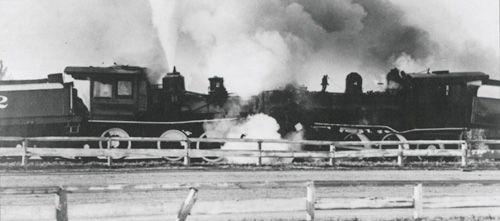
Two train wrecks, same track...

Two train wrecks, same track…

I discern that I was too subtle—imagine that!— when I wrote,

In light of all this, it seems that women really have done a relatively poor job at intimidating the left-biased media as well as its progressive pundits and elected officials. If they had sufficiently pressured journalists into believing that to challenge their accounts of rape, substantiated or not, was proof positive of malicious animus, like the civil rights machine has regarding narratives of police racism, they could depend on much of the media continuing to repeat the Rolling Stone account as truth even if it is completely discredited. This is, after all, what we are witnessing right now, as the recent grand jury decision in the Eric Garner death has allowed columnists, reporters, and broadcasters—and thus protesters and politicians—to continue to represent what happened to Michael Brown as if Dorian Johnson’s discredited description of his friend’s death was fair, accurate and unbiased.

So let me be clear….

We are told the the news media is furious with Rolling Stone over its discredited and anonymously sourced gang rape accusation against the University of Virginia’s chapter of the Phi Kappa Psi fraternity. Why is it not similarly critical of itself for publicly and far more widely accusing a single, named Ferguson police officer, Darren Wilson, of a race-motivated, cold-blooded execution of an unarmed man based on the allegations of Dorian Johnson? They are, from a journalism ethics perspective, equally irresponsible and unprofessional, and predictably more harmful. It is, we can stipulate, worse for a police officer to be accused of first degree murder than for unnamed members of a fraternity to be accused of rape.

Note:

1. Both Rolling Stone and the mainstream media were eager to accept the stories being told as fact because of their own ideological biases.

Rolling Stone is committed to the current campaign of the left to portray college campuses as perpetuating a “rape culture.” The mainstream media, as it had already proved in its slanted and incompetent coverage of Trayvon Martin’s death and the trial of George Zimmerman, is a shameless ally of the cynical Democratic Party’s tactic of representing the nation as racist. Continue reading →

Unethical Tweet Of The Month (Or Eternity?), “Jackie’s” UVA Gang Rape Ethics Train Wreck Division: Melissa McEwan

Melissa McEwan's profile photo. I'm not going to say a thing. No, really. Not a thing.

Melissa McEwan’s profile photo. I’m not going to say a thing. No, really. Not a thing.

“I can’t state this more emphatically: If Jackie’s story is partially or wholly untrue, it doesn’t validate the reasons for disbelieving her.”

— Melissa McEwan,  feminist proprietor of @Shakestweetz, an-all tweet blog, responding to the meltdown of the Rolling Stone story accusing a University of Virginia fraternity of gang rape.

Look, I’m not going to insult you by explaining what’s wrong with the assertion that those accusing others of horrific crimes shouldn’t be held to strict standards of credibility.

What is more significant than McEwan or her tweet is that this frightening and dangerous state of denial is moving from the status of self-evidently insane to acceptable. As I suggested in the previous post about the Rolling Stone retraction of its explosive story by Sabrina Rubin Erdely, the Ferguson demonstrators, the “Hands up!” protestors, the Congressional Black Caucus, and  pundits like Eugene Robinosn who are still arguing that Officer Wilson should be indicted are doing essentially the same thing. Having decided that the Ferguson narrative pressed by civil rights activists communicated a deep truth about America, they refuse to accept that it was false even in the face of overwhelming evidence because they are intellectually and emotionally committed to that “truth.”

The tweet also forces me to upgrade the Rolling Stone fiasco to Ethics Train Wreck status. Continue reading →

KABOOM! Now I’m Satisfied That The U.S. Will Never Solve Its Debt Problem, Since It Takes This Long For Congress To STOP PAYING ENTITLEMENTS To NAZIS

exploding-head

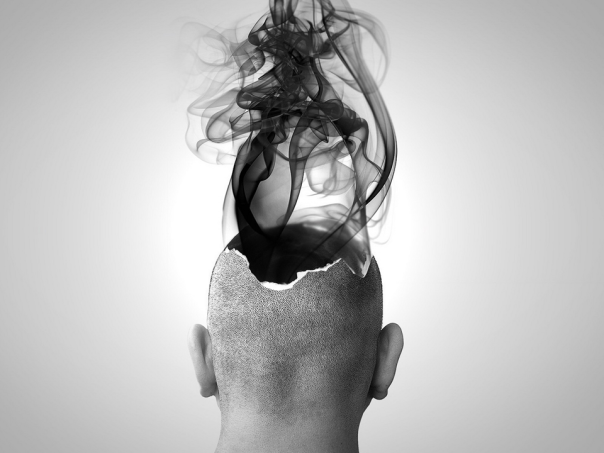
I’m on the way to Cleveland. I guess I might as well leave my brains on the ceiling, where this story deposited them:

“The House on Tuesday passed legislation to terminate Social Security benefits for suspected Nazi war criminals. Passed 420-0, the bill was approved after an October Associated Press report found that dozens of suspected Nazi war criminals forced to leave the U.S. collected millions of dollars in federal benefits.”

On the plus side, See? We can have bi-partisan agreement in Congress!

On the other side: why do we need the Associated Press to point out to Congress that we’re giving millions of dollars to former Nazis to keep them supplied with fresh Zykon B? Why wasn’t this bill passed six years ago? Sixteen years ago? As long as President Obama thinks he can rule by fiat, where was the executive order directing the Treasury to stop paying non-resident Nazis Social Security?

You can read the original AP story here, which I was going to post on until it got lost in the shuffle.

File this one under “Incompetent Elected Officials,” or perhaps simply, “We’re doomed.”

How Should We Judge Second Apologies?

Sure, who wouldn't think this was funny coming from a member of your school board?

Sure, who wouldn’t think this was funny coming from a member of your school board?

The most important feature of apologies is that they express sincere and honest regret for the real harm done. If the first apology for misconduct fails that test, how much credence should a second attempt have? Does it negate the first apology completely? Ought it to be read and understood in light of the initial, unsatisfactory apology? Or should it be ignored completely as a public relations document crafted to achieve a result, rather than to express genuine contrition?

The case of Chris Harris, a board member for the Hooks Independent School District in the town of Hooks, Texas, provides a fascinating test.

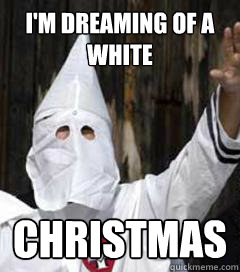
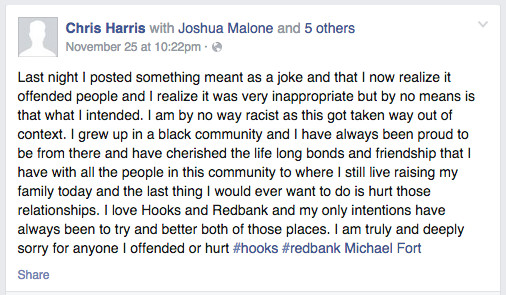
Lat week, Harris posted an image of a Klu Klux Klan member with the caption, “I’m dreaming of a white Christmas”  to his Facebook page. The reaction to this was what almost anyone with a fully functioning cerebrum would expect, a category that Harris does not belong to, or at least did not when he posted it. Perhaps after shouting, “Doh!” or perhaps not, Harris rushed to repair the damage, publishing this apology:

Harris apology 1

Terrible apology! Continue reading →

Contest Entry For Most Unethical Column, Post Or Essay About The Ferguson Ethics Train Wreck: Hip-Hop DJ Jay Smooth

It goes without saying that my efforts to avoid more Ferguson commentary is a failure. The race-baiters, grievance-mongers, police-haters and cynical Democratic-base-goosers are engaging in an orgy of self-righteousness, aided by an uncritical news media and encouraged by public sentimentality and ignorance. This is horrible for the rule of law, law enforcement, race relations and the nation, but to close our eyes and repress our gag reflexes, hoping it will go away, is cowardly and irresponsible. This stuff is dangerous, to be blunt. Lies always are, and public policy built on lies will always result in harm and distrust.

The onslaught is much more powerful than I expected: several member of the Congressional Black Caucus actually brought the false “Hands up! Don’t shoot!” rallying cry onto the House floor yesterday. Charlie Rangel is using the lawful shooting of Brown based not on race but on his conduct alone to re-open demands for slavery reparations.

In this context, I’m entering this video blog by John Randolph, a.k.a “Jay Smooth,” a popular and outspoken hip-hop DJ with pretenses of social relevance.  It is genuine mind-poison. “Smooth” is sure smooth: he’s articulate, facile, a good actor, attractive, and facts mean absolutely nothing to him. Here he spins a persuasive justification for the Ferguson riots based on a series of demonstrably false premises: garbage in, but insidiously persuasive garbage out, especially to his audience. It begins with an apparently popular tweet he made before the grand jury results came out, which said, “The fundamental danger of a non-indictment is not more riots, but more Darren Wilsons.” If Wilson was not indicted for lawfully protecting himself from a subject who attacked him, more police will protect themselves from attacking suspects? The tweet is cleverly misleading: it assumes, without stating, that a racist cop murdered a black youth, and the video blog proceeds accordingly from that assertion. The truth is that the danger of having an indictment would be to allow mob justice and vengeance to preempt due process and fairness. Not surprisingly, Smooth later reveals that he sent essentially the same dishonest tweet about the George Zimmerman trial. Continue reading →

President Lincoln’s Misunderstood Ethics Crisis: The Great Sioux Uprising

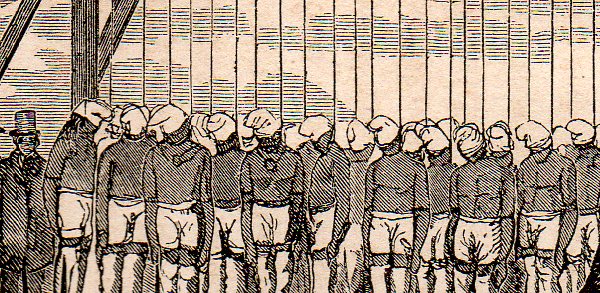
Dakota hanging

As part my so-far futile efforts to leave Ferguson in the rear view mirror, let’s revisit one of the Abraham Lincoln’s great ethical dilemmas during the Civil War, in which today’s date, December 1, was pivotal.

Minnesota’s Great Sioux Uprising, now usually called the Dakota-U.S. Conflict, was among the bloodiest Indian wars in the West, with hundreds of Native Americans, settlers and military casualties. The Sioux were defeated soundly, and the U.S. Army tried 303 Native Americans by military commission, finding them guilty of war crimes and sentencing them to death by hanging. Federal law required Presidential approval of the death sentences, and this was a problem Abraham Lincoln, the President at the time, did not need.

For it was 1862, and the Civil War was raging. This was a year full of Union defeats, indeed, disasters, like Fredericksburg, and both the war and Lincoln’s ability to lead it were in peril. Lincoln was also calculating all the political angles before issuing the Emancipation Proclamation. On top of the burdens of war and politics, he was coping with personal tragedy: his young son Willy had died nine months earlier, and Mary Todd Lincoln was teetering on emotional collapse from grief.
Now he had to decide whether to allow the execution of more than 300 Indians convicted in trials that were no better than kangaroo courts. Few Americans were concerned about the fate of the Native Americans, but Lincoln, with all of his other worries, took on the task of reviewing the trial records. What he found was manifest injustice.  Continue reading →