The A.I. Ethics Problem in News Reporting

Guest post by Matthew B.

JM Introduction: This excellent post arrived on yesterday’s open forum, and thus was immediately eligible for guest column status. It is especially timely, both because of this story from the legal ethics jungle and this more alarming one:

The top United States Army commander in South Korea revealed to reporters this week that he has been using a chatbot to help with decisions that affect thousands of U.S. soldiers. Major General William “Hank” Taylor told the media in Washington, D.C., that he is using AI to sharpen decision-making, but not on the battlefield. The major general — the fourth-highest officer rank in the U.S. Army — is using the chatbot to assist him in daily work and command of soldiers.

Speaking to reporters at a media roundtable at the annual Association of the United States Army conference, Taylor reportedly said “Chat and I” have become “really close lately.”

Great. What could go wrong? Now here’s Matthew…

***

One of the problems with AI is how often it is confidently wrong. This manifests itself all over the place. One of the most troubling is in the news industry. The news industry under tremendous financial pressure, and the appeal of moving towards AI generated content opens them up to completely BS stories spreading.

There are several great recent examples.

Continue reading

Sickness Ethics:  The Worker’s (and the Tourist’s) Dilemma

Guest Post

by AM Golden

About a month ago, I got my hair cut at a salon that is part of a nationwide chain.  It was a couple of days before my vacation.  During the cut, the stylist coughed several times into her arm.

Correction: she held her arm out and coughed in its general direction.  You know what I mean, right?  The arm is extended out front, allowing the cough to have plenty of space to spew germs out into the air with nothing to buffer them.

She complained about sinuses.  I sympathized.  Sinuses are tough.  It didn’t pass my notice, however, that one cough seemed a little congested.

At checkout, I told her I hoped her sinuses got better.  It was then that she disclosed that it was harder because she was also recovering from bronchitis.

Cue internal Homer Simpson-esque scream and flight.

I am highly susceptible to bronchial infections, especially this time of year.  It was 35 years ago that I caught pneumonia while in college which caused me to miss two weeks of classes and three weeks of work at McDonald’s.  I returned to classes the day mid-terms began.  The day I returned to work, they put me in the drive-thru and assured my mother they would take me out as soon as it got dark and too cold.  They didn’t.  Fast food work sucks. 

Probably for that reason, I am sympathetic to people in customer-facing positions because they are paid by the hour, generally don’t have sick time or much sick time and often have to make the choice of earning money to pay their bills or staying home unpaid when sick.

I get it.

Continue reading

On the Illegality of Illegal Aliens

Guest column by Ryan Harkins

We have this report from HotAir explaining that that the ICE raid on the meat packing plant in Nebraska was not simply due to the fact that the plant hired so many illegals. Instead, the focus of the raid was on an identity-theft ring running out of that plant.

I want to make it clear I am all in favor of whoever in the world who wants to come to the United States to make a better life for themselves should have the opportunity. I’d give top priority to those who wish to become US citizens, but I’m generally in favor of letting into the country far more people than our current immigration system allots. How many more, I can’t say, as I’ve not crunched the numbers. But in general more immigrants means more workers, more production, higher demand for services, all which contribute to a growing economy that enriches everyone here.

Continue reading

Off With Their Heads! The Unsustainable Echo Chamber of Bluesky

Guest Column by A M Golden

[From your host: I held this excellent guest column submission for about a week, waiting for a propitious time to post it. JD Vance’s adventure on the platform, which I discussed here, was exactly the context I was waiting for. And it gives me an0ther chance to feature Bing….JM]

Anyone who doubts the uniqueness of the American Revolution need only to look to France several years later when revolutionaries stormed the Bastille and set up a Republic.  As revolutions were wont to do, those who replaced the guys in charge eventually demanded that everyone follow their ideas in lockstep.  Those who did not were accused of lacking sufficient revolutionary fervor and risked literally losing their heads.  The self-righteous Jacobins who forced this pure ideology eventually devoured themselves as, again, revolutionaries are wont to do, until the head Jacobin, Robespierre, eventually lost his own head and disenchantment led to the installation of Napoleon as Top Dog.

That should have happened in the United States, too.  Despite the passions of the Federalists and the Jeffersonian anti-Federalists, though some nasty words were printed and spoken aloud, no one was murdered for his lack of purity (unless you count Alexander Hamilton, which I don’t because that was less an ideological battle than a personal grudge).

Ever since talented-but-socially-awkward Elon Musk bought Twitter, turned it into X and antagonized all those people who bought his so-called climate-friendly vehicles, those same Tesla owners have flocked to every other faddish social media that promises 24/7 Trump/Musk hate in addition to freedom from having to be exposed to the opinions of those who disagree with them.

It was one of our illustrious commentators here (I do not remember which one.  I apologize.  It’s been three years and I’ve slept since then) who suggested that many of the Hollywood types would realize their mistake when they exchange 80,000 followers for 80.  That person was right.

I have belonged to Facebook for years.  I’ve tried Instagram but find it unwieldy and boring.  I couldn’t help it, however, when one of my favorite performers made the Grand Announcement that he was headed over to the new Post.News in 2022, which promised conversations “moderated for civility”.  It took ten days to get me onboarded and I found the place to be overwhelmingly progressive….and small. 

Don’t get me wrong, there was a huge influx of members.  Then nothing.  Some of them even proposed that members try to make a positive platform there by building a community not based on complaining about the platform they’d just left.  I heavily curated what I followed and then began contributing content on a daily basis: I recommended books on history that I’d read myself.  I amassed over 30 followers over the next 18 months; the favorite performer barely broke 100.

Ultimately, though, it was not a sustainable platform. It folded.  Once again, members were looking for places to hide from the world, including Favorite Performer, and were pulled into Bluesky.  This time, I didn’t take the plunge.

Now, it appears that Bluesky has reached its ideological saturation point.  This week, Megan McArdle wrote this entry in the Washington Post: Bluesky’s decline stems from never hearing from other side .

Continue reading

Silent Pondering Our Shared Tomorrows As The Road Stripes Streak By

Guest post by Steve Witherspoon

From your host: The rioting in LA and other cities going on right now make this unusually emotional post by Steve especially timely. I have been pondering it for several days now. The essay is clearly a head explosion in process, an eruption of anger and frustration with the metaphorical fuse lit by the issues he mentions and others. [I hope Steve forgives me for more extensive editing than usual, prompted by his passion interfering with his characteristic precision]

I sympathize. This is an ethics blog, and part of my job is to keep the discussion focused on ethics, rational analysis, and open-mindedness. There has been so much in the past year particularly that reminded me of a legendary meltdown by a good friend, a lawyer, who suddenly snapped in the back seat of my car years ago and started screaming, “This is FUCK! It’s all FUCK! Everything is FUCK!” True, alcohol was involved. However, the outburst was therapeutic. We all knew what he was ranting about, he was essentially right, and after my friend had relieved himself of his frustrations, he was able to help us solve the problem at hand.

And we did.

Take it, Steve.and don’t despair.

***


I know exactly what my laser-focused conscious mind is doing in this situation, but what does your subconscious mind ponder when you’re on the road for many hours over 4,800 miles, while you crisscross a big chunk of the middle of the United States of America on vacation?

For hours at a time, when the road seems to vanish into a fine point on the horizon and the visible land meets the sky, the subconscious mind kicks into gear and is actively working behind the scenes… at least mine is. In past years that subconscious would be working on something creative. Maybe a few guitar riffs that I could put into practice at a later date, writing some music, designing a new addition on the house, or putting the final engineering touches on a new product for work, etc. The creative juices get flowing when the subconscious is given the opportunity to ponder for long periods of time as long as it’s relatively uninterrupted. Then when you’re no longer spending all those laser-focused hours on the road and settling back to your regular life, the stored thoughts that your subconscious mind had been working on are suddenly released into the brain. It can cause a bit of an information overload. This has happened to me more times than I can count.

I’ve learned that, at least for me, if you give the subconscious mind a chance to do what it does best, think deeply for long periods of time, it can feed your intellect.

For the last three weeks of May 2025, my wife and I were on an annual vacation. This time we focused on some National and State Parks in the western and southwestern United States that we wanted to see thoroughly. I briefly wrote about it and shared a few select photos in a blog post titled “There’s A Great Big World Out There To See.”

As usual, my subconscious mind was doing what it does best; however, this time the output was different. My mind wasn’t working on creative things like music, product designs or engineering; it appears that it was critically thinking about politically related things. This was particularly surprising because I generally cut myself off from all things political when on vacation and simply enjoy stopping to smell the roses with my wife. In the great scheme of things, life can be short, and I think it’s really important to do things with your spouse, especially after you retire, and not end up with piles of regrets that outweigh finding real peace after the end of life catches up with a spouse.

Again, my subconscious mind seemed to be thinking about politics and more specifically the political division we have. It doesn’t matter one bit how much critical thinking and facts you throw at the absurd things that are coming out of the political Left, the divide keeps getting deeper. It doesn’t seem to matter that life-long Democrats are leaving the party and openly stating that the Democratic Party has fallen over the edge of reality and left them.  It doesn’t seem to matter one bit that politicians like the baldfaced liar Adam Schiff get nailed in one lie after another and that he’s spewing the lies to intentionally mislead the voting public.

I’ve been writing about some of the absurdities coming from the political Left for a few years. What they are trying to force upon the American people is delusional, and undermines the core foundation of values that our country has been built upon.   

Continue reading

“Mostly Peaceful” Bullshit

Guest Post by Mrs. Q

From your host: Ok, this is technically a Comment of the Day on the post, “Let Us Call the George Floyd Freakout What It Was.” I decided that it warrants guest post status for several good reasons. 1) We haven’t had a guest post for a while, and I am still seeking submissions. 2) The George Floyd aftermath disaster is one of the signature ethics outrages of my life, and is certainly worthy of more than one post saying so on its 5th anniversary. 3) I’m slyly trying to entice Mrs. Q to revive her featured column on Ethics Alarms, and 4) not for the first time, I like her take on a current ethics topic better than my own.JM.

If anyone hasn’t had a chance to see this documentary, I’ll link it here: The Fall of Minneapolis | A Crowdfunded Documentary.

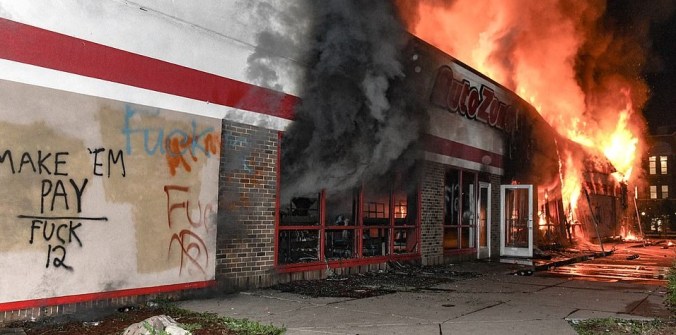
As some longtime readers here may remember, I am from Minneapolis and grew up literally at ground zero, where the Third Precinct, Auto Zone, and Minnehaha Lake Wine and Spirits were burned to a crisp. For three days and nights I watched others livestream on multiple cameras everything I knew from 4-14 years old go from vandalized to looted to burned from May 25th-28th. The first building they burned, was ironically, the last place I ever saw my black father work (it was a Snyders Drug Store then). I’d wait for him on the sidewalk in front of our four-plex, watching as he would step out the door of the building and head a half block home. Now that memory is infused with flames.

Then the riots went global.

What so many forget is that it was quite literally a war zone in Minneapolis. The documentary linked above illustrates what I witnessed. Areas were under siege and neighbors were trapped in their homes for days. It wasn’t just that crime increased, it was that the police could not help anyone. There were neighbor reports of rioters putting accelerants around neighborhoods, so people had to patrol their areas while putting themselves at risk for being attacked physically. I spoke with friends who had to flee in the early morning to get their families safe. And those who thought their BLM or Biden yard signs would save them were met with the same violence as everyone else.

Continue reading

Tariffs Have Been Needed For Decades

Guest post by Steve Witherspoon

[It’s shaping up as “Tariffs Monday,” at least in the morning! JM]

I worked as a Manufacturing Engineer in a metal fabrication plant for thirty years (I wore many hats in this small company) and I personally saw what other countries (especially, China, Mexico, and Canada) were doing to undermine manufacturing in the United States of America. The USA should have put tariffs on at least these three countries 20+ years ago, but instead they were allowed to continue to unfairly practice “free trade” with us unabated.

China took one manufacturing and assembly job after another, then China used its financial capital to seriously undercut USA steel manufacturing causing steel mills in the USA to slow to a dead crawl and increase their cost a lot. In addition to that, the steel coming out of China was rusty and didn’t meet quality standards and distributors were having real problems providing quality steel to long term customers like our company. We had to slow production of some products as a result of supply problems and that hurt some of our customers and that trickled down to problems for some consumers.

Canada has been undermining aluminum and stainless steel manufacturing in the USA for over twenty years, as they practiced their unfair “free trade”  with us unabated. When Canada’s stainless steel production slowed we had to seriously slow the manufacturing of some products. One stainless steel product that had to be slowed we made for a local company and that product ended up on United States Navy submarines. I personally know people who worked (past tense) in aluminum mills and they watched as the plants slowed down to a crawl. People got laid off and retired early as Canada took over most of the market for some aluminums.

Then there is Mexico. That nation has been undermining USA assembly plants of all kinds for well over twenty years. Where do you think a huge portion of assembled consumer goods are coming from, including PC computers? Yup, it’s Mexico and usually just across the USA/Mexico border. These are not the only countries that have been unfair with all this “free trade” bull shit.

Continue reading

Comment of the Day: Friday Open Forum [Tariffs Thread]

That’s the New York Times graph this morning showing stock markets since President Trump’s inauguration. The lowest line (in orange) is Japan; the next lowest line is the U.S. The reason for all of those declines are believed to be Trump’s tariff policies.

A commenter last week asked why Ethics Alarms hadn’t discussed Trump’s tariffs. My response was, 1) I didn’t see them as an ethical issue and 2) I wasn’t informed sufficiently on the topic to opine on it. Veteran EA commentator Chris Marschner said, “Hold my beer!” The post below is the result: you van review the whole thread, which includes more from Chris, here.

***

I don’t know if this is an ethics angle per se but the tariff objections illustrate without question America’s unwillingness to suffer any short term discomfort in order to obtain long term security. I keep hearing that Trump is a narcissist such that he has this inappropriate sense of sense but one of the clinical signs of narcissistic behavior is a sense of entitlement. The minute anything Trump does causes some immediate discomfort or loss many in the public feel they are entitled to what they had before.

A large percentage of the stock market gains are illusory because much of that growth was driven by inflated profits and subsequently inflated stock prices. Consumer and producer prices rise before costs are actually incurred because labor costs are negotiated on longer term contracts as are so many of our commodities. The Biden administration fueled those inflated profits – and he said as much in a speech in the port of Baltimore – when he poured 2 trillion dollars into the economy with too few goods to buy. Employment gains in the last 4 years were in large measure government jobs that produce intangibles whose values are only measured in terms of their employment.

People need to realize that the algorithms used by traders are driving much of the sell off because tariffs are deemed to be anti-growth. What the buy/sell programs are not factoring in is the 6 trillion dollars worth of investment commitment which will revitalize our semi-conductor industry and other strategic industries. We have to buy spare avionics parts for our military and the base materials for our medicines from our political adversary who has a 100 year plan to dominate the globe.

Continue reading

Societal Enabling of Abnormal Behaviors

Guest Post by Steve Witherspoon

[My first reaction to this passionate guest post was “Gee, how do you really feel, Steve?” My second was “The opinions expressed are not necessarily those of the host.” My third is: I wouldn’t laugh yet. One of my oldest friends is visiting D.C. to meet his new grandson, birthed by the wife of his former daughter, now son. When I went to the memorial service of a former thoroughly Irish Catholic boss from the streets of Brooklyn, I discovered that two of his three sons, all of whom I knew as children, are now middle aged women, and seemingly very happy about it. A close member of my immediate family is “transitioning.” Whatever it is that’s going on here, its getting dig in like a tick.]

I have raised the question in an earlier essay titled, What’s Considered Normal, where I looked into the differences between what is considered to be “normal” and “abnormal”. You can read the arguments presented in the entire post if you like, but I’ll briefly summarize some of the details as I go along in this essay.

I think it’s extremely important that everyone understands the core of an argument based on the words used and how those words are defined. So with that in mind, let’s start by presenting some generally accepted “norms”.

NORMAL

  • Conforming to a standard; usual, typical, or expected
  • Conforming to a type, standard, or regular pattern..
  • …characterized by that which is considered usual, typical, or routine.
  • If something conforms to a general pattern, standard, or average, we describe it as normal.

ABNORMAL

  • Deviating from what is normal or usual.

  • Not normal, average, typical, or usual.

  • Something that is abnormal is out of the ordinary, or not typical

ENABLING

  • Supporting or allowing (whether intentionally or unintentionally) harmful or destructive individual behaviors thus preventing the individual from facing either the consequences of their choices and/or generally accepted reality.

Dysfunctional: Deviating from the norms of social behavior in a way regarded as bad.

Delusional: Characterized by or holding false beliefs or judgments about reality that are held despite incontrovertible evidence to the contrary, typically as a symptom of a mental condition.

Now that we have the terms settled, on to the core of this essay…

Continue reading

Guest Post: How Do You Solve a Problem Like the Europeans?

By Michael West

[This epic post originally appeared as a comment on my post about the now legendary Oval Office confrontation that gave Ukraine president Zelenskyy brownie points with the Trump Deranged while sabotaging his nation’s prospects of getting the U.S. support he desperately needs. Good job! But long-time Ethics Alarms critic, commenter and ethics analyst Michael West’s commentary goes far beyond the margins of that essay, and I decided that rather than a Comment of the Day, it is better suited to be a guest post. And so it is…Oh! I apologize to Michael for the facetious introduction above, but when something gets me thinking about a song, especially and earworm like THAT song, I either get it out of my system or the thing drives me nuts all day. JM]

Before we talk about this topic, I have a problem I’m working through.

I live across the street from a guy who immediately behind his house is a large stock pond that is even higher than his house – the retaining berm is pretty high compared to the foundation of the house, if you can imagine. Well, across the street where we live, is lower.

He’s always been a little concerned about the water pressure against the berm possibly breaching and flooding his house – which, if bad enough could cross the street and affect my house. One day many years ago, when the weather threatened to have a very rainy season, he asked me, since we both have this mutual concern if I could come over and help clear out the relief spill way of the pond. So I brought my shovel, which I’d kept nice and clean, sharp and the wooden handle well oiled. He had his also – a little worse for wear, but whatever, it’s a shovel right?

Well, we cleared the spill way of debris – any serious rain raising the water level would then be free to pour clear of his yard and relieve pressure on the berm. We walked home exhausted from the work, he tossed his shovel in the shed. He’s always been a little brusque and arrogant (I think he thinks a little more of his lifestyle than mine), so I didn’t really think much of it when he only said “Thanks for that”.

When I got home, I spent about an hour cleaning my shovel, hammering out some dings from rocks and running the grinder on it to re-sharpen it. I then applied teak oil (a not inexpensive preservative and moisturizer) on the handle. I put my shovel away.

Later in the season my neighbor saw me doing some landscape work with my shovel to improve the neighborhood. He scoffed saying he didn’t agree with what I was doing and what business of mine was it.

The next year, the as the rainy season approached my neighbor, again concerned about the pond, asked me over again to make sure the spillway was clear for flow, reminding me the pond could just as easily affect me, downhill across the street. My kids enjoyed playing in his backyard with his kids plus it would be neighborly. I brought my shovel and he kind of took some time rummaging through his mess of shed to find his shovel. Looked like it still had the mud from last year.

We went to work. At the end of the day, he tossed his shovel in the shed. I went home and sharpened, cleaned, reshaped and oiled mine – I had work to do over the coming months in other locations. My neighbor always had comments about the work I did and always thought I wasted time keeping my shovel in working condition. He laughed that with my work I didn’t have time for the fun things he could do.

One time, I asked my neighbor if he would be prepared to help my on the other side of my house cut a firebreak because I was concerned about the danger of a wildfire over there. His response was “I’ll see what I can do, but I’m pretty busy over here, so I wouldn’t expect to be able to soon.”

Another season went by, this time rain came on us with little warning and he called me up demanding I get over there and clean out the spillway before disaster befell both of us. On my way with the shovel, he asked me to try to get most of the work done as his shovel was too rusty and dinged up – the wooden handle was dry rotted a likely to snap. He said he’d always intended on taking care of his shovel but that he just didn’t have time for it with all the fun things he was doing.

As the rain poured down, I went to the top of the berm only to discover the pond was dry – bone dry – as in, it probably didn’t have any water in it for a year or two. There was zero chance this pond was going to breach and threaten our yards unless a true deluge happened.

I walked home with my shovel to the great anger of my neighbor who said he might lose all respect for me if I didn’t pitch in. He told me I would have no standing in the community if I didn’t help him and that all the respect I’d earned as a hard worker around the neighborhood would be for nothing. He told me we had an understanding and that I owed him and that if something happened to my yard, he would certainly be there for me.

Anyway – I’m not sure what I owe my neighbor.

Can y’all help me out with this situation?

Now, let’s talk about the problem of Europe.

From the start of the modern era, that is the late 1500s on Europeans engaged in continent-wide savage bloodlettings on multiple occasions.

1618-1648: The Thirty Years’ War consumed possibly 4.5 to 8 million people out of an estimated population of 75 million people (6-10% – though slightly less because it doesn’t count full amount of new births in that era).
The Franco-Spanish War occurred roughly contemporaneously, adding to the death count. These sucked in various German states, the Dutch, Spain, France, Sweden, the Hapsburg realms (Austria, Hungary, Bohemia, etc)

1672-1678: Franco-Dutch War; France, England, Sweden, the Dutch, the Holy Roman Empire, Spain, several German states, etc, slogged it out to the tune of some 340,000 soldier deaths alone.

1688-1697: the Nine Years’ War; the Dutch, England, Scotland, the Holy Roman Empire, Spain, etc duked it out chalking up another 680,000 soldiers KIA.

1683-1699: the Great Turkish War; (somehow along side the 9 years war); the Holy Roman Empire, Poland, Lithuania, Russia, Venice, and the Spanish Empire against the Ottoman Empire. Europe sent another 384,000 soldiers to their doom.

1701-1714: the War of the Spanish Succession; consumed 700,000 to 1.3 million soldiers alone and saw Europeans stretch their legs to include combat abroad as their colonial empires grew. This sucked in France, various German states, England, the Dutch, Prussia, Portugal, and others.

1700-1721: the Great Northern War; Sweden, Poland, Ottoman Empire, a large variety of Slavic nationalities, Russia, various German states, Lithunia, England, Scotland, Ireland, the Dutch, Denmark, Norway, Prussia, Moldavia, et al, managed to run this war on the side of the War of the Spanish Succession at the cost of about 500,000 soldiers dead.

1740-1748: the War of Austrian Succession; France, Prussia, Spain, various German states, various Italian states, Sweden, some of Scotland, the Hapsburgs, Great Britain, and Russia laid each other out with 750,000 casualties. This war also saw widespread combat across the globe.

1756-1763: the Seven Years’ War; in another conflagration fought between Europeans across world wide locations; Great Britain, Prussia, Portugal, France, the Hapsburgs, Russia, Spain, Sweden, et al, slogged it out with some
630 to 850 thousand dead soldiers. This one saw widespread use of local colonial forces in the combat with Americans, Native Americans, Mughal Indians, Bengalese involvement.

1793-1802: the French Revolutionary reaction; France and some allies, Holy Roman Empire, Great Britain, Spain, the Dutch, Switzerland, some German and Italian States, the Ottomans, Portugal, Russia, the United States and various colonies – another 280,000 (at a minimum).

1802-1815: the French expansion and collapse – The Napoleonic Wars; here we get to see a prelude of what was really to come. The United Kingdom, the Hapsburgs, Russia, Prussia, Sweden, Spain, Portugal, Italian States, Iran, the Ottomans, Montenegro, German States, Netherlands, Denmark, Switzerland, Austria, and the French get to learn what unhealthy nationalism can allow a dictator to lead to – an unlearned lesson to the tune of at least 6 million dead.

1853-1856: the Crimean War; the Ottomans, France, the United Kingdom, go after Russia, with a loss of anywhere from 600,000 to 1 million dead.

1870-1871: The Franco-Prussian War; finally, a remarkably “isolated” war, pits France against Germany, but just the two nations racked up some 200,000 dead soldiers and 250,000 dead civilians.

Alongside all of that 250 year war-fest there were dozens of sideshows on the European Continent that were spats involving more than just neighboring powers in addition to the fights between unhappy neighbors. This summary history begins with the modern age primarily because Europe’s wars prior to this – the drama of the middle ages, mostly resembled what we would see familiarly in modern era in places like Africa or the Middle East – that is, man’s perennial condition – limited local wars of varying intensity waged primarily between prima donna young men and their loyal constituencies trying to make a name for themselves or two ethnos that just flat out refuse to live together.

Continue reading