[It’s shaping up as “Tariffs Monday,” at least in the morning! JM]
I worked as a Manufacturing Engineer in a metal fabrication plant for thirty years (I wore many hats in this small company) and I personally saw what other countries (especially, China, Mexico, and Canada) were doing to undermine manufacturing in the United States of America. The USA should have put tariffs on at least these three countries 20+ years ago, but instead they were allowed to continue to unfairly practice “free trade” with us unabated.
China took one manufacturing and assembly job after another, then China used its financial capital to seriously undercut USA steel manufacturing causing steel mills in the USA to slow to a dead crawl and increase their cost a lot. In addition to that, the steel coming out of China was rusty and didn’t meet quality standards and distributors were having real problems providing quality steel to long term customers like our company. We had to slow production of some products as a result of supply problems and that hurt some of our customers and that trickled down to problems for some consumers.
Canada has been undermining aluminum and stainless steel manufacturing in the USA for over twenty years, as they practiced their unfair “free trade” with us unabated. When Canada’s stainless steel production slowed we had to seriously slow the manufacturing of some products. One stainless steel product that had to be slowed we made for a local company and that product ended up on United States Navy submarines. I personally know people who worked (past tense) in aluminum mills and they watched as the plants slowed down to a crawl. People got laid off and retired early as Canada took over most of the market for some aluminums.
Then there is Mexico. That nation has been undermining USA assembly plants of all kinds for well over twenty years. Where do you think a huge portion of assembled consumer goods are coming from, including PC computers? Yup, it’s Mexico and usually just across the USA/Mexico border. These are not the only countries that have been unfair with all this “free trade” bull shit.
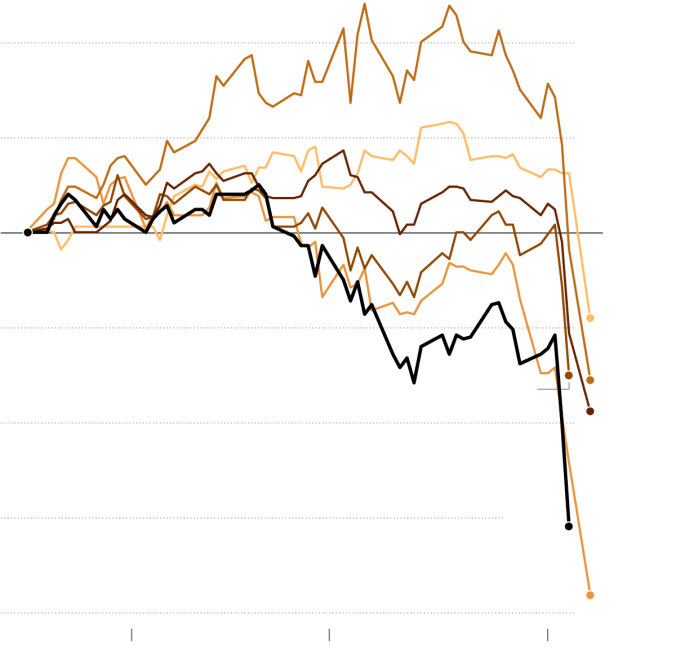
That’s the New York Times graph this morning showing stock markets since President Trump’s inauguration. The lowest line (in orange) is Japan; the next lowest line is the U.S. The reason for all of those declines are believed to be Trump’s tariff policies.
A commenter last week asked why Ethics Alarms hadn’t discussed Trump’s tariffs. My response was, 1) I didn’t see them as an ethical issue and 2) I wasn’t informed sufficiently on the topic to opine on it. Veteran EA commentator Chris Marschner said, “Hold my beer!” The post below is the result: you van review the whole thread, which includes more from Chris, here.
***
I don’t know if this is an ethics angle per se but the tariff objections illustrate without question America’s unwillingness to suffer any short term discomfort in order to obtain long term security. I keep hearing that Trump is a narcissist such that he has this inappropriate sense of sense but one of the clinical signs of narcissistic behavior is a sense of entitlement. The minute anything Trump does causes some immediate discomfort or loss many in the public feel they are entitled to what they had before.
A large percentage of the stock market gains are illusory because much of that growth was driven by inflated profits and subsequently inflated stock prices. Consumer and producer prices rise before costs are actually incurred because labor costs are negotiated on longer term contracts as are so many of our commodities. The Biden administration fueled those inflated profits – and he said as much in a speech in the port of Baltimore – when he poured 2 trillion dollars into the economy with too few goods to buy. Employment gains in the last 4 years were in large measure government jobs that produce intangibles whose values are only measured in terms of their employment.
People need to realize that the algorithms used by traders are driving much of the sell off because tariffs are deemed to be anti-growth. What the buy/sell programs are not factoring in is the 6 trillion dollars worth of investment commitment which will revitalize our semi-conductor industry and other strategic industries. We have to buy spare avionics parts for our military and the base materials for our medicines from our political adversary who has a 100 year plan to dominate the globe.
[My first reaction to this passionate guest post was “Gee, how do you really feel, Steve?” My second was “The opinions expressed are not necessarily those of the host.” My third is: I wouldn’t laugh yet. One of my oldest friends is visiting D.C. to meet his new grandson, birthed by the wife of his former daughter, now son. When I went to the memorial service of a former thoroughly Irish Catholic boss from the streets of Brooklyn, I discovered that two of his three sons, all of whom I knew as children, are now middle aged women, and seemingly very happy about it. A close member of my immediate family is “transitioning.” Whatever it is that’s going on here, its getting dig in like a tick.]
I have raised the question in an earlier essay titled, What’s Considered Normal, where I looked into the differences between what is considered to be “normal” and “abnormal”. You can read the arguments presented in the entire post if you like, but I’ll briefly summarize some of the details as I go along in this essay.
I think it’s extremely important that everyone understands the core of an argument based on the words used and how those words are defined. So with that in mind, let’s start by presenting some generally accepted “norms”.
NORMAL
Conforming to a standard; usual, typical, or expected
Conforming to a type, standard, or regular pattern..
…characterized by that which is considered usual, typical, or routine.
If something conforms to a general pattern, standard, or average, we describe it as normal.
ABNORMAL
Deviating from what is normal or usual.
Not normal, average, typical, or usual.
Something that is abnormal is out of the ordinary, or not typical
ENABLING
Supporting or allowing (whether intentionally or unintentionally) harmful or destructive individual behaviors thus preventing the individual from facing either the consequences of their choices and/or generally accepted reality.
Dysfunctional: Deviating from the norms of social behavior in a way regarded as bad.
Delusional: Characterized by or holding false beliefs or judgments about reality that are held despite incontrovertible evidence to the contrary, typically as a symptom of a mental condition.
Now that we have the terms settled, on to the core of this essay…
[This epic post originally appeared as a comment on my post about the now legendary Oval Office confrontation that gave Ukraine president Zelenskyy brownie points with the Trump Deranged while sabotaging his nation’s prospects of getting the U.S. support he desperately needs. Good job! But long-time Ethics Alarms critic, commenter and ethics analyst Michael West’s commentary goes far beyond the margins of that essay, and I decided that rather than a Comment of the Day, it is better suited to be a guest post. And so it is…Oh! I apologize to Michael for the facetious introduction above, but when something gets me thinking about a song, especially and earworm like THAT song, I either get it out of my system or the thing drives me nuts all day.JM]
Before we talk about this topic, I have a problem I’m working through.
I live across the street from a guy who immediately behind his house is a large stock pond that is even higher than his house – the retaining berm is pretty high compared to the foundation of the house, if you can imagine. Well, across the street where we live, is lower.
He’s always been a little concerned about the water pressure against the berm possibly breaching and flooding his house – which, if bad enough could cross the street and affect my house. One day many years ago, when the weather threatened to have a very rainy season, he asked me, since we both have this mutual concern if I could come over and help clear out the relief spill way of the pond. So I brought my shovel, which I’d kept nice and clean, sharp and the wooden handle well oiled. He had his also – a little worse for wear, but whatever, it’s a shovel right?
Well, we cleared the spill way of debris – any serious rain raising the water level would then be free to pour clear of his yard and relieve pressure on the berm. We walked home exhausted from the work, he tossed his shovel in the shed. He’s always been a little brusque and arrogant (I think he thinks a little more of his lifestyle than mine), so I didn’t really think much of it when he only said “Thanks for that”.
When I got home, I spent about an hour cleaning my shovel, hammering out some dings from rocks and running the grinder on it to re-sharpen it. I then applied teak oil (a not inexpensive preservative and moisturizer) on the handle. I put my shovel away.
Later in the season my neighbor saw me doing some landscape work with my shovel to improve the neighborhood. He scoffed saying he didn’t agree with what I was doing and what business of mine was it.
The next year, the as the rainy season approached my neighbor, again concerned about the pond, asked me over again to make sure the spillway was clear for flow, reminding me the pond could just as easily affect me, downhill across the street. My kids enjoyed playing in his backyard with his kids plus it would be neighborly. I brought my shovel and he kind of took some time rummaging through his mess of shed to find his shovel. Looked like it still had the mud from last year.
We went to work. At the end of the day, he tossed his shovel in the shed. I went home and sharpened, cleaned, reshaped and oiled mine – I had work to do over the coming months in other locations. My neighbor always had comments about the work I did and always thought I wasted time keeping my shovel in working condition. He laughed that with my work I didn’t have time for the fun things he could do.
One time, I asked my neighbor if he would be prepared to help my on the other side of my house cut a firebreak because I was concerned about the danger of a wildfire over there. His response was “I’ll see what I can do, but I’m pretty busy over here, so I wouldn’t expect to be able to soon.”
Another season went by, this time rain came on us with little warning and he called me up demanding I get over there and clean out the spillway before disaster befell both of us. On my way with the shovel, he asked me to try to get most of the work done as his shovel was too rusty and dinged up – the wooden handle was dry rotted a likely to snap. He said he’d always intended on taking care of his shovel but that he just didn’t have time for it with all the fun things he was doing.
As the rain poured down, I went to the top of the berm only to discover the pond was dry – bone dry – as in, it probably didn’t have any water in it for a year or two. There was zero chance this pond was going to breach and threaten our yards unless a true deluge happened.
I walked home with my shovel to the great anger of my neighbor who said he might lose all respect for me if I didn’t pitch in. He told me I would have no standing in the community if I didn’t help him and that all the respect I’d earned as a hard worker around the neighborhood would be for nothing. He told me we had an understanding and that I owed him and that if something happened to my yard, he would certainly be there for me.
Anyway – I’m not sure what I owe my neighbor.
Can y’all help me out with this situation?
Now, let’s talk about the problem of Europe.
From the start of the modern era, that is the late 1500s on Europeans engaged in continent-wide savage bloodlettings on multiple occasions.
1618-1648: The Thirty Years’ War consumed possibly 4.5 to 8 million people out of an estimated population of 75 million people (6-10% – though slightly less because it doesn’t count full amount of new births in that era). The Franco-Spanish War occurred roughly contemporaneously, adding to the death count. These sucked in various German states, the Dutch, Spain, France, Sweden, the Hapsburg realms (Austria, Hungary, Bohemia, etc)
1672-1678: Franco-Dutch War; France, England, Sweden, the Dutch, the Holy Roman Empire, Spain, several German states, etc, slogged it out to the tune of some 340,000 soldier deaths alone.
1688-1697: the Nine Years’ War; the Dutch, England, Scotland, the Holy Roman Empire, Spain, etc duked it out chalking up another 680,000 soldiers KIA.
1683-1699: the Great Turkish War; (somehow along side the 9 years war); the Holy Roman Empire, Poland, Lithuania, Russia, Venice, and the Spanish Empire against the Ottoman Empire. Europe sent another 384,000 soldiers to their doom.
1701-1714: the War of the Spanish Succession; consumed 700,000 to 1.3 million soldiers alone and saw Europeans stretch their legs to include combat abroad as their colonial empires grew. This sucked in France, various German states, England, the Dutch, Prussia, Portugal, and others.
1700-1721: the Great Northern War; Sweden, Poland, Ottoman Empire, a large variety of Slavic nationalities, Russia, various German states, Lithunia, England, Scotland, Ireland, the Dutch, Denmark, Norway, Prussia, Moldavia, et al, managed to run this war on the side of the War of the Spanish Succession at the cost of about 500,000 soldiers dead.
1740-1748: the War of Austrian Succession; France, Prussia, Spain, various German states, various Italian states, Sweden, some of Scotland, the Hapsburgs, Great Britain, and Russia laid each other out with 750,000 casualties. This war also saw widespread combat across the globe.
1756-1763: the Seven Years’ War; in another conflagration fought between Europeans across world wide locations; Great Britain, Prussia, Portugal, France, the Hapsburgs, Russia, Spain, Sweden, et al, slogged it out with some 630 to 850 thousand dead soldiers. This one saw widespread use of local colonial forces in the combat with Americans, Native Americans, Mughal Indians, Bengalese involvement.
1793-1802: the French Revolutionary reaction; France and some allies, Holy Roman Empire, Great Britain, Spain, the Dutch, Switzerland, some German and Italian States, the Ottomans, Portugal, Russia, the United States and various colonies – another 280,000 (at a minimum).
1802-1815: the French expansion and collapse – The Napoleonic Wars; here we get to see a prelude of what was really to come. The United Kingdom, the Hapsburgs, Russia, Prussia, Sweden, Spain, Portugal, Italian States, Iran, the Ottomans, Montenegro, German States, Netherlands, Denmark, Switzerland, Austria, and the French get to learn what unhealthy nationalism can allow a dictator to lead to – an unlearned lesson to the tune of at least 6 million dead.
1853-1856: the Crimean War; the Ottomans, France, the United Kingdom, go after Russia, with a loss of anywhere from 600,000 to 1 million dead.
1870-1871: The Franco-Prussian War; finally, a remarkably “isolated” war, pits France against Germany, but just the two nations racked up some 200,000 dead soldiers and 250,000 dead civilians.
Alongside all of that 250 year war-fest there were dozens of sideshows on the European Continent that were spats involving more than just neighboring powers in addition to the fights between unhappy neighbors. This summary history begins with the modern age primarily because Europe’s wars prior to this – the drama of the middle ages, mostly resembled what we would see familiarly in modern era in places like Africa or the Middle East – that is, man’s perennial condition – limited local wars of varying intensity waged primarily between prima donna young men and their loyal constituencies trying to make a name for themselves or two ethnos that just flat out refuse to live together.
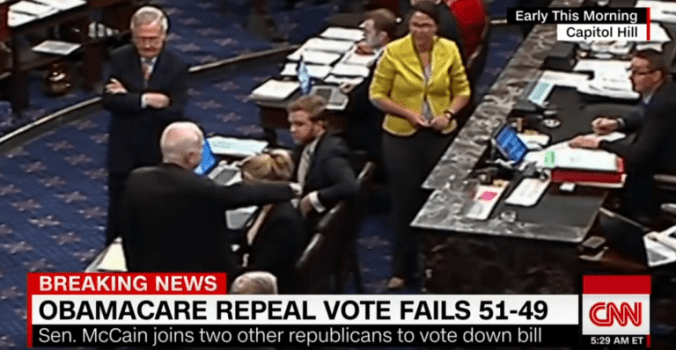
[I’m grateful to AM Golden’s guest post for many reasons, among them the chance to revisit (above) the moment when the late Senator John McCain‘cast a petty and unethical vote to save the Affordable Care Act, which he had opposed, from repeal just to spite Donald Trump. I am also glad, I guess, to have AM remind us of the decietful manner in which it was passed, with Democrats insisting that the ACA was not a tax, then later defending it before the Supreme Court on the grounds that it was a tax.JM]
One of the government expenditures I’d like to see looked into by DOGE is the cost and usefulness of the Affordable Care Act, particularly the tax subsidy
Full disclosure: I work for a nationwide health insurance company.
Not long ago, I commented how taxpayers are often gouged when the government spends our money. We’ve seen inflated prices by government contractors. We’ve read about the massive fraud perpetuated by those who got loans during the Pandemic to allegedly keep their businesses afloat. I suggested in that earlier comment that the availability of student loans has doubtlessly caused tuition rates to rise. The temptation of bottomless coffers of cash is hard to resist. I suspect it has resulted in higher costs for medical care submitted through Medicare/Medicaid. I noted then that government-paid health care would cause medical costs to go even higher.
It isn’t that U.S. citizens aren’t sympathetic to people who are sick, especially to those severely injured in accidents through no fault of their own or born with congenital conditions. In the 1990’s, government regulations established, among other things, requirements that health insurance carriers offer two of their most popular plans as Guaranteed Issue plans for those who could not get insurance elsewhere. These plans were expensive, but they put the onus for paying on the policyholder and not the taxpayer. It was a step, but, like other attempts at helping sick people get coverage, it didn’t address the cost of medical care.
Some of our elected leaders would like people to believe that the 2+ million workers are doing yeoman’s work keeping our nation secure and running like a well-oiled machine. They will suggest to you that only federal workers have access to sensitive data like your personal information. That is misrepresenting who can get access to your data.
The government uses numerous private contractors to perform all types of specialized services. Essential IT work such as systems engineering, data security, software development and other user support functions are handled by an array of prime contractors and their sub-contractors. To do this work, the contractor must be able to access private data. While some aspects do not require being able to sort through individual records others do. Software engineers must have the ability to parse records to create templates and test and debug systems.
Below are a few of these contractors whose employees are not federal employees. The point I am making is not that these organizations should not be in a position to access private records. The point is that this access happens every day in agencies managed by the Executive branch, whichoversees the agencies that issue contracts to carry out mission-critical services.
To hear Congress bemoan the fact that the DOGE team is somehow unlawful or illegitimate because they are not federal employees is laughable, and it is also misinformation. The person responsible for ensuring that the agencies are carrying out the policies laid out by the President through his Cabinet Secretaries is ultimately the President. As Harry Truman said, “The Buck Stops Here,” “here” being The White House.
[From your host: This is an epic post about something I know absolutely nothing about, except that I received the calls and marketing materials Wall Phone is writing about—JM]
***
“Well, not that. Actually, I have been trying to reach you about the Telephone Consumer Protection Act, TCPA for short. If you’re reading this, someone connected to your company, someone who cares about your company, and someone who cares about their career and livelihood, has been told that your company is violating at least one provision of this Federal law.
“If you don’t listen to them, it would be prudent of them to begin looking for another job. They shouldn’t want to go down with your ship. If they need to maintain some kind of licensure, they also don’t want to lose their credentials for whatever wrongdoing was going on that got them in contact with the person who gave them this webpage.“
Have you ever wondered why those auto warranty calls stopped? It’s because the government has fined the people connected to that advertising campaign more than six and a half million dollars. The fine came with a lifetime ban on any form of telemarketing. What would happen to your company if this kind of fine and ban were to be imposed on you?
“But we don’t make outgoing calls, let alone robocalls!”
And yet you have appeared to have done so. What you thought was a prospective customer told you about this page because they want you to stop harassing them.
“But our company is not harassing them!”
And yet you have appeared to be doing so. And worse, much worse, you appear to have been doing this for years.
“Years?”
Yes.
“But we only recently adopted this marketing partner/strategy!”
And you had better stop. Yesterday. Hopefully your contract has some sort of an enforceable indemnification clause that MIGHT protect you, but it probably won’t. If your marketing agreement does have such a clause, its actual purpose is to pacify any possible reservations at the signing stage of your marketing agreement with them, not the actual true purpose of these contractual things–to avoid the creation of moral hazard.
“Moral hazard” is explained below if you’re not familiar with that term. It’s high time you were.
The reason this indemnification clause on your contract won’t help you is the telemarketing company will be gone when the time comes that you’ll need it. They are betting that by the time it takes for you to figure out that you need to use indemnification, it will be too late. This page is here to help you figure it out sooner, help you recover as much as possible, and make their scam less profitable.
You need to—as soon as possible!—FIRST ask your bank how many of the past payments you made to your marketing partner that you can reverse, THEN ask the marketing partner for refunds. If you think you handling this business with them politely will work, then you have already lost. They will transfer all funds out of their accounts. They will disappear. You’ll lose more than if you IMMEDIATELY reverse as many payments as you can, because they’re not operating in good faith and they’re not intending to refund anything.
You are the victim of a scam. Victim of a crime. It’s literally an organized crime syndicate you are dealing with and they hav done this before, perhaps dozens of times before. They’re counting on you being polite and patient so they have time to disappear, whitewash a new business name on their operations, then start over. They don’t care that they destroyed your agency or business, they have thousands of other prospects they can milk this scam on. They have been doing this for years.
[From your host:I’m thrilled that my request for guest ethics commentary on the current upheaval in Washington attracted an entry so quickly, and especially pleased that it arrived from Steve Witherspoon, who has contributed so much here over the years but who has been unjustly neglected in my Comments of the Day choices.]
I consider myself to be a consummate observer. I listen and observe the world around me and openly question why some people make certain choices that seem to me to be completely devoid of critical thinking and logic, delve into how choices can affect their lives and society around them, and how those choices can either damage or support our culture as a whole.
I devoted the theme of my blog (Society’s Building Blocks: Social Commentary Blog – Critically Thinking About Things That Change Our Society) to just such a perspective even though it appears that there’s almost no interest, but I’ll trudge on.
I chose “Debates We MUST Have As A Modern Culture” as the title because in a culture that has freedom of speech as a core foundation, without continuing open, reasonably civil debate regarding things that have changed and are changing in our culture, we tend to flail around with absurd anti-American culture ideals that are dominated by the completely closed minds of freedom suppressing totalitarians. We are then afflicted with cancel culture, speech suppression, and Diversity Equity & Inclusion (DEI), as well as willful rationalizations for open politically motivated Lawfare.
Let’s face it: when reasonably civil debates are tossed aside as a quaint ideal and people withdraw into their tunnel-visioned cultish cliques, bigotry ensues. Unchallenged, absurd groupthink takes hold and people become so gullible that they’ll believe just about anything they’re told that supports their bias without any critical thinking. They become ideologically-consumed parrots. This isolationist cultish groupthink has the power to completely destroy our culture, and that may be the goal of some of these cultish anti-Americans.
The United States of America is rapidly approaching 250 years old and there have been some turning points in our history that have redefined us and shifted our culture in very good and thoughtful ways. I personally believe that we are at another turning point and we are going to go through another cultural shift; I just don’t know how much of a shift we are going to see. What I do know is that this cultural shift needs to be based on thoughtful and well debated choices that are guided by our Constitution, general law and order, and how we want to present our country to the rest of the world. We need to honor our core foundations as we look to the future.
Let’s bring a little more focus and briefly list some of the current hot political topics that we must openly debate instead of simply tossing them aside as being unconstitutional, racist, genocide, apocalyptic, etc. Immigration law, law enforcement, self protection, firearms, birthright citizenship, when does individual human life begin thus giving that individual constitutional rights, protecting the environment, government overspending, and illegal drugs are just some of these.
We cannot continue to do things in the same way we’ve been doing them if we want any kind of real change.
[Curmie raises so many casting ethics issues that fascinate me in this post that I’m going to announce right now that I’ll post a veritable “Part II” tomorrow, although it will be “Jack’s Conjectures”, or something. Not that I disagree with anything the esteemed Ethics Alarms featured columnist writes here, because I don’t. Here’s a clue about one issue I’ll be covering which Curmie only hints at: for a cast to be sufficiently “diverse,” do the BIPOC members have to obviously LOOK like they are “of color”? I’m thinking of performers like Jennifer Beals, the late Olivia Hussey, and Jessica Alba—JM]
Jack and I exchanged a couple of emails about this story, which I first saw on the OnStageBlog back around Thanksgiving, when this was still news. I’m pretty sure both of us wanted the other to write about it. So, a little late, here we go…
The case involves the casting of the Christmas-themed musical Elf at Broadway at Music Circus in Sacramento. OnStageBlog’s founder Chris Peterson often gets what Curmie’s grad school mentor would call “foam-flecked,” and his editorial here is no exception. But he does have a point. Sort of.
The company came under criticism when they announced the cast list for Elf; although a number of the leads were non-white, the entire chorus (seen above) looks pretty vanilla, white-passing if not literally white. Actress (or is she a “social media manager for major hotel brands”?) Victoria Price is one of those who led the charge, pointing to the difference between the Broadway ensemble and the one in Sacramento, and noting that any comments critical of the casting were being deleted. (I assume she’s telling the truth about this.)
Tony nominee Amber Imam joined the fray, writing that Price’s criticism of both the casting and the removal of negative comments was “absolutely right. A show that takes place in NEW YORK CITY cannot… CAN NOT have an ensemble that LOOKS LIKE THIS!!! Do better. Have you learned nothing?????”
The company’s CEO Scott Klier issued a response that made the situation much, much worse: “cover-up worse than the crime” worse. Here’s part of it:
“Inclusivity has been and remains my casting and staffing goal for every production. I fell short of that goal for ELF. There is an uncomfortable truth here: Our industry as a whole has largely failed to attract, train and foster the artists necessary to meet today’s demand, and I fear this conversation will continue until it does. It will unfortunately take time. The painful reality of ELF’s casting process was that both the casting submissions and audition attendance revealed few candidates of color and, while those few were undoubtedly talented, they did not meet the dance, music and acting criteria set by our team.”
Hoo boy… Claiming inclusivity as a “goal” and then going 0-for-15 at fulfilling it? Blaming other people while admitting the decision was yours? Admitting there’s a “demand” and then ignoring it?
[My post yesterday about ESPN’s decision to ignore the pre-game events at the Sugar Bowl attracted almost no commentary at all, but it did prompt this installment of Curmie’s Conjectures, which makes it all worthwhile. This is cross-posted on Curmie’s blog; once again, I encourage everyone to visit it regularly. Curmie doesn’t post often, but as Spencer Tracy says of Katherine Hepburn in 1952’s “Pat and Mike,”…what’s there is cherce.” —JM]
There’s a lot of brouhaha at the moment, including Jack’s apt commentary, about ESPN’s coverage of Thursday’s Sugar Bowl game in New Orleans, or rather of the pre-game. The game was postponed for a day in the wake of the horrific events of early New Year’s morning only a few blocks from the Superdome, where the game was played.
So why is the photo for this piece of a baseball game? Allow me to explain. I have been a fan of the New York Mets since 1962, the year of the team’s inception. I can tell you with certainty that the biggest home run in Mets history had nothing to do with their World Series championship years of 1969 or 1986. It was Mike Piazza’s two-run, come-from-behind, homer in the bottom of the 8th inning in Shea Stadium on September 21, 2001. That’s what you see above.
It was the game-winning hit and it came against the best team in the division, the arch-rival Atlanta Braves. Vastly more importantly, it was during the first major league game to be played in New York after the attacks of 9/11. And, for the first time in a week and a half, the locals had something to be happy about. That night, anyone who wasn’t a Braves fan per se (and probably a fair number who were) needed that home run. Not just Mets fans. Not just New Yorkers. Americans.
We’d been told the everything was going to be OK, but we needed more. David Letterman going back on the air helped, but everything was still somber. The Bush jokes that would cement the resolve—you don’t joke about the President if your country is in crisis—were to come later. But first, there was Mike Piazza. Sometimes, sports matter.
In the winter of 1980, I lived in a small town in rural Kentucky. I remember watching the “Miracle on Ice” Olympic hockey game on the TV. After the incredible upset of the powerhouse Soviet team by a bunch of American college kids, after the most famous line of Al Michaels’s career—“Do you believe in miracles? Yes!”—there was a lot of noise outside, loud enough to be not merely audible but intrusive in my second-floor apartment.
Outside, there was a string of cars with horns blaring; their windows were down (even in Kentucky it can get a little nippy in February), with a bunch of mostly teenagers leaning out and chanting “USA! USA! USA!” I’m willing to bet that I was one of fewer than a dozen people in the entire town who’d ever seen a hockey game live, but here were these kids who didn’t know a poke check from a blue line getting excited about the Olympic semi-final.
In the midst of the Iranian hostage situation, with the country only showing the slightest signs of emerging from the energy crisis (is it any wonder the incumbent President was routed in the election a few months later?), we—again, all of us—needed something to grab ahold of, something to suggest that we’d weather the storm. There have, of course, been other moments that transcended sports: Jesse Owens dominating at the Berlin Olympics in 1936, Joe Louis knocking out Max Schmeling in the first round, Billy Miles appearing from nowhere to win the 10,000m in the Tokyo Olympics; we might even add Spiff Sedrick’s improbable sprint to glory in the women’s rugby 7s in this year’s Olympics. But this year’s Sugar Bowl was most like that baseball game in September of 2001: what made it special wasn’t who won, or what political statement could be wrangled out of the victory, but the mere fact that the game went on was a sign of determination and perhaps a little bit of defiance. If you’re a Georgia fan, you’re disappointed that your team lost, but you were reminded before kickoff that there are more important things than football games.




 Ethics Alarms