Curmie’s Conjectures: Why There’s a Teacher Shortage, Exhibit A

by Curmie

I’ve promised two essays that are indeed partially written; I could finish one of them in 20 minutes or so if I could just concentrate, but something else always seems to come up.  So let me try yet a different topic.

One of my friends and former students (we’ll call him L for the purposes of this post) teaches theatre in a public school.  He recently posted on Facebook about a confrontation he’d had with the father of one of his students.  The boy had failed to do three significant assignments, and, curiously enough, his grade reflected that fact.

Ah, but you see, the lad is an athlete, and a failing grade made him academically ineligible.  So Dad screams for “about 15 minutes.”  My friend responded like this: “I want him to be able to play […], too. I understand how important it is for him to have that outlet. But if I want lights on in my house, I gotta pay bills. If I wanna drive a car, I gotta pay to put gas in the car. So, if _______ wants to play […] then he’s gonna need to stop being lazy and do what is required in this class. Not to mention the other three classes he is failing.” 

Continue reading

Oh Look, What a Surprise…California is Considering Another Law Sticking the State’s Nose Where It Doesn’t Belong

I don’t understand why anyone continues to live or work in California, a state with a culture that lurches between stupid, irresponsible and deluded.

The headline above does not refer to the recent, bone-headed decision to give fast-food workers up to a 25% raise, with cooking Big Macs the minimum wage jumping to $20 an hour in that sector next week. “It’s a big win for cooks, cashiers and other fast-food workers ” says taxpayer-funded progressive propaganda organ NPR. Right. Fast food wages have been growing at a faster clip than almost any other sector since the pandemic, with the result that more outlets are moving to automation, which means, as has happened every time the minimum wage jumps, lower-paid workers—whose skills often aren’t worth the minimum wage— will lose their jobs. Meanwhile, fewer people with strained budgets will buy fast food because of the duel problems that it’s no longer fast, and is absurdly expensive, and California is already one of the most expensive states.

Oh, who knows: maybe all those vegans and health nuts in the Golden State want to wreck the fast food business. More likely, however, it’s just that legislators there—Suspense! Will they actually vote to make all Californians-of-the-right-color millionaires?—don’t understand economics, cause-and-effect and reality.

But I find the proposed law this post concerns more offensive from an ethics point of view if less destructive. California Assemblyman Matt Haney wants California to be the first in the country to give employees the legal right refuse to respond if their superior calls after hours. Then the law would permit workers to ignore emails, texts and other work-related communications until the next day after the work day has begun. “People now find themselves always on and never off,” the Nanny State fan said. “There’s an availability creep that has reached into many people’s lives, and I think it’s not a positive thing for people’s happiness, for their well-being, or even for work productivity.”

Oh, shut up. The law aims to give workers a legal right to be unprofessional. If you have a job and believe in ethical work values, you believe in diligence, responsibility and self-sacrifice. If you believe in personal autonomy and character, you believe that human beings need to be able to make intelligent choices about their life, including their careers, without being bolstered by the legal right to stand up to bullies, jerks and unreasonable supervisors.

Continue reading

Curmie’s Conjectures: Court Storming and the Absence of ‘Sprezzatura’

by Curmie

After the Wake Forest Demon Deacons beat the Duke Blue Devils 83-79 in basketball Saturday afternoon in Winston-Salem, hordes of Deac fans stormed the court .  Actually, the previous sentence isn’t quite accurate.  Video footage shows that several fans who had gathered under one of the baskets ran onto the court and were already at the free throw line before the game even ended.

These incidents are increasingly commonplace, abetted by television coverage of the events, even as the networks pretend to be appalled by the potential for injuries resulting from the practice.  Court-storming may be part of the culture of the sport, but there are—or at the very least should be—limits.  I have no problem with displays of post-adolescent exuberance, but the safety of players, coaches, and officials must be paramount.

The inevitable finally happened, and Duke star Kyle Filipowski was not merely jostled, but injured, in the melee, seriously enough that he had to be helped off the court.  As the recipient of a degree from the University of Kansas, I am morally and ethically obligated to despise all things related to Duke basketball 😉, but whereas I want them to lose every game, I don’t really want anyone to get hurt.

The exact extent of Filipowski’s injury is still unclear, but it certainly could affect both the Blue Devils’ chances for the rest of the season and post-season, and, importantly, Filipowski’s future.  He’s projected as a first-round draft choice, possibly even a lottery pick, in the upcoming NBA draft.  He stands to make tens of millions of dollars over the course of his career… assuming he can play.  There is such a thing as a career-ending injury, especially when we’re talking about knees, and that’s what this is; if this injury wasn’t severe, that’s only because of what Jack would call “moral luck.” 

The video shows that at least three different Wake Forest fans made contact with Filipowski as he was trying to leave the court.  Whether or not the bumping was “intentional” and “personal,” as Filipowski alleges, it was at best reckless and at worst criminal.  Let’s face it: the man is seven feet tall; it’s not like he couldn’t be seen.  The ethics of the situation, of course, would be the same if it had been a bench player, a student manager, a coach, or a referee who was injured.  The incident attracts more headlines because it was Kyle Filipowski who needed to be helped off the court, but the rationale for banning court storming would be the same. 

At least two other visiting players have been bumped into by opposing fans in court stormings this season.  One of them is Iowa’s Caitlin Clark , probably the most famous women’s basketball player in the country—even more so than WNBA stars.  She was “blind-sided” and actually knocked to the floor by an Ohio State fan in a court storming in Columbus. 

Imagine if she’d been seriously injured.  She wouldn’t have broken the NCAA scoring record for the women’s game, and she wouldn’t be closing in on the real record, held by Lynette Woodard.  (The NCAA wasn’t the organization in charge of the women’s game when Woodard played, and they’re being predictably petty, narcissistic, and anal retentive about recognizing Woodard.)

Oops.  Once again, I indulged in a little inaccuracy.  What I referred to above as “the inevitable” had long since happened, as ESPN’s William Weinbaum reports:

 In a 2004 court storm, Tucson H.S. star Joe Kay suffered a stroke & was partially paralyzed. “It’s way too long that we’ve been putting up with this,” Kay told ESPN Sat. after Duke’s Kyle Filipowski got hurt. “I’m completely in favor of banning court storms & field storms.”  Now 38, Kay said, “The police should arrest people for going places they are not allowed to go… enforce the rules as they do at other places. It’s exactly the same thing.” “Hopefully people will now come to their senses.”

The only thing that’s changed is that Filipowski is known by virtually all college basketball fans across the country, whereas Kay may have been a local celebrity, but folks like me in East Texas weren’t saying “OMG, Joe Kay got hurt in a court storm.”  Now, maybe, something will happen… but not unless the powers-that-be actually want it to, and that, despite the copious tut-tutting from the NCAA, conferences, universities, and the media, doesn’t seem to be the case.  Indeed, statements of concern and promises of future action from the likes of ACC commissioner Jim Phillips seem very much to be what my mom would call “balloon juice.”

Among those who have engaged in court storming this season, both in games in which their team beat Kentucky, were LSU women’s star Angel Reese and South Carolina President emeritus Harris Pastides, who even took to social media to boast about his participation.  The problem isn’t going to go away, even in the wake of an injury to a star player, unless there are real, enforceable, guidelines designed both to allow celebrations and to protect the visiting team.  And by “enforceable,” I mean sanctions that will be felt, not petty fines of a few thousand dollars to multimillion-dollar programs.

Jay Bilas, probably ESPN’s best analyst (and a former star big man for Duke himself), is outspoken about this issue:

“It’s got to stop but it’s not going to.  There’s no appetite in college basketball to stop it. The SEC has a rule against it but the institutions are happy to pay the fine because they like the visual. And the truth is, we in the media like the visual too.  We put it at the end of every highlight. Years ago, when people used to run out on the field or on the floor, we wouldn’t show it. That was our policy. We don’t have that kind of policies with court stormings. We like it. It’s not stopping and it’s a shame.

Duke coach Jon Scheyer said after the game that when he played, “at least it was 10 seconds and then you could storm the court. Now, it’s the buzzer doesn’t even go off and they’re running on the floor.” 

Ten seconds isn’t enough, but 30 probably is.  It wouldn’t be difficult to institute a rule that no fans are allowed onto the court, ever, until 30 seconds after the final buzzer.  The mechanism already exists in the 30-second clock; let it serve another purpose.  The home university can forbid court storming altogether, but they must enforce the ban for 30 seconds.  If fans want to celebrate on the court and the home team doesn’t object, so be it, but not until the officials and the opposing team are out of harm’s way.

And if fans are on the court before the game clock has expired, that should be a technical foul on the home team in addition to the other penalties.  Would it have mattered this weekend?  Duke would have had two free throws and the ball with about a second left in the game.  Could they have forced overtime or even won in regulation?  It’s extremely unlikely, but the chances wouldn’t have been quite zero.

Whatever the exact rules become, violations must be punished severely.  At present, neither the NCAA nor the ACC (in which Wake Forest and Duke play) have any specific sanctions at all in place for court storming.  The home university must be responsible for enforcing the rules; failure to do so should be punishable by a significant fine even for the first offense.  I’d suggest $500,000 for the first offense, with half paid to the NCAA or the conference and the other half to the opposing school.  Subsequent offenses within a 36-month period would involve stiffer fines, loss of scholarships, and perhaps a prohibition against post-season play.

Continue reading

Curmie’s Conjectures: The Belfry Theatre’s Crisis of Nerve

by Curmie

[ JM here: I want to let Curmie’s Conjectures stand on their own, so I apologize at the outset by intruding with a brief introduction. Lest anyone be dissuaded from reading the whole post because the author’s scholarly tone and apparent focus at the start suggests that this will be a narrow discourse on topics rather more relished by Curmie and me than by the majority of EA readers—theater and the performing arts—fear not. The tags on the article will be “Canada, censorship, the Hamas-Israel War Ethics Train Wreck, and political theater.” The post also involves some of the same considerations as one of mine two days ago. ]

There is a theory, one to which I subscribe, which suggests that the Dionysian Festival of classical Athens began not really as a religious observance in honor of a demi-god but rather as a means of consolidating the political power of the tyrant Peisistratus.  Whether or not this is true, there is no doubt that by 458 BCE Aeschylus’ Oresteia, widely acclaimed as “the world’s first dramatic masterpiece,” offers commentary on the reforms of the Areopagus enacted by the strategos Ephialtes some three years earlier.

There is no question that since that time the theatre has often—not always, but often—been political.  The 20th century offered more than a few examples of playwrights and production companies who, often at personal risk, critiqued the power structures around them: Jean-Paul Sartre took on the Nazis; Lorraine Hansberry, racism in the US; Athol Fugard, apartheid; Václav Havel, communism in Eastern Europe.

Not all such efforts were for causes most of us would endorse, of course.  Socialist Realism was a Stalinist policy under which all art had to support The Revolution: not just avoid criticism of the regime, but actively and explicitly endorse it.  More recently, the Freedom Theatre of Jenin (on the occupied West Bank) has been in the news.  A few weeks ago, one of the student organizations at my university posted an encomium to the company, which they described as “an example of creating liberating theatre and serving communities through theatrical pedagogy and profound performance.”  I remembered having written about that theatre a dozen or so years ago.  If I might quote myself for a moment: “Turns out that the Freedom Theatre was pretty damned proud of having turned out alumni who engaged in armed insurrection, and at least one of whom, a suicide bomber, richly merited description as a terrorist.” 

So no, propagandistic theatre isn’t always a good thing… but engaging with the world is.  Even subtle messages matter.  Under normal circumstances, Aunt Eller’s wish that “the farmer and the cowman can be friends” doesn’t amount to much.  But Oklahoma! hit Broadway after the declaration of war against the Axis powers and before D-Day.  “Territory folks” need to put aside their petty grievances when there’s a guy with a funny mustache who’s far worse than any of your neighbors will ever be.

Continue reading

Curmie’s Conjectures— Punk’s Guide to Ethics, Part II: Strategies

by Curmie

The title for this two-part edition of Curmie’s Conjectures refers to a song by the Irish punk band the Boomtown Rats, “Don’t Believe What You Read,” which includes not only the title admonition but also lines like “I know most what I read will be a lot of lies / But you learn really fast to read between the lines.”  Part I of this exercise attempted to suggest something of the parameters of the problem.  As Jack suggested in his introduction to that piece, it’s not an exhaustive list of the various forms of journalistic chicanery, but I hope it served as a representative sample.

Here in Part II, I’ll attempt the daunting task of examining strategies to “read between the lines” and come at least a little closer to the truth of what happened in a given situation.  So, what to do?  How do we determine if that less-than-objective source we’re reading actually has this one story right, especially if it’s the only source about a particular story?  Boy, do I wish there was an easy answer to this one.  That said…

The most effective means of ascertaining the truth, of course, is to get different perspectives on the issue.  I think I’ve mentioned both here and on my own blog that when I was in England doing my MA (at the time “Don’t Believe What You Read” was released, as it happens), I’d alternate between reading the Telegraph, which leaned right, and the Guardian, which leaned left.  If the former said “X but Y,” thereby suggesting that Y was the more important point, the latter would likely say “Y but X.”  But whichever paper you read, you’d know that X and Y, though perhaps seemingly in opposition, were both true, and both worth knowing about. 

Of course, both the Telegraph and the Guardian were, whatever their political perspectives, both reputable news sources.  That’s a statement that would be difficult to make about many of the most prominent news media in this country in the 2020s.  Equally importantly, as suggested in Part I, the problem is often that we hear only from one perspective. 

There are three possibilities for why this should occur.  One, which is (alas!) probably the least likely, is that both X and Y editors make an honest decision that a story is or is not newsworthy.  Or X media outlet knowingly runs with a story that is either grossly distorted or fabricated altogether.  Or outlet Y, knowing the story casts their team in an unfavorable light, ignores it, hoping it will just go away.  At some point it becomes untenable to try to ferret out the true motives; the truth of the story may be a little easier to discern, although there are no guarantees.

Continue reading

Curmie’s Conjectures— Punk’s Guide to Ethics, Part I: The Problem

by Curmie

[I am particularly grateful for this installment of Curmie’s Conjectures because it assuages my guilt a bit. As longtime readers here know, I occasionally promise posts that never show up, or do, but so long after the promise that it’s embarrassing. Years ago, I promised a post defining and examining all journalistic tricks that I classify as “fake news,” and I use the term broadly to include misleading headlines, burying the lede, omitting key information that undermines the writer’s agenda, poisoning the well and other techniques. I started the thing, got frustrated and overwhelmed, and never finished it. Here Curmie doesn’t exactly present what I intended, but he touches on much of it, and as an extra bonus, he wrote it more elegantly than I would have (as usual). JM.]

I doubt that this blog has ever before turned to punk rock for ethics advice, but Boomtown Rats composer/frontman (and Live Aid impresario) Bob Geldof had it right in a song that’s probably more relevant today than it was 40+ years ago: “Don’t Believe What You Read.”  Well, not uncritically, at least.  At our host’s suggestion, I’m about to enter the fraught territory of trying to decide if a story published by an obviously biased media outlet might, this time, just be accurate. 

It’s difficult of late to find a news source that only leans in one direction or the other, rather than proselytizing for the cause.  The news networks and major newspapers have carved out their market shares based on feeding their viewers and readers what they want to be fed.  Whether the advent of Fox News was a trigger or a reaction is up to individual interpretation, but there’s absolutely no doubt that we’re now in an era in which news as reported is determined largely by editorial positioning, rather than the other way around.

It’s inevitable that, to steal a line from another of my favorite musicians, Paul Simon, “a man hears what he wants to hear, and disregards the rest.”  Fighting our own biases is not made easier by the knowledge that learning from experience and confirmation bias are opposite sides of the same coin.  If a story appears only on Fox News and the Drudge Report, or only on AlterNet and MSNBC, there’s an excellent chance that the indignation is feigned and the actual events are something of a nothing-burger.

But “usually” is not “always.”  As a society, we’re well aware of the tale of the boy who cried wolf and the miraculous last-second basket from well past half-court.  We nod and smile at the suggestion that stopped clocks are right twice a day. 

There are a few variations on the theme of biased journalism.  The first, editorializing in a news story, is generally the easiest to spot and the easiest to counteract.  If there are words like “communist,” “Nazi,” or “un-American” to describe a US politician, or phrases like “unborn children” or “reproductive freedom,” you’re reading an editorial, whether the article identifies itself as such or not.  There’s nothing wrong with editorializing; it’s what I do here and on my own blog, after all.  But I also try to not to suggest that what I write is completely objective.

Another variation on the theme, and a personal pet peeve, is what I call a Schrödinger sentence, because it is simultaneously true and not true.  For example, I’ve seen a whole lot of conservative commentary on this blog that “progressives want X.”  (“X” in this context, of course, has nothing to do with what Elon Musk renamed Twitter.)  True, there are enough progressives who advocate for X to make the noun plural, but I’m a progressive, and I’m a big fan of not-X.  The implication—or, rather, one possible implication—of the sentence is that in order to be a progressive, one must want X.  That is no more true than suggesting that all conservatives believe in Jewish space lasers.  And I really resent being told what I believe.

Continue reading

Guest Column: Shoplifting Ethics

by Sarah B.

[Introduction: This excellent post by Sarah B, who has a history of them, posed a dilemma. It was originally posted in this week’s Open Forum, but the comment easily could have been a Comment of the Day on two recent posts, “Irony: The Washington Post Telling CVS How To Handle Rampant Shoplifting,” and “Technology Ethics Fail: Self-Checkout.”

In the end, I decided to publish it as a guest post, as Sarah herself told us up front what she was commenting on, writing, “This article, about a woman who wrote a piece for the newspaper anonymously about how and why she shoplifts, is worth discussing,” referring to “I’m a middle-class shoplifter – and here’s why I’m happy to confess it” in the UK’s Independent. Proving once again that valuable insights can be obtained from idiotic essays, Sarah’s post is far, far, FAR superior to the article that apparently spawned it. The explanation of “anonymous” about why she’s apparently “happy” about being a shoplifter was so devoid of either logic or ethics comprehension that it made my phantom hair hurt. Among her fatuous excuses and rationalizations were “It’s easy, so it’s the stores’ fault,” “I don’t even see it as shoplifting” (#64 on the rationalizations list, “It isn’t what it is”), “I’m owed it,” and #22, the worst rationalization of all, “It’s not the worst thing,” because she “would only do this in a supermarket chain, rather than any family-run small business.” People like the author make me want to chuck my business and profession and become a pimp or something. Why do I spend so much time on ethics when so many people think like this? Fortunately, Sarah had a different and more constructive reaction.JM.]

***

First, there is no doubt that her actions are unethical, and while we could just analyze this as a “name the rationalizations”, I also think that a deep dive into the article can show many things about our society and make for a good discussion. There are options for discussing how she doesn’t shoplift because she has to, but does it to decrease the prices of expensive alternatives instead of paying for what she wants. However, I want to look at how I think we could combat her “how-to guide”.

This seems to me to be a great case study in “locks keep an honest man honest.” The author admits that much of her stealing is predicated on the app-shopping and self-checkout philosophy of big stores. My main proposal, after looking at this, is to somehow return to the “good old days” of customer service.

Continue reading

Curmie’s Conjectures: Eye Black Is Not Blackface. Duh.

by Curmie

[It turns out that Curmie and I were writing about the same issue more or less simultaneously. Shortly after I posted The Great Stupid: Child Abuse Edition,” Curmie sent me this installment of his  periodic column, expressing concern that it was redundant. It’s not, and I’m putting up Curmie’s take for several reasons: 1) I love his writing and style; 2) he approaches the incident from some different angles than I did; 3) I believe this incident is an important one that involves many critical ethics problems: the public school disaster; hypersensitivity to racial offense, real or imagined; the indoctrination and intimidation of children; and more. The plight of J.A. is not just the metaphorical canary dying in the mine, but strong evidence of just how badly our society’s air is poisoned. It is worth more than one post. Finally, I especially want this essay read after Curmie commented recently that he disagreed with my analysis on “countless” topics. In fact, I find that his values and ethical navigation equipment are closely aligned with mine. If they weren’t, he couldn’t have dissected this story so expertly.—JM.]

***

A few days ago, I commented on Jack’s post on the high school principal in Sherman, Texas who declared that the musical Oklahoma! contains “mature adult themes, profane language, and sexual content” “would come in third place in a battle of wits with a sack of hair and an anvil.”

I hereby retract that characterization.  It appears that Sherman Principal Scott Johnson was merely a good soldier, enforcing the dictates of a superintendent and school board that can’t decide if the Victorian age was a little too permissive.  So… Johnson appears capable of giving that anvil a run for its money. 

The good news is that the international attention this case received resulted first in a decision to re-instate the original student cast but in a shortened “kids” version of the musical that would have cut the solo from Max Hightower, the trans student at the center of the controversy, and finally—when the students and parents wouldn’t accept that utterly stupid “compromise” or the notion that Oklahoma!, of all plays, ought to be bowdlerized—a return to the original version with the students the director cast.

More to the present point, when compared to Jeff Luna, the principal at Muirland Middle School in La Jolla, California, even the folks who did make the idiotic decisions that led to the kerfuffle would appear to embody all the best attributes of Solomon, Socrates, Confucius, Albert Einstein and Leonardo da Vinci rolled into one.  We do sorta know what Ado Annie means when she laments her inability to “say no,” after all.

I was about to say that what Luna did surpasses credulity, but, alas, it does not.  There are a lot of adjectives that do apply—”boneheaded,” “irrational,” and “unconstitutional” come to mind—but unfortunately “unbelievable” has no place on the list.

Last month, a Muirland 8th-grader identified as J.A. attended a high school football game, looking like he does in the photo above.  That is, he wore eye black, just as he’s seen countless football players (and not a few baseball players) do; I won’t bother you with the literally dozens of photos of players of all races doing so.  Now, whether eye black has any direct practicality is a matter for debate.  It started as a means of keeping glare out of the eyes.  I have no idea whether it actually does that, and even if it does, it doesn’t require the amount used by J.A.  But that, of course, is irrelevant.

Continue reading

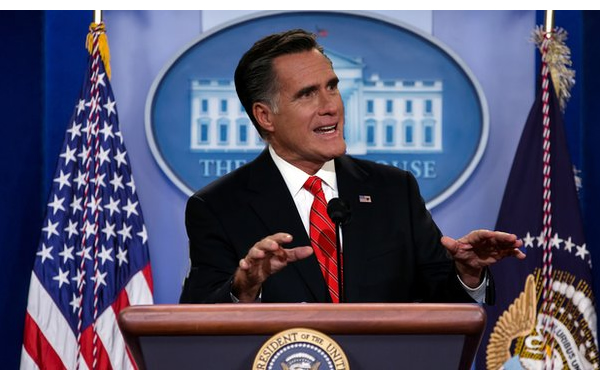
An Ethics Obituary For Mitt Romney

Guest Post by Steve-O-in NJ.

[This is a comment posted by Steve-O in response to the post, “KABOOM! I Have To Take Back Every Positive Thing I Ever Said About Mitt Romney.” Properly it would be a Comment of the Day, but I decided that in both theme and length it deserved to be a free-standing guest post. I know comments are usually written with less precision than the authors might apply if they knew they were going to be highlighted—I know my comments are—so I did edit Steve’s work a bit, not substantively, and I hope he approves. JM]

I don’t know if this is even worth talking about very much, since Romney is headed toward the door and will exit as an also-ran. In his day, he amassed quite an impressive resume, certainly much more impressive than Barack Obama’s. He did a reasonably good job as governor of Massachusetts. That’s why it strikes me as odd that he did not run an effective presidential campaign, nor did he seem to grasp that campaigning on the national stage in 2012 was very different than campaigning 20, 10, or even 5 years before that.

The other side had one goal, and they stuck relentlessly to it: destroy Mitt Romney, by all means fair or foul. Positive campaigning has been pretty much dead since the days of Bush the Elder. It’s negative campaigning that moves the numbers, and Romney didn’t seem to grasp that. He tried to run a gentlemanly campaign when the other side and the media were prepared to fight as dirty as possible. This country didn’t give a damn about his resume or his plan for fixing the economy, at least not enough. They wanted things to be better, but Mitt just couldn’t make his case.

Continue reading

“Curmie’s Conjectures”: The Revenge of the Wackadoodles

by Curmie

One of my favorite lines from the late singer/songwriter Warren Zevon is “Just when you thought it was safe to be bored / Trouble waiting to happen.”  That lyric came to mind when I happened across an article in the Chronicle of Higher Education titled “Hamline President Goes on the Offensive.”Well, that lyric and one of my most oft-used phrases, “Oh, bloody hell!”. 

This rather lengthy article—over 3000 words—deserves to be read in its entirety, even if it involves a registration process for free access to a limited number of articles per month, but I’ll try to hit the highlights here.  The author is Mark Berkson, the Chair of the Religion Department at Hamline University.  His was for a very long while the only voice, or at least the only audible one, on the Hamline campus to come to the defense of erstwhile adjunct art history professor Erika López Prater as she was being railroaded by the school’s administration on absurd charges of Islamophobia.

You may recall the incident.  Jack first wrote about it here; my take came a little later, here.  Dr. López Prater was teaching a course in global art history, in which she showed images of a couple of paintings depicting the prophet Muhammad.  Recognizing that there are some strains of Islam in which viewing such images is regarded as idolatrous, she made it clear both in the course syllabus and on the day of the lecture in question that students who chose not to look at those particular photos were free not to do so, without penalty.

Ah, but that left too little room for victimhood.  So student Aram Wedatalla blithely ignored those warnings and (gasp!) saw those images… or at least she says she did, which is not necessarily the same thing.  Wounded to the core by her own sloth and/or recklessness, she then howled to the student newspaper and, urged on by Nur Mood, the Assistant Director of Social Justice Programs and Strategic Relations (also the advisor to the Muslim Student Association, of which Wedatalla was president), to the administration.  The banner was then raised high by one David Everett, the Associate Vice President of Inclusive Excellence.  (Those folks at Hamline sure do like their pretentious job titles, don’t they?)

Anyway, Everett proclaimed in an email sent to literally everyone at Hamline that López Prater  had been “undeniably inconsiderate, disrespectful and Islamophobic.”  To be fair, he didn’t identify her by name, but there weren’t a lot of folks teaching global art history.  Everett was just getting warmed up.  He subsequently co-authored, or at least jointly signed, a statement with university president Fayneese Miller that “respect for the observant Muslim students in that classroom should have superseded academic freedom.”  Not at any university worthy of the name, it shouldn’t.  Anyway, López Prater was de facto fired, because destroying the careers of scholars for even imaginary offenses has become a blood sport for administrators (and, in public colleges, for politicians).

Continue reading