Morning Ethics Warm-Up. 1/3/2020: “Those Who Don’t Understand The Cognitive Dissonance Scale Are Doomed To Behave Like Idiots And Not Know Why”

Who said that?

I did.

1. “This is Rose. Won’t you give to help her and people life her who suffer from crippling hatred of the President of the United States? Just a few dollars a month...”

A more vivid example of where anti-Trump hysteria can lead than these two tweets can hardly be found. The author is #MeToo activist Rose McGowan, Harvey Weinstein victim, conventional Hollywood progressive. These were her reactions to the unequivocally welcome news that General Qassim Soleimani, head of Iran’s elite Quds force and the architect of terrorism all over the Middle East, was killed by a U.S. airstrike at Baghdad’s international airport:
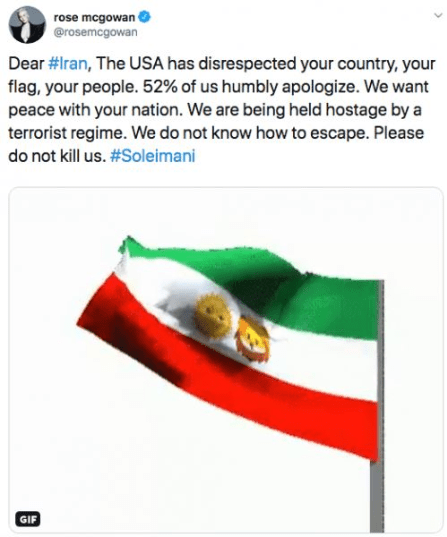
When a social media critic correctly pointed out the lunacy of that one, the former “Charmed” actress responded,
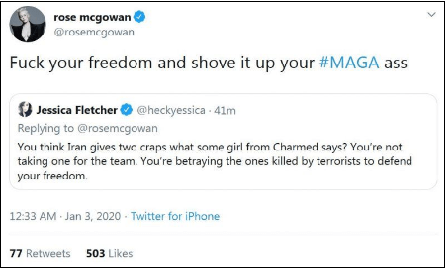
Would it be unfair to say that “Please do not kill us” was the message conveyed by President Obama’s craven and dangerous  nuclear deal with Iran, giving the rogue state billions of dollars in exchange for a (worthless) promise not to pursue nuclear arms capability until later, at which time there would be nothing the U.S. could do about it?

I heard these kinds of sniveling, “Better Red than Dead” protests many times in my youth. They come often from people so young,  inexperienced and ignorant that their confusion can be forgiven—a little–but also from older Americans—more frequently women, unfortunately, and make of that what you will—who have somehow reached maturity without learning that everyone, but especially this unique country, has to be ready to defend their values, and just as important, has to be able to communicate clearly that we will defend those values, with terrible force if necessary.

Over the last couple of decades, a large and influential segment of the progressive community has forgotten that. Fortunately, the majority of Americans have not.

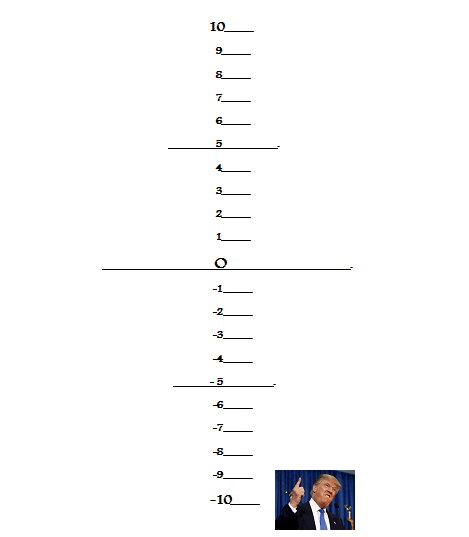
2. How it works: The fact that President Trump is at the dead bottom of the cognitive dissonance scale for most Democrats means that anything he does and any result that would normally and objectively be regarded as positive if another President, especially a Democrat and particularly Barack Obama, were responsible drags that event or decision down below the midpoint into negative territory, unless someone recognizes that their opinion is being warped by psychological forces and biases beyond their control, and adjusts appropriately. Apparently none of the Democrats who have shot off their mouths since Soleimani‘s demise have such wisdom and self-control. Thus they are beginning critical comments with statements like this tweet by Rep. Andy Levin, which was typical:

“There is no question that Qasem Soleimani was an enemy of the United States. I feel no sadness at the news of his death. But I have serious concerns about this President’s execution of a potential act of war without authorization of Congress.”

 “He was a terrible, murderous enemy of our nation and we’re fortunate he’s dead BUT” is just not a smart message.

The President gave the order that resulted in the death of the Quds Force leader after multiple attacks against Americans and American facilities in Iraq that could be traced back to Soleimani.  The Iran-backed Iraqi militia Kata’ib Hezbollah began the exchange  with a rocket attack on a U.S.-led coalition base on December 27. A U.S. contractor was killed andmany Americans and Iraqis were wounded. The Pentagon concluded that  Soleimani ordered the attack. In response, the U.S. launched airstrikes against the militia, killing 25 militiamen. Members of the militiamen stormed the U.S. Embassy in Baghdad, an invasion of  American soil. Again, the Pentagon concluded that Soleimani “approved the attacks on the U.S. Embassy in Baghdad that took place this week.” After U.S. troops forced the attackers to retreat, the President made it clear that there would be harsh consequences for the episode. There was.

Iran’s leader had tweeted that there was “nothing” the U.S. could do. What kind of American does not take satisfaction in what occurred next? My view: only those in the powerful grip of the Cognitive Dissonance Scale.

Here’s Joe Biden: Continue reading →
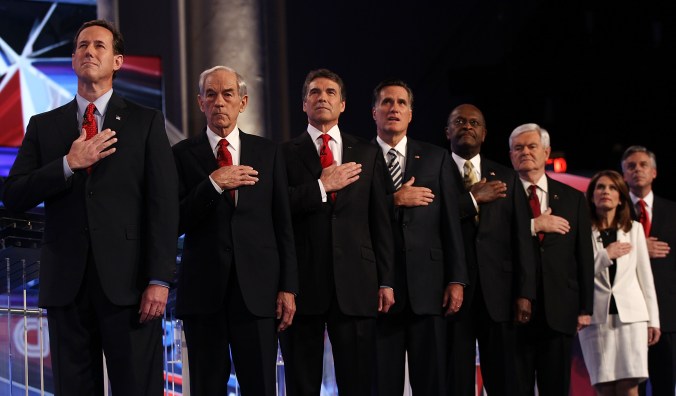
Verdict: Worst Candidates Debate Ever, Part IV: Weak, But Strong On Pandering [Corrected]

You want “a weak presidential field”? I’ll show you a weak presidential field!

[Part 1 is here; Part II is here; Part III is here, and the November debate review is here.]

David Leonhardt, whom I sometimes think is the worst of the horrible stable of New York Times op-ed writers until Michelle Goldberg launches into another fact-free rant or Charles M. Blow authors the latest escalation in his campaign to convince readers that President Trump is the spawn of Satan, wrote an op-ed last week attacking the parties’ nominating processes and asserting that “We have an unnecessarily weak presidential field, especially the incumbent.” Read the article. There is no logic to it, nor consistency; it is yet another “I wonder how gullible and ignorant my readers are?” experiment. Essentially the piece is anti-democratic, as a majority of progressives seem to have soured on democracy once it “failed” by not electing Hillary Clinton President. (I regard the election of Donald Trump over Clinton as one of the most important and exhilarating expressions of democracy in our history, though it was substantially due to moral luck.) Leonhardt’s argument is also historical nonsense, as he claims that the parties were better at picking qualified and electable candidates in the past. They most certainly were not: overage generals like Winfield Scott*, W.H. Harrison and Zachary Taylor, the latter two who, though elected,  promptly died, thus elevating to the White House VPs that nobody ever wanted or envisioned as Presidents…popular generals with no governing experience whatsoever, like U.S. Grant and John C. Fremont…wildly popular outgoing Presidents’ handpicked successors who would never have been nominated otherwise, like Van Buren, Taft, and Bush? Packaged puppets like Warren G. Harding and William McKinley? Doomed losers like Horace Greeley, James Cox, Bob Dole, Walter Mondale, George McGovern, Mike Dukakis  and (yechh) John Kerry? Already once or twice beaten past candidates like Henry Clay, William Jennings Bryan, Thomas Dewey and Adlai Stevenson?  Brilliant!

Leonhardt even offers Abraham Lincoln as an example of the effectiveness of past party nominating systems, ignoring, or, based on his established level of acuity, unaware of the fact that Abe won despite getting only 38% of the vote, or about the same proportion Barry Goldwater and George McGovern received while losing in landslides. That he turned out to be a great President was more moral luck: Lincoln had no executive governing experience at all before being thrust into the most difficult challenge a President had faced since Washington, hadn’t even been a general, and was known mostly for his wit and oratory. With the nation teetering on destruction, the candidates selected by the Democratic and Republican parties in 1860 consisted of Lincoln, John Breckinridge, Buchanan’s inert Vice-President, who had also no executive governing experience, and Stephen Douglas, who also had never run anything and had been a full-time legislator for two decades. In his favor, he had a lot more relevant experience than Lincoln. On the deficit side, he would die in 1861, meaning that if Douglas had been elected the new President would have been the immortal Herschel Vespasian Johnson.

Leonhardt explains why the current field of Democrats is so weak, as if that wasn’t already depressingly obvious, but he never points to a single current non-candidate who would be any more promising, because there aren’t any.  He muses about Democratic governors who might be more promising: Like who, exactly…the ridiculous Andrew Cuomo? How many Democratic governors have distinguished themselves enough to have any national name recognition at all, other than Cuomo and Virginia’s Ralph Northam, of blackface fame?

It’s not the process, obviously, it’s the people. Then Leonhardt ends with “Of course, the biggest sign that the process is broken isn’t any of those seven. It is the man in the Oval Office.” Got it. The op-ed is just more anti-Trump teeth gnashing.

Whatever Donald Trump may be, the fact that he beat a supposed Democratic star overwhelmingly expected to win proves that he was not a weak candidate by definition, and as an incumbent President, he is stronger now. Incumbent Presidents are usually strong candidates because no matter who they are, if the economy is thriving, their foreign policy weaknesses haven’t crippled them, and there’s no prominent third party candidate to siphon votes away, they win, like Obama, Bush, Clinton, Reagan, Nixon, Ike, Truman and FDR (and going back further yet to the beginning of the 20th Century, , Wilson, Teddy, and McKinley).

But I digress. The shocking deficiencies of the current Democratic hopefuls were on full display as the awful awful, awful December debate wound down.

Pete Buttigieg began the worst pander-fest of the evening: Continue reading →

Ethics Observations Upon Watching “Ford v. Ferrari”

My son is an auto tech and car enthusiast as well as a lover of speed (sufficiently to get him in trouble), so when he told me that I should see “Ford v Ferrari” and that he loved it, it was no surprise. I knew nothing about the film other than its title: no reviews, no background. My son said he would eagerly see it again, and was our guide as my wife and I attended a New Year’s Day afternoon showing (which was packed, incidentally.)

To get the basics out of the way up front, “Ford v Ferrari” is a wonderful movie. It immediately takes its place as one of the great sports movies of all time (with “Rocky,” The Natural,” “Hoosiers,” “The Bad News Bears,” “Sea Biscuit,” and a few others we could argue about), but it is also just a great movie. Christian Bale is astonishing, as usual, and the rest of the cast is uniformly excellent, as is the direction, film editing and screenplay. It is the best film I have see this year, easily leaving such critic’s favorites as “The Irishman” and “Once Upon A Time in Hollywood” in the dust.  That, however, is beside the point….

Observations: Continue reading →

Unethical Quote Of The Month: Pete Buttigieg

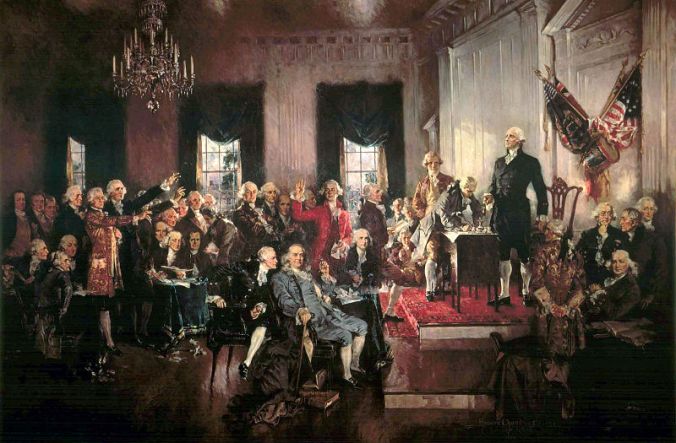
“The people who wrote the Constitution did not understand that slavery was a bad thing.”

South  Bend mayor Pete Buttigieg in 2011, disgracing himself and betraying the trust of the a group of students who trusted him to tell them the truth. Instead, he made them ignorant while encouraging disrespect and distrust of the Founders, an especially sinister component of the Democratic effort to undermine the Constitution and to “remake” America.

I reluctantly concluded that Buttigieg was, to be indelicate, an asshole almost exactly a month ago, after he returned the contributions of two lawyers who represented  Justice Kavanaugh when Buttigieg’s party was attempting to destroy him using an unsubstantiated and conveniently recalled alleged episode when he was in high school. With Buttigieg, unlike, say, Joe Biden, I assume he is educated and intelligent, and thus I knew that this was dishonest grandstanding. Mayor Pete knows that lawyers do not personally endorse those they represent, even if much of the public does not. Worse, in justifying his actions, Buttigeig’s campaign declared that Justice Kavanaugh was guilty of sexual assault. I wrote,

Buttigieg rejects fairness, due process, logic and decency to declare a Supreme Court Justice with a history of  impeccable professional and personal conduct guilty of a crime without evidence, and further impugns the lawyers who helped protect him from a vicious political attack, all to suck up to the worst elements of the Democratic base. This is signature significance. Pete Buttigieg is an asshole. Good to know.

It’s also good to know that my assessment in November was accurate, as this re-surfaced episode confirms, and that the mayor didn’t just recently become an asshole as he pursued the Presidency (an occupational hazard) but has been one all along.

Good to know. Continue reading →

(You Know When I Said I Had Posted The Last Christmas Music Post Of 2019? Oops!) Reconsidering “I Heard The Bells On Christmas Day”….

The post last week about “definitive” recordings of Christmas songs sparked some excellent comments. An epic was Jeffrey Valentine’s own list, which I recommend highly. One comment, however, churned around in my brain: it was from periodic commenter Patrice, a singer and musician herself as well as an expert in sacred music, who wrote in part,

A beautiful Christmas song you didn’t include is “I Heard the Bells on Christmas Day” (which I think was covered by Bing) with its lyrics by Longfellow after the loss of his son in the war.

As I said in my reply to Patrice, I had thought about the song, but didn’t include it on the list for three reasons: 1. It seems to have declined in popularity 2. There weren’t many recordings to choose from, and the two versions I was most familiar (by Bing and Johnny Cash)  with had different melodies. 3. If i was going to pick a “definitive” version, it would be Crosby’s, and I have a pro Crosby bias. This was one of those times when correcting for bias creates a bias.

So the song went around and around in my brain for days, and kept me awake at night. Finally, I researched it. Continue reading →

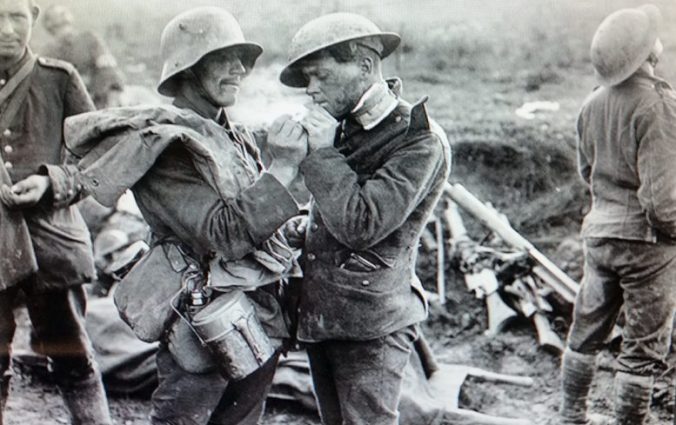
The 105th Anniversary Of “The Christmas Truce”

One hundred and five years ago today, one of the weirdest events in world history took place at the very beginning of the five year, pointless and stunningly destructive carnage of The Great War, what President Woodrow Wilson, right as usual, called “The War to End All Wars.”

World War I, as it was later called after the world war it caused succeeded it,  led to the deaths of more than 25 million people, and if anything was accomplished by them, I have yet to read about it.

The much sentimentalized event was a spontaneous Christmas truce, as soldiers on opposing sides on the Western Front, defying orders from superiors, pretended the war didn’t exist and left their trenches, put their weapons and animus aside, sang carols,  shared food, buried their dead, and perhaps, depending on which source you choose to believe, even played soccer against each other.

The brass on both sides—this was a British and German phenomenon only—took steps to ensure that  this would never happen again, and it never did.

It all began on Christmas Eve, when at 8:30 p.m. an officer of the Royal Irish Rifles reported to headquarters that “The Germans have illuminated their trenches, are singing songs and wishing us a Happy Xmas. Compliments are being exchanged but am nevertheless taking all military precautions.” The two sides progressed to serenading each other with Christmas carols, with the German combatants crooning  “Silent Night,” and the British adversaries responding with “The First Noel.“ The war diary of the Scots Guards reported that a private  “met a German Patrol and was given a glass of whisky and some cigars, and a message was sent back saying that if we didn’t fire at them, they would not fire at us.”

The same deal was struck spontaneously at other locales across the battlefield. Another British soldier reported that as Christmas Eve wound down into Christmas morning,  “all down our line of trenches there came to our ears a greeting unique in war: ‘English soldier, English soldier, a merry Christmas, a merry Christmas!’” He wrote in a letter home that he heard,

‘Come out, English soldier; come out here to us.’ For some little time we were cautious, and did not even answer. Officers, fearing treachery, ordered the men to be silent. But up and down our line one heard the men answering that Christmas greeting from the enemy. How could we resist wishing each other a Merry Christmas, even though we might be at each other’s throats immediately afterwards? So we kept up a running conversation with the Germans, all the while our hands ready on our rifles. Blood and peace, enmity and fraternity—war’s most amazing paradox. The night wore on to dawn—a night made easier by songs from the Germantrenches, the pipings of piccolos and from our broad lines, laughter…

Continue reading →

Christmas Eve Ethics Stocking Stuffers, 12/24/2019: All Right, It’s All About Impeachment…

Merry Christmas to all, and to all a good night…

1. In the spirit of the season, I did not post this on Facebook with the note, “Good plan, everybody!” But I wanted to…According to Gallup, Trump’s approval is at 45 %. This actually beats Barack Obama’s approval rating of 42%  from Gallup at the exact same point in his presidency.  Obama went on to win reelection the following November, against a much stronger opposition candidate than anyone the Democrats have in the running. True, it helped that his IRS knee-capped conservative groups that might have helped Romney, but still.

Meanwhile, more bad news for the “everything is terrible” gang: Bloomberg reports that holiday shopping last Saturday sales reached $34.4 billion, the biggest single day in U.S. retail history.

2. Meanwhile, Trump Derangement reached a critical stage: Continue reading →

Day Before The Night Before Christmas Ethics Package, 12/23/2019, Now UPDATED With The Meme I Stupidly Didn’t Post Despite Polling On It (Sorry!)

Merry Christmas!

TWICE yesterday store employees returned my “Merry Christmas!” with  a “Happy Holidays!” that was delivered in a tone that to my ear was intended to convey, “No, THIS is what you should say.” Both times, I was tempted to call them on it, but did not. Maybe I was being hypersensitive, maybe that wasn’t their intent…but of course it was. The next clerk or cashier who does that to me might get a “No, Merry Christmas. Do you have a problem with that?” back.  I’m that close…

1. ARGHH! “Baseball” censorship! Here’s another nauseating example of the capitulation to the word-banners. The MLB TV channel, which, like its satellite radio counterpart, is challenged to come up with programming this time of year. (The radio version held a quiz last week in which we were challenged to identify expressions of despair and horror as either coming from Cleveland Indians fan tweets about the trading of ace pitcher Corey Kluber, or from reviews of “Cats.”) Yesterday the channel was showing Ken Burns’ terrific documentary “Baseball.” In the segment on Ty Cobb, we were told about in infamous incident in which Cobb jumped into the stands to beat up an abusive fan, who, it turned out, had no hands. When the crowd shouted this fact at the infuriated player, he reportedly replied that he’d throttle anyone who called him “that” even if he had no legs. What was “that”? Why, it was that Cobb was a “half-BEEEEEEEEP!” Yes, a loud, high-pitched beep was injected into the narration instead of the word itself, which was in Burns’ original work (I own a copy.) Morons. If the word is  discernible from the context, then the beep equals the word, so just use the word. If it isn’t clearly indicated—and while I was pretty sure, knowing the story, but uncertain enough that I had to check—then it is incompetent to leave viewers wondering. Half-crazy? Half-wit? Half-lizard? Half-breed? No, Cobb was called “half nigger,” and the exact word is essential to understand the incident but also a key component of Cobb’s character. Did Burns approve the marring of his soundtrack? I doubt it.

This has got to stop.

2. Great: colleges are now free to bribe students to renege on their promises. In a proposed agreement announced this month in response to Justice Department antitrust accusations, the National Association for College Admission Counseling said it would allow its member college and university counselors to recruit students even after they have committed to another school and would permit members to encourage students to transfer after they have already enrolled. From the Times:

Now, colleges will be free to offer perks, like special scholarships or priority in course selection, to early-decision applicants, students who are less likely to need tuition assistance and use the process to secure a spot at their first-choice schools. …Institutions will also be able to continue recruiting students beyond a widely applied May 1 deadline that is typically imposed for students who have applied through a regular decision process and are considering offers based, at least in part, on financial aid packages.

The promises to commit to a school that gave you an early admission were never legally binding, just ethically binding. And they still are. Any college whose applicant reneges on such an agreement after being seduced by another college should send a letter telling him or her, “Thank you for voluntarily withdrawing your acceptance. Our school wants only students of good character, who are trustworthy, honest, and value integrity. Now that we know that you do not honor commitments, we realize that we erred in accepting you. We’re sure you will fit right in at the school you chose, however, and wish you the best in your years there.” Continue reading →

The Cowardly Courage of Tulsi Gabbard

Rep. Tulsi Gabbard, the Hawaii Congresswoman who is engaged in a quixotic effort to win the Democratic nomination for President from the relative center, became the fourth House Democrat not to vote for both articles of impeachment, instead voting “present.” Here is her statement explaining the non- vote:

Throughout my life, whether through serving in the military or in Congress, I’ve always worked to do what is in the best interests of our country. Not what’s best for me politically or what’s best for my political party. I have always put our country first. One may not always agree with my decision, but everyone should know that I will always do what I believe to be right for the country that I love. After doing my due diligence in reviewing the 658-page impeachment report, I came to the conclusion that I could not in good conscience vote either yes or no.

I am standing in the center and have decided to vote Present. I could not in good conscience vote against impeachment because I believe President Trump is guilty of wrongdoing.

I also could not in good conscience vote for impeachment because removal of a sitting President must not be the culmination of a partisan process, fueled by tribal animosities that have so gravely divided our country. When I cast my vote in support of the impeachment inquiry nearly three months ago, I said that in order to maintain the integrity of this solemn undertaking, it must not be a partisan endeavor. Tragically, that’s what it has been.

On the one side — The president’s defenders insist that he has done nothing wrong. They agree with the absurd proclamation that his conduct was “perfect.” They have abdicated their responsibility to exercise legitimate oversight, and instead blindly do the bidding of their party’s leader.

On the other side — The president’s opponents insist that if we do not impeach, our country will collapse into dictatorship. All but explicitly, they accuse him of treason. Such extreme rhetoric was never conducive to an impartial fact-finding process.

The Founders of our country made clear their concerns about impeachment being a purely partisan exercise. In the Federalist Papers, Alexander Hamilton warned against any impeachment that would merely “connect itself with the pre-existing factions,” and “enlist all their animosities, partialities, influence, and interest on one side or on the other.” In such cases, he said, “there will always be the greatest danger that the decision will be regulated more by the comparative strength of parties, than by the real demonstrations of innocence or guilt.”

Donald Trump has violated public trust. Congress must be unequivocal in denouncing the president’s misconduct and stand up for the American people and our democracy. To this end, I have introduced a censure resolution that will send a strong message to this president and future presidents that their abuses of power will not go unchecked, while leaving the question of removing Trump from office to the voters to decide.

I am confident that the American people will decide to deliver a resounding rebuke of President Trump’s innumerable improprieties and abuses. And they will express that judgment at the ballot box. That is the way real and lasting change has always occurred in this great country: through the forcefully expressed will of the people.

A house divided cannot stand. And today we are divided. Fragmentation and polarity are ripping our country apart. This breaks my heart, and breaks the hearts of all patriotic Americans, whether we are Democrats, Republicans, or Independents.

So today, I come before you to make a stand for the center, to appeal to all of you to bridge our differences and stand up for the American people.

My vote today is a vote for much needed reconciliation and hope that together we can heal our country. Let’s work side-by-side, seeking common ground, to usher in a bright future for the American people and our nation.

If you expect Ethics Alarms to award Gabbard an Ethics Hero designation for such equivocation, you don’t know me very well yet. Continue reading →

Ethics Round-Up, 12/18/2019: The Day Before An Invasive Procedure Edition [UPDATED]

Yuck.

Even the satisfaction of knowing that the President reads Ethics Alarms, or at least thinks like I do…wait, that came out wrong. Anyway, today I expect to be uncomfortable, hungry and distracted, so who knows what might appear here today?

You were warned.

1. The Ethics Quote of the Day comes from ex-Marine and TV talk show host Montel Williams (who was very nice to me when I was on his show), on the “scandal” of some cadets flashing the dreaded “OK” sign during the Army-Navy Game:


“Both West Point and Annapolis are investigating, and it strikes me as defamatory that some in the media have branded these young people as racists without a shred of evidence. I understand that a handful of racists (perhaps living in their parents’ basements) attempted to co-opt the ‘OK’ sign as a symbol of white power … but that is not evidence that these kids were motivated by racial animus. We owe these young people, who had the courage to sign up to be part of the 1% who defend this democracy, better than this,”

I would say that we owe them better than even investigating such trivia. A ambiguous gestures are ambiguous, and no student, in a military academy or anywhere else  should have to defend or explain them. The students are entitled to the benefit of the doubt.  As with the “It’s OK to be White,” flyers, the rational, responsible approach by administrators is to ignore them, rather than to make a scandal out of nothing.

When will we see the first “It’s OK to make the OK sign” flyers? Heck, I may put some up myself…

2. Nah, there’s no progressive “war on Christmas,’ and there’s no mainstream media bias, either. And CNN’s Brian Stelter isn’t the most incompetent and absurd “media critic” since the term was coined! Imagine: Stelter asked on Twitter,

“Justice Neil Gorsuch is on “Fox & Friends” right now. The Q: How is it appropriate for a Supreme Court justice to try to goose sales of his three-month-old book by chatting on one of the most partisan shows on TV?”

More “Q’s”: Would it be appropriate for Gorsuch to chat on another network, like, say, CNN? Would “wtachdog” Stelter bitch about that? What does the level of partisanship of a show have to do with whether a Supreme Court Justice should appear there? Is there any rule or precedent holding that it is unethical for a sitting Justice to promote a book? (I’ll answer that one: no.)

Stelter’s whining wasn’t close to the most contrived objection to Gorsuch’s visit to the Fox and Friends couch, though. This was: Continue reading →