The New York Yankees opened their season by crushing the Milwaukee Brewers with a record number of home runs. Some of the homers were hit by players using a new bat design imagined by a one-time MIT physicist. The bat is shaped at teh end like a bowling pin, or a torpedo. The Yankees hit a franchise-record nine home runs in the first game—-notably the player who hit the most was Aaron Judge with three, and he used an old-fashioned bat. The series sweep served “as a live infomercial.”
The Yankees aren’t the only team with players using the new bats. The Cubs, Minnesota Twins, Toronto Blue Jays and Tampa Bay Rays have some players who are trying them out. “It’s legal,” says one enthusiastic player. “It’s under MLB rules and everything. Just basically moving the sweet spot down. Those balls that you’re getting jammed on are finding some barrels.”
Before I leave the first installment of this post and move on to the film’s ethical significance, I should mention that “It’s a Mad, Mad, Mad, Mad, World” caught a cultural wave perfectly, accounting for its box office success. In this it was just lucky, and that moment in time is now long gone, which is why the film appeals to me from a historical perspective more than as entertainment.
There have been many attempts to mine the same property for laughs, and none of the offspring of IAMMMMW have equaled its model in reputation or box office success. Blake Edward’s “The Great Race,” just two years later, was billed as the most expensive movie comedy ever made, and bombed. (Peter Falk is in both IAMMMMW and “The Great Race.”) In 2001, the “Airplane!” gang made “Rat Race,” which was obviously inspired by Kramer’s opus. It had a less starry cast (of course) and made a profit, but was generally regarded as a second rate (second rat?) version of the original. “Scavanger Hunt was a 1979 rip-off with a more IAMMMMW-like ensemble cast, and was a flop. Lesser attempts to recycle the film’s formula, “Midnight Madness” and “Million Dollar Mystery” (note the “m” alliterations) were even more embarrassing failures.
On to the ethics…Much was made of the fact that director Stanley Kramer had never directed or produced a comedy before. In fact, his career output was ostentatiously serious, and often criticized as preachy and overly preoccupied with moral-ethical conflicts. Among his most famous movies are “Judgement at Nuremberg,” “Guess Who’s Coming to Dinner,” “Inherit the Wind,” “The Defiant Ones,” “On the Beach” and “Ship of Fools.” I’m sure that part of Kramer’s motivation for directing a huge slapstick comedy was to show his versatility, just as Spielberg felt that he needed to direct a movie musical with “West Side Story.” However, viewed in light of the times and Kramer’s artistic sensibilities, IAMMMMW now seems schizophrenic, a silly comedy with serious social commentary…and both parts undermine each other.
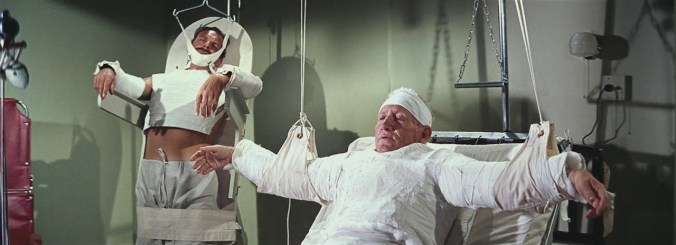
There were three distinct stages in my consideration of the sui generis Cinerama feature from 1963, “It’s a Mad, Mad, Mad, Mad, World.” The movie’s gimmick was that it collected more comedians and comic actors in a single Hollywood production than has ever been featured before, which meant, naturally, that it had to be the funniest movie ever….or so we were told.
I first saw IAMMMMW at Boston’s Cinerama Theater when I was 12. It was the first of the new, improved, seamless Cinerama features, which meant it was inferior to the original format, which wrapped around the audience. There were few effects in the movie that took advantage of the giant screen, either. But like all boys under 20 or so, I thought IAMMMMW was very amusing and a lot of fun. Girls didn’t get it, for the most part, and that has never changed. It’s physical comedy and slapstick throughout, and often cruel slapstick. This is a real male-female divide that appears to be timeless.
I was also, even back then, an omnivore of popular culture. Seeing so many familiar comedy icons of the era (and the previous one) in one movie was a thrill; of course, that was one of the main goals of the film. Sid Caeser, Milton Berle, Jimmy Durante, Jonathan Winters, Phil Silvers, Buddy Hackett, Mickey Rooney and more, with well-conceived cameos by the likes of Jack Benny, Jerry Lewis and Don Knotts—in the waning period of Hollywood all-star cast spectaculars, the idea of doing one with comedians was irresistible.
I saw the movie a second time in my thirties, and was shocked how different my reaction to it was. To be fair, I recalled many of the sequences that would have been funnier as a surprise, but the film seemed over-long, abrasive and, most surprisingly, sad. The subplot in which Spencer Tracy plays an aging police captain who becomes disillusioned with his professional and family life to the extent that he tries to steal the money that has set off an insane race among the assorted loonies is more tragedy than comedy, and, oddly, Tracy didn’t play any of his role for laughs. Grace, my wife, hated the movie in 1963 and hated it just as much when I made her watch it again with me.
Baseball season starts next week, bringing me memories of my happy childhood in Arlington, Mass. and how I would pass the golden summers there metaphorically glued to my transistor radio for all 162 Red Sox games except for the very few that I attended or saw on TV. My team’s games were broadcast on WHDH 850 AM in those days, with Curt Gowdy doing the play-by-play. Right before each game was a favorite feature on that station: “Warm-up Time,” a 5 minute story from baseball’s rich and often strange history. “It’s Warm-up Time!” each segment began, “Your baseball story before every Red Sox game! Don Gillis reporting for Atlantic Refineries!” Don had a great voice and a rich delivery, and taught me a lot over the years.
Don introduced me to the strange and tragic saga of the 1919 Black Sox, the fixed World Series, the bizarre aftermath, and how baseball Commissioner Kenesaw Mountain Landis banned for life all eight of the players alleged to have participated in the plot to make the American League champion White Sox to throw the Series to the vastly inferior Cincinnati Reds.
Among the banned: superstar “Shoeless” Joe Jackson, whose supporters argue that he should be allowed into the Hall of Fame to this day. Joe was glamorized in the movie and novel “Field of Dreams.” His defense was that he accepted money from gamblers to throw the Series but still played his best—hardly an ennobling theory, but plausible, since by all accounts “Shoeless” was an illiterate dolt. His familiar story was featured on “Warm-Up Time,” but I was always interested in another one of the banned eight, third baseman George “Buck” Weaver, sympathetically played by John Cusack in the movie “Eight Men Out.”
This has been happening to me a lot lately: I finish a post under the pressure of my large and enthusiastic dog making it painfully obvious that he wants a walk and won’t leave me in peace before he gets one, rush to get it up while he’s pawing at my arm, and then, on the walk, think of something I should have included in the post.
In this case, I should have mentioned the comparison with the military. We don’t want those suffering from mental and emotional illnesses holding guns and defending the country any more than we want them flying planes, but the standards are much, much lower. A “Section 8” draft deferment required far more serious symptoms than chronic depression.
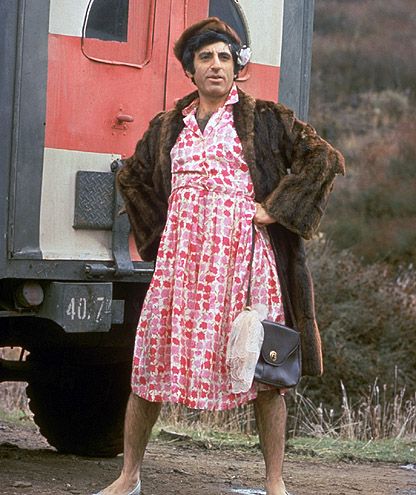
Four famous movies had the issue of mentally ill soldiers at their centers: “Dr. Strangelove…,” “The Dirty Dozen,” “M*A*S*H,” and “Catch 22.” (I never could figure out what was the problem with Trini Lopez in “The Dirty Dozen” except for his obsession with songs about vegetation.) My father was somewhat bitter about the low standards WWII draftees were subject to, I assume because his foot was almost blown off because of a member of Dad’s platoon who had an IQ in the sixties.
On the bright side, I suppose its reassuring to know that The Great Stupid is even worse “across the pond” than it is here…
Shakespeare’s Birthplace Trust, which cares for buildings in the immortal playwright’s home town of Stratford-upon-Avon, has announced that it wants to “create a more inclusive museum experience.” Therefore, the center of Great Britain’s essential public appreciation of the fact that it was so fortunate to be the birthplace of the greatest writer the world has ever known (unless the Bard was really a visitor from another planet, which has been my personal theory since I had to study “King Lear” in detail in order to direct a production of it) will seek ways to act on the diagnosis that Shakespeare’s works have been used to advance white supremacy.
Yes, these are morons. The legacy of one of the most vital catalysts of Western civilization is in the hands of morons. Now what?
2012’s “The Company You Keep” was the last film directed by Robert Redford, which tells you something. Redford is an excellent director but often not a commercially popular one: this movie, about aging Sixties radicals and their slow-dawning realization (or not) that their “movement” was ethically and logically flawed did not do well at the box office, and after his previous ethics movie (“The Conspirator,” which I posted about here) bombed, Redford’s days of getting studios to bet on his work were over.
“The Company You Keep” is not as good as “The Conspirator,” but it is surprisingly relevant in 2025 as we watch the American Left struggling with its hypocrisy, foolish utopianism and increasingly obvious hatred for its own country. Redford plays a former Weatherman (“The Weathermen” was the violent faction of the Students for Democratic Action) who has been in hiding in plain sight since a domestic terrorism action by the group turned fatal. When his long-standing alternate identity as a prominent lawyer is outed by an idealistic young journalist, Redford goes on the run. In the process he encounters former fellow-revolutionaries, some of whom still burn for the cause.
Once an institution publicly embraces or endorses something that wasn’t that institution’s proper role to endorse, the mistake cannot be remedied without the undesirable result of appearing to reject what should never have been embraced in the first place. The reverse is also true: as EA has pointed out, when the government starts legalizing previously banned substances, it appears that society now approves of their use.
The Trump administration is falling victim to the first version of this phenomenon in its admirable purge of DEI propaganda and practices across the government and its agencies. Naturally, this is being weaponized by the Trump-Hating news media. Today’s example: “Arlington Cemetery Website Loses Pages on Black Veterans, Women and Civil War” at the New York Times.
The story goes on to say, after the deliberately inflammatory title (President Trump is a racist and a misogynist, you know!), that the pages were taken down in response to the administration’s policy of ending promotion of the woke “diversity, equity and exclusion” fad, which is designed to inject “good discrimination” and group preferences into the culture.
The cemetery is operated by the Army, and issued a statement that it is dedicated to “sharing the stories of military service and sacrifice to the nation with transparency and professionalism.” The missing pages are being re-drafted. Representative Adam Smith of Washington, the ranking Democrat on the House Armed Services Committee, accused the Trump administration of trying to erase the accomplishments of women and people of color.
In 1936, Merle Oberon, best known today because of her co-starring role opposite Laurence Olivier in “Wuthering Heights,” became the first Asian actress to get an Academy Award nomination, for her role in “The Dark Angel.” But in 2023, Michelle Yeoh was widely hailed as the Academy of Motion Picture Sciences’ first Asian Best Actress winner. That is because Oberon hid her ethnicity from journalists and the public for her entire career in order to have a career at all. It worked: in addition to getting the much-sought role of Kathy in “Wuthering Heights,” Oberon played Anne Boleyn (in the Charles Laughton classic, “The Private Life of Henry VIII”) at a time when non-traditional casting was unheard of.
Oberon died of a stroke in 1979; it wasn’t until four years later that it was revealed that she had been born in Bombay, India, the daughter of an Indian woman who had been raped by a white man. Written before the secret was revealed, the Times obituary seems naive in retrospect: “A diminutive 5 feet 2 inches tall, Miss Oberon was of an almost exotic beauty, with perfect skin, dark hair and a slight slant to her eyes that was further accentuated by makeup.” Almost!
No, I didn’t forget the Alamo, and I hope against hope that more Americans than not are at least noting the anniversary of when the mission that became a fort fell in the early morning hours of March 6, 1836. As soon s I get this post up, I’m going to re-watch the 1960 John Wayne movie commemorating the siege and the men who died that day. The Duke’s film has plenty of flaws, but a lack of conviction and passion isn’t one of them; in the end that, plus the Demiri Tiomkin score, is what what makes “The Alamo” my favorite cinematic telling of the story.
Did the old newspaperman’s manifesto from another John Wayne movie, “The Man Who Shot Liberty Valence” ever apply more perfectly to an event in American history? “When the legend becomes fact, print the legend.” “I answered them with a cannon shot.” The line in the sand. The couriers who came back to the fort to die. Jim Bowie fighting from his sickbed. Davey Crockett fighting to the end. Truth and fiction, the Alamo is my favorite of all American history tales, and the Alamo itself is my favorite historical site to visit in the United States.
I didn’t have a new inspiration to justify a new post this year, so I’m reprising the one from this date in 2023. Among other things, it included the climax of the Alamo diary Michael West contributed a few years ago.
Now the bugles are silent And there’s rust on each sword And the small band of soldiers Lie asleep in the arms of the Lord.
***
I regard the siege of the Alamo one of the signature ethics events in U.S. history, both for what it was and what it came to represent. There have been many posts on the subject as well as many references to the Alamo in other posts, all of which are accessible here.
Today, March 6, marks the fall of the converted mission. Ethics Alarms has two pieces from its archives to present: Continue reading →





 Ethics Alarms