Canyon County Deputy Prosecutor Erica Kallin wanted to make the point that the defense attorney for the African American defendant, James D. Kirk, was trying to lead the jury to ignore the evidence that pointed to his guilt in his trial for lewd conduct with a 17-year-old girl and sexual battery of a 13-year-old girl—making them, in effect,”look away” from the truth. How could she make that argument in a vivid way? Clarence Darrow used to use poems in his famous closing arguments; was there a memorable poem that used the phrase, “look away”?
“‘Oh I wish I was in the land of cotton. Good times not forgotten. Look away. Look away. Look away,’ And isn’t that really what you’ve kind of been asked to do? Look away from the two eyewitnesses. Look away from the two victims. Look away from the nurse and her medical opinion. Look away. Look away.”
The jury convicted Kirk, on both counts; the evidence against him was indeed strong. He was sentenced to 20 years in prison. Continue reading →
My post about the tragic shooting incident in the Idaho Walmart continues to generate fascinating comments, not always directly related to the post. (Linking publications and websites to the contrary, I took no position on guns or gun control measures, though I have elsewhere on Ethics Alarms. The post’s positions were anti-incompetent gun ownership and anti-irresponsible parenting.) In the inevitable gun-related debates that have emerged, frequent commenter and blogger Shelly Stow opined that the need for guns to resist a government that attempts to crush individual freedom no longer exists.
This sparked the Comment of the Day, a history lesson as well as an explication for the need to have the last resort of armed revolution available, from 2014’s most prolific commenter, texagg04, and here it is, beginning with a quote from Shelly’s comment, on the post, “Comment of the Day: ‘Hard Lesson Of The Walmart Tragedy: Bad Ethics Kills’”:
“I disagree that, should our citizenry today become threatened by a government bent on tyranny, weapons in the hands of that citizenry would right the situation.”
Wait. What????
So, you are saying that IF we truly faced a tyrannical government at home THEN we aren’t supposed to do anything about it to overthrow it. And that’s precisely what you are saying if you think weapons in the hands of citizens isn’t the right situation.
What???? God knows in the face of a tyrannical government, sit-ins, hunger strikes, and demonstrations accomplish precisely nothing. Certainly no external forces would come to our succor — the UN, populated by precisely the kind of tyrannies we don’t want? No. Western Europe, which can’t even be bothered to solve it’s own problems? No…
Chevy Chase Circle is the official border separating the District of Columbia and Chevy Chase, Maryland. The inscription on the fountain at the center of Chevy Chase Circle honors Francis Griffith Newlands, saying, “His statesmanship held true regard for the interests of all men.” He was a three-term senator from Nevada, serving from 1903 until his death in 1917, but more important to this controversy, founded the Chevy Chase Land Co., which created neighborhoods on the Washington and Maryland sides of the circle. Yes, the founder of Chevy Chase is honored with a fountain in Chevy Chase Circle. What could possibly be wrong with that?
The problem is that Senator Newlands was a racist, and a proactive one. He was a white supremacist who described blacks as “a race of children” too intellectually handicapped for democracy. In 1912, he attempted to have the 15th Amendment, which granted voting rights to African American men, repealed. Not surprisingly, his vision of Chevy Chase did not include black residents, or Jewish ones for that matter.
The Advisory Neighborhood Commission that represents the D.C. section of Chevy Chase wants to remove Newlands’ name from the fountain, and has introduced a resolution calling on the D.C. Historic Preservation Office to rename the landmark “Chevy Chase Fountain.” The reason is his advocacy of anti-black policies.
This is a classic ethics conflict, a problem in which valid ethics principles oppose each other. There are so many conflicting ethical principles and objectives at work here: Continue reading →
It is slowly dawning on me that Christmas music, one of the annual joys of my childhood and perhaps yours, is in a perilous state, both culturally and aesthetically. The best of the songs musically are religious in nature, which means that schools won’t pass them along to their charges as happened routinely when I was a child, and even playing them on the radio is likely to be regarded as a religious statement. I just loved the music, as I think most kids would if they ever got the chance before they were brainwashed into believing the ancient songs were subversive.
A full court cultural press is underway to make those songs as rarely heard outside of church as hymns, and I don’t see the trend as reversible. One obvious bar to a comeback: current pop stars don’t have the pipes to sing most of them without causing a sound pollution emergency. Or, if one of the few singers who could actually hit the notes dared to cover a carol like “O Holy Night,” he or she would feel required to apply flourishes of the sort that make every rendition of “The Star Spangled Banner” at a major sports event an invitation to PTSD.
Even for the more secular Christmas repertoire, the clock is running out. The most listenable versions, and the definitive ones in most cases, are by performers of the past who are not just dead, but also long forgotten by the current culture. An hour of classic Christmas recordings on the radio is now a reminder of how old I am and close to joining great singers like Bing Crosby, Judy Garland, Andy Williams, Nat King Cole, Jo Stafford, Burl Ives, Gene Autry, Frank Sinatra, Dean Martin, Elvis—dead, dead, dead. I guess Brenda Lee is still alive, so “Rockin’ Around The Christmas Tree” is a little less depressing, but it’s a minor classic at best. It’s gotten so bad that when I hear “The Little Drummer Boy,” I find myself wondering if the whole Harry Simeone Chorale is dead too—Harry died in 2005, and the recording is 56 years old, after all.
Meanwhile, our post-modern culture is sneering at the whole idea of Christmas songs, and Christmas itself. Most modern Christmas songs either are making fun of Christmas, about sex, or just lousy. The tradition is being undermined in more creative ways, too: this week I watched a 2012 straight-to-video movie called “12 Disasters of Christmas,” based on the loopy premise that “The Twelve Days of Christmas” was really a coded recipe for stopping the 2012 apocalypse predicted by the Mayan calendar. “The Mayans knew that the knowledge would have to be preserved for centuries, so they devised a song that would carry the secret and would be passed on and learned by children for generations,” explains the old codger who’s figured it all out. (But why would they choose such a monotonous and stupid song?) Come on, guess: How does the “Chosen One” stop the end of the world?[Answer below.]*
The movie is on to something, though. The Christmas songs that have the best chance of persevering though this age of cynicism and cultural illiteracy may be those that either tell a story or that have an interesting one related to their creation. The simple and beautiful tune of “Silent Night,” for example, as one of those films they used to show in school assemblies every year before some anti-religious hysteric sued, was composed for guitar in response to a Christmas Eve crisis for a small church in the Austrian alps in 1818: the church organ wasn’t working. I have found that Irving Berlin’s “White Christmas” affects me far more deeply since I learned that the Berlins’ infant son died on Christmas day, and that while his children celebrated Christmas as a cultural holiday, Berlin and his wife did not. They spent each Christmas after their son’s death in mourning. The song is a wistful remembrance of a happier time that the composer will never experience again.
Maybe another Christmas song will persevere if its origins are remembered; I was reminded of its history this week as a result of the thaw in U.S. relations with Cuba. Though my wife hates it, the song is one of my favorites, perhaps because it brings back warm memories: I watched the song’s first national broadcast with my sister and parents, and the Marshalls bought the recording the next day.
It was 1962. Noel Regney and Gloria Shayne were a husband and wife songwriting team of modest success. They were saddened by the lack of any spiritual content in popular Christmas songs then; imagine what they would think today.
Like all Americans, they were petrified during the thirteen days of the Cuban Missile Crisis, when the world stood on the brink of nuclear annihilation. As the crisis intensified, Regney found himself inspired to write down a simple poem with a Christmas theme. (Later, the couple would say that neither of them could ever sing the song through, because of the strong emotions it recalled.) When the nation could finally take a deep breath of relief as the threat ended, Gloria devised a melody for her husband’s words, though he had always been the composer when he and wife wrote songs together.
The result of this unique variation on their collaboration was recorded before the end of 1962, but it wasn’t until the following year, when Bing Crosby sang the team’s creation live on ABC’s “Hollywood Palace,” that it became widely known. The song written during the Cuban Missile Crisis became a best-seller, Crosby’s last hit Christmas record, and also the last popular Christmas song to have a religious theme.
It was, and remains, a prayer for peace.
____________________________
* By finding and wearing FIVE GOLDEN RINGS, of course!
On December 7, 1914, as the horrible, pointless, world-disrupting “War to End All Wars” was only five months old, Pope Benedict XV suggested a truce for the celebration of Christmas. The governments of the battling nations rejected the idea, but in the days leading up to Christmas and after, many of the soldiers in the trenches of this ugly conflict took the Pope’s advice.
On December 20, Germans soldiers in some areas took in British wounded from the no man’s land between the warring armies. A German soldier reported on December 22 that both sides had been heard singing Christmas Carols in the trenches. German troops arriving into the lines had begun bringing Christmas trees, and some men placed them on the parapets of the fire trenches. Then, on Christmas Eve, many German and British troops serenaded each other across the lines. Allied soldiers reported that sometimes their singing was accompanied by German brass bands. Then, Christmas Day, 1914, some of the German soldiers left their trenches and carefully approached Allied lines, shouting“Merry Christmas” in French and English. Allied soldiers climbed out of their trenches, and shook hands with the men who had only recently been trying to kill them. Some even exchanged exchanged gifts of cigarettes and and food. There were even instances where soldiers from opposing sides played soccer: in England, one organization is holding a match next week against a German team to commemorate such contests. Continue reading →
I’m on the way to Cleveland. I guess I might as well leave my brains on the ceiling, where this story deposited them:
“The House on Tuesday passed legislation to terminate Social Security benefits for suspected Nazi war criminals. Passed 420-0, the bill was approved after an October Associated Press report found that dozens of suspected Nazi war criminals forced to leave the U.S. collected millions of dollars in federal benefits.”
On the plus side, See? We can have bi-partisan agreement in Congress!
On the other side: why do we need the Associated Press to point out to Congress that we’re giving millions of dollars to former Nazis to keep them supplied with fresh Zykon B? Why wasn’t this bill passed six years ago? Sixteen years ago? As long as President Obama thinks he can rule by fiat, where was the executive order directing the Treasury to stop paying non-resident Nazis Social Security?
You can read the original AP story here, which I was going to post on until it got lost in the shuffle.
File this one under “Incompetent Elected Officials,” or perhaps simply, “We’re doomed.”
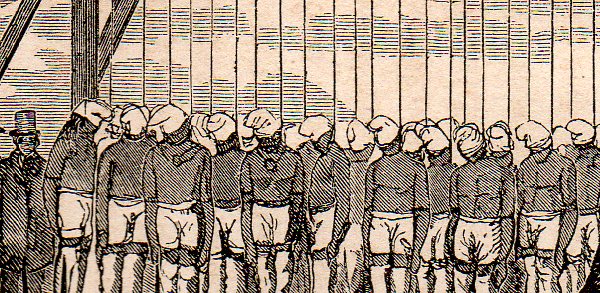
Minnesota’s Great Sioux Uprising, now usually called the Dakota-U.S. Conflict, was among the bloodiest Indian wars in the West, with hundreds of Native Americans, settlers and military casualties. The Sioux were defeated soundly, and the U.S. Army tried 303 Native Americans by military commission, finding them guilty of war crimes and sentencing them to death by hanging. Federal law required Presidential approval of the death sentences, and this was a problem Abraham Lincoln, the President at the time, did not need.
For it was 1862, and the Civil War was raging. This was a year full of Union defeats, indeed, disasters, like Fredericksburg, and both the war and Lincoln’s ability to lead it were in peril. Lincoln was also calculating all the political angles before issuing the Emancipation Proclamation. On top of the burdens of war and politics, he was coping with personal tragedy: his young son Willy had died nine months earlier, and Mary Todd Lincoln was teetering on emotional collapse from grief.
Now he had to decide whether to allow the execution of more than 300 Indians convicted in trials that were no better than kangaroo courts. Few Americans were concerned about the fate of the Native Americans, but Lincoln, with all of his other worries, took on the task of reviewing the trial records. What he found was manifest injustice. Continue reading →
There are times, not many, but a sufficient number to make my existence significantly grayer than I wish it to be, when I feel as if my professional endeavors have been in vain, and indeed, a waste of time. One such instance was the widespread defense of torture during the Bush administration. Another has been the reaction of some readers here to my post about Israel razing the homes of the families of presumed terrorists. I do not see how anyone who grasps the basic principles of ethics as they are explored and explicated on Ethics Alarms daily can pronounce such a policy as justified, justifiable, or anything other than unethical. If regular readers hear can come to a different conclusion, I am either not doing my job well, or the job itself is not worth doing.
Yesterday, Human Rights Watch called on Israel to stop razing the homes of Palestinians accused of attacking Israelis. The group called it a war crime, and I don’t like the concept of war crimes generally. The New York based organization’s argument, however, is irrefutable:
“Israel should impose an immediate moratorium on its policy of demolishing the family homes of Palestinians suspected of carrying out attacks on Israelis. The policy, which Israeli officials claim is a deterrent, deliberately and unlawfully punishes people not accused of any wrongdoing. When carried out in occupied territory, including east Jerusalem, it amounts to collective punishment, a war crime.”
Putting the war crime label aside, it is wrong enough that the act punishes those who have done nothing wrong other than be associated with a wrongdoer. There is no ethical system under which such an act is ethically defensible. It is an abuse of power. It fails any standard of Kantian ethics, using human beings as a means to an end, and proposing a standard that would, if universally adopted, send civilization into barbarism. It even fails extreme utilitarian ethics, for this means doesn’t even achieve a desirable end. The Israeli army believes that the razings do nothing to stem terrorist attacks, and there is no way that contention can be disproved. It is simply Old Testament justice of the most irrational and brutal kind. Continue reading →
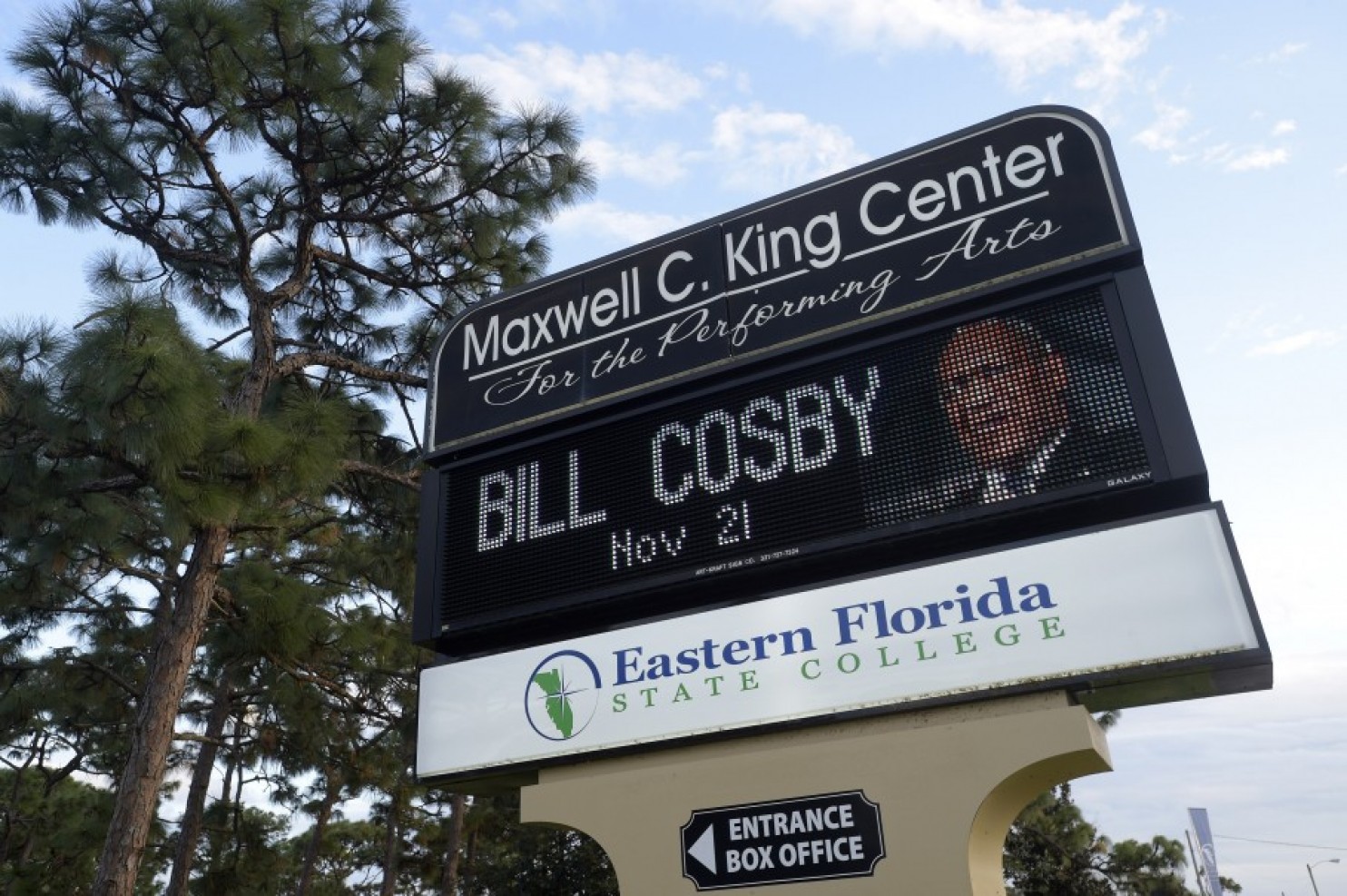
Frequent commenter aaronpaschal weighed in with this rich post on the Bill Cosby matter. I will hold my response to the end, because there is much to consider here, and much I disagree with. However, aaron has articulated well the thoughts many are having about the Cos, and I am grateful for the exposition. Here is his Comment of the Day regarding the post, On Cosby, Clinton, And An Ethics Dunce Convention In Melbourne, Florida.
I don’t know if I fully believe the allegations. I don’t know if the girls and women involved should bear some responsibility for choosing to become impaired. I don’t know if Cosby’s career will long survive this uproar – Netflix is dropping all of Cosby’s works in response, and that’ll cost someone a pretty penny.
But I do know that I don’t feel completely at ease with the notion that he faces ruin. That there is no evidence, no words, nothing he could present in his own defense. No courtroom, no trial, no lawyers. That the man who allegedly committed these acts did so a lifetime ago. I’ll admit that the women who have come out don’t have much tangibly to gain – but I also know all too well that revenge, hatred, defending existent lies, even merely time in the spotlight can be powerful motivators for some people (bearing in mind that pursuing justice, speaking the truth, and protecting the innocent are well – it could be any of them, all of them, or more.) There must, however, be SOME motive somewhere, or they would not be stepping forward – if there was truly nothing to gain.
But I do know that his works have always made me laugh, and I will appreciate them for years to come. I know I’ve heard wisdom from him, and these crimes don’t change the wisdom, either. I might not choose to leave my daughter alone with him. And I know that the court of public opinion makes very few wise choices, it is a terrible thing to be tried by it, guilty or innocent, and true justice is rarely found there.
It is kind of funny, isn’t it, to hear and read the shocked reactions of pundits to the fact that probable serial rapist Bill Cosby got a standing ovation from his concert crowd of 2100 in Melbourne, Florida last night? “What could this mean?” they ask. Does this mean that Cosby’s popularity will survive the onslaught of women reporting that he drugged and raped them years ago? Well, no, it means that 2100 people who paid premium prices to see Bill Cosby and attended his concert even after hearing more than sufficient evidence that he is a sick hypocrite like Bill Cosby.
Wow.
What a surprise.
Nor should it be any surprise that that many people will adopt rationalizations and tortured logic to avoid confronting the cognitive dissonance resulting from a self-styled moral exemplar having a spectacularly immoral, indeed criminal, past. After all, the Democratic National Convention, with a lot more that 2,100 in attendance, cheered serial sexual harasser and sexual predator William Jefferson Clinton as he spoke to a throng protesting Republican attitudes toward women, as progressive journalists and pundits from MSNBC to the New York Times nodded in approval.
Unrelated, you say? Wrong. The phenomenon is exactly the same, and therein lies a serious problem for Hillary Clinton. The rationalizations used to rescue her husband from accountability for his decades long abuse of women are exactly the same as those being used now by Cosby’s desperate fans to try to keep laughing at the wise humor of the icon who includes in his storehouse of wisdom such nuggets as… Continue reading →







 Ethics Alarms