Ethics Dunce: Washington University in St. Louis

Halloween prank

Before we leave the topic of the ravages of political correctness and the excessive fear of  grievance bullies, let’s pause to ask the administrators of Washington University in St. Louis…What’s wrong with you?

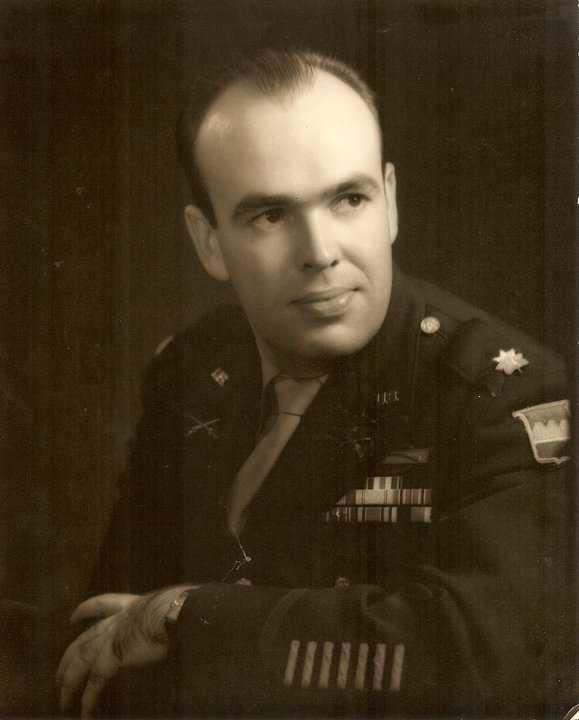
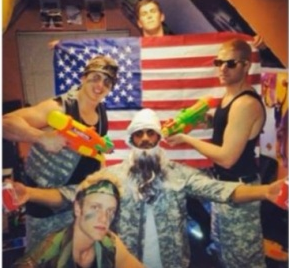
On October 30, several students posted a photo (that’s it on the left) on Facebook costumed as three U.S. soldiers pointing super-soakers at another student dressed as Osama bin Laden, with a fifth student holding a large American flag as a backdrop. Several things are not in doubt. 1. This was a Halloween stunt. 2. Osama bin Laden masks and costumes have been relatively common since Halloween 2002, as have been all historical villains in U.S. history since Halloween became a tradition. 3. There is nothing wrong with that. 4. An Osama bin Laden costume  is in no way, shape or form an insult to Muslims. 5. Osama bin Laden himself was an insult to Muslims.

Notwithstanding all this, a typical grievance bully on campus named  Mahroh Jahangiri, was determined to flex her muscles on behalf of her religion and make innocent fellow-students knuckle under and bow to her will. Maybe she thought they’d even let her speak at the next Democratic national convention, who knows? She posted a screen shot of the photo on her website, and wrote,

“This photo makes a costume of the lives of the thousands of civilian Muslim men who have been murdered during our ‘War on Terror’ and the countless others who have been mutilated, robbed, and stabbed to death in hate crimes across the United States. This is disgusting and cannot be tolerated on this campus. There are very few Muslim students on this campus, and our voice is not loud enough. For those of you who had not heard of this until now, now you have. What are we going to do to change this?” Continue reading

Ethics Heroes: The Mourners of Harold Jellicoe Percival

It’s a simple story.

Thanks Dad. Thanks, Harold. Oh, shut up. Justin!

Thanks Dad. Thanks, Harold. Oh, shut up. Justin!

From the Los Angeles Times:

When Harold Jellicoe Percival died last month, the British World War II veteran’s obituary mentioned that he had no close family to attend his funeral. But after the obituary went viral, hundreds of people showed up to honor him Monday. Percival, who served as a member of the Royal Air Force’s Bomber Command, died on Oct. 25 at the age of 99. His obituary requested that “any service personnel who can attend his funeral service would be appreciated.” It spread across social media brought it to the attention of service members and veterans organizations in Britain, They, in turn, rallied people to attend his funeral and honor his memory on Armistice Day.

There were reportedly 100 mourners in the church, and another 400 standing outside.

The ethical virtues demonstrated here are respect, gratitude, kindness, and citizenship. Somebody please explain this to Salon’s clueless, obnoxious, ungrateful and ethically, historically, logically and rhetorically-challenged writer Justin Doolittle, who argues that there is no reason to thank veterans for doing the dirty work of democracy and putting their lives on the line to protect his. Continue reading

Comment of the Day: “Jimmy Kimmel, Child Abuse, And Signature Significance”

(I am backed up three deep on the “Comments of the Day,” and I apologize to the deserving and patient commenters.)

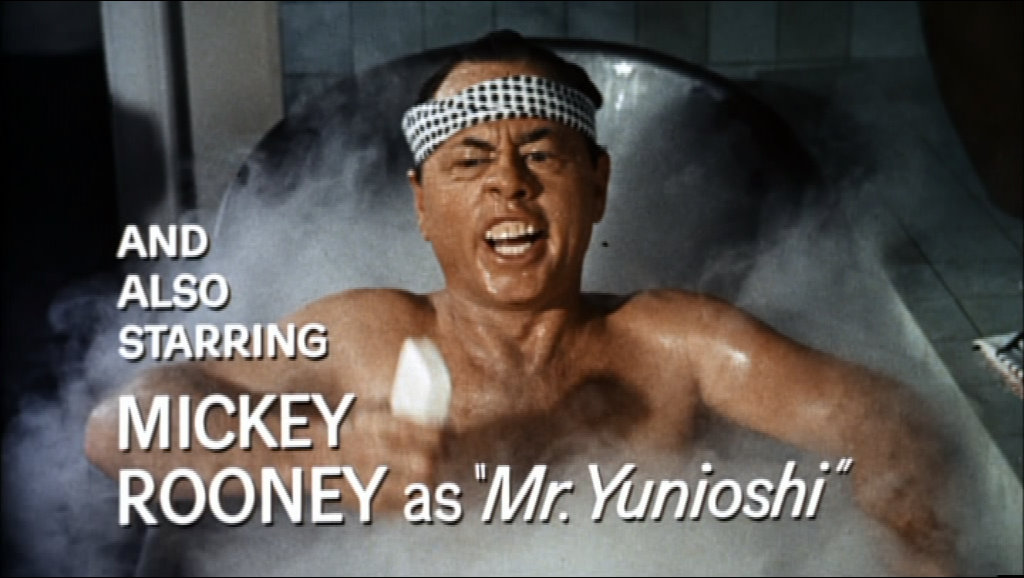
And who can forget Mickey Rooney's hilarious turn in that beloved American film masterpiece "Breakfast at Tiffany's"?

And who can forget Mickey Rooney’s hilarious turn in that beloved American film masterpiece “Breakfast at Tiffany’s”?

Alex Yuan raised an element of the revolting Jimmy Kimmel stunt discussed in my post, an extension of his penchant for using children as uncomprehending props for his often ugly comedy, that I glided right over: Why was showing a child suggesting that wiping out the Chinese was  a viable solution to national problems even considered fit for broadcast, when a similar comment about Jews, gays, Hispanics or blacks would be considered instantly taboo? Why doesn’t the ethics alarm sound when the minority being slurred or threatened is Asian?

Here is his Comment of the Day on the post, Jimmy Kimmel, Child Abuse, And Signature Significance:

It is interesting that you should mention political correctness because I can’t help feeling that in deciding it appropriate to air this segment, ABC – perhaps as a reflection of societal attitudes at large – is illustrating the alleged double standard against Asians when it comes to how topics concerning minorities and other protected classes are handled in public. Continue reading

November 9-10, Kristallnacht, And The Duty To Remember

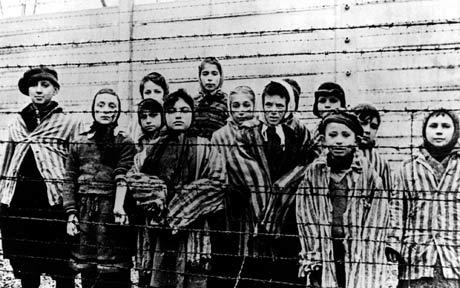
Auschwitz

This is the 75th Anniversary of Kristallnacht, November 9-10, 1938. Had you forgotten? Did you even know? If you weren’t looking in the right places, it would be very easy to miss the fact that these are days to remember—that we have a duty to remember.

In 2009, citing the cultural importance of another date in November, one that is going to be much commemorated this year (being the 50th anniversary) but that was barely noted four years ago, I said…

“Apart from national holidays, there are not an overwhelming number of calendar boxes that citizens of the United States should pause and think about every year. July 4. September 11. December 7, when America was attacked by Japan at Pearl Harbor. June 6, D-Day. We can argue about others, but there should be no argument about November 22. It was a sudden, unexpected tragedy that scarred a generation, and it changed the course of  national and world history in many ways.

“Year after year, Americans know less and less about their own country. This makes us incompetent in our civic duties, infantile in our understanding of America’s role in the world, stupid and apathetic on election day, and patsies for our supposed elected officials, who can tell us lies about our country’s mission and heritage as we stand nodding like cows. Most of all, it makes us disrespectful of the brave and brilliant men and women who built, sustained and defined the United States. College graduates go on “The Jay Leno Show” and shamelessly identify the faces on Mount Rushmore as the Marx Brothers or the Beatles, and giggle about it as Jay rolls his eyes. This is becoming the standard level of American appreciation of the nation’s past.”

In holding close critical events affecting the rest of the world, we are even worse, as the overwhelming ignorance of this date shows. If July 4, 1776; September 11, 2001; December 7, 1941, and November 22, 1963, are moments in history that all of us should remember, honor and think about because we are Americans, November 9 and 10th present the same obligations because we are human beings, and citizens of the world. Continue reading

Comment of the Day: “Print the Legend Ethics: The War of the Worlds Panic”

war_worlds

Bravo and thanks to penn for a thoughtful and thought-provoking personal reminiscence that supports my recent post about the claim that the famous panic over Orson Welles’ famous 1938 “War of the Worlds” radio drama never happened. Here is his fascinating Comment of the Day on Print the Legend Ethics: The “War of the Worlds” Panic:

This story came up every Hallowe’en in my family as I was growing up. We had family living in Toms River and in Lakewood, NJ (about 35 miles from Grover’s Mill) at the time Orson did his thing. The different reactions to the broadcast by the people living in the two places resulted in a minor family schism which continues to this day in the attitudes of their descendants.

It was a city mouse/country mouse situation. The Lakewood adults were elementary school teachers — the sophisticates. They listened to that program as a matter of course and as they later reported, they declared this one silly from the very beginning. But then, all science fiction was silly to them (really! space ships and aleeums? pshaw!) — my father (it was his side of the family) always contended they had no imagination. My mother recalled, however, many years later (and after taking several psychology courses at the New School), that commercials or not, she was convinced they had been very disturbed, if not downright scared. Scared enough to sit through the whole “silly” program in the first place, and for the rest of their lives to focus an uncharacteristic rage on the writers … for using the name of a real location in the program. [I think this naming of Grover’s Mill may account for some of the anxiety, if not the panic — people were sooo trusting of the media in those days .. . .] Continue reading

World Series Ethics: He Tipped His Cap

What would Ted Williams have done? We know the answer to THAT question...

What would Ted Williams have done? We know the answer to THAT question…

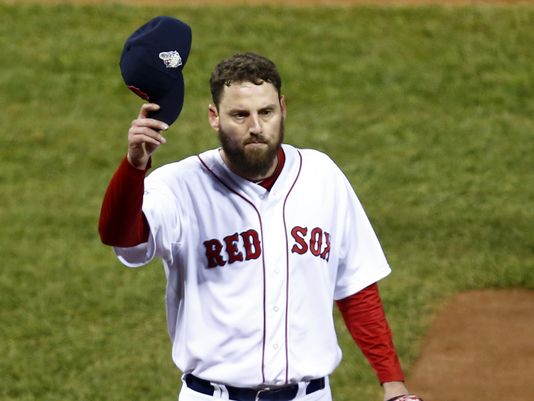
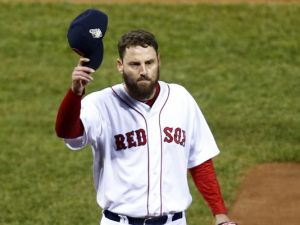
The Boston Red Sox won the World Series last night, making me happy. Something else happened too.

Some background is in order. The great Ted Williams used to give Boston baseball fans the biggest hat tip in baseball as they cheered him after a home run. This was when he was first known as “the Kid’ and indeed was one, as his Hall of Fame trajectory was obvious from the moment he stepped on a major league field in 1939 at the tender age of 19. Gradually but rapidly, a vicious local press and some ugly incidents in response to a few jackasses in the stands caused the Kid to sour on the admission-paying mortals who booed him when he struck out, and he decided to ignore their cheers, refusing to extend the traditional courtesy of a hat tip to the fans as he rounded the bases after a home run—which, since he was Ted Williams, happened frequently. Williams  spent his whole career in the city of Boston playing before those fans who offended him in his twenties, but right up to and after his final home run, which he hit, famously, in his last at bat, the Red Sox fans got no hat tip from Ted. He rounded the bases the final time as they cheered themselves hoarse, and never looked up or acknowledged their praise. Screw ’em.

That was Red Sox pitcher John Lackey’s attitude toward the current generation of Fenway fans, for similar reasons. He had been signed to a rich, long-term contract in 2010 to be a Red Sox mound ace, but arrived in Boston with his arm deteriorating and his abilities diminished. 2010 was a disappointing season for Lackey and 2011 was worse, as he pitched in pain for a team that was short of hurlers. The 2011 Red Sox became infamous for their late-season collapse and underachieving starting pitchers, and no one on that team was jeered on the field or savaged in the call-in sports shows like John Lackey. He missed the entire next Red Sox season recovering from arm surgery after the 2011 collapse, and thus missed the 2012 debacle that was even worse. In 2013, however, Lackey returned with a renewed right arm, a fit body and a fierce determination to finally live up to the big contract. He did, too. He pitched well all season, and became a key factor in the Boston charge to the World Series, as they rose from last place in their division in 2012 to first.

In 2013, Lackey received nothing but cheers from the surprised and grateful Boston fans. Nevertheless, he adamantly maintained the Kid’s attitude—“Screw ’em”—all season long. As he walked into to the Red Sox dugout after being relieved in another fine pitching performance and the Boston fans saluted him, Lackey refused to reciprocate with the traditional hat tip, all season long and through the play-offs. The fans were fickle hypocrites, and their loyalty conditional. They booed him when he was valiantly pitching hurt and embarrassed in 2011, and he wasn’t going to forget it. They were going to get snubbed like they deserved, and that was the way it was going to be.

Last night the Boston Red Sox won their third World Series in the last ten years. It was the first time the home team fans had been able to witness the deciding game since 1918 (as the Fox announcers informed the presumably senile audience over and over and over again), and John Lackey was the pitching star for the home town team. The night was a love fest for Boston baseball fans, as they cheered every move of their frequently star-crossed and quirky team, and no Red Sox player was cheered more loudly than John Lackey, as he walked off the field for the final time in 2013 in the 7th inning, with his team safely ahead by five runs. They stood and applauded and chanted his name, as he moved deliberately to the Boston dugout, head down, grim, just like Ted on that gray day in 1960 when he hit homer number 521.

Then he tipped his cap.

It was a small thing, the smallest really, only a gesture and for most players, most of the time, an automatic one…except that it symbolized the ethical virtues of grace, forgiveness, gratitude, humility and fairness. This memorable, wonderful night for the Boston Red Sox and the grand old city it represents—my home town– was no time to let bitterness and resentment prevail. Unlike Ted Williams (who wouldn’t make his peace with Boston fans until years later, when he returned as an opposition manager), John Lackey found the strength and decency to let it go.

It was, as I said, a small thing. But it took character, and it was the right thing to do.

______________________________
Graphic: USA Today
Print The Legend Ethics: The “War of the Worlds” Panic

OrsonWellesDailyNews

One of the worst results of an untrustworthy news media is that it becomes difficult, as time passes, to determine with any certainty what the truth is.

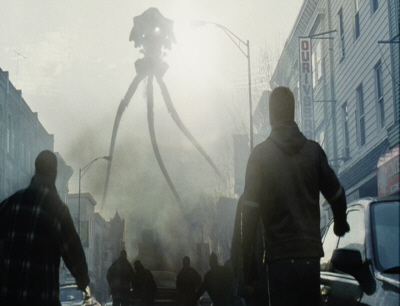
A classic example is on display today, in Slate, which celebrates the 75th anniversary of young, svelte, Orson Welles’ famous Halloween Eve broadcast of his radio adaptation of H.G. Wells’ “War of the Worlds,” with no Tom Cruise or Dakota Fanning but a nice conceit that involved telling the story through fake news flashes and eye-witness interviews. (One reporter is fried on the air by the Martian invasion vehicles.) An new NPR program and a PBS documentary both tell the familiar story of how the realistic-sounding radio play caused widespread panic among radio listeners who missed the opening credits, leading them to think that Earth was really under attack. Newspapers of the day headlined mass panic, and gave accounts of citizens running for cover, huddling in the basement, and cringing in terror.  The episode made Orson Welles a national celebrity, and launched him on his meteoric, long and strange career.

According to Slate authors Jefferson Pooley and Michael Socolow, it never happened. Declaring the story of the “War of the Worlds” panic a myth, the authors state without equivocation that the newspaper accounts, headlines, commentary and interviews, were fabricated:

“Radio had siphoned off advertising revenue from print during the Depression, badly damaging the newspaper industry. So the papers seized the opportunity presented by Welles’ program to discredit radio as a source of news. The newspaper industry sensationalized the panic to prove to advertisers, and regulators, that radio management was irresponsible and not to be trusted. In an editorial titled “Terror by Radio,” the New York Times reproached “radio officials” for approving the interweaving of “blood-curdling fiction” with news flashes “offered in exactly the manner that real news would have been given.” Warned Editor and Publisher, the newspaper industry’s trade journal, “The nation as a whole continues to face the danger of incomplete, misunderstood news over a medium which has yet to prove … that it is competent to perform the news job.” Continue reading

Unethical Quote of the Week: “Face the Nation” Host Bob Shieffer

“The nation was plunged into shock. Nothing like this had ever happened.”

—“Face the Nation” host Bob Shieffer, looking forward to the 50th anniversary of President Kennedy’s assassination, and describing the aftermath of the murder in Dallas on November 22, 1963.

Wait…what???

Hey Bob...do any of these guys ring a bell?

Hey Bob…do any of these guys ring a bell?

As it is, younger generations have a tendency to assume that what is happening now is unprecedented, that every crisis is the worst crisis, that what they are experiencing is unique. The remedy to this self-centered, ignorant and crippling cognitive malady is education, resulting in perspective. Unfortunately, the schools are doing increasingly little to provide useful historical context, and our leaders find it useful to exploit the low-information voter (worker, driver, patient, parent, student) for its own devices.

That leaves the field of journalism. Journalists, however, do not generally go into the arena of describing the present because of any particular respect or appreciation for the past, so their ability to convey perspective is usually limited as well. Fortunately, there are still older, veteran, experienced pros like Bob Shieffer,  76 years young, who…who…who appears to be as irresponsibly ignorant of basic American history as the college goofs Jay Leno makes look silly on his “Jay Walking” segments. How is this possible?

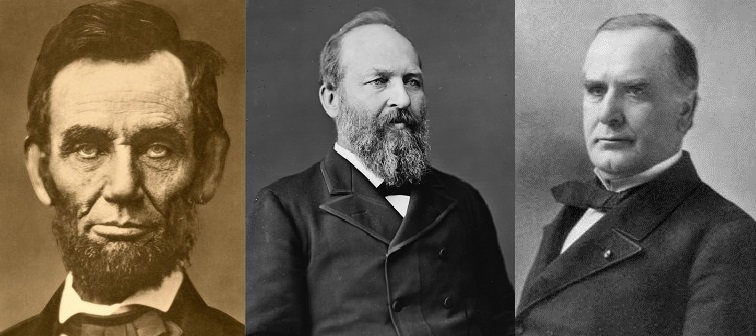
What could Shieffer possibly mean by saying of JFK’s assassination that “Nothing like this had ever happened” that is not flagrantly misleading, careless, ignorant and wrong? For those of you as bad off as Bob, there had been three previous Presidential assassinations before JFK, and all of them were big deals. Lincoln’s was a bigger deal than Kennedy’s in fact, because the U.S. had barely finished a war, and Lincoln’s assassination caused legitimate fears that it was part of a second Southern assault. Let’s see…maybe we can give Bob the benefit of the doubt and find an explanation for his statement that doesn’t involve having to shop for rest homes: Continue reading

Case Study: The Botched DP, Baseball, Ethics Evolution, and “Getting It Right”

manager-mike-matheny-argues

I know this is a long essay.

Yes, it involves baseball.

Bear with me. I think it is worth your time.

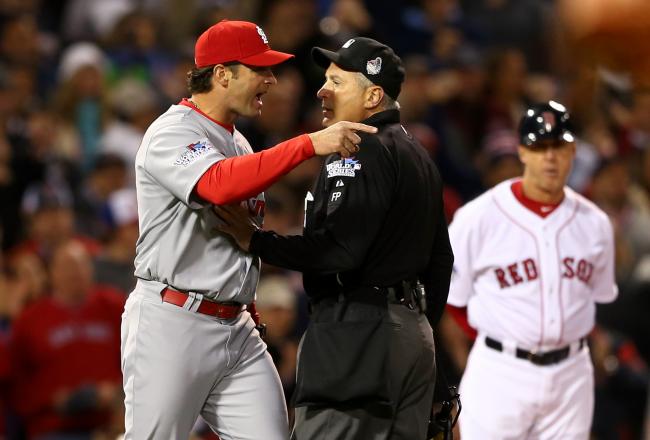
Last night, in Game 1 of the 2013 World Series, embarrassingly kicked away by the St. Louis Cardinals and won handily by some team called the Boston Red Sox,  an intricate ethics drama appeared, allowing us to see the painful process whereby a culture’s ethical standards evolve and change in response to accumulated wisdom, altered attitudes and changing conditions. An obviously mistaken umpire’s call was reversed by the other umpires on the field as the Cardinals manager argued not that the original call had been correct, but that reversing it was a violation of tradition, established practice and precedent….in other words, doing so was wrong, unfair, unethical because “We’ve never  done it this way,” a variation of the Golden Rationalization, “Everybody does it.”   You should not have to appreciate baseball (but if you don’t, what’s the matter with you?) to find the process illuminating and thought-provoking. Continue reading

If Your Institution Is Named After George Washington, Shouldn’t We Be Able To Trust It To Tell The Truth?

The General is not pleased.

The General is not pleased.

Shame on George Washington University (in Washington, D.C.), not only for lying to its students and community, but also for dishonoring the name of the scrupulously ethical American icon which they presumed to expropriate as their own. Such things carry with it some crucial obligations.

For years, the GW admissions and financial aid offices have claimed in printed materials and on the University website that admissions were independent of need. The admissions process does not consider financial need during the first round of screening applications. Before applicants are notified, however the University examines its financial aid budget and decides which students it can actually afford to admit. Wealthier students are accepted, taking the spots of students who would need more financial aid from the University.

Last week, a GW administrator confessed to a student newspaper—one ironically called “The Hatchet” after the apocryphal axe little George used to cop down that cherry tree in Parson Weems’ fable—– that financial resources indeed were considered in the admissions process, and have always been considered despite University statements to the contrary.  As  recently as last weekend, admissions representatives told prospective students that their applications would be judged without consideration of their financial aid profiles. Until it was removed Saturday evening, the newspaper reports, the undergraduate admissions website read, “Requests for financial aid do not affect admissions decisions.”

That site now confirms a “need-aware” policy that has always been in place. George Washington University just had another policy of lying about it. Continue reading