The Bill James Effect, Or How Nature Conspires To Make Us Irresponsible

Quiz: What do Gen.Lee and Bill James have in common?

You see, our strengths do us in, sooner or later. The greater the strength, the more successful it has made us, the more dangerous it is.

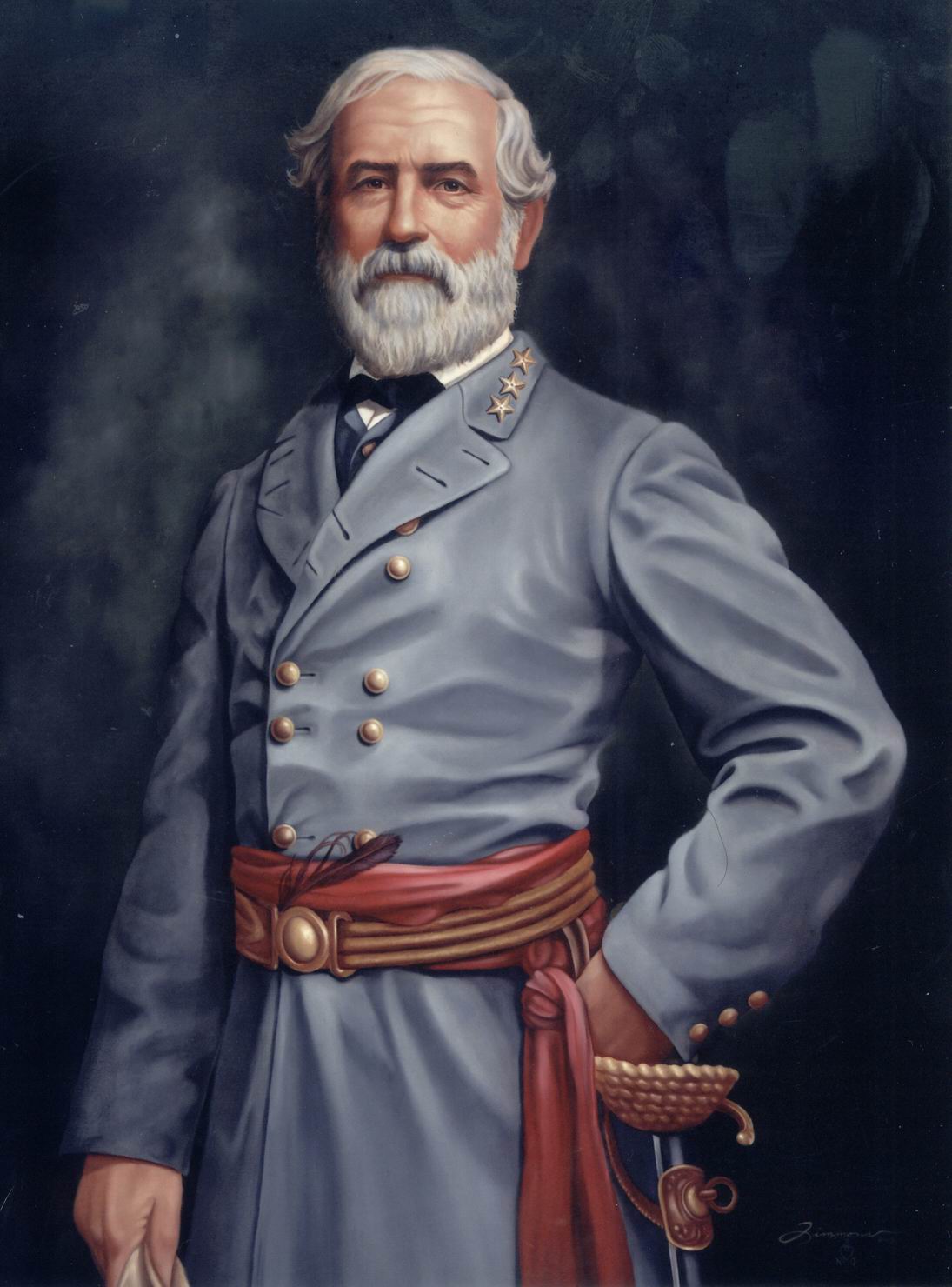
In the American Civil War, Robert E. Lee was the smartest general on the field…so smart that he broke iron-clad rules of battle strategy again and again, and prevailed every time. When everyone told him how it was usually done, always done, Lee knew that he could get an edge by doing something else. You never divide your forces, his aides, subordinates and the military books told him. So Lee did, at Chancellorsville, and won an incredible victory.

Then came July 3, 1863: the final day of the Battle of Gettysburg, and Pickett’s Charge. Everyone told Lee that a massed Napoleonic assault, over an open field, into enemy artillery and a fortified line, was suicidal. But when conventional wisdom dictated a course of action, that was when Lee had always succeeded by ignoring it. So he ordered Pickett’s Charge. This time, conventional wisdom was right. The same qualities of creativity, courage, certitude, and willingness to resist the power of convention that had caused Lee’s men to trust him unconditionally had resulted in the massacre of thousands. Pickett’s Charge wasn’t bold or ingenious. It was irresponsible. Lee, because of a lifetime of success challenging what others thought was obvious, was no longer able to tell the difference. Continue reading

The Ethical Fate For Joe Paterno’s Statue

In the wake of the Freeh Report’s revelations regarding the extent of the late Joe Paterno’s involvement in allowing Jerry Sandusky’s child molesting appetites to be sated with Penn State’s  assistance, many are calling for the campus statue honoring the now-disgraced coach to be removed.

I am generally opposed to removing memorials and honors to historical figures according to the popular verdicts of the day, for several reasons. The main one is that every individual who ever achieved something worthy of such honor also was guilty of misconduct that someone could convincingly argue outweighs it on moral or ethical grounds. New facts are uncovered, cultural values shift, and over time, no revered figure is safe from deconstruction. The reverse is also inevitable: if a life can be judged unworthy of honor, subsequent generations may well disagree. The verdict of a community, a culture and an era should be given due weight and respect;  a statue, memorial or monument not only recognizes an individual but also represents the judgment of our predecessors. Leave their judgments alone, and if we disagree with them, try to make ours better. Continue reading

In Tennessee, the Tea Party Tries An Anti-Chris Rock

The fine art of whitewashing, brought to you by Tennessee’s tea parties.

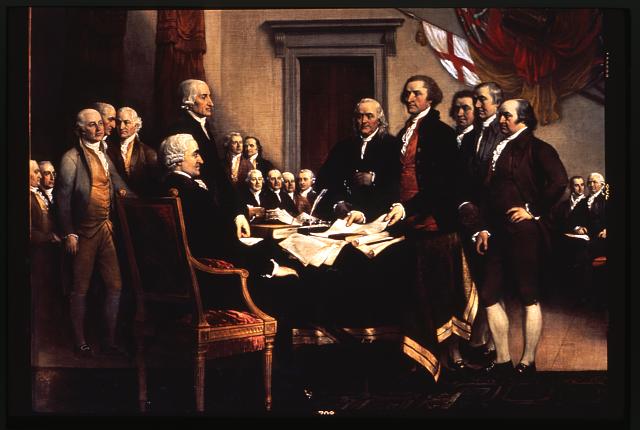
It might have been Chris Rock’s anti-Fourth of July tweet, or perhaps because there hadn’t been enough news stories making tea party members look racist or foolish (though there have), but suddenly Salon and other left-leaning websites started publicizing an 19 month-old press conference by Tennessee tea parties demanding that the Tennessee legislature pass a law that would whitewash American history, particularly as it applies to the Founders. From a report in the Commercial Appeal from January of 2011:

“Hal Rounds, spokesman for the group, recently claimed at news conference that there was ‘an awful lot of made-up criticism about, for instance, the Founders intruding on the Indians or having slaves or being hypocrites in one way or another.’ As a result, the Tea Party organizations argue, there should be ‘no portrayal of minority experience in the history which actually occurred shall obscure the experience or contributions of the Founding Fathers, or the majority of citizens, including those who reached positions of leadership.’ ‘The thing we need to focus on about the Founders is that, given the social structure of their time, they were revolutionaries who brought liberty into a world where it hadn’t existed, to everybody — not all equally instantly — and it was their progress that we need to look at,’ Rounds explained of his interpretation of the legacy of the Founding Fathers.”

There is a lot of useful information to be extracted from this remarkable theory, some with ethics ramifications, and some without. Among the non-ethical conclusions are that… Continue reading

Why Journalists Can’t Shoot Straight

George probably wasn’t lying, but Bill sure was.

The issue in the Washington Post’s weekly Outlook section concerned the virtues and dangers of honesty in a Presidential campaign, a matter that interests me from the perspective of ethics, presidential history, and citizenship. Two Post reporters were given the assignment of creating sidebars to the main article, one on candidates who told the truth and were punished for it, the other on campaign lies that came back to haunt the Presidents involved.

These are not difficult assignments, by any means. Either would be a legitimate term paper topic for a high school senior’s history class; both would be rejected as a history major’s thesis topic as overly simplistic. Yet both Rachel Weiner and Aaron Blake botched their tasks, and would have earned D’s at best in high school history, and that’s only because of grade inflation. The reasons for their failures exemplify the inadequacy of the mainstream media for the job we need it to do during a Presidential election.

Continue reading

Unethical Quote of the Day: Comedian Chris Rock

“Happy white peoples independence day the slaves weren’t free but I’m sure they enjoyed fireworks”

—-Chris Rock, in a 4th of July tweet

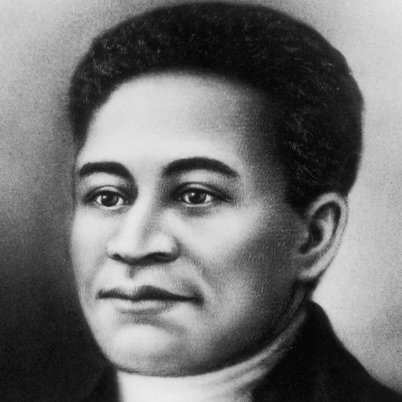
Crispus Attucks. Missed the fireworks.

Let’s see: what’s wrong with this comment?

Ignorant, racist, divisive, unfair, disrespectful, bitter, dumb, and not funny…what else?

In analytical terms: What an ass!

Ethics Quotes of the Day: On Liberty, Freedom, and Democracy

“Hurrah for the flag of the free!
May it wave as our standard forever,
The gem of the land and the sea,
The banner of the right.

“Let despots remember the day
When our fathers with mighty endeavor
Proclaimed as they marched to the fray
That by their might and by their right
It waves forever.”

—–John Phillip Sousa, “The Stars and Stripes Forever”

“Democracy is like sex. When it is good, it is very very good. And when its is bad, it is still pretty good.

—–Anonymous.

“The real democratic American idea is, not that every man shall be on a level with every other man, but that every man shall have liberty to be what God made him, without hindrance.”

—-Henry Ward Beecher, American preacher

“Democracy is moral before it is political.”

—- Louis Brandeis, Supreme Court Justice

“The experience of democracy is like the experience of life itself-always changing, infinite in its variety, sometimes turbulent and all the more valuable for having been tested by adversity.”

—-  Jimmy  Carter

“A constitutional democracy like ours is perhaps the most difficult of man’s social arrangements to manage successfully. Our scheme of society is more dependent than any other form of government on knowledge and wisdom and self-discipline for the achievement of its aims. For our democracy implies the reign of reason on the most extensive scale. The Founders of this Nation were not imbued with the modern cynicism that the only thing that history teaches is that it teaches nothing. They acted on the conviction that the experience of man sheds a good deal of light on his nature. It sheds a good deal of light not merely on the need for effective power if a society is to be at once cohesive and civilized, but also on the need for limitations on the power of governors over the governed.”

—- Felix Frankfurter, Supreme Court Justice

“In contrast to totalitarianism, democracy can face and live with the truth about itself.”

—-Sidney Hook, American philosopher and historian

“America’s experiment with government of the people, by the people, and for the people depends not only on constitutional structure and organization but also on the commitment, person to person, that we make to each other.”

—-Robert Hutchins Continue reading

Comment of the Day: “Ethics Dunce: Animal Planet”

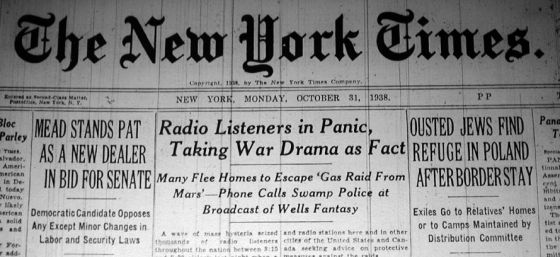
Arthur in Maine contributes the Comment of the Day, expanding on the predictable comparison between Orson Welles’ Halloween radio broadcast of his adaptation of “War of the Worlds,” which many gullible listeners believed was a real invasion, with the misinformation broadcast by Animal Planet in its recent fake documentary claiming that mermaids may exist. I have a few comments afterwards; meanwhile, here is Arthur’s interesting perspective on the post, “Ethics Dunce: Animal Planet”:

“I’ll give Welles a pass here. Because of my work, I am a student of the media (contrary to the assumptions made by a kindhearted poster on another thread).

“Welles was not irresponsible. He was groundbreaking in his art, using a new form of media in a way it had never been used before. The program was announced as a radio play; it was interrupted by commercial breaks, it ended in an hour, nothing about the invasion was carried on other networks, and even more to the point: the panic ascribed to “The War of the Worlds” broadcast never happened. Continue reading

Reminder: July 2 Is “Thank Minnesota Day,” and Remember Gettysburg, Too.

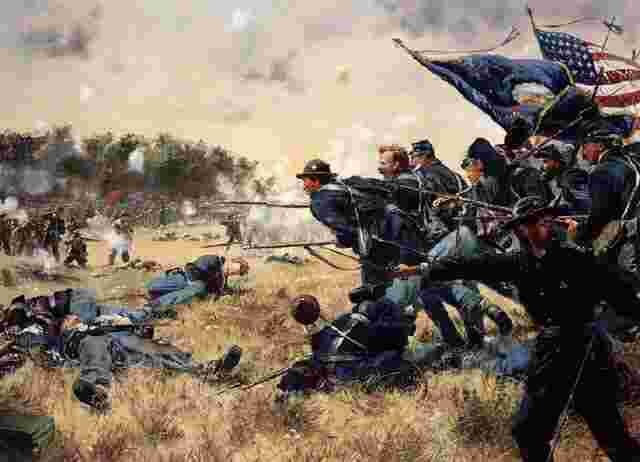
Last year on this date, I posted about the injustice of historical memory, and how the heroic exploits of the Maine soldiers on Little Round Top commanded by Col. Joshua Chamberlain on the second day of the Battle of Gettysburg have all but obliterated recognition of the even more remarkable sacrifices made by the First Minnesota Volunteer Regiment that same day, when it took on the suicide mission of blocking a hole in the Union line against a Confederate force that outnumbered it five to one. Those Minnesotans quite possibly saved the United States of America at the price of their lives.

I see that some readers are finding that post today: let me make it easier for everybody. Here is the link. This a day for all of us to honor the heroism of the First Minnesota, and indeed all of the Americans, North and South, who fought for their nation, their states, their ideals and the soul of America in the Pennsylvania town of Gettysburg, on July 2, 1863. Continue reading

Nomination For Enshrinement in the Hall Of Bad Ethics Ideas: A Hippocratic Oath For Scientists

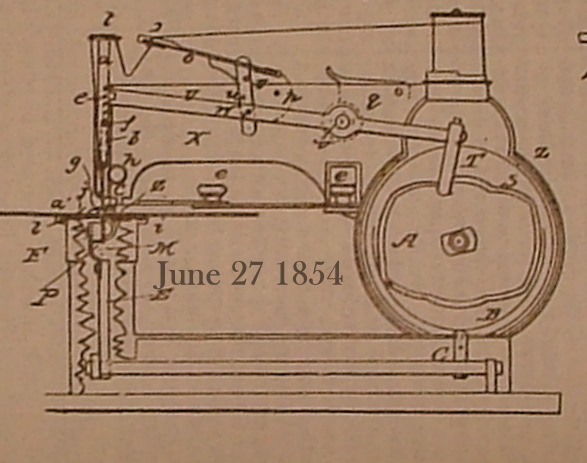
Nope. No sewing machine. It will cause too much “harm.”

A blogger for the Lindau Nobel community asks, as a follow-up to a discussion raised in one of the august group’s recent meetings, whether scientists should have to take an oath similar to that traditionally (but not universally, by the way) taken by physicians, a pledge to “do no harm.”

No. Next question!

This is not merely a bad idea, but an arrogant and ignorant one. The medical profession is dedicated to healing, without regard to who is being healed. “First, do no harm” is a rational and excellent absolute principle, one that relieves the profession of the burden of many (but not all) complex utilitarian dilemmas that doctors and other health professionals may not be equipped to solve. Medicine is much narrower than science, and its limitations more clear. Most people would agree with doctors on what constitutes “harm” in 99% of the situations where the issue would be raised. Not so science, where one man’s monstrosity is another’s giant step for mankind. Continue reading

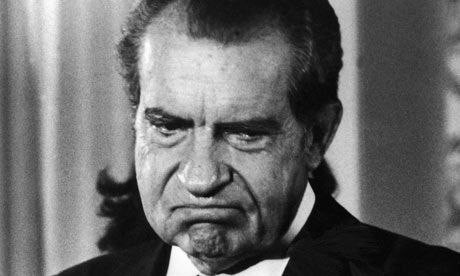
Don’t Blame Nixon

They can’t lay this one off on you, Dick.

I know it is much the vogue in Washington these days for leaders to blame previous leaders for persistent problems rather than to accept accountability and responsibility for not successfully solving them. Trendy though this attitude may be, however, Washington Post columnist Kathleen Parker’s column assigning fault for the U.S. public’s growing and frightening distrust of government institutions to Richard Nixon and the Watergate scandal shows its folly. It flies in the face of history and fairness, and lets literally thousands of subsequent leaders, elected officials, journalists, pundits and assorted knaves and hypocrites off scot-free.

Parker writes,

“Beyond the obvious, Nixon and the Watergate episode did great, perhaps irreparable, harm to the American spirit. A generation already traumatized by a war that ended up killing 58,000 of its brothers, boyfriends, husbands and fathers lost any remaining innocence, as well as trust in authority and faith in governmental institutions. The flag our forefathers raised on the moral high ground looked suddenly shabby and soiled. When even the president of the United States was willing to burglarize the American people, there was no one left to trust”

Oh, nonsense. The Watergate scandal, by the end, was one of the American system’s finest hours. The system worked, and worked on live television for all to see. A brave judge, John Sirica, showed integrity and grit in refusing to cave in to Presidential intimidation, ordering Nixon to turn over the tapes that ultimately proved his guilt. Senators and House members of both parties handled a complex inquiry diligently and well, with ethics heroes emerging on the Republican side, in individuals like Sen. Howard Baker, and the Democratic side, with the inspiring Senator Sam Irwin and others. When Nixon decided to fire the Special Prosecutor, Archibald Cox, who was getting too close to the truth, his own Cabinet member, Attorney General Eliot Richardson, resigned rather than do Nixon’s dirty work. Ultimately, Republicans and Democrats alike on the House Judiciary Committee voted for impeachment, forcing Nixon to resign. Yes, Tricky Dick was unethical and untrustworthy, but Americans had known that—and called him Tricky Dick— for decades. Then as now, too many Americans decided that “policies” trumped character, so they elected a man whose flawed values and integrity was a matter of public record—twice. Nonetheless, when he and his minions violated the law and threatened the principles of democracy, the vital institutions of the House, the Senate, the judiciary and the press showed their strength and virtue. Nixon was corrupt, not the Presidency, not the government. Continue reading