Ethics Quote of the Week: The Washington Post

“Mr. Obama has spoken only once in public about the Libyan crisis. He has yet to condemn Mr. Gaddafi by name. He has not called for an end to the regime. He has expressed concern about protecting U.S. citizens – most of whom were evacuated from Libya on Friday – but has showed no intention of protecting the Libyans whom Mr. Gaddafi is slaughtering. The White House appears content to allow France and other nations to take the lead. But the reality is that as long as the president of the United States remains passive, the help Libyans are begging for will not come.”

—-The Washington Post, in an Editorial entitled “A Passive President”

President Obama is unilaterally abdicating the United States’ critical and honorable role as the world’s advocate for freedom and human rights. As President Obama calculated the political angles, people are dying at the hands of a mad dictator. He has condemned the Governor of Wisconsin with more intensity than he has Libya’s butcher.

There are certain sacred duties of being President Of the United States, and this one doesn’t apparently sit well with Obama’s famous “reserve.” It is the duty to lead the World to oppose evil, and he is ducking it as people die.

Cheers to the Washington Post for noticing, caring, and speaking out.

UPDATE: 2/26/11 The same day the Post ran its editorial, the White House announced that the President told Germany Chancellor Angela Merkel that “when a leader’s only means of staying in power is to use mass violence against his own people, he has lost the legitimacy to rule and needs to do what is right for his country by leaving now.” I suppose that covers “He has not called for an end to the regime” part of the Post’s indictment, though someone has to explain to me why Obama is condemning the Libyan dictator without mentioning his name ,and weirder still, only doing so by reporting what he has said to the German Chancellor.

The Remarkable Character of George Washington

Today is George Washington’s birthday, and it is appropriate for every American, and certainly every ethicist, to pause in awe of this unique and indispensable man. Ethics Alarms honors him today with his own words, showing the depth of his good character, good judgment and commitment to ethical conduct in a letter to a man who later betrayed his trust, Benedict Arnold. This is the letter sent to Arnold, then his most trusted subordinate in the Revolutionary War, as Arnold was preparing to invade Quebec.

Happy Birthday, General Washington. More than three hundred years later, you lead us still.

George Washington to Benedict Arnold
September 14, 1775. Continue reading

Presidents Day Ethics: The Presidents of the United States on Ethics and Leadership

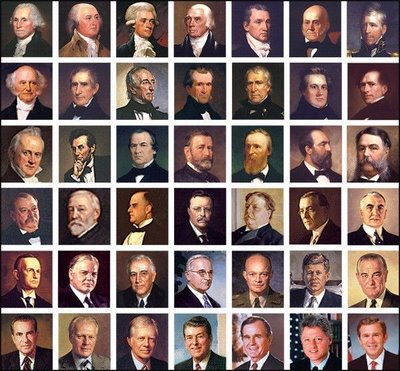
In commemoration of President’s Day, Ethics Alarms presents the ethics wisdom of the remarkable men who have served their country in the most challenging, difficult, and ethically complicated of all jobs, the U.S. Presidency.

Ladies and Gentlemen, the Presidents of the United States:

George Washington: “I hope I shall possess firmness and virtue enough to maintain what I consider the most enviable of all titles, the character of an honest man.” Continue reading

The Wrestler, the Girl, and Cultural Confusion

"Wanna wrestle?"

Sixteen-year-old high school sophomore wrestler Joel Northrup forfeited his match against a fourteen-year-old wrestler with two X chromosomes, Cassy Herkelman, at the Iowa state wrestling championships, saying that “As a matter of conscience and my faith I do not believe that it is appropriate for a boy to engage a girl in this manner.” Obviously Herkelman didn’t require protection from anyone or anything. She was her district’s 112-pound champion wrestler, and she won the Iowa championship for her class as well.  Cassie had won 20 of 33 matches, all against male wrestlers, on her way to the state championship. Maybe Northrup didn’t want to risk being ridiculed for losing to a girl; maybe he was uncomfortable with the sexual overtones of an inter-gender contest. All we can do is assess his conduct by taking him at his word: he believes a young man wrestling a young woman is morally wrong, and was willing to forfeit a match he might have won. Joel was, after all, the fifth-ranked wrestler in the state at 112 pounds, and had a 35-4 record.

Was his decision admirable, or sexist? Was it gentlemanly, or demeaning? Continue reading

Why Students Lose Respect for School Authorities, Case Study 309,456: “The Red Scare”

Inappropriate, Thomas!

It is not directly relevant to Natalie Munroe’s complaints perhaps, but when students today seem less than in awe of those adults who claim to be qualified to guide them to wisdom and success in school, they often have good cause to be wary. Take the example of Stephanie Plato, a sixth grader at Cobb Elementary School in Houston’s Channelview school district.

Stephanie was suspended from school because the red and blonde highlights her mother let her get died into her hair as a 12th birthday present violated the school’s code of conduct.

You read that right.

We are not talking electric orange here, or anything strange and disruptive. Just a few red highlights in her naturally brown hair. But the school dress code bans “inappropriate hair color”…such as red.  Don’t ask me why. It doesn’t matter why. It is stupid. Continue reading

The Problem With Multi-Culturalism

One of many abominations we can blame on Jimmy Carter is the United States’ blessedly half-hearted embrace of multi-culturalism, which Jimmy and his acolytes believed was enlightenment from Europe when in fact it was a disease. This was linked to the ethical value of tolerance, which was in turn used to bludgeon into submission anyone who committed the politically incorrect crime of criticizing conduct that was antithetical to American values engaged in by citizens from other nations.

Civilization needs standards, and culture is the setting of standards, ethical and otherwise. Multi-culturalism is a compact oxymoron that makes society’s standards schizophrenic, impeding efficiency, fairness, and consensus about right and wrong. “Tolerance” requires acceptance of the intolerable, or in its most common permutation here, tolerating the intolerable practices that progressives would like to see established here, while somehow reasoning that other practices that progressives don’t admire shouldn’t qualify for “tolerance.” Continue reading

Are GOP Leaders Obligated to Condemn Doubters of Obama’s Birth and Beliefs?

No.

But NBC’s David Gregory thinks so. Here was his exchange with Republican Speaker John Boehner on “Meet the Press” yesterday: Continue reading

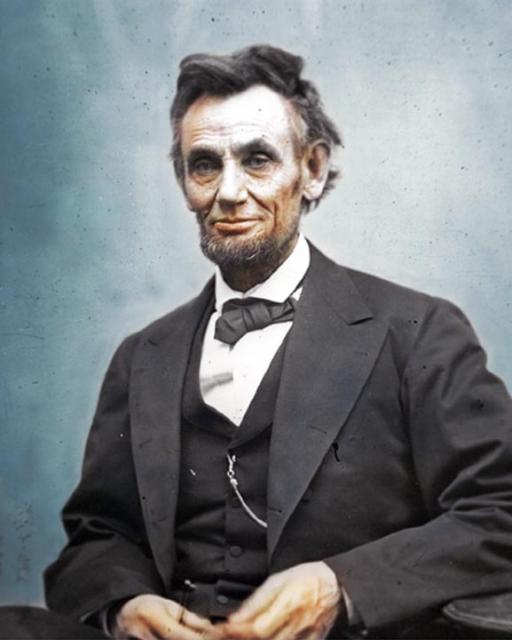
Happy Birthday, Mr. Lincoln: Abe on Lawyer Ethics

John Steele, on his essential blog, the Legal Ethics Forum, had the wit and wisdom to post Abraham Lincoln’s “Notes for a Law Lecture” today in commemoration of Abe’s birthday. I had been looking for an appropriate post for the occasion, and I cannot improve on John’s selection.  Written around 1850, it is as excellent a statement of what lawyers should aspire to in 2011 as it was when Lincoln was practicing, and it also confirms our 16th President’s eloquence, clarity of thought, and instincts for good.

Happy Birthday, Mr. Lincoln.

________________________________________________________________

Abraham Lincoln’s Notes for a Law Lecture Continue reading

Death by Ethics: John Paul Getty III

The tragic life of J. Paul Getty III, grandson of the late oil tycoon who long held the title “The World’s Richest Man,” is testimony to the truth that wealth is no match for a family culture devoid of ethics.

Getty III, known to his friends as Paul, died last week at the age of 54. He had been confined to a wheelchair-bound for 30 years, after a drug overdose caused a stroke that left him paralyzed, mute and mostly blind. His father, J. Paul Getty II, who had little contact with his son after divorcing his mother when Paul was a child, refused to help him with any of his inherited billions, declaring that his son had earned his misfortune with his irresponsible ways. In truth, few sons have been given more reason to doubt their self-worth based on their callous treatment by their father figures. Continue reading

Aesop’s Unethical and Misleading Fable: “The North Wind and the Sun”

Today, by happenstance, I heard an Aesop’s Fable that I had never encountered before recited on the radio. Like all Aesop’s Fables, this one had a moral, and it is also a statement of ethical values. Unlike most of the fables, however, it doesn’t make its case; it is, in fact, an intellectually dishonest, indeed an unethical, fable.

It is called “The North Wind and the Sun,” and in most sources reads like this:

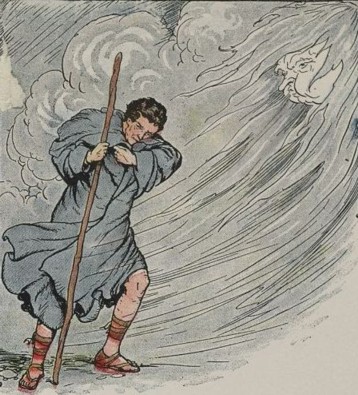
“The North Wind and the Sun disputed as to which was the most powerful, and agreed that he should be declared the victor who could first strip a wayfaring man of his clothes. The North Wind first tried his power and blew with all his might, but the keener his blasts, the closer the Traveler wrapped his cloak around him, until at last, resigning all hope of victory, the Wind called upon the Sun to see what he could do. The Sun suddenly shone out with all his warmth. The Traveler no sooner felt his genial rays than he took off one garment after another, and at last, fairly overcome with heat, undressed and bathed in a stream that lay in his path.”

The moral of the fable is variously stated as “Persuasion is better than Force” , or “Gentleness and kind persuasion win where force and bluster fail.”

The fable proves neither. In reality, it is a vivid example of dishonest argument, using euphemisms and false characterizations to “prove” a proposition that an advocate is biased toward from the outset. Continue reading