President Trump signed a pair of executive orders directing that there be federal investigations and other sanctions against high-profile administration critics from his first term. The first is former homeland security official Miles Taylor. He’s the jerk who wrote the anonymous New York Times op-ed in 2018 boasting about how he and others were working behind the scenes to sabotage the first Trump term. describing an internal resistance to Trump in his first term. The other is Christopher Krebs, the former head of the Cybersecurity and Infrastructure Security Agency (CISA), who worked to oppose Trump’s claims that the 2020 election was “fixed” and “stolen,” and was was subsequently fired.
In the case of Taylor, the President implied in his remarks that he engaged in “treason,” which is a stretch, to put it lightly. Krebs was fired: that should have been punishment enough. In either case, Trump has bigger fish to fry, as the saying goes, and these orders do nothing to advance his agenda.
Another epic and irritatingly rational Comment of the Day from Extradimensional Cephalopod, this one on the thorny topic of discussing unlikely conspiracy theories with true believers. Almost all of E.C.’s contributions to Ethics Alarms topics are helpful and impressive; this is one of his—its?—best.
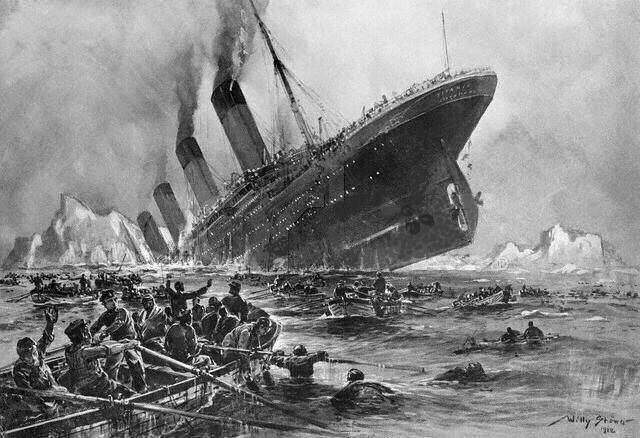
Your friend has arrived at a conclusion that is based on, generously speaking, an implausible interpretation of the evidence surrounding the Titanic’s disaster. If he were looking at the evidence with no biases, he presumably would not have come to this conclusion. Therefore, I suspect that he has either an emotional attachment to the conclusion, or an emotional attachment to the process he used to reach it.
An person’s attachment to a conclusion might be as personal as a belief about what that conclusion says about them or someone they respect, or it might be as impersonal as preferring a more pleasant view of the world, such as one where disasters don’t just happen by accident.
An attachment to the reasoning process may be based on a fear of not having a good alternative reasoning process to turn to, a fear of what conclusions those alternative processes might lead to, or (similarly) an attachment to another conclusion that they arrived at through their current process. For example: “I have to believe this person wearing a cape is a bad person, because if people who aren’t bad can wear capes, that means that maybe I did a bad thing by attacking those other people for wearing capes.”
I’d like to talk with your friend and see how his worldview compares to what I suspect it is. My preliminary hypothesis is that your friend’s subconscious reasoning process is loosely based on the following premises, which I am not rendering judgment on at this time:
A friend and business associate just stunned me by professing belief in a conspiracy theory that I had never encountered before. He doesn’t see it as a theory, either: he is certain that it is historical fact, that it has been covered up by historians and other malign forces, and that eventually it will all be revealed.
This one is, I am quite certain, bonkers, just as bonkers as the Truther claim that Bush and Cheney were really behind the attack on the Twin Towers. My cognitive dissonance scale is in revolt: I have to trust and rely on this individual, whom I respect and admire. Yet embracing something this wacky is a red flag. A big one.
The short version of the conspiracy is that the calamitous sinking of “Titanic” in 1912 was secretly orchestrated by financier J.P. Morgan. His motive was to remove three powerful businessmen—Benjamin Guggenheim, Isidor Straus, and John Jacob Astor—who opposed the formation of the Federal Reserve.
A related conspiracy theory is that as part of an insurance fraud scheme, Morgan had “Titanic” secretly switched with one of its sister ships, “Olympic.” That one is, if possible, even wackier than the murder plot, and like it, the theory is easy to debunk. Both ships had distinct construction identification numbers or yard numbers that were stamped on many of their parts, including their wood paneling. “Olympic’s” yard number was 400 and “Titanic’s” was 401. Many artifacts bearing the number 401 have been raised from the wreck of “Titanic,” and items auctioned off after “Olympic” was retired in 1935 show the number 400. Also, I can’t figure out why switching nearly identical ships would benefit anyone, but we don’t need to go into that.
The National Park Service website has an Underground Railroad page. It used to feature a large photograph of the remarkable female “conductor,” Harriet Tubman (left above). The page began, “The Underground Railroad — the resistance to enslavement through escape and flight, through the end of the Civil War — refers to the efforts of enslaved African Americans to gain their freedom by escaping bondage.” But some boob or combination of boobs thought that the Trump EOs and other measures aimed at purging divisive, partisan and often discriminatory “diversity, equity and inclusion” programs from the government, education and other private institutions mandated eliminating straightforward and historically accurate information. It wasn’t just the National Parks Service, of course. The Defense Department also eliminated many pages that celebrated important minority veterans, such as civil rights champion and icon, Jackie Robinson.
A crucial component of institutional competence is “know the history and culture of the organization you work for.” Obviously the Pittsburgh Pirates, one of the original National League Major League Baseball franchises, contains too many employees who lack this component. Had not this been true, the team would not have taken down a tribute to Pirates icon and Hall of Famer Roberto Clemente, whose uniform number, 21, was retired by the club, to put up a liquor advertisement.
How clueless can you get?
“Hey, Fred, what does this “Clemente 21″ thing stand for?”
“Oh, I don’t know, Stinky, just some old guy nobody remembers! Just cover it up!”
Clemente, who died in a plane crash while trying to deliver humanitarian aid to Nicaragua, played 18 seasons for the Pirates, during which he joined the elite ranks of players with 3000 hits, had a .317 lifetime batting average and won four batting titles, twelve Gold Gloves, two World Series, and a National League MVP award. He may not have been the greatest Pirate—that honor goes to Honus Wagner—but he was and is the most beloved. For the team to replace his number with a liquor ad was spectacularly ignorant.
We’re back in Julie Principle territory again, unfortunately: “Fish gotta swim, bird’s gotta fly, Trump’s gong to keep saying crazy stuff to make progressives cry…” This is a particularly annoying example. Just as the position of Ethics Alarms is that trusted professionals do not have the luxury of pulling April Fool’s Day hoaxes on the public, it is also unethical for Presidents of the United States to deliberately raise phony issues for public consumption.
The President began raising the possibility of a third term almost from the moment he was elected to his second. It is, of course, impossible. The Constitution forbids it quite unambiguously thanks to the 22nd Amendment, the eventual Congressional reaction to Franklin Roosevelt shattering the unwritten rule, set by our first President, that two elected terms is enough. Over the weekend, Trump said he was “not joking” about there being “methods” to circumvent the two-term limit. No, there really aren’t and never mind that: Trump is 78 years old, not exactly in peak physical condition, and would be 86 at the end of a third term. The real question is whether he can complete this one.
Trump was even sparking speculation about a fantasy race between him and Barack Obama in 2028 for an unconstitutional third term, and a depressing number of morons on social media are taking it seriously. Yes, Dana, that’s your cue…
Here’s what’s happening. I was pondering Trump’s nonsense, and concluded that there are three things going on here, only one of which is substantive:
The New York Yankees opened their season by crushing the Milwaukee Brewers with a record number of home runs. Some of the homers were hit by players using a new bat design imagined by a one-time MIT physicist. The bat is shaped at teh end like a bowling pin, or a torpedo. The Yankees hit a franchise-record nine home runs in the first game—-notably the player who hit the most was Aaron Judge with three, and he used an old-fashioned bat. The series sweep served “as a live infomercial.”
The Yankees aren’t the only team with players using the new bats. The Cubs, Minnesota Twins, Toronto Blue Jays and Tampa Bay Rays have some players who are trying them out. “It’s legal,” says one enthusiastic player. “It’s under MLB rules and everything. Just basically moving the sweet spot down. Those balls that you’re getting jammed on are finding some barrels.”
Before I leave the first installment of this post and move on to the film’s ethical significance, I should mention that “It’s a Mad, Mad, Mad, Mad, World” caught a cultural wave perfectly, accounting for its box office success. In this it was just lucky, and that moment in time is now long gone, which is why the film appeals to me from a historical perspective more than as entertainment.
There have been many attempts to mine the same property for laughs, and none of the offspring of IAMMMMW have equaled its model in reputation or box office success. Blake Edward’s “The Great Race,” just two years later, was billed as the most expensive movie comedy ever made, and bombed. (Peter Falk is in both IAMMMMW and “The Great Race.”) In 2001, the “Airplane!” gang made “Rat Race,” which was obviously inspired by Kramer’s opus. It had a less starry cast (of course) and made a profit, but was generally regarded as a second rate (second rat?) version of the original. “Scavanger Hunt was a 1979 rip-off with a more IAMMMMW-like ensemble cast, and was a flop. Lesser attempts to recycle the film’s formula, “Midnight Madness” and “Million Dollar Mystery” (note the “m” alliterations) were even more embarrassing failures.
On to the ethics…Much was made of the fact that director Stanley Kramer had never directed or produced a comedy before. In fact, his career output was ostentatiously serious, and often criticized as preachy and overly preoccupied with moral-ethical conflicts. Among his most famous movies are “Judgement at Nuremberg,” “Guess Who’s Coming to Dinner,” “Inherit the Wind,” “The Defiant Ones,” “On the Beach” and “Ship of Fools.” I’m sure that part of Kramer’s motivation for directing a huge slapstick comedy was to show his versatility, just as Spielberg felt that he needed to direct a movie musical with “West Side Story.” However, viewed in light of the times and Kramer’s artistic sensibilities, IAMMMMW now seems schizophrenic, a silly comedy with serious social commentary…and both parts undermine each other.
There were three distinct stages in my consideration of the sui generis Cinerama feature from 1963, “It’s a Mad, Mad, Mad, Mad, World.” The movie’s gimmick was that it collected more comedians and comic actors in a single Hollywood production than has ever been featured before, which meant, naturally, that it had to be the funniest movie ever….or so we were told.
I first saw IAMMMMW at Boston’s Cinerama Theater when I was 12. It was the first of the new, improved, seamless Cinerama features, which meant it was inferior to the original format, which wrapped around the audience. There were few effects in the movie that took advantage of the giant screen, either. But like all boys under 20 or so, I thought IAMMMMW was very amusing and a lot of fun. Girls didn’t get it, for the most part, and that has never changed. It’s physical comedy and slapstick throughout, and often cruel slapstick. This is a real male-female divide that appears to be timeless.
I was also, even back then, an omnivore of popular culture. Seeing so many familiar comedy icons of the era (and the previous one) in one movie was a thrill; of course, that was one of the main goals of the film. Sid Caeser, Milton Berle, Jimmy Durante, Jonathan Winters, Phil Silvers, Buddy Hackett, Mickey Rooney and more, with well-conceived cameos by the likes of Jack Benny, Jerry Lewis and Don Knotts—in the waning period of Hollywood all-star cast spectaculars, the idea of doing one with comedians was irresistible.
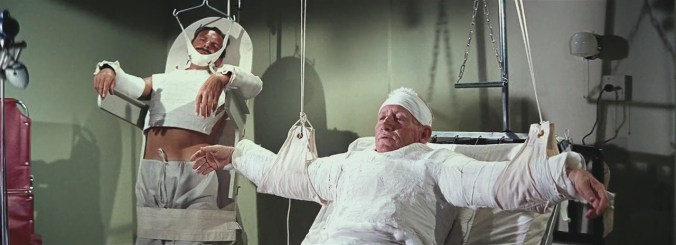
I saw the movie a second time in my thirties, and was shocked how different my reaction to it was. To be fair, I recalled many of the sequences that would have been funnier as a surprise, but the film seemed over-long, abrasive and, most surprisingly, sad. The subplot in which Spencer Tracy plays an aging police captain who becomes disillusioned with his professional and family life to the extent that he tries to steal the money that has set off an insane race among the assorted loonies is more tragedy than comedy, and, oddly, Tracy didn’t play any of his role for laughs. Grace, my wife, hated the movie in 1963 and hated it just as much when I made her watch it again with me.
Baseball season starts next week, bringing me memories of my happy childhood in Arlington, Mass. and how I would pass the golden summers there metaphorically glued to my transistor radio for all 162 Red Sox games except for the very few that I attended or saw on TV. My team’s games were broadcast on WHDH 850 AM in those days, with Curt Gowdy doing the play-by-play. Right before each game was a favorite feature on that station: “Warm-up Time,” a 5 minute story from baseball’s rich and often strange history. “It’s Warm-up Time!” each segment began, “Your baseball story before every Red Sox game! Don Gillis reporting for Atlantic Refineries!” Don had a great voice and a rich delivery, and taught me a lot over the years.
Don introduced me to the strange and tragic saga of the 1919 Black Sox, the fixed World Series, the bizarre aftermath, and how baseball Commissioner Kenesaw Mountain Landis banned for life all eight of the players alleged to have participated in the plot to make the American League champion White Sox to throw the Series to the vastly inferior Cincinnati Reds.
Among the banned: superstar “Shoeless” Joe Jackson, whose supporters argue that he should be allowed into the Hall of Fame to this day. Joe was glamorized in the movie and novel “Field of Dreams.” His defense was that he accepted money from gamblers to throw the Series but still played his best—hardly an ennobling theory, but plausible, since by all accounts “Shoeless” was an illiterate dolt. His familiar story was featured on “Warm-Up Time,” but I was always interested in another one of the banned eight, third baseman George “Buck” Weaver, sympathetically played by John Cusack in the movie “Eight Men Out.”