The asinine “Stand Up For Science” mug I wrote about earlier today still rankles, and I just realized that a video that surfaced this month is relevant to it. I had seen a recently released TEDTalk given in 2013 by S. Matthew Liao. He is the Director of the Center for Bioethics and Affiliated Professor in the Department of Philosophy at New York University, and has previously been on the faculty of Oxford, Johns Hopkins, Georgetown, and Princeton. He’s also the Editor-in-Chief of the Journal of Moral Philosophy. Several conservative commentators had freaked out over the video; naturally, the mainstream media buried it. They did that because it represents the outer limits of a climate change panic whackadoodle, and this guy is unquestionably not just a SCIENTIST of the sort that the mug-makers want us to fall down and worship as the all-knowing, all-seeing societal architects they are, but also an ethicist as well. I considered it as a post topic but decided against using it, because, well, it seemed too silly to have to point out how irresponsible Liao is.
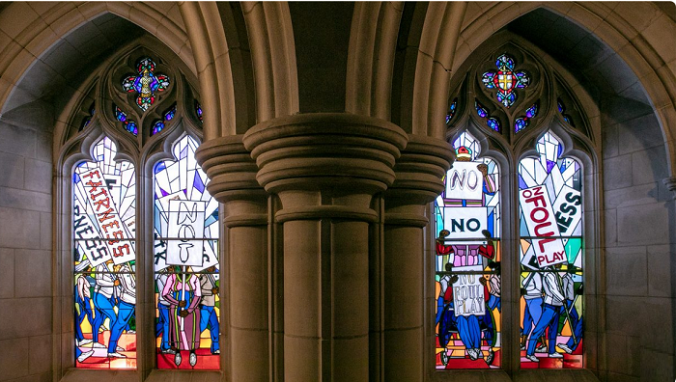
I look at these windows and I am disappointed. Our culture has moved away from what should be presented everywhere: the true, good, and beautiful. Let us put these windows to the test.
Are these windows depicting what is true? Yes, things like this have happened. No one can argue on this. Are they depicting what is good? This is harder. The windows have the intent of being understood in several ways, some of them, NOT good. Finally beautiful. Beauty is in the eye of the beholder, that is true, but no one seriously thinks that the rose windows in Notre Dame are ugly. I certainly do no see much beauty in these windows. The signs are jarring and take up most of the space on the windows. The emphasis, therefore, is on signs and messages, not on beautiful pictures.
In addition, I look at this from the Catholic standpoint of stained glass typically showing multiple scenes of import or people to be admired. From that standpoint, I can come up with many better pictures for an attempt at a mostly apolitical set of windows. If one wants to tell the history of slavery even, I have some great ideas. I think our history has more important matters than that, but I’ll give the slavery a shot first. Of course, all of these will have to be simplified for the material of stained glass, but we have had Jesus feeding the multitudes on stained glass for centuries, not to mention all the other Bible stories. A true student of stained glass can simplify anything and do so meaningfully.
The stained glass windows in the National Cathedral show different scenes from American history. Someone made the dunderheaded decision when the cathedral was being designed to have windows honoring Robert E. Lee and Stonewall Jackson, which seemed, in a setting with limited opportunities to highlight American heroes, an odd choice even back when the structure was opened to the public.
After a gunman shot and killed nine Black worshipers at a church in South Carolina in 2015 and the movement began to ban all things Confederate, the cathedral management decided that Stonewall and Lee had to go. Six years after the glass’s removal in 2017, National Cathedral has unveiled their replacement, which you can see above. The new windows , titled Now and Forever, show black protesters holding protest signs bearing the words “No,” “Not,” “Fairness” and “No foul play.”
Your Ethics Alarms Ethics Quiz of the Day is…
Is this a responsible, appropriate, ethical decoration for the National Cathedral in Washington, D.C.?
Something made me watch Ken Burns’ documentary “The Roosevelts” again last week. I was not looking for current perspective or political enlightenment, and the stories told are all very familiar to me, being an admirer of Teddy from childhood and fascinated by the complexities and contradictions that were Franklin. But history always surprises, and it often resonated differently depending on when it is examined. I realized, for the first time, that the Roosevelts have much to teach us about the conflict roiling the nation now….and the worse roiling that seems to be on its way.
It is ironic that serial Ethics Villain and NEA president Randi Weingarten writes that her tweet “speaks for itself” when it is indeed a wonderful example of res ipsa loquitur, but not in the way Weingarten would have us believe.
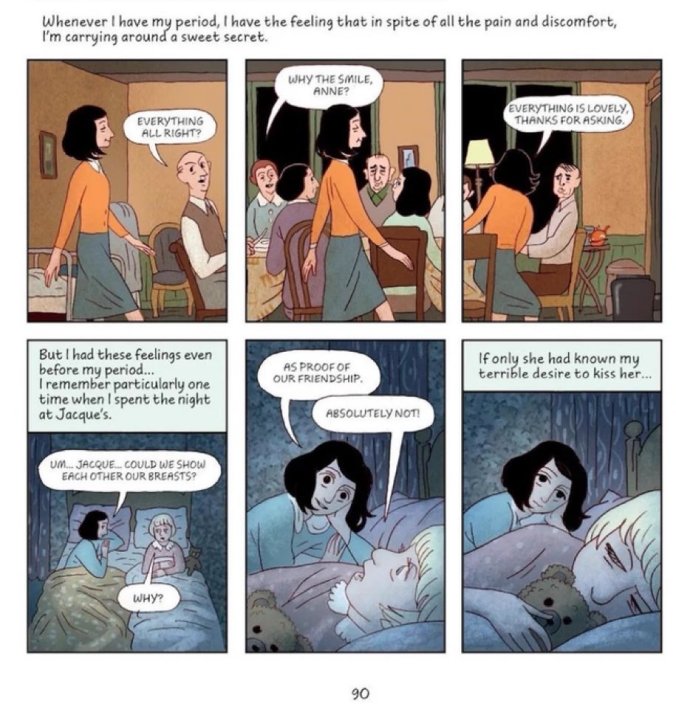
The teacher was not fired for reading the “Diary of Anne Frank” to her class, but for using “Anne Frank’s Diary: The Graphic Adaptation” without proper authorization from the school and using it to launch a class discussion of sexual molestation. The graphic version, in the style of a comic book…
…is true to Frank’s original diary but contains the sexual and other content that was taken out of the original version published by Frank’s father. The graphic novel-syle version has been critically praised, but the previously redacted material it includes are of a nature that require sensitive instruction and certainly prior approval by parents.
Weingarten misidentified the book involved due to carelessness, devotion to her political agenda, or deliberate deception, none of which are qualities any responsible parent wants in their child’s teachers. Yet Weingarten is the teacher the teachers’ union chose to represent and lead it.
People who don’t adequately research what they write about as pundits, experts or authorities spread their own biases, ignorance and misconceptions like a virus-infected audience member coughing in a crowded theater. Two annoying examples of the phenomenon have surfaced in the last week, but the phenomenon is widespread and frequent.
“Sadly, time machines don’t exist, or I’d transport you back a few decades to a wonderful tradition this country has abandoned: the World’s Fair,” Tatano writes. “This piece of Americana sadly made its last appearance in New Orleans in 1984. The event moved every few years from one major city to another, and there was always something new to experience….I was fortunate enough to grow up a 30-minute drive from the 1964-65 World’s Fair in New York. It ran from April to October both years, and we made plenty of visits. Combining entertaining rides with a time travel element, it blew away anything you could experience in Orlando…The fair was so big there was an actual cable car called the “Swiss Sky Ride” which took you airborne from one end of the fair to another…It’s been almost 40 years since the last World’s Fair. I find it sad that an entire generation never got to experience one and wonder if we’ll ever see such an amazing event again.”
Tatiano bashes Disney several times in his article, but I found myself wondering, “Has this guy been to Walt Disney World?” and “Did no one tell him that the 1964 World’s Fair was substantially a preview of Walt’s last great project?” About half the New York World’s Fair major attractions Tatiano nostalgically marvels at were designed by Disney engineers and transferred to the new theme park as soon as the New York World’s Fair closed. He doesn’t mention others Disney contributions, like the G.E. “Carousel of Progress” and the audio-animatronic Abe Lincoln, who starred at the Illinois state pavilion. The experience at Flushing Meadows in Queens in 1964-65 didn’t “blow away anything you could experience in Orlando,” it was exactly what Disney World visitors a couple of years later experienced in Orlando: I was at the ’64 World’s Fair, and the similarities were the first thing that struck me when I finally got to Disney’s mega-park ten years later.
Jason Patterson, an African American artist who is obsessed with flags and who apparently can sniff out racism that normal people don’t notice, managed to convince the Washington Post to validate his hysterical assessment that the seven state flags pictured above (on a field of “The Stars and Bars” flags) are all secretly sending anti-black, racist, pro-slavery and pro-Confederate messages. He thinks they all should be removed, even though (I’m estimating here) not one American in 10,000 would detect any such messages at all. This is the weird state of mind that has led to statue-toppling across the country, movements to end the honoring of essential Founders like Washington, Jefferson and Madison, and, at its silliest, the elimination of “Turkey in the Straw” as the tinkly tune played by ice cream trucks. It’s fair to describe Patterson as obsessed and unhealthily so, making the Post’s effort to spread his paranoia unethical and irresponsible.
Yes, it’s Bluto’s (John Belushi) now iconic gaffe in “Animal House” come true: “Was it over when the Germans bombed Pearl Harbor?” Those are German planes on the cover of Michael J. Clark’s history book for young readers about the sneak attack that brought the U.S. into World War II.
Just think about all of the careless, irresponsible boobs, including the author and the cover artist, who had to breach the ethical values of competence, diligence and respect for that book to be published and put on the market. How many must it have been? Then you can add to that List of Shame our pathetic, ruinous education system, which has produced such a nation of dolts that not even a humble secretary or passing clerk had the knowledge to point out, when they saw the book as it made its way through production, “Uh, aren’t those German planes?” Anyone who did, thus preventing this epic embarrassment, might have received a promotion or a bonus. Or at least someone would have bought him or her a nice lunch.
And this is one more example where cultural literacy rot matters. If you can’t learn your American history, at least know your classic films.
Paul Landis, one of the Secret Service agents near John F. Kennedy when he was assassinated in Dallas in 1963, has suddenly decided to reveal relevant actions and observations from that terrible day 60 years ago. His new perspectives, as the New York Times puts it, may “rewrite the narrative of one of modern American history’s most earth-shattering days in an important way,” and “encourage those who have long suspected that there was more than one gunman in Dallas on Nov. 22, 1963, adding new grist to one of the nation’s enduring mysteries.” The appropriate responses to Landis’s sudden urge to tell all are 1) “What took you so long?” and 2) “Oh, shut up.”






 Ethics Alarms