Emoji Ethics…Oh, All Right, I Won’t Be Coy: The Unethical Firing Of Chad Franks

Screen-Shot-2015-04-28-at-10.50.42-PM

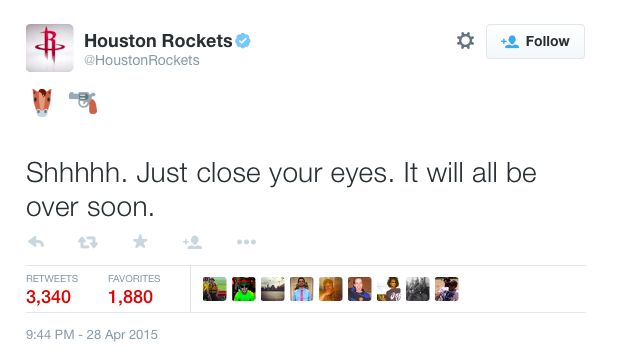
Would you fire someone based on that tweet? Is it so horrible to you, so seering to your senses, that it warrants harming a human being’s career and welfare? Can you even detect what it was that got its author fired? Could the person doing the firing believe that he or she would deserve firing for such a tweet, as in, say, The Golden Rule?

Has the world gone mad?

First the basics: What the hell is an emoji? From Wikipedia:

“Emoji (絵文字(えもじ)are the ideograms or smileys used in Japanese electronic messages and Web pages, the use of which is spreading outside Japan. Originally meaning pictograph, the word emoji literally means “picture” (e) + “character” (moji). The characters are used much like ASCII emoticons or kaomoji, but a wider range is provided, and the icons are standardized and built into the handsets. Some emoji are very specific to Japanese culture, such as a bowing businessman, a face wearing a face mask, a white flower used to denote “brilliant homework,” or a group of emoji representing popular foods: ramen noodles, dango, onigiri, Japanese curry, and sushi. The three main Japanese mobile operators, NTT DoCoMo, au, and SoftBank Mobile (formerly Vodafone), have each defined their own variants of emoji. Although originally only available in Japan, some emoji character sets have been incorporated into Unicode, allowing them to be used elsewhere as well. As a result, emoji have become increasingly popular after their international inclusion in Apple’s iOS in 2011 as the Apple Color Emoji typeface,which was followed by similar adoption by Android and other mobile operating systems. Apple’s OS X operating system supports emoji as of version 10.7 (Lion).Microsoft added monochrome Unicode emoji coverage to the Segoe UI Symbol system font in Windows 8 and added color emoji in Windows 8.1 via the Segoe UI Emoji font.”

In short, they are tiny pictures increasingly used by Twitter freaks to jazz up their tweets. If you don’t look for them, you may miss them. They are, essentially, cartoons.

Chad Shanks, who ran the NBA Houston Rockets’  Twitter account as the team’s digital communications manager, posted the above tweet to celebrate the impending end of the first-round NBA play-off series with the Dallas Mavericks. The emoji of a pistol pointed at a an emoji of a horse’s head—the Mavericks’ mascot is some kind of a horse-human hybrid monster—in the upper left-hand corner was deemed by management so vile that Shanks’ head had to metaphorically roll. The shocking, PTSD triggering tweet with its reference to cartoon violence was deleted and sent to cyber Hell, and Shanks grovelled an apology, writing, via Twitter, of course, that he was no longer with the organization:

“I did my best to make the account the best in the NBA by pushing the envelope, but pushed too far for some and for that I apologize….Sometimes you can go too far. I will no longer run @HoustonRockets  but am grateful to the organization that let me develop an online voice.” Continue reading

The Kinky Law Professor Principle: “It’s No Shame To Be Kinky, But It Still Might Be Newsworthy”

We haven’t had a “Naked Teacher Principle” story to mull over for a while, and this isn’t one. It raises some parallel issues, though.

I saw the story about the Drexel Law professor who who accidentally sent her students a link to a pornographic video about anal beads. I didn’t find it worthy of a post, though I thought it was funny. It is funny. But we had covered a similar issue here, in the ethics quiz about the hapless teaching assistant at the University of Iowa who somehow managed to send her class not merely sexually provocative photos of herself, not merely nude photos of herself, but something much more kinky. Attached to a message that read “Hi Class, I attach the solutions for number 76 and 78 in this email” were a series of images showing the young woman sans clothes and sans inhibitions having a lively cyber-sexting chat with a partner in which the two were pleasuring themselves in front of video equipment while streaming to each other.

That was funnier. She was “reassigned”—a not unreasonable result of presumed reduced respect from the class.  The Naked Teacher Principle doesn’t strictly apply when the students are adults, and Lisa McElroy, the professor at Drexel University’s Thomas R. Kline School of Law who is apparently an anal bead fan–the video she sent by accident was called called “She Loves Her Anal Beads”—wasn’t naked. There is no “Kinky Law Professor Principle.”

However, Prof. McElroy was mightily offended that her cyber-goof was picked up by the professional publications and websites, and that she was embarrassed as a result. She even posted a Streisand Principle-defying op-ed in the Washington Post, blaming everybody—students, bloggers, and Drexel, which briefly suspended the professor pending an investigation on the basis of possible sexual harassment—but herself. She argued that she should not have been publicly shamed, because, she wrote,

“…there was nothing newsworthy about it. What happened was, in the grand scheme, pretty trivial. My students are adults. The link was quickly removed. There was nothing illegal in the video. The post occurred in the same two-month period when the movie “Fifty Shades of Grey” grossed almost $570 million worldwide. Yet, because it was porn and I’m a law professor, news organizations spread the story around the world.”

Yup. Because it was funny. I understand that the Professor doesn’t see the humor of a law professor—especially her—inadvertently sending her private porn film about anal beads, which themselves are kind of amusing, to a staid law school class. It’s still funny. Trivial? Of course. But trivial can still be funny. Would it be kind for all of us to scrupulously refuse to communicate the hilarious tales of when we do dumb things or embarrass ourselves? Yes. But society as a whole benefits from being reminded that we are all equally fallible human beings—especially the elite and privileged. A lot of people think laughing at slapstick is cruel too.

I pity them. Continue reading

Acting Ethics: Why We Don’t Want Actors Being Too Picky About Their Roles

FergusonX

In the strange ethics category of “Conduct That Isn’t Exactly Wrong But That Will Have Nothing But Bad Consequences To Society If There Is A  Lot Of It” (CTIEWBTWHNBBCTSITIALOI for short) is actors rejecting roles because they have philosophical or political disagreements with the script.

We’ve had two high profile examples of this occur lately. All we can do is hope that it’s a coincidence. The first was when about a dozen Native American actors, including an adviser on Native American culture, left the set of Adam Sandler’s first original movie with Netflix, “The Ridiculous Six,”a western send-up of “The Magnificent Seven,” claiming some of the film’s content was offensive.

Really? An Adam Sandler movie offensive?

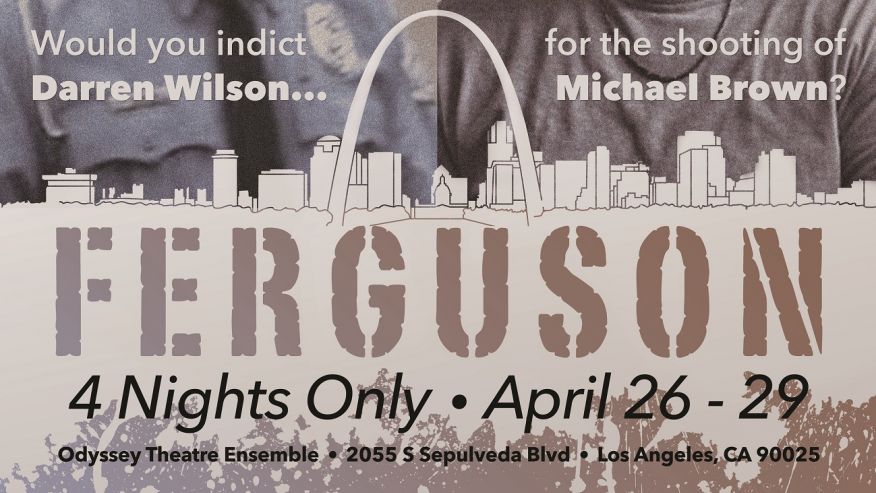
The second and more troubling was in LA,  where five actors quit the cast of the new play “Ferguson,” which consists entirely of dramatizations of the Michael Brown murder grand jury testimony, because the actors apparently felt that it did not appropriately support the “Hands Up! Don’t Shoot!” narrative.

That’s really stupid, but I’m not getting into that again.

We don’t see many examples of professional actors doing this for several reasons. One is that they can’t afford to. Acting, except for the top fraction of a per cent, is anything but lucrative; it’s a subsistence level job, redeemable because it is, or can be, art, and tolerable as long as the actor doesn’t have a family to support, or has a trust fund.

The main reason this is unusual, however, is that an actor isn’t responsible for the content of the play, movie or TV show he or she acts in, but only the skill with he or she helps present that content to an audience. Actors—and technical artists like costume and light designers—are the conduits through which a writer’s work of performance art gets to live. They don’t have to like a show, agree with it or understand it, which is a good thing, since many excellent actors don’t have the  education, experience or intellect to understand complex and profound works. As one realistic actor friend once told me, “If we were that smart, we’d be smart enough to be in another profession.” Continue reading

When Do Private Text Messages Between Two Individuals Justify Punishment?

text

I’d like to say “never,” except that when especially offensive private text messages become public, they aren’t private any more. As with e-mails, any time you send a text message that you know will embarrass you if it falls into malign hands or is seen by righteous eyes, you have authored the means of your potential destruction.

That’s not right, but that’s the way of the world.

Thus a Washburn University Phi Delta Theta fraternity member posted a photo of a man with a topless woman in bed as part of a fraternity text exchange following a chain of crude text messages between frat members. These were obtained by The Topeka Capital-Journal on a slow news day—Wow! Stop the presses! College guys are crude!-–and before you could say “thought control,” the national Phi Delta Theta organization suspended the Topeka campus chapter.

“We are very concerned by the messages reviewed thus far. Phi Delta Theta is a values-based organization and any behavior or statement contrary to those values is subject to significant action,” Phi Delta Theta spokesman Sean Wagner said in a statement. Naturally, the chapter president then grovelled an apology. Continue reading

Unethical Quote Of The Week: Cartoonist Garry Trudeau

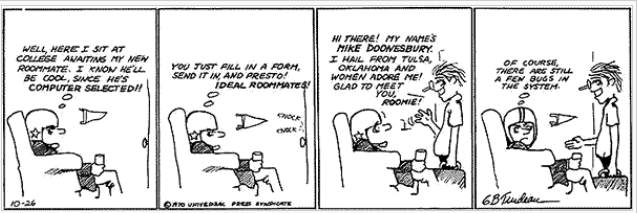
The exquisitely rendered artwork of Gary Trudeau, circa 1970.

The exquisitely rendered artwork of Gary Trudeau, circa 1970.

“At some point free expression absolutism becomes childish and unserious. It becomes its own kind of fanaticism.”

—-Doonesbury cartoonist and relentless critic of the Right, Garry Trudeau, in a speech delivered on April 10 at the Long Island University’s George Polk Awards ceremony, where he received the George Polk Career Award.

Trudeau is a Yale grad, so perhaps we should cut him some slack muddled thinking. (Kidding!) However, in making his weak case that legitimate and socially acceptable satire only consists of “punching up,” he appeared to be advocating government prohibition of certain kinds of speech, to be designated by Trudeau and his ideological allies, who, of course, know best.

In doing this, Trudeau came very close to aping the popular theme from activists on the Left, especially on campuses, that “hate speech isn’t protected by the First Amendment.” “Hate speech” is an invention of progressives, and is generally defined as political or social criticism of members in good standing of their club, or groups and individuals they sympathize with or approve of.  Saying that you hope Rush Limbaugh’s kidneys fail is funny and deserved;  saying Mike Brown engineered his own demise by attacking a cop is hate speech. It’s easy when you get the hang of it: just look at the world like Gary Trudeau.

Earlier in his speech, he talked about “red lines” in satire, and blurrily–that is, inarticulately enough that he has plausible deniability, called for restrictions on “hateful” cartoons like those that prompted Islamic assassinations in Paris: Continue reading

Ethics Dunce: Major League Baseball

RalphieI just learned, via TV ad, that the fantasy sports company DraftKings is endorsed by Major League Baseball.

MLB needs to rethink that. The commercial I watched just concluded with the promise that if you play fantasy baseball using DraftKings, “You could win a ship-load of money!”

Stay classy, MLB. Why in the world would any sport that is trying (not so successfully, I may add) to attract more kids as fans and encourage families to go to the ballpark ally itself with a company that advertises itself during major league baseball games with dumb, gratuitous potty-mouth crudeness like that? It’s not clever. It’s not witty. Anyone who thinks that it’s funny is 12, Adam Sandler, or a moron. It’s rude, that’s all.

Professional and trustworthy operations, including sports, choose partners that are professional too. This advertising equivalent of fart jokes reflects horribly on the sport, and the people who run it.

And, I may add, the advertising industry. The wit who thinks “a ship-load of money” is a real come-on is probably the same slob who gave us Verizon’s “half-fast” internet ads.  At least that one was original: this Noel Coward-worthy play on words is the same low-life effort that K-Mart embarrassed itself with in its“ship my pants” ads in 2013.

We all have to swim in this water we call a culture, and this is the equivalent of pissing in the pool. We should be able to expect better from baseball.


First Lady Ethics: Sorry, Michelle Obama Fans, But This Is Way Over The Line

I was silent the first time this happened, because I was trying to provide the benefit of the doubt with an assumption that the First Lady would realize why it was inappropriate. I was wrong.

I can predict the “Get off my lawn!” retorts, the “Things have changed!” excuses and the “Lighten up!” deflections already, but this has to be said. The leadership of the free world and the office of the Presidency of the United States demands the assumption and maintenance of a basic measure of dignity, decorum, prudence and restraint. I realize the erosion of these qualities, not just in the White House but in society generally, is ongoing and that this will trigger the usual rationalizations.

Nevertheless, the First Lady represents her husband and his office. She is not a clown, an entertainer, a red carpet celebrity or a comedian’s sidekick, and every time she acts like any of these, no matter how pleasantly or charmingly she does so, it diminishes the prestige of the office and the nation. I don’t want to hear about how a majority of a public that wears tank tops on airplanes and flip-flops to the theater think it’s just wonderful for the First Lady to cavort with Jimmy Fallon in a manner indistinguishable from what we would expect from the latest flavor-of-the-month pop-tart.  Part of her job is modelling conduct for the clueless and unmannerly, and not sinking to their warped conduct of dignified professional conduct.

I am well-aware that this ethics verdict will be mocked. Never mind. I’m right.

Back to rationalizations: I’m expecting at least 17 of them from the Ethics Alarms list. None justify Michelle’s televised antics: Continue reading

Well-Earned But Wrong: The Parody Website And The Attack On Memories Pizza

Memoriespizza

It is difficult to work up much sympathy for Memories Pizza, the Indiana pizza place that rushed to be known as the first business to announce that it plans on refusing to serve gay customers under the cover of Indiana’s new and poorly thought-out religious freedom law.  Oh, I agree that it was thoughtful of the owners to help show that the law, regardless of the neutral words used, was intended to be a rallying point for anti-gay advocates who want to fight back against what they see as a frightening cultural shift that they don’t understand and can’t accept, but the owners are still, to be blunt, morons.

Announcing that the law would allow them to refuse to cater a gay wedding, they injected their biases into a debate they were neither legally, ethically, morally or intellectually equipped to participate in. Crystal O’Connor, whose family owns the small-town pizzeria, spouted off  that “If a gay couple came in and wanted us to provide pizzas for their wedding, we would have to say no,”  as the national debate over the law was heating up. Well, no, Crystal, you wouldn’t have to, and the law probably wouldn’t protect you if you did. Baking pizza is not the exercise of religion, and nothing in the Bible says “Thou shalt not send pizza to the reception of a wedding you disapprove of.

I just heard one of the law’s supporters from a “family values” group that spends much of its time, words and money attacking homosexuality swear to Chris Cuomo on CNN that the law has nothing whatsoever to do with Indiana embracing anti-gay bigots (and tricking them into thinking that stunts like Crystal’s are acceptable). “It’s about conscience, ” he intoned, without giggling. But the law says nothing about conscience either.It prevents the government from  substantially burdening the exercise of religion. Catering an event, religious or not, is not a religious act, nor is a wedding reception a religious ceremony. It is no more legitimate to say that your conscience forbids you from selling pizza to strangers than it is to say that your conscience forbids you from letting a transsexual into your cab. O’Connor, not surprisingly, doesn’t comprehend the law. Continue reading

Ethical! Funny! But Stupid: Kentucky’s Risible Same-Sex Marriage Ban Defense.

laughing Scotus

Supreme Court justices deserve to have a good laugh now and then.

Michigan, Ohio, Kentucky, and Tennessee are all defending their legislative bans on gay marriage in briefs before the U. S. Supreme Court. Only one of their legal teams came up with—-or had the guts to include—the novel argument contained in the Bluegrass State’s brief, which explains why a ban on gay marriage does not “discriminate on the basis of sexual orientation”:

Kentucky’s marriage laws treat homosexuals and heterosexuals the same and are facially neutral. Men and women, whether heterosexual or homosexual, are free to marry persons of the opposite sex under Kentucky law, and men and women, whether heterosexual or homosexual, cannot marry persons of the same sex under Kentucky law.

This is in the amusing category of arguments that make technical sense in legal terms—well yes, come to think of it, if you look at it that way, you’ve defined discrimination right out of the case!— but no sense whatever in the real world. Gays can’t marry their intended life partner but heterosexuals can; that’s obviously unequal treatment and constitutes discrimination. The defense deceitfully pretends that the whole reason for the emotional controversy doesn’t exist: “Love? What’s that? We know nothing of this thing you call love!”

These come up all the time when legal teams are brainstorming which theories to pursue in an appellate brief, and are virtually always discarded after some general amusement and admiration for the Clintonian who devised it. There is nothing unethical about including a dubious argument along with better ones in a brief, even a Supreme Court brief: consider the position that carried the day in the Obamacare case, when Chief Justice Roberts adopted a rationale for the individual mandate that the Obama Administration had repeatedly rejected and denied. The problem is that such an off-the-wall argument is risky:

1. It pulls time, attention and consideration from more promising arguments.

2. It makes the client look foolish or unserious to the public.

3.  Worse, it might make the client look foolish to the justices.

4. Some justice might react to it as an insult to his or her intelligence.

More than all of that, however,the argument is not going to work. Can you imagine what the reaction would be if the Supreme Court endorsed gay marriage bans relying on that logic? The argument is a non-starter, so including it in the brief sends a loud and clear message that no appellate lawyer ever wants a judge to hear:

“We got nothin’.”


Lena Dunham, Double Standards and the Jester’s Privilege

Jewish DogLena Dunham—you know, the celebrity hyper-feminist, sister-molesting, slandering lying creator/writer/actress of HBO’s “Girls”?—-is again at the center of controversy. This is how people like Dunham, who is wan of talent or appeal so she has to manufacture ways to keep herself in the public eye, stretch out their lucky 15 minutes of fame to interminable lengths. They do it by regularly pissing people off, and requiring those who feel they have to defend her because she is on “the team” (Female, feminist, Democrat, “Pro-choice,” pro-gay, pro-gay marriage, progressive) to compromise whatever genuine values they have by insisting that her crummy behavior isn’t crummy after all.

Yes, she is an ethics corrupter.

Dunham’s latest foray into calculated offense is an alleged  humor piece inexplicably published by The New Yorker. Well, let me back that up: if you or I wrote it, publishing it would be inexplicable, because it’s just not very clever or funny. The New Yorker published it because Dunham is link bait.

The article is called Dog or Jewish Boyfriend? A Quiz, and it begins,

“Do the following statements refer to (a) my dog or (b) my Jewish boyfriend?”

It is drawing fire from many sources because it invokes negative Jewish stereotypes for the “following statements” such as these: Continue reading