Some Hillary E-Mail Ethics Test Results: Dowd, Carville, Maher, Whitehouse, Boxer, Huffington

F minusLast week I pointed out that the controversy over Hillary’s secret e-mail server and the various deceits and lies she has employed to justify is invaluable, not merely as further evidence of the character of the woman Democrats seem determine to stuff down America’s throat as the next President, but also as an integrity and values test for the politicians, elected officials, pundits and journalists who choose to publicly defend her…or not.

So it has been, and continues to be. Unfortunately, Republicans and reliably conservative pundits are disqualified from the test, as they would be condemning Hillary whether there was an ethical defense of her e-mails or not. They will end up on the right side of this issue by simply following their ideological proclivities, and thus deserve no credit for being incidentally correct.

Here is what you have to remember, however: the fact the Republicans and conservatives who reached their position on this issue without giving it any thought detest and distrust Hillary Clinton and are being, in some cases, unattractively gleeful about the scandal does not make Hillary’s defense any stronger. As I explained in the earlier posts, she has no legitimate defense, just spin, rationalizations and deceit. That’s why the e-mail incident challenges the non-Hillary haters to exhibit integrity.

I was tempted to exempt Democratic strategists and Clinton consultants from the test as well, since they are, in essence, paid liars. For anyone inclined to believe them, however, the fact that these people—Karen Finney, Donna Brazile, Lanny Davis, David Brock, James Carville— will go on national TV, look an interviewer and the American public in the eye and say what they know is false should prove that their level of trustworthiness is below sea level.

Carville, for example, gave a tour de force of rationalizations on ABC’s “This Week” yesterday, making the recently popular argument that the Clinton’s just can’t get away with fudges and sneaks that other politicians do, and that this is so, so unfair.  Let’s go to the Rationalizations List! This is the Golden Rationalization (“Everybody does it”) squared by the #39. The Pioneer’s Lament, or “Why should I be the first?” (That argument is disingenuous, because the Clintons are not like everyone else. They have a long, ugly record of deception and rule-breaking. At this point, they cannot credibly claim, “We just made a mistake” —# 19 and #20. There is a pattern. Once a pattern is established, you have to be especially careful not to repeat it, or there is a rebuttable presumption that you can’t help yourself. Is it unfair to an alcoholic to make a bigger deal out of him coming home drunk than when an occasional drinker does the same thing?) Continue reading →

Ethics Alarms On The Air!

onair

I have been on the radio a lot recently. The opinions expressed there will not surprise anyone who is a regular reader of Ethics Alarms, but for those curious about whether I speak with a British accent or a bi-lateral lisp, or those who are aurally inclined, below are links to three radio shows that had me as a guest of late, and one that interviewed me as background, and included some of my comments.

Here you go:

1. This is WGAN’s examination of the Hillary Clinton e-mails scandal, delivered by me while in shock after listening to Karen Finney spin herself sick on CNN, ably hosted as always by Arthur King…

2. Here is national host for the Local Job Network, Tim Muma, a terrific interviewer, on a podcast chatting with me about the “Ick!” and “Awww!” Factors and their relationship to ethics.

3. Tim again, this time cross-examining me about the Brian Williams mess and related issues.

4. Finally, NPR reporter Hawes Spencer’s report on the Sweet Briar closing.

Fair vs Fair: Ethics and the “No-Tip” Restaurant

You know, this looks like a place that would believe that dishwashers deserve as much pay as waiters...or as bankers, for that matter.

You know, this looks like a place that would believe that dishwashers deserve as much pay as waiters…or as bankers, for that matter.

William Street Common is a new restaurant in Philadelphia, and is getting publicity for, we are told, experimenting with a different and (maybe?) fairer compensation model. Owner Avram Hornik  pays all of its employees, from the servers to the dishwashers, at least $15 an hour plus paid sick leave and health insurance benefits. There is a 20 percent service charge for drinks, and that goes into a common fund that makes that  $15 an hour wage affordable. Money left over at the end of a pay period is divided up among employees based on a point system related to various factors.

Hornik came up with this structure, he says, to deal with the well-debated problems of tipping. “Some people just tip the same amount, but some people base it on how quickly the food was there, whether we were out of something, whether the server was there when they wanted them to be,” he says. “So much of that is out of the control of the individual server… So why would it be fair for the service employee to be responsible for the poor decisions of management?”

Hornik argues that his model “essentially creates a guaranteed floor. But we’re also capping the ceiling,” he points out, because the tipping gets shared equally with all employees. “We didn’t think it was fair [that] in some places you have dishwashers earning 10 dollars an hour and the bartender earning 30 dollars an hour.” He also is convinced that the customers will benefit.  “That atmosphere among the employees, a sense of community and empowerment and happiness with the job, is going to translate into a better environment for customers,” he said. “By having happy staff customers are going to be happier too.”

Is this system really fairer than the current one? Progressives are cheering it, because it represents a “living wage,” or at least something close to it. OK, but it would be nice not to feel hyped: ThinkProgress, for example, had headlines that the William Street Common “got rid of tipping” and writes “tips aren’t mandatory.”

Inept reporting or lies, take your pick. A 20% “service charge” is a mandatory tip, so tips ARE mandatory. The reports don’t explain how voluntary tipping has been eliminated, or whether a server would be prohibited from keeping a ten-dollar bill that a diner hands him, saying, “You know, the food was lousy, but you were so gracious and accommodating that you single-handedly made the evening bearable. Thank you. If I ever come back, it will be because of you.” If so, is that fair?  I don’t think so. In fact, it’s exactly as unfair as a diner not rewarding excellent service, and tipping a dime. Continue reading →

Hillary’s Secret E-Mails: An Invaluable Ethics Litmus Test

finney_newday

All civic minded citizens should encourage as many individuals—public, private, elected, celebrities, media figures, reporters and pundits—to discuss the issues and significance of the Clinton e-mail scandal. It is a marvelous litmus test to unerringly reveal whether the individual understands basic ethical principles like integrity, honesty, responsibility and trust, as well as his or her reliance on intellectually and ethically bankrupt rationalizations like “Everybody does it,” “It’s not the worst thing,” “Don’t sweat the small stuff,” and others, or, just as disturbing, whether the individual is willing to reject basic ethical principles in a misguided effort to defend a public figure unworthy of the sacrifice, like Hillary Clinton. Keep this public debate going. Before it has run its course, we may have outed thousands, hundreds of thousands, who we will know cannot themselves be trusted.

It takes all my will and civility reserves not to say that this is an IQ test as well. I keep reading comments on blogs and Facebook by people who really seem to be unable to fathom why it should matter when the individual who leads our official dealings with foreign governments mysteriously chooses to take dominion over all her official communications, allowing her to destroy them at will, when such conduct violates the policies and directives of the administration of which she is a member, her own department, and common sense, despite incurring security risks, despite questions over her foundation soliciting contributions from foreign governments while she was in a position to have such contributions warp national policy, when the individual involved, was well as her husband, has a history of skirting laws, obfuscation and mendacity. “This is just more manufactured Hillary-bashing!” Seriously? I know the Clintons pay people to say this, but really believing it requires total corruption or life-threatening brain lesions.

As an example of how this issue exposes a lack of honesty and integrity the way those blue light things show traces of blood on “CSI,” let’s examine the CNN transcript of yesterday’s segment on “New Day,” which featured a “point-counterpoint” style debate on the Clinton e-mails featuring former Bush press secretary Ari Fleischer and former Hillary press secretary (and current Media Matters partisan warrior) Karen Finney.

This pairing is manipulation by CNN, by the way. Nobody but hacks, liars and fools honestly defends Clinton’s conduct here, and many non-partisan commentators can articulate clearly exactly what’s wrong with it. Placing a presumed partisan like Fleischer opposite Finney cleverly and unethically suggests that this is one more political dust-up without substance, where there’s no real dispute, just a red/blue divide. That may be what CNN wishes were true, but this issue is not partisan, and shouldn’t be presented as such. The Washington Post, which has, like most of the print media, been pretty straight on this issue, played to the partisan spin by saying,

“Instead of a fresh chapter in which Clinton came into her own, her time as the country’s top diplomat now threatens to remind voters of what some people dislike about her — a tendency toward secrecy and defensiveness, along with the whiff of scandal that clouded the presidency of her husband, Bill Clinton.”

Wait, there are people who like secrecy and scandal? Are they called Democrats, perhaps? Clinton supporters? What an idiotic way to frame Hillary’s problem.

It’s not complicated: the issues involve trust and the character of a potential President.

Now here is the CNN transcript, with my comments in bold: Continue reading →

Ethics Observations On The Selma Celebration “Gotcha’s!”

Selma redux

1. The big controversy as of this morning involved the New York Times front page photo, which managed to be cropped exactly at the point where former President Bush could have been seen. Given the Times’ proclivities, conservative blogs and Fox News presumed the snub was intentional. If it had been intentional, that would have indeed been disrespectful and unethical photojournalism. The Times explanation, however, seems reasonable. It tells us something, though, that nobody at the Times saw this coming. I think it’s incompetence born of bias. “Where’s Bush?” “He was too far down the line, so the photo looks lousy if he’s included.” “Damn. Well, put a note in explaining that.” Bias makes us stupid, and the fact that no Times editor had this conversation is, in fact, stupid.

2. If the NAACP was setting the place cards, and I assume they were, then Bush should have been second row center, and not an MSNBC demagogue and race-hustler who owes the U.S. back taxes. Talk about biased and stupid. The NAACP claims it wants to be a unifying force in the country, but it doesn’t. It promotes divisiveness,and intentionally. It’s good for business.

3. A graceful, fair, respectful and competent President of the United States would have insisted that his immediate predecessor be in a position of prominence, as part of the message that this event was an important part of the history of America and all Americans. It would have been the right thing to do. Bush would have done the same for him. But we do not have a graceful, fair, respectful and competent President. We have an arrogant, petty, self-absorbed and divisive one.

4. …who can, on occasion, rise to give an excellent speech, which he did. Continue reading →

“House of Cards” Ethics: Why Should We Believe TV Journalists and Pundits Have Any Integrity When They Don’t Value It Themselves?

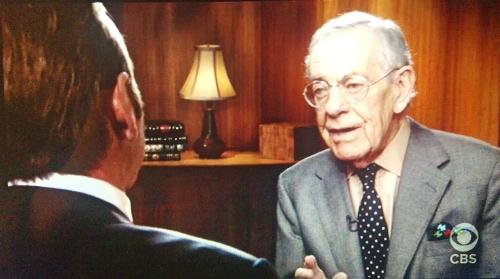
Safer interviews "President Frank Underwood." Morley, Morely, Morely...

Safer interviews “President Frank Underwood.” Morley, Morely, Morely…

The third season of “House of Cards,” a Netflix series about the corruption in Washington, continues to corrupt real Washington journalists and talking heads. On the third season  episode I just watched, “This Week With George Stephanopoulos” was drawn into this alternate universe (or Hell) and George, along with regular panel members Donna Brazile and Matthew Dowd, rendered trenchant if predictable opinions about fictional President Frank Underwood with exactly as much passion and certitude as they do when they aren’t just playing themselves, but being professional analysts whose job it is to objectively enlighten the TV news audience. With that, they joined CNN’s John King ,Candy Crowley,and Carol Costello, Soledad O’Brien, now with Al Jazeera America, NBC’s Kelly O’Donnell, MSNBC’s Rachel Maddow, Fox’ Sean Hannity, CBS’s Morley Safer of “60 Minutes,”  and Matt Bai as “House of Cards” journalist/actors. I’m sure I missed a few. The mystery is why none of these journalists (and whatever Sean Hannity and Brazile are) don’t hear ethics alarms ringing when invited to sully their already dubious credibility (they are in the news media, after all), by showing themselves reporting and commenting on fiction exactly the way they are seen reporting on reality. Brian Rooney, a media critic who writes “The Rooney Report,” states succinctly what’s the matter with this:

“The trouble with journalists appearing as themselves in entertainment is that the public already has difficulty discerning fact from fiction in the news. Reporters and news organizations survive on truth and trust. Readers and viewers need to believe what they are told so they can make informed decisions. When real reporters allow themselves to be part of fiction, the trust is shattered. They do it with a wink, like they are in on the joke, but it costs them their credibility.”

Well, it would cost them credibility, if they had any. Continue reading →

How Listening To Democrats Spin Shamefully To Excuse Hillary Clinton Makes Me Think Of Sir Thomas More…

Today’s Sunday Morning spectacle of Democrat spin-meisters using deceitful rationalizations to make the untenable case that Hillary Clinton’s  violating her own agency’s policies to allow her the power to redact and hide her communications as needed prompts in me, in addition to disgust, a reflection on my favorite ethics drama and film. To paraphrase but slightly one of the more memorable lines from Robert Bolt’s play and screen play, “A Man For All Seasons,” delivered by the doomed martyr Sir Thomas Moore:

“It profits a man nothing to give his soul for the whole world… but for Hillary Clinton?”


Hillary Clinton and the E-mails: A Case Study In Ethics Corruption

corrupted

I’ve been meaning to write this post for a couple of days now, but haven’t had the heart. Frankly, I am really sick of having to make the same point about the Clintons over and over again—they never learn, and will never change—knowing that so many people will just immediately turn off their brains and run for the rationalizations dispensary any time dishonesty, hypocrisy, deceit or misconduct by one of them is uncovered.

This happens, you see, because the Clinton are perhaps the most prominent among a particular harmful species of individual in our culture, the ethics corrupter. Ethics corrupters are popular, powerful, successful and famous people who, because they are popular, powerful, successful and famous, many citizens conclude that they must also be good and wise, and therefor trustworthy. Since they are (many believe) good and wise, what they choose to do must also be good, and when they are accused of doing wrong, even when the evidence is unavoidable that they have done wrong, there can be only two explanations to those vulnerable to correuption. The first is that the evidence, no matter how strong, cannot be believed, and those wielding it are in fact enemies of right, good, honesty and fairness. The second is that if these good and wise people did it, then what they did cannot be wrong, or can be justified, usually by “the ends justify the means.”

Thus by gaining the trust and admiration of good people, usually through clever use of dishonesty, deception and manipulation, ethics corrupters set their admirers and supporters up to have their own values weakened or destroyed. Richard Nixon caused honest people to defend the covering up of crimes. Charlie Rangel caused people with integrity to support accepting bribes. Bill Clinton made feminists excuse exactly the kind of sexual harassment they persuaded Clinton to sign a law prohibiting, and inspired lawyers to excuse perjury because “everybody lies about sex.” Lance Armstrong made parents who once taught their children not to cheat to defend cheating, because he had a foundation with a noble cause. Brian Williams and Bill O’Reilly made TV viewers excuse lying by journalists.

Ethics corrupters make their supporters worse parents, friends, employees, employers and human beings; in turn, those corrupted supporters make society less ethical and more cynical as well. These are genuine cultural polluters; indeed, they are cultural pollution.

Hillary Clinton is an ethics corrupter, and the response to the revelations of her use of exclusively personal e-mails proves it beyond the shadow of a doubt.

There is no benign interpretation of her conduct regarding her State Department e-mails. It was not a mistake; one cannot claim that it was accidental. Since it was intentional, there must have been a purpose, and the only conceivable purposes are unethical ones. According to the 2009 National Archives and Records Administration regulations in effect when Clinton took office, “Agencies that allow employees to send and receive official electronic mail messages using a system not operated by the agency must ensure that Federal records sent or received on such systems are preserved in the appropriate agency recordkeeping system.”  With a private e-mail account and only using that for official correspondence, Clinton did not have a system that ensured such preservation. She, not the system, determined what would be preserved. Anything not preserved or left on her private account would not be subject to the Freedom of Information Act. Is there any explanation for having a private account only, an justification that is simultaneously responsible, plausible and does not suggest that Clinton wanted to control which of her communications could come before the public and the press?

No.
Continue reading →

Ethics Quote of the Month: Dan Savage

“If being gay is a choice, prove it. Choose it. Choose to be gay yourself. Show America how that’s done, Ben, show us how a man can choose to be gay. Suck my dick. Name the time and the place and I’ll bring my dick and a camera crew and you can suck me off and win the argument.”

—Columnist and gay rights advocate Dan Savage, responding to Dr. Ben Carson’s assertion on CNN that being gay is a choice, and that men choose to become gay as a result of prison experiences.

"Hmmm...I'm straight, but that Dan Savage looks mighty good. Maybe I should choose to gay...."

“Hmmm…I’m straight, but that Dan Savage looks mighty good. Maybe I should choose to be gay….”

Some observations:

1. Savage works in shock rhetoric the way Rodin worked in marble. Yes, the response to Carson is uncivil and vulgar. As such, it is as good an example as one could find of the importance of not banning words, even the obscene, ugly and hurtful ones. They are certainly subject to abuse, like all words. Still, they have legitimate and valuable uses.

2. Unfortunately, because Savage’s own conduct in the gay rights wars has been unyieldingly abusive, contemptuous and hateful, he only amuses his own constituency, and persuades no one who needs persuading. Yet his comment deftly unmasks the absurdity and ignorance of Carson’s. If it had come from a critic who was regarded as objective and not habitually offensive for the sake of being so, Savage’s attack would have impact beyond those who already have made up their minds about Ben Carson.

3. Thus the lesson of Savage’s assault is that incivility’s effectiveness, like its justifiability, is inversely related to its rarity. Continue reading →

Ethics Quiz: The Controversial Photo


WORLDPRESS

Sometimes cheating isn’t cheating at all, but a just a different interpretation of the rules. And sometimes, it’s just cheating.

The World Press Photo contest just stripped “The Dark Heart of Europe,” a 10-photo series by Giovanni Troilo about life in Charleroi, Belgium, of a first prize after the judges decided that he had misrepresented the location of one of the  images. But before proof of the mislabeling of one of the photos settled the matter—Troilo had taken one of the images in the artist’s studio outside Brussels and not in Charleroi as the series titles had represented—another of the images in his entry had caused a rules dispute.

 Troilo had photographed his cousin having sex with a woman in the back of a car, using a remote-control flash to illuminate the steamy back seat. By putting a flash in the car, the stickers said, Troilo had effectively staged the photo, violating the ethics of  photojournalism and the rules of the contest.

The original caption on the photo posted on the World Press Photo website was, “locals know of parking lots popular for sexual liaisons.” The photographer said he had made it clear to World Press Photo that he had followed his cousin on a night when his cousin had planned to have sex, and had his cousin’s consent to place the flash device in the car. World Press Photo rules state that “staging is defined as something that would not have happened without the photographer’s involvement.”

Troilo argues that his photo of the sexual liaison qualified under this definition. He didn’t tell his cousin to have sex in the car, and it would have happened whether he photographed it or not. “This is not a stolen photo of a couple caught unawares,” the photographer said, explaining that his goal was “to show voyeurism through voyeurism. The camera becomes active; it becomes the sense of shame.”

Other photojournalists argue that by conspiring with one of his subjects to illuminate the event, Troilo left the realm of photojournalism and entered that of .  portraiture. One of the harsher critics wrote on Facebook, “The photojournalists we want to represent do not call upon their cousins to fornicate in a car.”

Your Ethics Alarms Ethics Quiz is:

Did Troilo cheat under the photojournalism rules by planting a flash in the car where his cousin was planning to have sex?

Continue reading →