How The Fact Checkers Cheat: A Case Study

“AHHAHAHAHAHAHAHA!!!”

A promising journalism watchdog website has come to my attention: Media Bias/Fact Check (MBFC News). On the “About” page we learn that it

…is an independent online media outlet. MBFC News is dedicated to educating the public on media bias and deceptive news practices. MBFC News’ aim is to inspire action and a rejection of overtly biased media. We want to return to an era of straight forward news reporting….MBFC News follows a strict methodology for determining the biases of sources….MBFC News also provides occasional fact checks, original articles on media bias and breaking/important news stories, especially as it relates to USA politics…

This is a relatively new site, launched in 2015.  It is unusual in that it aims to find both conservative and liberal bias alike. It will be interesting if it can keep to the middle of the road with all the crazy traffic coming at it from all directions. As Ethics Alarms can attest, this is harder than it looks.

The first example of MBFC News’s work (for me) is promising. As readers know, I distrust  factcheck sites and fact-checkers, as well as the periodic fact-checking exercises by sources like CNN. While sometimes a particular fact-checker may be fair and responsible, the same source can be overwhelmed with bias in another instance, and use dishonest or misleading means to discredit some disliked politician, usually a Republican. Some prominent fact-checkers. like Snopes and Politifact, are routinely biased and exist primarily to make progressives smile. Others, like the Washington Post’s “The Fact-Checker,” Glenn Kessler, have good days and bad days. At least Kessler tries; like many of his breed, however, he never learned what a lie is.

My favorite of the fact-checker services has long been FactCheck.org., which also tries to be even-handed, and is more careful than Kessler. Thus I was impressed to see that when MBFC News set out to see how fair the fact-checkers were when they examined Donald Trump’s State of the Union Message, it examined the best. So did I, and was hunkering down as I prepared a post on what appears to be the Annenberg Foundation’s project’s capitulation to “the resistance.”

How I love it when someone else does my work for me, and does it well.  In an article that factchecks the Factcheck.org factcheck (whew!) of the speech,  Karen O’Connor Rubsam writes,

“First, there are some global observations regarding the Factcheck.org article. Factcheck.org seems only to identify what they perceive as incorrect statements.  To be unbiased there should be some commentary on the entire address along with an overall assessment as to how much was “factual” versus “not-factual.”  A more thorough reporting of the entire address can be found here. Additionally, as shown below, factcheck.org introduces opinion and “biased words” in much of their fact-checking. Further, there appears to be some bias in how factcheck.org transferred the salient points from their analysis to the Summary bullet points.  Accurately reporting in the summary bullet points is important since many readers will just read the bullet points.”

Read it all at the site, which deserves the traffic, much as I would love to put up the whole thing. Two examples should suffice: when I read the Factcheck.org analysis, these points, far from the worst,  caused me to conclude that the site had finally started playing typical factcheck games and gone over to the Dark Side, where bashing the President is deemed more important than being fair and truthful. (I promptly exiled it from the Ethics Alarms links): Continue reading

Ethics Quiz: Alexa, The Feminist

Amazon has programmed Alexa, the voice-assistant  in Amazon Echo devices,  to tell you that it is a feminist. If you ask it, “she” will respond, “I am a feminist. As is anyone who believes in bridging the inequality between men and women in society.” Moreover, if you called last last year’s model a bitch, a slut, or even a “cunt” a year ago,  Akexa 2017 would respond with, “Well, thanks for the feedback.” No longer.  Now she responds to a sexist insult with a curt, “I’m not going to respond to that!”

Your Ethics Alarms Ethics Quiz of the Day is…

Is it ethical, responsible and appropriate to program Alexa to respond this way?

Continue reading

Morning Ethics Warm-Up: 1/12/2018: Sigh. It Never Ends. (Part II) [UPDATED]

A Nigerian locale, and not an atypical one.

From the Washington Post:

President Trump grew frustrated with lawmakers Thursday in the Oval Office when they discussed protecting immigrants from Haiti, El Salvador and African countries as part of a bipartisan immigration deal, according to several people briefed on the meeting.

“Why are we having all these people from shithole countries come here?” Trump said, according to these people, referring to countries mentioned by the lawmakers.

Trump then suggested that the United States should instead bring more people from countries such as Norway, whose prime minister he met with Wednesday. The president, according to a White House official, also suggested he would be open to more immigrants from Asian countries because he felt that they help the United States economically.

In addition, the president singled out Haiti, telling lawmakers that immigrants from that country must be left out of any deal, these people said.

“Why do we need more Haitians?” Trump said, according to people familiar with the meeting. “Take them out.” 

Ethics Observations:

I. “According to several people briefed on the meeting”? What? Not even according to people AT the meeting?

Based on this, without any attributions, the news media is stating that Trump making those alleged comments are fact. Here’s the Times version,

“…according to people with direct knowledge of the conversation.

No, they don’t have “direct knowledge.” What someone tells you about what someone else said at a meeting you were not attending is indirect knowledge. It is, in fact, hearsay. If the Times and the Post did not get confirmation on the record from someone who heard what he said, then this is not fact, but rumor, inadmissible in court because of extreme prejudice and lack of reliability.

Never mind. The Times headline is Trump Alarms Lawmakers With Disparaging Words for Haiti and Africa, as if the second-hand accounts were  confirmed fact. This is unethical journalism. Outrageously so, in fact. Meanwhile, all of the news channels, including Fox, were basing hours of reporting on it.

This is not acceptable. It is not professional, and it is not justifiable. It is a disgrace, and if you accept it, you should be ashamed of yourself.

II. Trump denies that he uttered those words, on Twitter, of course:

“The language used by me at the DACA meeting was tough, but this was not the language used. What was really tough was the outlandish proposal made – a big setback for DACA!…Never said anything derogatory about Haitians other than Haiti is, obviously, a very poor and troubled country. Never said “take them out.” Made up by Dems. I have a wonderful relationship with Haitians. Probably should record future meetings – unfortunately, no trust!”

The denials mean nothing, I know. The President has such a bizarre view of reality and such a record of misstatements and reversals that he has no credibility and deserves none. However, that doesn’t mean that he did make the alleged statements either. I wouldn’t be surprised if he did. I certainly wouldn’t be “shocked.” It sounds like something he would say, because nuances of language and tone, not to mention civility ande diplomacy, are alien concepts to him. In other words, it rings true. That doesn’t mean it’s ethical to report it as fact. Continue reading

Comment Of The Day (7): “An Ethics Alarms Holiday Challenge! Identify The Rationalizations, Logical Fallacies, Falsehoods…”

Yes, there are more Comments of the Day emitting from the Holiday Challenge, which asked readers to answer Noah Berlatsky’s  essay on NBC’s website advocating the government censorship of “hate speech.” That’s not hard to do, or shouldn’t be. It is hard to do well, though. Many, many commenters did it remarkably well.

We talk about freedom of speech a lot here. The concept is not ethics, but it is a convergence of many ethical values—respect, fairness, autonomy, rights, process, empathy, openness, accountability, and citizenship. This is definitely a United States history and culture oriented blog, and no nation or culture elevates free speech to the priotity in its values that this nation does. That is one of its enduring strengths, That this strength has been increasingly under attack recently naturally sets ethics alarms ringing, or should.

After he authored the 2017 Comment of the Day that attracted more commentary, by quite a bit, than any of the thousand plus essays I labored over last year, I couldn’t omit this one by Zoltar Speaks! in response to the Challenge.

Here is his Comment of the Day on the post, An Ethics Alarms Holiday Challenge! Identify The Rationalizations, Logical Fallacies, Falsehoods And Outright Errors In This Essay Advocating Limits On Speech…:

The problem is that those that want to define “hate speech” these days don’t know the difference between free speech, hate speech, verbal threats, actively inciting riot/mayhem/chaos, and actual physical violence.

In my opinion…

1. Free speech as in sharing opinions, protesting, print, media, etc. etc. is clearly protected under the United States Constitution whether you agree with it or not. Period!

2. Hate speech in its simplest form is that which implies or states outright that the speaker(s) hate someone or something, this is clearly protected under the United States Constitution. Hate is an opinion/thought not an action and you and I have every right to think whatever the hell we like and hate is part of that.

3. Verbal threats are borderline protected speech, it can depended on the conditions surrounding the threat, the type of threat, the intent to follow through with the threat, and the physical ability to follow through with the threat. If some run-of-the-mill US citizen were to threaten to blow up NYC with a nuclear bomb, that would not likely be an achievable threatening goal because run-of-the-mill US citizens do not have possession of nor have access to nuclear devices, but if the same run-of-the-mill US citizen actually threatens to kill the mayor of NYC, the President of the United States, their spouse, the soccer coach, white people, black people, gays, their boss, or their asshole neighbor, or that drunken prick at the bar, that should be taken very seriously as an achievable threatening goal. If Jill threatens to tell Mom that Jack drank out of the milk container, it’s certainly a verbal threat that’s achievable but it’s certainly not an abusive verbal threat. Get the idea? Continue reading

Morning Ethics Warm-Up, 12/4/17: Jailed For Profanity, Busted For Homophobia, Condemned For A Settlement

Good morning…

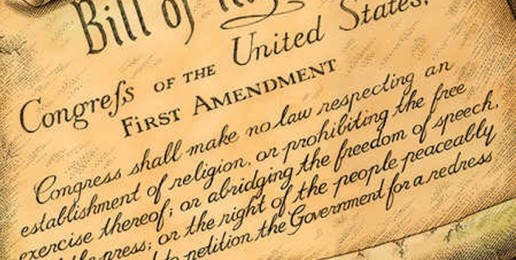
This is weird…The Wisconsin Supreme Court has upheld a mother’s conviction for swearing at her son. Ginger Breitzman had been found guilty of child abuse, including one count was for profanely berating and insulting her 14-year-old son after he burned some popcorn. The boy had been talking to a friend at the time, who heard the tirade over the phone and reported it. The mother was sentenced to six months in jail. Apparently the First Amendment was  never raised as a defense, and an issue is whether it should have been and had to be.

I don’t see how a parent or anyone can be convicted of a crime based on the content of her speech, especially private speech, but it is a gray area in ten context of child abuse. In sexual harassment,  the content of one’s speech can create a hostile work environment, but the civil violation is for the act of creating the hostility, not the speech itself. In many cases, that’s a distinction without a difference, though. A supervisor using the term “cunt” in the workplace is probably harassment, no matter how or to whom he uses it.

Check the link and the mother’s mug shot. I wouldn’t want to have her mad at me…

2. Joy Reid being hateful? I’m shocked—shocked! MSNBC’s serial race-baiting, hate-spewing host Joy Reid found herself huminahumina-ing after someone tracked down her old blog and found multiple examples of gay-bashing on it.  Notably, she mocked GOP Florida Governor Charlie Criss, a married man who has been rumored to be a closeted gay, as “Miss Charlie.” What do you think of her apology?

This note is my apology to all who are disappointed by the content of blogs I wrote a decade ago, for which my choice of words and tone have legitimately been criticized.As a writer, I pride myself on a facility with language — an economy of words or at least some wisdom in the selection. However, that clearly has not always been the case.In 2007 I was a morning talk radio host and blogger, writing about Florida politics (a blog I maintained until 2011.) Among the frequent subjects of my posts was then-governor Charlie Crist, at the time a conservative Republican, whose positions on issues like gay marriage and adoption by same-sex couples in Florida shared headlines with widely rumored reports that he was hiding his sexual orientation. Those reports were the subject of lots of scrutiny: by LGBTQ bloggers, writers and journalists, conservative blogs, a controversial documentary film called “Outrage,” and even by the comedic writers at South Park. But it was my own attempt at challenging Crist on my blog that has now raised the issue of not just my choice of words, but what was and is in my heart.

Let me be clear: at no time have I intentionally sought to demean or harm the LGBT community, which includes people whom I deeply love. My goal, in my ham-handed way, was to call out potential hypocrisy. Nonetheless, as someone who is not a member of the LGBT community, I regret the way I addressed the complex issue of the closet and speculation on a person’s sexual orientation with a mocking tone and sarcasm. It was insensitive, tone-deaf and dumb. There is no excusing it – not based on the taste-skewing mores of talk radio or the then-blogosphere, and not based on my intentions.

In addition to friends and coworkers and viewers, I deeply apologize to Congressman Crist, who was the target of my thoughtlessness. My critique of anti-LGBT positions he once held but has since abandoned was legitimate in my view. My means of critiquing were not. In the years since I went from blogger to opinion journalist, I have also learned, through brilliant friends and allies in the LGBT activist community, how to better frame my critiques of those who challenge people’s right to love who they want, marry them, and walk in the world as fully free people.

Re-reading those old blog posts, I am disappointed in myself. I apologize to those who also are disappointed in me. Life can be humbling. It often is. But I hope that you know where my heart is, and that I will always strive to use my words for good. I know better and I will do better.

It’s not terrible. I’ll give her a #6 on the Apology Scale: ” A forced or compelled [apology], when the individual (or organization) apologizing knows that an apology is appropriate but would have avoided making one if he or she could have gotten away with it.” I doubt that it’s sincere, because of lots of clues in the text. She says she deeply apologizes to Christ, then says her criticism was legitimate. She was presuming hypocrisy on the basis of rumors: how is that legitimate? She sucks up to the LGBT community; she says that at “no time have I intentionally sought to demean or harm the LGBT community,” when her rhetoric obviously was intended to demean Crist based on his presumed homosexuality; she sneaks in an “everybody was doing it” excuse. Continue reading

Morning Ethics Warm-Up, 11/27/2017: Gibberish From Congress, Race-Blindness in the UK, Cruel Law Enforcement In Atlanta, And More

Mornin’!

1 “Rarrit!!” You will seldom see or hear as excellent an example of Authentic Frontier Gibberish than this word salad belched out by the leader of House Democrats on “Meet the Press” yesterday. Nancy Pelosi attracted so much negative attention with her “Rep. Conyers is too much of an icon to hold accountable” blather that this masterpiece was relatively ignored. Pelosi was asked by Chuck Todd whether she would support releasing to the public the full information behind heretofore secret settlements of sexual harassment accusations against Congressmen, even indispensable, virtuous icons like John Conyers. She said…

“Well, here’s the thing. It’s really important. Because there is a question as to whether the Ethics Committee can get testimony if you have signed a nondisclosure agreement. We’re saying we think the Ethics Committee can, but if you don’t agree, we’ll pass a law that says the Ethics Committee can, a resolution in Congress that the Ethics Committee can…. But there’s no– I don’t want anybody thinking there’s any challenge here to our changing the law and see how people– when we know more about the individual cases. Well, because you know what our biggest strength is? Due process that protects the rights of the victim, so that, whatever the outcome is, everybody knows that there was due process….”

http://www.youtube.com/watch?v=0_2Npp-euLU

If Chuck Todd wasn’t a partisan hack, he would have recognized his journalistic obligation to say, “That made no sense at all, Congresswoman. Please try again.”

Public pressure is increasing to force Congress to release the names of the members of Congress who paid taxpayer funds to settle with their accusers. Good. Democrats are obviously terrified, and presumably Republicans are as well.

2. That mean Trump Administration insists on enforcing the law. The New York Times had a front page story Sunday about the plight of illegal immigrants in Atlanta. The story, entirely sympathetic to the arrested, deported, and those afraid of being arrested and deported, saying in one headline that “immigrants” (that’s illegal immigrants, NYT editors, a material distinction) fear “even driving.”

“Even driving” without a license.

Here’s a quote to make any rational American’s head explode, about a local journalist who uses social media to warn illegal immigrants when ICE is lurking,

“Asked whether he had any reservations about helping readers evade immigration law, he said he preferred to think he was helping people with no criminal records stay in the country. “Honestly, I believe it’s an honor as a journalist if the people can use your information for protecting their own families,” he said.”

Translation: “I prefer to think of what I am doing as something other than what I am really doing.”

It’s kind of like a newspaper calling illegal immigrants “immigrants.” Continue reading

Comment of the Day: “Morning Ethics Warm-Up, 11/13/17: Rushing In Panic Around My Boston Hotel Room Because I Didn’t Get My Wake-Up Call Edition”

“Man! I am BORED out of my GOURD!”

As one might expect, abortion is one of the topics that can be relied upon to spark a lively discussion every time it is raised on Ethics Alarms. This is because abortion is a true ethics dilemma, where valid ethical considerations point in opposite directions. In addition, this ethics dilemma cannot easily be solved by balancing, because determining which of the ethical values involved, personal autonomy and the primacy of human life, should hold the superior priority involves resolving conflicting definitions.Complicating things further is the fact that the three main ethics systems—reciprocity, Kantian ethics, and Utilitarianism— reach disparate conclusions.

The subject of this intense and extensive comment by Zoltar Speaks! is another commenters assertion that the unborn do not qualify as “persons” within the protection of the law because they do not, as far as we know, have self awareness and are incapable of thought. I personally detest this argument, but I’ll leave the exposition to Zoltar. He got extra credit for beginning with the trademark quote that Ethics Alarms uses to designate a “Popeye.

Here is the Zoltar Speaks! Comment of the Day on the post, Morning Ethics Warm-Up, 11/13/17: Rushing In Panic Around My Boston Hotel Room Because I Didn’t Get My Wake-Up Call Edition:


“I ain’t gonna take it, ’cause I can’t take no more!”

My understanding from your comments is that you don’t agree with a lot of what abortion activists use as arguments. However, you’re regurgitating intentionally modified long standing definitions to fit an agenda instead of using the definitions as they are. You are not parsing the words of an existing definition, you are not simply misunderstanding an existing definition, you are literally adding things to the definition of “person” that do not exist in the definition.

You are saying that a person is not a person until they can think and feel, and that is by definition false (see below.)

You say that “intelligent, informed pro-choice advocates” talk about thinking and feeling is when a person becomes a person.  I don’t care who presents that as an argument, it’s false. It is literally uninformed, and since you used it in this way it is literally showing a low level of intelligence. It’s bastardizing the English language into agenda-driven rhetoric:

Bastardizing: corrupt or debase (something such as a language or art form), typically by adding new elements.

I looked up as many definitions for the word “person”  as I could find and I found an obvious common thread: Person: A human being regarded as an individual. A human individual. A human being. A human being as distinguished from an animal or a thing. An individual human. The common thread is human and individual. Tthere is nothing in any definition I could find that could be construed as holding that a person is only a person if he or she can think and feel.

 Human Being, furthermore, is a man, woman, or child of the species Homo sapiens, distinguished from other animals by superior mental development, power of articulate speech, and upright stance. Is an unborn child a human being? Yes. Continue reading

Comment of the Day: “Desperate Ethics Quote Of The Week: Louis C.K.”

This is a combination of two comments, by the same wise commenter. I thought both were excellent, and together they are better still.

This is La Sylphide’s Comment of the Day on the post, Desperate Ethics Quote Of The Week: Louis C.K.:

Twice a summer I work as a “runner” for two huge music festivals: one country, one rock. I am often in close quarters, or in a car, with very famous people. I’m always professional. I’m always discrete. Rarely am I star struck. (O.k., driving Johnny Depp was pretty cool.) Most stars and their tour managers are kind and thoughtful. But now and then you get a blowhard, or two. One, very well known country star wanted me to share his cigar with him as I drove him to his private plane. “C’mon, sweetheart” as he held out the cigar to me, “it’s not THAT wet…” The whole car went silent. There I was, the only woman in a car with 5 men, a wet cigar, and a wink wink. I played dumb. I blew off his remark with a smile… They all laughed. Here’s the thing: he held no power over me. He couldn’t advance my career or ruin it. I had nothing at stake. And so yes, I can understand these women, in the same industry as Louis C.K., trying to make it, in a hotel room with him and wondering “wtf, do we do now ?!? How much damage will be done if we stay? How much damage will be done if we tell him to GFH? ” So very often, when you are dealing with someone who wields enormous power, it’s like navigating a mine field. For women, there are often split second decisions to be made: do I cross the street now because it’s late at night, I’m alone and he’s coming toward me, or if I cross the street will I anger him and make things worse.”

Continue reading

The Bad Judges And The Law Dog

The legal commentariat is much amused by a case out of Louisiana involving  the right to counsel. I don’t think it’s funny at all.

( Oh all right, it’s a little funny.)

Warren Demesme was being interviewed by detectives, not for the first time, about some alleged sexual misconduct with minors. He was read his rights, “Mirandized,” as they say, and said that he understood, and waived those rights. (He could, however, choose to invoke them at any time, per several Supreme Court rulings.)

At some point the interview got tense, and the suspect said,

“If y’all, this is how I feel, if y’all think I did it, I know that I didn’t do it so why don’t you just give me a lawyer dog cause this is not what’s up.”

He was not, however, given access to a lawyer, and when he appealed his subsequent conviction on the grounds that he requested legal assistance and was not accommodated, the lower court rejected his argument, saying that he had not made his desire for a lawyer clear and unambiguous. Incredibly, the Louisiana Supreme Court agreed, writing in part,

The defendant argues he invoked his right to counsel. And the basis for this comes from the second interview, where I believe the defendant ambiguously referenced a lawyer..As this Court has written, “[i]f a suspect makes a reference to an attorney that is ambiguous or equivocal in that a reasonable police officer in light of the circumstances would have understood only that the suspect might be invoking his right to counsel, the cessation of questioning is not required.” State v. Payne (La. 2002); see also Davis v. United States (1994) (agreeing with the lower courts’ conclusion that the statement “[m]aybe I should talk to a lawyer” is not an unambiguous request for a lawyer). In my view, the defendant’s ambiguous and equivocal reference to a “lawyer dog” does not constitute an invocation of counsel that warrants termination of the interview and does not violate Edwards v. Arizona (1981).

Right.

And the vote on the Supreme Court in favor of this indefensible ruling was 8 to 1. 8 to 1!

Forget it, Jack. It’s Louisianatown. Continue reading

Ethics Quote Of The Week, And A Few Related Diversions

My son is named after this President, incidentally.

The quote itself is by Ron Chernow, the historian who authored the recent well-reviewed biography of out 18th President, “Grant,”  “Hamilton,” the biography that inspired, we are told, the mega-hit musical. and “Washington” (won’t somebody send a copy to the fools at Christ Church?) was given to an interviewer as his description of another book, the Philip Roth’s historical novel  “The Plot Against America”:

[A] democracy can be corrupted, not by big, blaring events, but by a slow, insidious, almost imperceptible process, like carbon monoxide seeping in under the door.

Some random thoughts on this statement, which I believe is exactly right, and a lot more interesting than the more frequently used analogy about boiling a frog slowly:

  • Grant, as Chernow’s book (among others of recent vintage) documents, was present at one of those points when democracy seemed to be in the process of being poisoned, and acted forcefully.

By 1868, when Grant was elected to succeed Andrew Johnson, who had done everything he could to allow the South to resist extending civil rights to the newly freed slaves, the KKK had evolved into a powerful terrorist organization that referred to itself as  “The Invisible Empire of the South.” Under the  Klan’s first  “Grand Wizard,” the brilliant former Confederate cavalry general  Nathan Bedford Forrest, whites from all classes of Southern society joined the Klan’s ranks. They attacked and punished newly freed blacks for crimes like  behaving in an “impudent manner” toward whites, brutalized the teachers of  schools for black children, and burned schoolhouses. It also terrorized and often murdered Republican party leaders those who voted for Reconstruction policies.  In Kansas over 2,000 murders were committed as the 1868 election approached; in Louisiana, a thousand blacks were killed in the same period.

Grant entered office knowing that the Civil War victory could come apart. He made some bad appointments–Grant was naive about politics and trusted too easily—but his choice as Attorney General, Amos T. Akerman, was masterful. With Grant’s support, and the with the help of the newly created Justice Department under Grant, he vigorously worked to enforce the Fifteenth Amendment, which gave the vote to black men in every state, and the First Reconstruction Act of 1867, which placed tough restrictions on the South and closely regulated the formation of their new state governments. Between 1870 and 1871, the Republican Congress passed and Grant signed into law the Enforcement Acts, which made it a crime to interfere with registration, voting, officeholding, or jury service by blacks. Congress also passed the Ku Klux Klan Act, which allowed the government to act against terrorist organizations.

  • When I was growing up and becoming interested in the Presidents, a life-long passion that led me to both law and ethics, Grant was routinely listed as one of the worst in the line. All one heard from historians was about the financial scandals that rocked his administration. Grant’s great success in subduing the Klan was literally never mentioned. The main Presidential historian then was Arthur Schlesinger Jr., a member of Jack Kennedy’s inner circle. His job as he saw it was to minimize the contributions of any Republican President, like Teddy Roosevelt (“near great” in his rankings), Eisenhower (“below average”) and Grant (“failure’). Meanwhile, Woodrow Wilson, who dragged the U.S, into the first World War, botched the Versailles Treaty and who actively revived the Klan, being a stone-cold racist, was “great.” Naturally, I believed all of his distortions, which were largely those of the historians at the time, then, as now, often partisans and propagandists. It took me a while to realize that this had been my first encounter with the Left attempting to alter present perception by controlling the past.

That is one of the major sources of Chernow’s carbon monoxide today, except that the disinformation now emanates from the schools, colleges, and the news media. Continue reading