
Searching for ethical outrages not related to the George Floyd Freakout,
…..and not having much luck.
1. What does it tell us that so many employees of the New York Times oppose freedom of speech? It’s a rhetorical question. Prominent employees of the New York Times protested because they disagreed with this op-ed by a U.S. Senator:
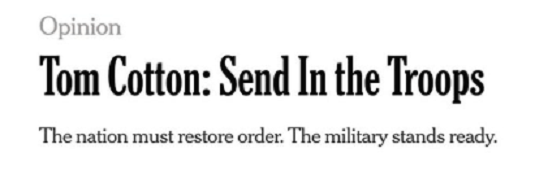
Opinion writer Roxanne Gay’s argument was typical:
“As a NYT writer I absolutely stand in opposition to that Tom Cotton ‘editorial.’ “We are well served by robust and ideologically diverse public discourse that includes radical, liberal, and conservative voices. This is not that. His piece was inflammatory and endorsing military occupation as if the constitution doesn’t exist.”
Oddly, when Times Op-Ed writer Bret Stephens called for the abolishment of the Second Amendment, nobody on the Times made the “as if the Constitution doesn’t exist” argument. Moreover, the argument against Cotton in this case is legally dubious to say the least. Whether the Insurrection Act should be used to restore order in riot-torn cities is a separate issue. There is precedent indicating that it can be so used, and even if there was not, Sen. Cotton’s opinion is quite a bit less objectively outrageous than various leftist screeds the Times happily bombards its readers with routinely.
Professor Turley’s reaction: “There is a growing orthodoxy in journalism that is now openly calling for the censorship of opposing views. It is particularly problematic when opinion writers seek the removal of editors for allowing such opposing positions to be published.” Uh, yes, professor, “problematic.” It is a whole lot more serious than that. Un-lablable pundit Andrew Sullivan was more assertive, as Turley should have been, tweeting,
The Op-Ed was designed so it offers an opposite view to the Editorial board. Liberals believe that ideas should be open to debate. This should be utterly uncontroversial in a liberal paper….It’s important to understand that what the mob is now doing to the NYT is what they did to Evergreen University. They hate liberal institutions and they want them dismantled from within. These people are not liberal and they are a disgrace to journalism….What’s happening at the NYT is an attempted coup.
Isn’t this inevitable, however? When a news media source regularly manipulates its news and reporting for ideological ends, why wouldn’t its employees eventually lobby for the next step, which is active censorship of views the organization deems “inappropriate”?
2. Note to Drew Brees: If you don’t have the guts to stand up to social media mobs, keep your mouth shut and your social media accounts occupied with football trivia.
New Orleans Saints quarterback Drew Brees had opposed the NFL kneelers, now back in the news because if they had been permitted to keep grandstanding at NFL games, nobody would have knelt on George Floyd’s neck. Or something—I’m sure there’s a connection in there somewhere—by telling Yahoo Finance in an interview, “I will never agree with anybody disrespecting the flag of the United States of America or our country….Is everything right with our country right now? No, it’s not,” Brees said, “We still have a long way to go. But I think what you do by standing there and showing respect to the flag with your hand over your heart, is it shows unity. It shows that we are all in this together. We can all do better. And that we are all part of the solution.”
But then the twitter mob descended, so the big, strong, straight-talking quarterback groveled on Instagram like a little glasses-wearing bot being stomped by a bully, writing on Instagram (accompanied by a nauseatingly pandering graphic of a white hand and a black one grasping each other):
I would like to apologize to my friends, teammates, the City of New Orleans, the black community, NFL community and anyone I hurt with my comments yesterday. In speaking with some of you, it breaks my heart to know the pain I have caused.
In an attempt to talk about respect, unity, and solidarity centered around the American flag and the national anthem, I made comments that were insensitive and completely missed the mark on the issues we are facing right now as a country. They lacked awareness and any type of compassion or empathy. Instead, those words have become divisive and hurtful and have misled people into believing that somehow I am an enemy. This could not be further from the truth, and is not an accurate reflection of my heart or my character.
This is where I stand:
I stand with the black community in the fight against systemic racial injustice and police brutality and support the creation of real policy change that will make a difference.
I condemn the years of oppression that have taken place throughout our black communities and still exists today.
I acknowledge that we as Americans, including myself, have not done enough to fight for that equality or to truly understand the struggles and plight of the black community.
I recognize that I am part of the solution and can be a leader for the black community in this movement.
I will never know what it’s like to be a black man or raise black children in America but I will work every day to put myself in those shoes and fight for what is right.
I have ALWAYS been an ally, never an enemy.
I am sick about the way my comments were perceived yesterday, but I take full responsibility and accountability. I recognize that I should do less talking and more listening…and when the black community is talking about their pain, we all need to listen.
For that, I am very sorry and I ask your forgiveness.
We know what happened here. Brees’ employers and agent todl him he was jeopardizing his income and market public relations, so he was forced to beg for forgiveness. What are the odds that he wrote that apology himself?
But it’s sure reassuring to know that he stands “with the black community in the fight against systemic racial injustice and police brutality and support[s] the creation of real policy change that will make a difference.” I’m sure he knows what that is, and can answer the 13th question.
3. And while we’re on the topic of the 13th question, here’s what socialist Vermont ice-cream makers Ben and Jerry think is an answer. I’ll break in here and there when I can’t stand it…
All of us at Ben & Jerry’s are outraged about the murder of another Black person by Minneapolis police officers last week and the continued violent response by police against protestors.
Like the good Leftists they are, Ben and Jerry begin with falsity to frame their argument. It is not a murder until due process of law had determined it to be a murder. “Another” is rhetorical dishonesty. Police action against rioters, arsonists and looters is not “violent response.” It is mandatory law enforcement.
We have to speak out. We have to stand together with the victims of murder, marginalization, and repression because of their skin color, and with those who seek justice through protests across our country. We have to say his name: George Floyd.George Floyd was a son, a brother, a father, and a friend. The police officer who put his knee on George Floyd’s neck and the police officers who stood by and watched didn’t just murder George Floyd, they stole him. They stole him from his family and his friends, his church and his community, and from his own future. The murder of George Floyd was the result of inhumane police brutality that is perpetuated by a culture of white supremacy. What happened to George Floyd was not the result of a bad apple; it was the predictable consequence of a racist and prejudiced system and culture that has treated Black bodies as the enemy from the beginning.
This is racist, inflammatory, vicious rhetoric calculated to provoke fear, violence and hate.
What happened to George Floyd in Minneapolis is the fruit borne of toxic seeds planted on the shores of our country in Jamestown in 1619, when the first enslaved men and women arrived on this continent. Floyd is the latest in a long list of names that stretches back to that time and that shore. Some of those names we know — Ahmaud Arbery, Breonna Taylor, Oscar Grant, Eric Garner, Trayvon Martin, Michael Brown, Emmett Till, Martin Luther King, Jr. — most we don’t.
Normally I would bail on any article that conflated Emmit Til, who was lynched 75 years ago, and Martin Luther King, who was assassinated, with Ahmaud Abbery, whose death did not involve police, with Eric Garner, who died in an example of sloppy police work while resisting arrest, with Trayvon Martin, who was killed by a Hispanic man in self -defense and whose death also had nothing to do with police, with Michael Brown. An argument that starts off with such deliberate misrepresentation cannot be respected.
The officers who murdered George Floyd, who stole him from those who loved him, must be brought to justice.
They are arrested and charged, and will stand trial. Or do Ben and Jerry want Emmett Till-style “justice”?
At the same time, we must embark on the more complicated work of delivering justice for all the victims of state sponsored violence and racism. Four years ago, we publicly stated our support for the Black Lives Matter movement. Today, we want to be even more clear about the urgent need to take concrete steps to dismantle white supremacy in all its forms. To do that, we are calling for four things: First, we call upon President Trump, elected officials, and political parties to commit our nation to a formal process of healing and reconciliation. Instead of calling for the use of aggressive tactics on protestors, the President must take the first step by disavowing white supremacists and nationalist groups that overtly support him, and by not using his Twitter feed to promote and normalize their ideas and agendas. The world is watching America’s response.
Translation: Unilaterally submit to our ideological position. Right. Again, this is an unserious argument that is entirely political.
Second, we call upon the Congress to pass H.R. 40, legislation that would create a commission to study the effects of slavery and discrimination from 1619 to the present and recommend appropriate remedies. We cannot move forward together as a nation until we begin to grapple with the sins of our past. Slavery, Jim Crow, and segregation were systems of legalized and monetized white supremacy for which generations of Black and Brown people paid an immeasurable price. That cost must be acknowledged and the privilege that accrued to some at the expense of others must be reckoned with and redressed.
Translation: Reparations! Who didn’t see that coming? Reparations, of course, would do more to exacerbate racial tensions than almost anything I can think of, and again, the idea isn’t serious, because it is politically impossible, and should be. It is a “solution” to justify endless criticism for not adopting it.
Third, we support Floyd’s family’s call to create a national task force that would draft bipartisan legislation aimed at ending racial violence and increasing police accountability. We can’t continue to fund a criminal justice system that perpetuates mass incarceration while at the same time threatens the lives of a whole segment of the population.
Translation: Authentic Frontier Gibberish. It’s meaningless.
And finally, we call on the Department of Justice to reinvigorate its Civil Rights Division as a staunch defender of the rights of Black and Brown people. The DOJ must also reinstate policies rolled back under the Trump Administration, such as consent decrees to curb police abuses.
Police shootings and police involved deaths have declined during the Trump Administration, though the Obama Administration had a completely racialized Justice Department and Civil Rights Division. This is Trump bashing disguises as police advice.
Unless and until white America is willing to collectively acknowledge its privilege, take responsibility for its past and the impact it has on the present, and commit to creating a future steeped in justice, the list of names that George Floyd has been added to will never end. We have to use this moment to accelerate our nation’s long journey towards justice and a more perfect union.
It’s virtue-signaling and dog-whistling without substance. Like ice cream, it may taste good to many, but there’s little of substance to savor later. The 13th question isn’t even nicked in this screed.



 Ethics Alarms