An Urgent And Probably Futile Call For Empathy And Compassion For The Victims Of Cultural Whiplash

north-carolina-protest-transgenderIt is sobering to read  the hateful and contemptuous comments from so many of my Facebook friends about the legislators of Georgia, Indiana, North Carolina, Mississippi and other states that have either passed or have tried to pass laws allowing citizens to opt out of the cultural freight train that gives them the option of boarding or getting crushed. Whether these are “religious freedom” laws or “bathroom laws,” aimed at transgendered interlopers in the once orderly realm of public bathrooms, or whether they are designed to fight for the definition of marriage as “between a man and a woman,” these laws, every one of them unwise and unethical, and probably unconstitutional too, need to be regarded as the inevitable and predictable result when human beings are forced to absorb cultural shifts in a matter of years or less that properly would evolve over generations

Culture–what any society, country, region, religion, business, organization, club, family, secret society or tree house agrees over time as how they do things, think about things, what is right and what is wrong, what is remembered and what is forgotten–is a constantly evolving process. Efforts to freeze it inevitably fail, because human beings as a species can’t stop themselves from learning. Efforts to rush the installment of major changes, however, can be disastrous, even when there seems like no alternative but to rush.

Laws don’t automatically change culture. They are part of the process, both reflecting and facilitating cultural shifts, as well as institutionalizing them. They do not even mark the end of such shifts. Nobody should be surprised, angry or abusively critical when those who have been raised to believe in certain values and practices feel betrayed and mistreated, and see the need to resist when their sense of what is right is suddenly proclaimed as not only wrong but the sign of a character deficiency and a cause for denigration and disrespect. Continue reading


When Counting On Ethics Isn’t Enough: The Delegate Bribery Risk At The GOP Convention

Fortunately, we all know Donald Trump doesn't operate this way...

Fortunately, we all know Donald Trump doesn’t operate this way…

This hasn’t come up before in party nominating conventions, because the last time there was a threat of a brokered convention no billionaires were running. Now, however, with Donald Trump likely facing a battle for delegates at the GOP battle looming in Cleveland, the specter has been raised of horribly unethical conduct being nonetheless legal: bribing delegates.

There are federal and state laws prohibiting bribery of elected officials, and laws making paying for votes illegal in elections. No laws seem to  restrict what private citizens serving as delegates at their parties’conventions can take in exchange for their votes on a nominating ballot, however. The closest, suggests former Bush administration lawyer Richard Painter at the Legal Ethics Forum, is the “theft of honest services” statute 18 U.S.C. § 1346, and it isn’t close enough. Continue reading

If You Know Anything About Ethics, You Don’t Even Ask These Questions, Because You Know The Answers Already

virtual reality

Darrell West, a Brookings scholar, believe it or not, queries, “What happens when virtual reality crosses into unethical territory?” It is the topic of his essay, but the question is self-answering. Virtual reality is, by definition, not real. Ethics is about determining right and wrong in reality, in interaction with real people, real consequences and real dilemmas in the real world.

West doesn’t seem to grasp that, and neither, according to him, does the playwright of a work being presented in my metaphorical back yard: Jennifer Haley, who authored “The Nether” playing at the Woolly Mammoth Theater in Washington, D.C. West tells us that Haley

“…explores the troubling questions that arise when the main character known as Papa uses advanced software to create a fantasy environment where adult clients molest young children and then kill them….  Should there be limits on human fantasies involving heinous thoughts? Do fantasies that remain in the private realm of someone’s brain warrant any rules or regulations by society as a whole?  Even if the bad behavior rests solely in one individual’s private thoughts, does that thinking pose a danger to other people? For example, there is some evidence that repeated exposure to pornography is associated with harmful conduct towards women and that it legitimizes violent attitudes and behaviors. Does that evidence mean we should worry about misogynistic or violent virtual reality experiences? Will these “games” make it more acceptable for people to engage in actual harmful behaviors?”

These are not troubling questions or even difficult questions, unless one is intrigued by the Orwellian offense of “thought crime.” Here, for the edification of West, Haley, those nascent brainwashers out there who find his ethically clueless essay thought-provoking of any thought other than: “How the hell did this guy get to be called a “scholar”?, let me provide quick and reassuring answers to West’s questions: Continue reading

Observations On The ‘Ole Miss’ Sigma Chi Derby Days Controversy

Derby DaysNews Item:

The University of Mississippi’s Title IX office has launched an investigation after allegations surfaced on social media that men of the Sigma Chi fraternity asked sorority members questions tainted with sexual innuendo on a loud speaker system in front of hundreds of students at the closing festivities of Derby Days, the fraternity’s annual philanthropic initiative.

Those “allegations” came in the form of an emotional Facebook post by student Abby Bruce, who began,

“Tonight, my eyes watered up as I watched women be humiliated in the name of “philanthropy.” After a week long process of all the sororities on campus competing to raise money for Sigma Chi’s philanthropy, the guys proceeded to ask the contestants for their Derby Days queen over the mic at the dance competition where hundreds of women were gathered “which sigma chi they would go down on,” “what type of sausage would they prefer: linked or sigma chi,” and other questions of the like.”

Observations:

1. I’m sure Ole Miss administrators are shocked, shocked (I know this “Casablanca” reference is an over-used cliché, but it perfectly fits this episode) that fraternity members would use sexual innuendo at an event like this. In truth, this is undoubtedly been going on for decades, but the combination of the sexual assault posse culture that the Education Department’s “Dear Colleague” letter inflicted on campuses combined with social media shaming prompted the college to act as if it had no idea such vulgarity was going on.

The University of Mississippi has allowed and by its passivity endorsed such piggish conduct in its fraternities, and it is now grandstanding.

2. A Title IX investigation, in this case to see if frat boys making sexual innuendos about sorority girls during an extra-curricular event, is an abuse of the law and free speech intimidation, and is unwarranted, except, I suppose, to make Old Miss  immune from government harassment. The test in Title IX is whether conduct with sexual content and intent rises to the level of non-consensual and unwelcome sexual harassment in which students are “deprived of equal and free access to an education.”  Being subjected to rude comments on Derby Day when in all likelihood the women participating knew what was coming isn’t going to deprive anyone of anything. Continue reading

Pop Ethics Quiz: Is This Hypocrisy?

"Do as I said, not how I wished they would have done before I said it, and definitely not to me now. Got that?"

“Do as I said, not how I wished they would have done before I said it, and definitely not to me now. Got that?”

In 2003, Dennis Hastert, then Speaker of the House and as yet unmasked as a child molester in his days as a High School wrestling coach,  said

But it is equally important to stop those predators before they strike, to put repeat child molesters into jail for the rest of their lives and to help law enforcement with the tools they need to get the job done.”

The news media has labeled this statement hypocrisy. Is it?

It is not.

Hypocrisy is a statement of moral or ethical standards that an individual proves by his own actions that he does not believe. The actions that supposedly mark Hastert as a hypocrite had already taken place when he made that statement in 2003. There is no reason to assume that he did not believe that sexual predators should be stopped and prevented from doing harm to others, even though he had been one, and indeed even if he was still inclined to molest young men in 2003.

This is another version of the flawed argument that a parent who smoked pot as a youth cannot credibly demand that his or her own child not do the same. What makes a hypocritical statement is insincerity and pretense at the time it is made, demonstrated by conduct in close temporal proximity to that statement. Continue reading

Ethics Dunce: Above The Law

silence

The legal news, commentary and gossip site Above the Law—Ethics Alarms uses it a s a source for legal ethics issues from time to time, usually to disagree with its writers—has announced that it is banning comments on the site. This has become an increasing trend on-line. The argument for doing this is always the same, with variations: they don’t add value, they too often are vulgar or abusive, they just aren’t as good as the used to be. Here’s ATL today:

“Today the comments are not what they once were. Although occasionally insightful or funny, ATL comments nowadays are generally fewer in number, not very substantive (often just inside jokes among the commentariat), yet still often offensive. They also represent a very small percentage of our total traffic (as we can tell because of the click required to access them)”

The site also comforts itself that increasingly “everybody does it”:

“What we do know is that the decline in comment quality is not unique to ATL. As noted by Wired, NiemanLab, and Digiday, numerous websites have eliminated their comments sections in recent years, largely because they felt that the comments were not adding sufficient value and that discussion had migrated to social media.”

Yes, I’ve noticed all that high-quality, nuanced commentary on Twitter.

What’s going on here? Continue reading

The Washington College Of Law’s Embarrassing “All Lives Matter” Freak-Out

"I can't believe you would say that!"

“I can’t believe you would say that!”

A law professor at D.C.’s  Washington College of Law at American University, who is identified with civil rights issues, discovered that someone had posted a handwritten flyer reading “All Lives Matter” on his door.

The Horror.

A normal, proportionate, hinged, response would be to ponder the multifaceted nuances of those three words, muse quickly about why anyone would feel moved to leave such a message anonymously, and worry about the Nationals starting pitching, perhaps.  Ah, but this is 2016, so hinged is uncool and so 2008. Thus the faculty member complained to the Dean and the faculty, who both felt that writing  “all lives matter” on a flyer is perilously close to hanging a noose or writing KKK or burning a cross:  Racial harassment and intimidation!

Quoth Claudio Grossman, the Dean: Continue reading

Considering the Retrograde Mississippi Freedom of Comment of the Day #2: “Conscience from Government Discrimination Act, This Shouldn’t Be Surprising At All…”

Jesus-Burdens-our-Religious-Freedom

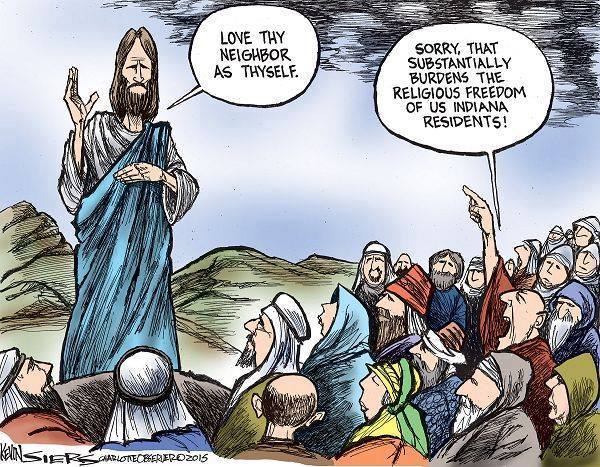
The second Comment of the Day, also on the same post, comes from frequent COTD author Extradimensional Cephalopod. His topic is religious freedom. Here it is…

Human logic is so warped by truisms. Why are we discussing the competition between religious freedom and the principle of respecting others? Once we strip away the artificial distinction between religious beliefs and any other beliefs, everything becomes more obvious.

It makes no sense at all to say that people are free to believe whatever they want but that they should not impose those beliefs on others in public. Society is built on a foundation of mutual beliefs, beliefs about the best obligations we can all impose on ourselves on behalf of each other. Fundamental disagreements or paradigm mismatches about ethics and rights cannot be ignored, because they disrupt the fabric of society itself. (No, gay marriage in itself doesn’t disrupt the fabric of society; the fact that only a small percentage of the population can discuss it respectfully and intelligently indicates the fabric has been looking for an excuse to unravel.)

“Religious freedom” is an excuse to avoid difficult conversations and careful thought, and just sweep the differences under the rug. The only reason that’s possible is because (most) people decided they would prefer to ignore each other rather than kill each other, but that doesn’t make the underlying misunderstandings go away. They show up in politics because the law of the land is the only place where people have no alternative but to deal with each other’s beliefs about right and wrong (or leave the country). If we face our disagreements head on, but with the goal of learning, there is no reason “tolerance” needs to last forever.

I would never tell a person who believes that gay marriage is an offense against a magical energy being that they should keep that belief to themselves, any more than I would ask it of someone who believes that evolution is a more accurate and useful concept than creationism. People who keep beliefs to themselves rarely get the opportunity to learn they’re wrong. Of course, people who never shut up about their beliefs and listen to alternatives never learn either. Ideas should be sent out into the world to stand on their own. Most of them will be torn to shreds, and that’s good. The ideas that don’t survive weren’t useful, at least not by themselves.

There is no way to defend religion as a concept, let alone its exercise, because religion is an arbitrary collection of descriptive and normative beliefs with a lot of people who consider them somehow existentially important. Religion in general cannot be defended ethically or legally, because its beliefs could say literally anything. Any such defense would merely be an excuse to completely ignore skepticism and critical thinking in the name of… somehow being morally superior in a way that critical thinking and skepticism… somehow prevents. However, most (but not all) religions allow critical thinking in ways that don’t threaten their tenets, because the ones that don’t are even more horribly crippled due to their intellectual bankruptcy. Few complain because few know how to think critically, or value the practice.

Continue reading

As Usual When Gender Discrimination In Wages Is The Issue, There Is More To The Women’s Soccer Lawsuit Than The Media Wants You To Know

women's soccer

The gender wage discrimination issue makes my head start to hurt every time it is raised, which, I admit, has made me grateful that Hillary and Bernie have been concentrating on the other progressive issues they fill with half-truths and deceit. Some of those are the wealth gap, mass incarceration, the evil of big banks, discrimination against Muslims, trigger-happy police, campus sexual assault, climate change, gun violence  and the minimum wage. As with these pet progressive agenda items, it isn’t that there aren’t real problems there that require effective policy initiatives, but that advocates are so infuriatingly dishonest when debating them—exaggerating statistics, demonizing opponents, and persisting in using false facts, studies and myths long after they have been definitively disproved.

If the new media was competent and even-handed, challenging the false assertions as they should, this would not be such an impediment to rational debate. The news media is seldom objective, however. On all of these issues and more, it plays the role of advocate and partisan ally with depressing regularity. An activist on the keft has to make a truly outrageous statement to even be challenged, as when Black Lives Matter organizer Aaron Goggans suggested on CNN yesterday that black on black crime is a “myth.”

There is gender discrimination in wages; I have seen it up close, in my family and in companies and organizations I have worked for. I have personally taken action to address it. The issue is complicated, however, and not close to the absurd “77 cents on the dollar” figure that has been employed, unchanged and virtually unchallenged, for decades, nor is it fairly represented by studies that show how men in the same careers make more over their working lives than women.

Never mind; the news media allows the issue to be debated in an atmosphere dominated by misrepresentations. My reflex approach is that  until advocates for a position are willing to stop lying, spinning, and demonizing, I will pointedly avoid supporting them. Call it the Clean Hands Doctrine. Gun control is one example. Climate change is another.

When  five players on the U.S. Women’s Soccer team filed a federal complaint last week accusing U.S. Soccer of wage discrimination because, they said, they earned as little as 40% of what players on the United States men’s national team earned despite reaching the team’s third World Cup championship last year, I read and heard nothing but cheers from women’s advocates, Democrats, pundits and Facebook posters I also read nothing but sexist snorting from the conservative side. (“Wanna know how to get paid the same as men for playing soccer? Try out for the men’s team! HAR!” ). The truth, as usual, is somewhere in the middle, but you wouldn’t know that from reading most accounts or watching the news channels. Continue reading

Law vs. Ethics: The Infuriating Big Branch Mine Disaster Sentence

UBBMemorial

We really have to change sentencing guidelines so that white-collar criminals get the sentences they deserve.

Twenty nine men were killed in West Virginia’s Upper Big Branch coal mine explosion six years ago, and former Massey Energy CEO Don Blankenship, who was  found guilty of conspiring to avoid safety regulations that could have prevented those deaths, received only a one-year prison sentence and a fine.

A federal jury convicted Blankenship last year of a misdemeanor conspiracy to violate mine safety standards at Upper Big Branch. The jury acquitted him of felonies that could have put him in jail for 30 years. The judge handed down the stiffest sentence allowed for his misdemeanor conviction, but U.S. Labor Secretary Thomas Perez, prosecutors and the family members said later that the punishment was far too lenient for the nature of the crime.

Indeed it was. Corporations play the odds in a risk-reward game. If violating rules, regulations and laws can save or make millions and the eventual penalty when and if the company is prosecuted is only a fine, many companies and executives think it’s a risk worth taking. . If the risk also includes significant prison sentences for decision-makers, the risk-reward ratio changes significantly.

Blankenship was CEO of a company that intentionally risked the lives of its employees, and 29 men died. One year in jail looks like a rap on the wrist. Forget about the “Affluenza” kid: this sentence is far more disturbing.

“This man has no remorse at all!” a family member of one of the victims said. “He never approached none of us [after the mine disaster], he never told us he was sorry for what happened, and he knows he could have done the right thing.”

“I miss my family. (Blankenship) hugged his,”  he continued. “And all he gets is a year. The judge has done great; she gave him what she can give him. But there need to be stricter, more harsh penalties for people like that who put greed and money over human life.”

Yes.