Comment of the Day: “The Golden Rule Distortions”

bread

In a comment on the post about the various versions of the Golden Rule, including popular distortions of it, Isaac revisited the ever-popular “Les Misérables” scenario, in which a desperate man steals a loaf of bread to achieve a greater good. Is such law-breaking still unethical? I have consistently maintained that it is from society’s standpoint, if not from the perspective of the lawbreaker. The issue has arisen in the past in relation to illegal immigration.I think Isaac nails it.

Here is his Comment of the Day on the post, The Golden Rule Distortions: Continue reading

Some content on this page was disabled on November 29, 2017 as a result of a DMCA takedown notice from Tara Margetson. You can learn more about the DMCA here:

https://wordpress.com/support/copyright-and-the-dmca/

Business Ethics: Searching For An Effective Way To Show Contempt, And Failing Miserably

"You got a complaint?"

“You got a complaint?”

After yesterday’s excursion, I am adding Gold’s Gym to the long list of companies I will no longer patronize come Hell or high water. As my Dad used to say (he died exactly four years ago today, on my birthday, which I suspect may have been just another in a long line of his black humor pranks), “That and twenty cents will get you a ride on the MTA.”

Gold’s Gym screwed me in one of those little ways that doesn’t matter much in any one case, but that multiplied by thousands probably pays for some nice bonuses. I don’t appreciate this, and there should be a some way to make it stop, or at least hurt the company a little.  As with so many other unethical business practices, however, by other companies large and small, there isn’t, which is why those practices persist. And the fact that they are just scrimey, petty, unfair and wrong apparently isn’t that enough to make cause an executive somewhere in the chain of command who was raised right to just say, “Wait—this makes our company look like a used car lot.  Where’s our integrity?”  I suspect it’s because when such an executive does this, his boss says, “Integrity is nice, Bill, but that little trick pays for your raise.” To which Bill answers, “Oh. Never mind.” Continue reading

Wait…The Judge And The Defense Attorney Were Having An Affair, And The Defendants Were Convicted Anyway? So What’s The Problem?

"Yes, counsel, I am throwing the book at your clients because I love you."*

“Yes, counsel, I am throwing the book at your clients because I love you.”*

The Georgia Court of Appeals has ordered new trials for five men convicted of serious crimes in Fayette County because their trial judge was having an undisclosed affair with defendants’ public defender.

Doesn’t  that seem strange to you? After all, the clients of the judge’s secret love were convicted and sentenced. Why should they get the benefit of  new trials when the judge’s evident conflict and judicial misconduct didn’t benefit them or harm them in any way (unless a judge making sure his lover’s clients get prison time is a quirky way to say “I love you” in the Peach Tree State). This isn’t like the horrendous Charles Dean Hood case in Texas, where a man was sentenced to death after a trial in which the state prosecutor was sleeping with the judge.

The Georgia judge-lawyer affair (and I thought Steven Bochco was making it all up!) came to light in 2010. Paschal English, who subsequently resigned as chief Superior Court judge, had been involved in a romantic relationship with assistant public defender Kimberly Cornwell, who has also moved on to new pursuits, ideally those that don’t require trust or ethics. A three judge panel recently agreed that this relationship, undisclosed and a clear cut ethical violation for both judge and attorney, required that there be new trials for Christopher Wakefield and Travion Willis on charges of armed robbery, kidnapping, aggravated assault and other crimes; William Nutt for aggravated child molestation and aggravated sexual battery; Rashad Arnold for burglary; and Calvin Boynton for armed robbery, aggravated assault, possession of a sawed-off shotgun and drug possession.

Hmmmm… Continue reading

Ethics Hero, Thanksgiving Division: Scott Stuckey, Manager of Atlanta’s Omni Hotel

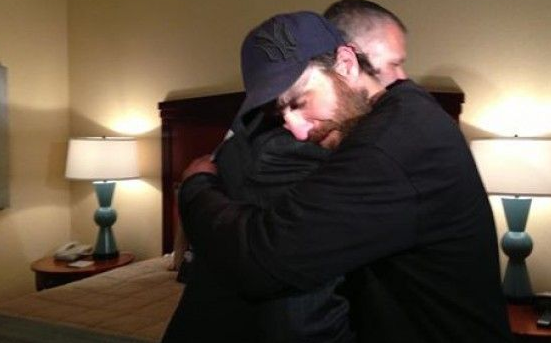
Scott Stuckey gets hugged by a grateful non-criminal Joel Hartman was homeless and surviving in Atlanta by dumpster diving, but when he found a lost wallet with the owner’s identification and credit card inside, he was determined to do the right thing. The wallet obviously belonged to a tourist, so the 36-year-old man checked the hotels in downtown Atlanta until he found out that the tourist (from France, for a conference) was staying at the Omni Hotel.

After Alanta’s Omni manager Scott Stuckey saw the surveillance video of Hartman—who looked as destitute as he was— turning in the wallet to the hotel’s  security guards, he decided that a reward was in order.  Hartman had given them a fake name, so it took some effort to track the shy good Samaritan down. Stuckey and his staff searched for a week, leaving messages with other homeless people that the Omni wanted to thank the man who recovered its guest’s stolen wallet. Eventually Hartman heard about their quest, and showed up at the hotel. He was shocked at what Stuckey had planned for him. Hartman was told that he would be the Omni’s guest in a luxury room through the Thanksgiving holiday with complimentary room service. The hotel also  gave him $500.

I think the gesture by Stuckey and the Omni was kind, appropriate, and in keeping with the spirit of the holiday….but: Continue reading

Comment of the Day: “Ethics Quiz: The Kidneys of Orlac”

But first, a last act of altruism...

But first, a last act of altruism?

The presumptive winner of the annual Ethics Alarms award for “Commenter of the Year” in 2013, texagg04has delivered a Comment of the Day expanding the topic of the post regarding a condemned prisoner in Ohio who wrangled a postponement of his execution so he could donate his organs to relatives. Here is  texagg04’s  take on “Ethics Quiz: The Kidneys of Orlac.” I’ll have some comments at the end.

“First, a murderer or other capital criminal being held responsible for his or her conduct seems to be in conflict with the same individual being allowed to display charity when you say they  forfeited their freedom, all of it, with their commission of a  capital crime. I’m not so sure it should be viewed from that angle.

Punishment serves a variety of purposes. Some petty crimes receive punishment designed to compensate, as best as can be, the victim – the victim being dead, capital punishment does not serve this purpose. Some crimes are of an anti-social nature, and the apt punishment seeks to rehabilitate or reconcile the perpetrator to the community. Capital crimes are so heinous that we have determined that the perpetrator must be completely cut off from society, through their death. In this case, the punishment does nothing for the victim OR for the criminal; the punishment is designed solely for the benefit of society.

If the criminal wishes to donate his/her organs to (what we must assume is to salve their own conscience – even though we can, probably, cynically assume is just a delaying tactic), we should not care one bit. They are gaining no material benefit from the community, nor are they engaging in any direct interaction with the community – so the act of cutting them off from the community as part of the punishment is still complete. Continue reading

“How Dare Universities Charge Such High Tuition?” KABOOM!* #1: Georgetown University Law Center

headexplode

Kaboom.

James Feinerman, the James M. Morita Professor of Asian Legal Studies at Georgetown University Law Center, who also serves as its associate dean for transnational programs, was hired by the U.S. government as an expert witness  to bolster the prosecution in a spying case, and apparently plagiarized a substantial potion of the report submitted to the court from <sigh–there goes that value of THAT degree> Wikipedia.The defense picked up on the uncited cribbing and the federal court is now examining whether the sources used by Wikipedia are reliable enough for his report to be accorded any validity. The Government, meanwhile, represented by assistant U.S. attorneys Peter Axelrod and John Hemann, is stuck with making desperate “ahumunahumuna” sounds like Ralph Kramden used to do on “The Honeymooners” when he was caught looking stupid and spouting lame arguments in court filings about how Feinerman “utilized language from Wikipedia as a concise English-language summary of his opinions on certain topics.”

Riiiight. Continue reading

Ethics Quiz: The Kidneys of Orlac

Kidneys, okay, maybe...BUT NOT THE HANDS! NEVER THE HANDS!!!

Kidneys, okay, maybe…BUT NOT THE HANDS! NEVER THE HANDS!!!

One individual who may be having complicated sentiments this Thanksgiving is Ronald Phillips, who is current residing on Ohio’s death row. He was supposed to be dead by now, but was spared at the last moment when Governor John Kasich issued a stay of execution to ponder Phillips’ unusual request, which had been rejected by prison officials. Phillips, you see, is not a nice guy, as his current address might suggest. He was convicted of raping and killing the three-year-old daughter of his girl friend. (They subsequently broke up. It was him, not her.) He had experienced a change of heart, however, or rather, wished to facilitate one. His sister needs a heart transplant, and he wants his to be passed over to her after his execution by lethal injection. He also wants his kidneys donated to his mother, who is on dialysis because hers are failing, and any other parts of him that might save a life given to others.

Presumably this will not include his hands, because there are a couple of horror movies, one old one in particular, about what happens after that operation, and they are pretty scary. There are no horror films that I know of, however, about the aftermath of getting an executed murderer’s kidney.

Yet.

Gov. Kasich, who is a nice guy, has explained that as heinous as Phillips’ crime was, the state should try to accommodate his desire to save innocent lives. The tentative plan is to hollow Phillips out, execute him in July, and then harvest anything that’s left.

Have you seen that movie, by the way?

Your Ethics Alarms Ethics Quiz:

Should such a request by a condemned prisoner be granted?

I’ll play devil’s advocate here, except that the advocate for the child rapist deserves the title more than I do. I think Kasich is confused, and that Phillips or his lawyers have figured out one more way to foil the criminal justice system. Continue reading

Annie Dookhan, The Nightmare Employee

Funny---she doesn't LOOK evil.

Funny—she doesn’t LOOK evil.

Every organization dreads the falsely competent employee who is secretly cutting corners and covering their tracks. Sometimes, they are embezzlers. Sometimes they are plagiarists, or journalists who fabricate quotes and only pretend to check sources.  Sometimes they are managers, CEOs, generals and leaders who are faking it, not providing oversight and diligently making sure that others are doing their jobs. These people are thieves, essentially: they are stealing their salaries under the false pretense that they know what they are doing and can be trusted. Often they are worse than thieves, because they sap their organizations of efficiency and momentum, secretly, stealthily. Needless to say, government bureaucracies are crawling with them, and they cost all of us money, security, hope and happiness.

Annie Doohkan is one of the worst of this breed I have ever encountered.  She was a state chemist in Massachusetts who intentionally mishandled evidence in drug cases, rushing results, falsifying them, certifying that she did tests when she really didn’t. Finally the lies became too much to hide, and she was exposed, but not before her perfidy forced the release of hundreds of convicts, raised new questions about thousands of other cases, and forced the state to spend millions of dollars. Apparently she had no greater motive for inflicting this carnage than her desire to give police and prosecutors what they wanted, and to appear to be fast, efficient and reliable. Continue reading

Ethics Hero (Animal Lover Division): Janet Sinclair

janet+and+sedona

Janet Sinclair used United Airlines’ “PetSafe” service to fly her beloved greyhound Sedona cross-country from San Diego. The service assures flyers that their pets will make the journey safe and sound, with responsible care and personal handling. Sinclair, however, became alarmed when she saw a United employee kick Sedona’s crate six times to shove it under the shade of the plane’s wing instead of carefully moving it. She then began documenting United’s pet care. Her video  shows her dog being left outside in 94 degree heat at a mid-journey stop (in Houston), and not placed in a temperature-controlled vehicle as she had been promised. When Sinclair landed at Logan Airport in Boston, her dog was barking at death’s door.

“Sedona’s entire crate was filled with blood, feces, urine,” Sinclair told reporters. “Sedona was in full heat stroke. All of the blankets were filled with blood. She was urinating and defecating blood. She was dying, literally, right in front of me.” The veterinarian who saved Sedona diagnosed her with heat stroke, urinary tract infection and liver dysfunction, all arising from the over-heating the dog experienced during the United Airlines flight. The airline, for its part, claimed that the dog’s distress was due to pre-existing conditions, though Sinclair’s vet had declared Sedona healthy following a pre-trip exam. Continue reading

Three Case Studies In Ethics Obtuseness: The Sheriff, His Victim, And The Hollywood Loudmouth

Hear-No-Evil-See-No-Evil-Speak-No-Evil

These Ethics Dunces  don’t get it, and probably never will.

There is nothing quite as frustrating as the ethics offender who receives a clarion lesson in response to the wrongful conduct, and completely misses the point:

Case Study #1 : Alec Baldwin

The serial loudmouth actor, who alternates between banal progressive nostrums and outbreaks of public violence, verbal abuse and denigrating slurs, was inexplicably addressing a gathering of ServiceSource International Inc. employees in the aftermath of his suspension by MSNBC for calling a photographer a “cocksucking fag” and getting caught on video in the process (the network was trying to make sure the actor understood that it was harmful to have one of its show hosts denigrate a strong demographic slice of their viewing audience, and that in the future he should confine his outbreaks of vile language to calling for conservatives to be defecated in and upon). ServiceSource CEO Michael Smerklo, having already booked Baldwin, said that Baldwin’s  insult to  gays created  one of the toughest decisions in his career. Hmmm… pay Alec Baldwin lots of money to impart his wisdom to a tech firm’s employees, or spend the money on something more worthwhile, like, say Cheetos. Wow. What a quandary. And why did the CEO think that Baldwin’s wisdom was worth imparting? CBS says: Continue reading