Clarence Thomas Gets A Rare “Double Dunce,” Ethical And Political

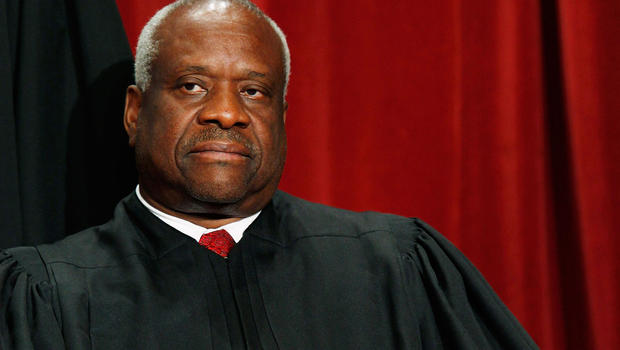
I really don’t comprehend how this can happen with someone like Justice Clarence Thomas. Donald Trump, sure. But Thomas is smarter than this.

Between 2003 and 2007, Ginni Thomas, the Justice’s controversial wife and a hard-Right activist, earned $686,589 from the Heritage Foundation, according to a Common Cause review of the foundation’s IRS records. Yet Justice Thomas failed to note the income in his Supreme Court financial disclosure forms for those years. He checked a box labeled “none” where “spousal non-investment income” is supposed to be disclosed.

Federal judges are bound by law to disclose the source of spousal income, meaning that if the information found by Common Cause is accurate, Thomas did not comply with the law. SCOTUS justices are supposed to obey the law, even more than everybody else, in some respects. Legal ethics expert Steven Lubet (I used his legal ethics textbook when I taught the subject at American University!) says that a failure to disclose spousal income by a federal judge “is not a crime of any sort, but there is a potential civil penalty” for it. “I am not aware of a single case of a judge being penalized simply for this,” the professor says.

Continue reading

Comment Of The Day: NetChoice LLC v. Paxton (Item #4 In “Sunday Consequential Ethics Epiphanies, 9/18/2022”)

I am enmeshed in a disagreement with esteemed and long-time Ethics Alarms commenter Chris Marschner regarding Texas’ HB 20 signed into law last year. It prohibits social media platforms with over 50 million monthly U.S. users from censoring posts based political positions and viewpoints. To my surprise (although considering the Court, maybe it shouldn’t have been) the Fifth Circuit helding that the right to free speech didn’t include the right to censor speech, a privately-owned platform. That opinion is here. I wrote that I didn’t understand the opinion at all, meaning that while I find the way social media platforms employ bias and partisan favoritism to censor posts using double standards profoundly unethical, I also think the Texas law is screamingly unconstitutional, and is likely to be held to be so by the U.S. Supreme Court. However, I understand the opinion better than I did thanks to Chris’s advocacy.

Here is his Comment of the Day on Item #4 of the post, “Sunday Consequential Ethics Epiphanies, 9/18/2022: On Incompetence, Diversity, Censorship And More..”

***

You and I are in complete agreement on the issue of viewpoint discrimination. I will counter that the service provided is not free. It is true that monetary compensation is not used but the Users barter for the service by providing valuable personal data and rights to the content they post online on an ongoing basis.

While Facebook does not sell users data directly it does so indirectly by serving as a middleman using its algorithm to serve up targeted advertising. That is the foundation of the business model from which the service derives its income.

One might argue that the perceived value of this trade is lopsided in favor of the user because of the billions of dollars needed to create and maintain the platform while all the user exchanges for access is giving the Service intelligence about the User. The problem with that argument is that it only appears lopsided because until the business model was developed the user has no individual means to collect financial compensation for them being subjected to an endless barrage of advertisements. Through this business model Users obtain an exchange of value by creating a social media account. In a sense, Facebook, et al serves as a medium of exchange which is the primary defining characteristic of money. Continue reading

Observations On Another Capital Punishment Fiasco

That’s Alan Eugene Miller, who was convicted of murdering three men in 1999. Nobody disputes that he is guilty. The only question is how and when he will be executed, as he received the death penalty and deserved to. The fact that he is still breathing 23 years after his crimes speaks for itself, and is self-evidently absurd, a direct consequence of the moral and ethical confusion over capitol punishment. People like Miller—that is, people who have forfeited their right to continue living in a civilized society—cost law abiding citizens millions by the time they finally get their just desserts.

This story is especially infuriating as well as ridiculous. Alabama passed a law in 2018 that gave death row prisoners a choice between being killed by a lethal injection and dying by a nitrogen hypoxia, which is death by being deprived of oxygen.

[Observation: Why a condemned prisoner should be given any choice at all is beyond me. As Alabama Governor Kay Ivey, said, Miller’s three victims didn’t get to choose whether they would be shot in the chest.]

Miller is, we are told, afraid of needles, so he chose suffocation.

[Observation:  This already sounds like a Monty Python skit. Again, who cares what he’s afraid of? Presumably he’s also a bit afraid to die. So what? Why should the state, or the society he betrayed, have any ethical obligation to yield to his delicate sensitivities?] Continue reading

“Salt And Seltzer,” A True Life Ethics Spectacular!

I can’t believe I am just writing about this wonderful ethics saga from 2005 now, after it had been sitting in my files for all this time. The story has everything: fine art, cowboys, nasty tycoons, fraud, irony, lawsuits, unethical lawyers and condign justice.

In 1972, Steve Morton, heir to the Morton Salt fortune and a noted California art collector, bought the 21-by-27-inch watercolor above, “”Lassoing a Longhorn,”  from the Kennedy Galleries in New York for $38,000. The Kennedy Galleries had purchased it from the Amon Carter Museum of Fort Worth, Texas, which had acquired it from its founder, Amon Carter, a collector of western art. The painting was signed by Charles Russell, along with Frederic Remington recognized as the master of Wild West fine art.  Morton decided to sell the painting in 2001, as the value of Russell painting had ballooned.He arranged to have the Coeur d’Alene Art Auction in Reno, Nevada handle the sale, and as was their practice, the auction house had the painting appraised.

Before agreeing to sell the painting, the auction house contacted Western art expert Steve Seltzer to examine the work, and he announced that it wasn’t a genuine Russell at all. He concluded that it was forgery by a a lesser-known western artist who forged Russell’s signature on the painting. If anyone would know, Seltzer would: the forger was his own grandfather, O.C. Seltzer. Continue reading

Ethics Quiz: Those Illegal Immigrant Exporting “Stunts”

In today’s Open Forum, veteran commenter Arthur in Maine writes in part,

I’m sure you’ve all heard about the fact that Ron DeSantis sent two charter planes loaded with illegal aliens to Martha’s Vineyard, which is about 10.5 miles south of me. I find this situation absolutely hilarious on the macro scale. But from an ethics standpoint, it’s more troubling.

1) The Biden administration has been flying illegals to airports all over the country and dumping them off. This, in my view, is unethical (as is the administration’s policy on the southern border). Essentially, DeSantis did the same thing, but that doesn’t make it ethical in return.

2) Conservative media is, in my opinion, overstating the reaction on the left. Unethical. That said, there’s enough pearl clutching on the left to make this all highly entertaining. To me. Which is unethical, and I’m not proud of it, but I never claimed to be perfect.

3) DeSantis’s timing could have been better. Most of the uber-rich limousine liberals with summer homes on the Vineyard head out around Labor Day. Had he done this in August, he actually could have made this a bigger story. Which would, of course, be unethical – but no more so than it already is.

4) The aforementioned pearl-clutchers on the left are calling this a political stunt, using illegal aliens as pawns. That argument is not without merit. But it’s curious that they didn’t seem to care much when the border states were bearing the brunt of hundreds of thousands of illegals by themselves. Which is… unethical.

DeSantis’s move, though it is funnier and more diabolical (can something be ethical and diabolical?), has to be considered in the same category as the busloads of illegals that were sent to the “sanctuary cities” of New York, Washington, D.C., and Chicago. The original idea was the inspiration of Texas Governor Greg Abbott, or a particularly creative advisor.

Your Ethics Alarms Ethics Quiz of the Day is…

Is it unethical for the governors of Texas and Florida to be sending illegal immigrants to ostentatiously progressive destinations?

Continue reading

Morning Ethics Warm-Up, 9/7/2022: Neil, Sam, Kwame, Mehmet And More

I took a wild guess that Neil had to have done this parody of his biggest hit because it was so obvious, and sure enough, I was right!

It’s not exactly an ethics story, but it does involve my home town of Arlington, Massachusetts: on September 7, 1813, a local newspaper in Troy, New York wrote about how Troy’s Samuel Wilson, a meat packer who supplied barrels of beef to the United States Army during the War of 1812, was being facetiously called “Uncle Sam” by soldiers because he stamped the barrels of meat “U.S.” The trivial story caught on and the nickname persisted. Decades later, brilliant 19th Century political cartoonist Thomas Nast (1840-1902) began using a character called Uncle Sam as the personification of the nation, giving Sam the white beard and stars-and-stripes suit that he still wears today. Troy, quite reasonably, later dubbed itself “The Home of Uncle Sam.” But Wilson was born in Arlington, Mass., and the town management, frustrated with its relative obscurity despite being in the midst of other Greater Boston tourist destinations like Concord, Lexington and Cambridge, decided a few decades ago to promote Arlington as “The Birthplace of Uncle Sam,” essentially horning in on Troy’s historical territory (Troy was not pleased). Arlington even paid to have a statue of Nast’s Sam designed, cast and erected.

Nobody cared.

1. More on “quiet quitting”:  Gallup estimates that at least half the workforce is “quiet quitting,” meaning that it does the bare minimum required to keep jobs rather than working to do their best. Gallup’s analysis blames management, which is certainly part of the problem. It does not address the serious cultural ethics issue of workers seeking to be excellent because it is beneficial for society as a whole and an embodiment of the Golden Rule, as well as a life habit that develops good character and justifies trust. Quiet quitters are just a few degrees better than freeloaders, an anchor on the nation, the economy and the quality of life. Continue reading

Of COURSE Trump Having All Those Documents At Mar-A-Largo Was Unethical…Is Anyone Seriously Confused About That?

Well, maybe Donald Trump. But definitely not Ethics Alarms.

At the Washington Examiner, editor and columnist Quin Hillyer writes that…

Former President Donald Trump’s defenders in the matter of the Mar-a-Lago documents controversy are defending the indefensible. Forget the legalities: For the sake of (spurious) argument, let’s stipulate that somehow Trump can concoct some looking-glass version of a legal argument that justifies his “authority” to do with the documents as he did. The point is that even if it was technically legal, it was wrong, wrong, wrong.

Heck, I’ll go farther than that; this is the proverbial low-hanging fruit. Donald Trump doesn’t know what ethics is: never has, never will. He decides what is “right” according to some secret personal algorithm that changes daily so it can’t be stolen, or something. His lifting government documents and storing them at his home without authorization after he had left office is as indefensible as any time an ex-employee takes property from the workplace home. Funny, I didn’t think that was even worth writing about; I do try to avoid the obvious here as often as possible.

Continue reading

Ethics Quote Of The Week: Legal Ethicist Stephen Gillers

“I don’t think a jury would convict him without proof of harm. I’m not sure I would…It has to be one-hundred-per-cent irresistible as a matter of law. There can be no fact, no event, no piece of evidence that could support any room for ambiguity.” 

—NYU law professor and legal ethics expert Stephen Gillers, reflecting on the chances of conviction arising from an indictment of Donald Trump for violations of the Espionage Act and other statutes making the mishandling classified information a crime.

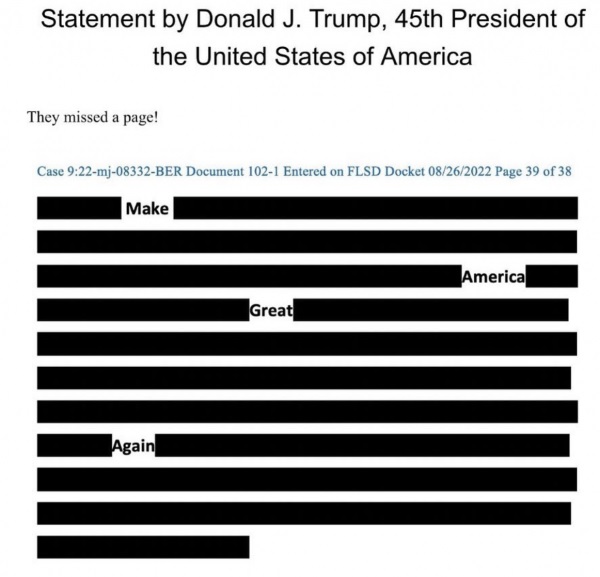
Gillers’ position is similar to that of Alan Dershowitz, who also said last week that while there appears to be sufficient evidence to charge Trump (based on the heavily redacted affidavit Trump was mocking in his meme above), it would be unwise to do so. It would also be unethical prosecutorial conduct unless there is a significant likelihood that Trump could be convicted. It is unethical to make “the process the punishment,” and Attorney General Garland knows it.

This is why the raid on Mar-a-Largo was suspicious as well as a terrible precedent in the first place. In the absence of any demonstrated urgency, the raid looked like an effort to “mess Trump up a little” by treating him like a drug kingpin or a Mafia crime boss rather than with the deference every other former POTUS has received. This made it political theater rather than legitimate law enforcement, executed by a struggling administration apparently terrified of the previous President and his passionate supporters. Continue reading

Someone Explain The Kobe Bryant Photos Case To Me, Because I Don’t Understand It At All

It appears to be a triumph of “ick” over both law and ethics.

Kobe Bryant’s widow, Vanessa, was awarded $16 million as her part of a $31 million jury verdict Wednesday against Los Angeles County. Deputies and firefighters had shared gruesome photos of the NBA star; their 13-year-old daughter, Gianna; and other victims killed in a 2020 helicopter crash; the family of those other victims received the rest of $31 million. The nine jurors unanimously agreed with Vanessa Bryant and her attorneys’ argument that the photos invaded her privacy and caused emotional distress.

I’m sure they caused emotional distress. But how can an event that occurs in public be declared sufficiently private to have the protection of the right to privacy? If a journalist had taken the photos and published them, or shared them on a news website, presumably there would be no way Bryant’s widow would have a cause of action. I don’t see how a bystander with a cell phone could be blocked or sued either. These pictures were shared mostly among employees of the Los Angeles County sheriff’s and fire departments.They also were seen by some of their spouses and in one case by a bartender at a bar where a deputy was drinking. Well not to be unsympathetic, but so what? How does the right to privacy make reality a personal property protected by the law? If the bloody crash occurred where a crowd of a hundred people could see it, how would the law black them from taking photos and showing them to friends?

Continue reading

The NY “Body-Snatchers” Case: Why Do Good People Do Bad Things? It May Be That They Aren’t The Good People They Think They Are….

I intended to write a post after seeing Tony Dye’s 2010 documentary “Body Snatchers of New York” a few years ago. Through a series of interviews with law enforcement officials, lawyers, journalists and victims, it tells the story of a sensational case out of Brooklyn in 2006 where a former dentist and his associates operating a company called Biomedical Tissue Services of Fort Lee, New Jersey, conspired with funeral homes to steal human bone and skin from dead bodies. The tissue was then sold to various processing companies to make medical products, including dental implants and spinal disc replacements. These, in turn were sold to hospitals to be transplanted.

In some cases, the families of the deceased individuals were told that their loved ones had been cremated when in truth they had been carved up and skinned. One such body belonged to the late Masterpiece Theater host, Allistair Cooke. Biomedical Tissue Services made as much as $250,000 from processing each body. In addition to lying to families and not receiving consent to distribute tissue and bone from corpses, the company also routinely sold body remnants from dead individuals who had suffered from drug and alcohol addiction, cancer, AIDS, hepatitis, and other diseases that compromised the safety of the tissue without informing their purchasers, tissue recipients or their doctors.

Continue reading