Morning Ethics Warm-Up, 2/27/2020: “Macho Man” Rights, A Billionaire Jerk Contest, And More

Good morning!

Not thrilled to be up before Virginia’s sunrise, but looking forward to it…

1. It’s sad what happens to Ethics Alarms expatriates...One upon a time, uber-progressive blogger/cartoonist Barry Deutsch, aka Ampersand, was one of the most prolific, open-minded, articulate and reasonable commenters here. Then Barry banned himself because he didn’t like my pointing out that his blog is an echo chamber, after he censored my comment there noting that his SJW throng’s  position on the Trayvon Martin-Zimmerman affair was intellectually dishonest.  So Barry retreated to his self-made bubble. I check in on him now and then, and that admirable open-mindedness has disappeared in the marinade of relentlessly woke and intolerant fans.

Here’s how bad it is for Barry: this what he wrote on his “Alas! A Blog”recently: “Conservatives are against all immigrants (or at least all non-white immigrants), not just unauthorized immigrants.”

Tragic. Barry Deutsch now believes that anyone who disagrees with his far left world view is a racist. The Ampersand who followed Ethics Alarms would never think such a thing, much less publish it.

2. The trouble with billionaires. The class warfare being fomented by Bernie Sanders and others for a cynical and destructive power grab is an old formula that, when it works, always brings chaos in its wake. Throughout history, it has succeeded more often than basic economics and common sense would dictate in part because so many of the ultra-rich persist in being jerks. Does being a jerk make one more inclined to get rich, or does becoming extremely rich have a tendency to make one a toxic jerk?

That’s a question for the ages, but the behavior of people like billionaires Peter Nygard and Louis Bacon make things easier for class warfare demagogues like Sanders, Elizabeth Warren, and Rep. Ocasio-Cortez, just as it did for Lenin and Robespierre before them. This story, about their absurd and costly feud, illustrates how extreme wealth can permit one’s ethics alarms, not to mention sense of proportion, go dead.

From the Times:

The Bahamian pleasure palace featured a faux Mayan temple, sculptures of smoke-breathing snakes and a disco with a stripper pole. The owner, Peter Nygard, a Canadian fashion executive, showed off his estate on TV shows like “Lifestyles of the Rich and Famous” and threw loud beachfront parties, reveling in the company of teenage girls and young women. Next door, Louis Bacon, an American hedge fund billionaire, presided over an airy retreat with a lawn for croquet. Mr. Bacon preferred hunting alone with a bow and arrow to attending wild parties, and if mentioned at all in the press, was typically described as buttoned-up.

The neighbors had little in common except for extreme wealth and a driveway. But when Mr. Nygard wasn’t allowed to rebuild after a fire, he blamed Mr. Bacon. Since then, the two have been embroiled in an epic battle, spending tens of millions of dollars and filing at least 25 lawsuits in five jurisdictions. Mr. Nygard, 78, has spread stories accusing Mr. Bacon of being an insider trader, murderer and member of the Ku Klux Klan. Mr. Bacon, 63, has accused Mr. Nygard of plotting to kill him.

Read the whole thing. Continue reading

Oh, This Will Be Fun! How Ignorant And Misleading Was David Frum’s Vicious Attack On President Trump’s Physical Condition? [PART 2] [CORRECTED!]

David Frum’s assertion that President Trump is one of the “least physically capable” Presidents only shows that his knowledge of the Presidents is an inch deep and about as wide….or, in the alternative, that he knows what he is saying is false but is counting on the public’s ignorance of history and CNN’s complicity in gratuitous Trump bashing to get away with it. Well, at least on Ethics Alarms he’s not going to get away with it.

Let’s look first at Trump’s predecessors after FDR. Recall that Frum’s  statement was that Trump is “the least physically capable president since Franklin Delano Roosevelt was in a wheelchair.”

  • George H.W. Bush, tough old bird that he was, dealt with more health issues as President than Trump. He suffered from bleeding ulcers, arthritis,  atrial fibrillation and the autoimmune disorder Graves’ disease.
  • John F. Kennedy was a sick man throughout his short term in office; he just had his staff and reporters cover it up.  His 1947 diagnosis of Addison’s disease, an incurable disorder of the adrenal gland, was kept secret until well after his death. JFK’s chronic back pain caused him to develop an addictions to painkillers, stimulants, and other medication; historians suspect that he made important decisions while “bombed out of his mind.”
  • Dwight D. Eisenhower had three major medical incidents during his two terms in office: a heart attack, a stroke, and Crohn’s disease. Saying Eisenhower was more “physically able” than Donald Trump is either gross ignorance on Frum’s part, or a lie. Of course, Stelter couldn’t correct him, because he’s an idiot, and wouldn’t correct any false attacks on President Trump anyway.

Going back before Franklin Roosevelt (who was beyond question the least physically able President in history when he won his final term in 1944, since he was dying of heart disease and worse, knew it; it had nothing to do with his whellchair) we have a veritable Presidential intensive care unit. Let’s skip over Harding, who suffered his whole life from anxiety and emotional problems, and who had undiagnosed heart problems that ultimately killed him, and go to the runner up champ of physically disabled Presidents, Woodrow Wilson. Afflicted with untreatable (then) hypertension, Wilson was plagued by chronic headaches and double vision until he had  a series of strokes. One affected his right hand, leaving him unable to write normally, then more serious strokes rendered Wilson blind in his left eye, paralyzed on his left side, and eventually unable to discharge his duties as President. This was hidden from the public and Congress, with his wife and his doctor handling most of Wilson’s presidential tasks.

President Taft, as we all know, was morbidly obese at well over 300 pounds, and as a result suffered from sleep apnea (he dozed off during meetings), high blood pressure, and heart disease. Teddy Roosevelt managed to exude health with his ostentatiously vigorous lifestyle, but he wasn’t healthy. TR battled clinical depression his whole life, and despite what you will often read, he never overcame his childhood asthma. He was also diagnosed with a heart murmur, and advised to live a sedate life.  He did not.

This may well have contributed to the fact that he was dead shortly after his 60th birthday.

In addition to being the second most obese President, Grover Cleveland suffered from many maladies while President, most notably cancer, necessitating a secret operation that replaced his upper palate with a rubber prosthetic. My favorite obscure President, Chester A. Arthur, was ill during his entire three years in office, and died shortly after. He had progressive kidney failure from Bright’s Disease.

Before Arthur, the previous physically-limited President was, surprisingly, Abraham Lincoln. Lincoln was another depressive, but his symptoms probably had a physical cause: likely permanent brain damage from being kicked in the head by a horse when he was young. Lincoln also had malaria flare-ups, and got smallpox during the Civil War. He may have suffered from mercury poisoning from pills that were frequently prescribed at the time.  Abe’s  photographs indicate drmatic weight loss and muscle wasting during the war, and some doctors believe he  was afflicted with multiple endocrine neoplasia type 2B (MEN2B) or Marfan syndrome, rare genetic disorders, although he lived longer than either of those conditions usually permit.

Two Presidents before Lincoln we had poor, broken Franklin Pierce in the White House, perhaps the most disabled of all.  He spent his entire, disastrous term in office in deep depression following the horrible death of his young son before his eyes in a train accident as his family headed to Washington after his election. Pierce’s wife Jane was never the same after teh accident, and Pierce’s alcoholism became intermittently debilitating.

Donald Trump, as you probably know, is a lifetime abstainer from alcohol.

Jumping past Presidents Taylor and William Henry Harrison, neither of whom were sufficiently physically able to last a single term before succumbing to illness  (Taylor less that a year and a half, Harrison about a month), we finally reach the all-time champion of unhealthy Presidents, Andrew Jackson.

When he finally won the Presidency at the age of 62 (after having been robbed of victory four years earlier), Old Hickory was plagued by the lingering wound from two of his less successful pistol duels. One bullet was lodged in his arm, where it festered and gave him chronic pain. ( This bullet was finally removed when Jackson was President) A second bullet, lodged in his chest near his lung and  heart, was considered inoperable. It caused serious pulmonary problems and caused Jackson to cough up blood periodically. The bullets also caused lead poisoning.

Jackson was seriously underweight, and there was a good reason for that: his digestive tract was permanently damaged. He suffered from recurring flare-ups of malaria, typhoid, typhus and dysentery, progressive heart failure, and some sources say he had tuberculosis as well. Like Lincoln, Jackson was poisoned by mercury pills given to him by his doctors.

I think I’ll stop with Andy, the President that Trump most identifies with, and justly so.  There is more than sufficient evidence that David Frum didn’t know what he was talking about, and that CNN allowed him to misinform its viewers by adding fake history to its usual fare of biased and fake news.

Ethics Observations On This Hilarious Trolling Competition

  • The President  wins, obviously. It does not demonstrate good judgment to challenge a master at his own game, on his home turf.

The ethics values at issue: hubris, competence.

  • It’s good to see that Mike Bloomberg is determined to elevate the level of campaign discourse, isn’t it?

Of course, Trump’s trademarked person insults about adversaries’ appearance are unpresidential and infantile, but they are his unapologetic style. Did Bloomberg not watch the 2016 GOP debates, when Marco Rubio lowered himself to Trump’s level with return personal insults only to see his support erode as a result? Did Bloomberg’s advisors?

Running against a President on the basis that he is a boor and an asshole and behaving like a boor and an asshole to do it is both hypocritical and stupid. Moreover, Rubio’s blunder is a matter of record. Bloomberg isn’t doing his homework.

Ethics values: Honesty, integrity, competence, diligence. Continue reading

Trump Tweets: The Movies

Stipulated: the ethics position here has been since long before the Trump years that Presidents should keep their opinions of persons, places, things and events having nothing to do with their duties or responsibilities to themselves.

Presidents are not kings, nor popes, nor universal authorities on everything. They have a role to fill, and they should fill it; it’s not like there should be plenty of time left over for weighing in on such matters as sports, popular culture, celebrities, and local controversies.

President Obama did far more of this than was responsible or good for the country, notably during race-related controversies. President Trump, obviously, has taken this misuse of his position into the stratosphere with his addiction to Twitter. His unrestrained tweets have done him at least as much harm as good; my own guess is that if he eschewed social media, his approval ratings would be 10% higher than they are.

It is also, I think, beyond argument that Trump’s use of Twitter guarantees that future Presidents will also use it to opine on matters that are none of their business. This is not a good thing.

The President’s latest self-made controversy, actually two controversies, came when he tweeted in part last week,

“How bad were the Academy Awards this year? Did you see? And the winner is: a movie from South Korea. What the hell was that all about? We’ve got enough problems with South Korea, with trade. On top of it, they give them the best movie of the year? Was it good? I don’t know? I’m looking for — where? — can we get ‘Gone with the Wind’ back please? ‘Sunset Boulevard.’ So many great movies. The winner is: from South Korea. I thought it was Best Foreign Film. Best Foreign Movie. No. Has this ever happened before? …”

And then he went off on Brad Pitt’s gratuitous crack about John Bolton. Continue reading

Saturday Ethics Warm-Up, 2/22/2020: A Girl Named Nazi, And Other Ethics Puzzles

Good morning!

Believe it or not, that was what kids looked forward to on Saturday mornings.

Amazing.

1. Naming Ethics. I just learned that the U.S. Women’s Chess Champion in 2016 and 2018, is named  Nazi Paikidze.  Apparently in her parents’ native Georgian her euphonious first name means “gentle.”

Oh! Well no problem then!

2. Completely unrelated…no really, completely...In Hobart, Indiana, 23-year-old Kyren Gregory Perry-Jones and 18-year-old Cailyn Marie Smith drove up to two teenage boys who were riding their bikes, and asked if they supported President Donald Trump. The two boys’ bicycles were flying small American flags. After they answered yes, the couple swerved to drive them off the road.  Perry-Jones, according to the boys; account, left his car to rip one of the flags from its bike tossed it on the road, got back into his vehicle and ran over it. He also shouted, “Don’t let me see you downtown.”

The suspects—I wonder who their candidate is? My money’s on Bernie—were apprehended after they posted videos of the incident on Snapchat. One shows Cailyn Marie saying,  “Ya’ll scared, just like your President!…America is not great!” to the teens. I haven’t used tis video in a while, and this seems like a good time..


The two have been charged  with felony counts of intimidation and criminal recklessness. Continue reading

Comment Of The Day:“’Mini-Mike’ Height Ethics”

Some day I’ll have to tote up the number of Comments of the Day attributable to each commenter. I have no idea who the current leader is, but there is no doubt that Chris Marschner is among the contenders. Here he discusses a long-time favorite topic of mine, the effect of height and size on the perceptions and uses of power.

Here is his Comment of the Day on “Mini-Mike”Height Ethics:

What is interesting is why people view tall people as somehow better leaders. There are numerous studies on the anthropological underpinnings of size and pecking order in the animal kingdom. It is not a stretch to think that deep within the reptilian parts of the human brain are the remnants of the need for a strong protector. The entire concept of the alpha male embodies this notion.

The larger, stronger member of the group takes on all comers and provides for the group while the betas and very meek simply do as they told or fight among themselves for the highest possible status in the group who, at some point, will eventually challenge the alpha member for dominance. Other studies involving what is considered beauty have also been done. We routinely give deference to attractive tall people unconsciously. Nature has imbued these folks with an innate power to get others in the group to do for them. I have termed these innate physical traits a source of natural power.

There are also numerous books on the origins of power. Some types include: Legitimate Power; Expert Power; Coercive Power; Referent Power; and, Reward Power. The Resistance attempts to convince the less informed that Trump is using coercive power while working to undermine his legitimate powers granted by the Constitution. Some who state that Trump has created a cult like following are ascribing Referent Power to him. I doubt a single Trump supporter with more than two brain cells sees him as a deity. But that seems to be what the resistance wants people to believe because it would create a schism in the religious communities. Continue reading

Ethics Alarms Celebrates Presidents Day: The Speeches: Theodore Roosevelt’s “The Man In The Arena,” April 23, 1910

Theodore Roosevelt wasn’t still President when he gave his speech,  “Citizenship In A Republic”,  at the Sorbonne, in Paris, France on April 23,, 1910. He was a President, though, and getting ready to run for the office again; moreover, you can have a speech be any more pure Teddy than this one.

It is his most quoted speech as well as the one which describes his essence. I wonder if President Trump has read it? Teddy wouldn’t approve of Trump, I think, but he would have to admire the President’s determination to spit  in the eyes of his critics, and “whose face is marred by dust and sweat and blood; who strives valiantly; who errs, who comes short again and again, because there is no effort without error and shortcoming; but who does actually strive to do the deeds; who knows great enthusiasms, the great devotions; who spends himself in a worthy cause; who at the best knows in the end the triumph of high achievement, and who at the worst, if he fails, at least fails while daring greatly, so that his place shall never be with those cold and timid souls who neither know victory nor defeat.”

That describes Donald Trump these past three years as much as any President, including Teddy Roosevelt.

Strange and impressive associations rise in the mind of a man from the New World who speaks before this august body in this ancient institution of learning. Before his eyes pass the shadows of mighty kings and war-like nobles, of great masters of law and theology; through the shining dust of the dead centuries he sees crowded figures that tell of the power and learning and splendor of times gone by; and he sees also the innumerable host of humble students to whom clerkship meant emancipation, to whom it was well-nigh the only outlet from the dark thraldom of the Middle Ages.

This was the most famous university of mediaeval Europe at a time when no one dreamed that there was a New World to discover. Its services to the cause of human knowledge already stretched far back into the remote past at a time when my forefathers, three centuries ago, were among the sparse bands of traders, ploughmen, wood-choppers, and fisherfolk who, in hard struggle with the iron unfriendliness of the Indian-haunted land, were laying the foundations of what has now become the giant republic of the West. To conquer a continent, to tame the shaggy roughness of wild nature, means grim warfare; and the generations engaged in it cannot keep, still less add to, the stores of garnered wisdom which where once theirs, and which are still in the hands of their brethren who dwell in the old land. To conquer the wilderness means to wrest victory from the same hostile forces with which mankind struggled on the immemorial infancy of our race. The primaeval conditions must be met by the primaeval qualities which are incompatible with the retention of much that has been painfully acquired by humanity as through the ages it has striven upward toward civilization. In conditions so primitive there can be but a primitive culture. At first only the rudest school can be established, for no others would meet the needs of the hard-driven, sinewy folk who thrust forward the frontier in the teeth of savage men and savage nature; and many years elapse before any of these schools can develop into seats of higher learning and broader culture.

The pioneer days pass; the stump-dotted clearings expand into vast stretches of fertile farm land; the stockaded clusters of log cabins change into towns; the hunters of game, the fellers of trees, the rude frontier traders and tillers of the soil, the men who wander all their lives long through the wilderness as the heralds and harbingers of an oncoming civilization, themselves vanish before the civilization for which they have prepared the way. The children of their successors and supplanters, and then their children and their children and children’s children, change and develop with extraordinary rapidity. The conditions accentuate vices and virtues, energy and ruthlessness, all the good qualities and all the defects of an intense individualism, self-reliant, self-centered, far more conscious of its rights than of its duties, and blind to its own shortcomings. To the hard materialism of the frontier days succeeds the hard materialism of an industrialism even more intense and absorbing than that of the older nations; although these themselves have likewise already entered on the age of a complex and predominantly industrial civilization. Continue reading

Ethics Alarms Celebrates Presidents Day: The Speeches. IV. President John F. Kennedy’s Inaugural Address, January 20, 1961

In some ways, Jack Kennedy was the anti-matter Donald Trump.

He unified the country with optimistic words and soaring idealism, and was treated by the media and much of the public as if appearances and substance were the same thing. Like Trump, he was rich and the son of a ruthless business man; unlike with our current President, few seemed to care. JFK was young and vigorous (or as he would say, “vigahrous”), and nobody accused him  of hyperbole and lies. The press loved him; his press conferences were all laughs and smiles. Yet Kennedy was every bit the narcisisist that Donald Trump is, and at least as much of a misogynist. He engaged in open nepotism, having his brother as his Attorney General and chief advisor, but nobody suggested he was hving incestuous relations with Bobby. Both had glamorous wives, but while Melania has been effectively banned from the covers of women’s magazines, Jackie was on a cover every month, if not every week. Kennedy committed impeachable offenses, like having a secret sexual liaison with an Israeli spy (and Mafia moll), but it was Trump who was impeached. Meanwhile, President Trump’s accomplishments in his first term far exceed those of Kennedy, who also managed to prompt East Germany to erect the Berlin Wall, and to nearly trigger World War III.

His inaugural address, however, marked his Presidency as the gateway to a new era, when anything was possible. Kennedy was not a great orator—all the Kennedys had and have a tendency to shout—but he was a a passionate one, and he had charisma, that indefinable magic that makes strangers love and trust a politician. Though he had barely received 50% of the votes in the 1960 election, nearly seventy-five percent of Americans expressed approval of President Kennedy after this speech.

Mostly crafted by Kennedy aide Ted Sorenson, it is undeniably a masterpiece.

Vice President Johnson, Mr. Speaker, Mr. Chief Justice, President Eisenhower, Vice President Nixon, President Truman, Reverend Clergy, fellow citizens:

We observe today not a victory of party but a celebration of freedom–symbolizing an end as well as a beginning–signifying renewal as well as change. For I have sworn before you and Almighty God the same solemn oath our forbears prescribed nearly a century and three-quarters ago.

The world is very different now. For man holds in his mortal hands the power to abolish all forms of human poverty and all forms of human life. And yet the same revolutionary beliefs for which our forebears fought are still at issue around the globe–the belief that the rights of man come not from the generosity of the state but from the hand of God.

We dare not forget today that we are the heirs of that first revolution. Let the word go forth from this time and place, to friend and foe alike, that the torch has been passed to a new generation of Americans–born in this century, tempered by war, disciplined by a hard and bitter peace, proud of our ancient heritage–and unwilling to witness or permit the slow undoing of those human rights to which this nation has always been committed, and to which we are committed today at home and around the world.

Let every nation know, whether it wishes us well or ill, that we shall pay any price, bear any burden, meet any hardship, support any friend, oppose any foe to assure the survival and the success of liberty.

This much we pledge–and more.

To those old allies whose cultural and spiritual origins we share, we pledge the loyalty of faithful friends. United there is little we cannot do in a host of cooperative ventures. Divided there is little we can do–for we dare not meet a powerful challenge at odds and split asunder.

To those new states whom we welcome to the ranks of the free, we pledge our word that one form of colonial control shall not have passed away merely to be replaced by a far more iron tyranny. We shall not always expect to find them supporting our view. But we shall always hope to find them strongly supporting their own freedom–and to remember that, in the past, those who foolishly sought power by riding the back of the tiger ended up inside.

To those people in the huts and villages of half the globe struggling to break the bonds of mass misery, we pledge our best efforts to help them help themselves, for whatever period is required–not because the communists may be doing it, not because we seek their votes, but because it is right. If a free society cannot help the many who are poor, it cannot save the few who are rich.

To our sister republics south of our border, we offer a special pledge–to convert our good words into good deeds–in a new alliance for progress–to assist free men and free governments in casting off the chains of poverty. But this peaceful revolution of hope cannot become the prey of hostile powers. Let all our neighbors know that we shall join with them to oppose aggression or subversion anywhere in the Americas. And let every other power know that this Hemisphere intends to remain the master of its own house. Continue reading

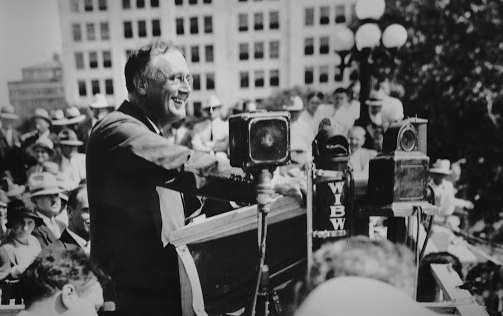
Ethics Alarms Celebrates Presidents Day: The Speeches. III. FDR’s First Inaugural Address, March 3, 1933

By late winter 1933, the Great Depression had caused more than 11,000 of 24,000 banks to failed, wiping out the savings of depositors. Millions of Americans were unemployed and desperate;  millions more were working at vastly diminished wages that barely provided subsistence. Currency values had dropped  and farms were failing.

The Democratic Party had  run on a vague but revolutionary  platform  that made it clear  that the election of its Presidential  candidate, Franklin D. Roosevelt,  would result in unprecedented governmental growth to deal with the crisis. Roosevelt’s task in his first speech as President was to calm the burgeoning panic, and to reassure America that it was in competent hands.

Lincoln, Reagan and Roosevelt were the greatest orators ever to hold the office of President, and FDR was perhaps the greatest of them all. His strong and confident delivery, cocky body language and dramatic delivery made this speech a success as much as its content. And, of course, it contains his most famous quote, and one of the endearing quotes in our history.

I am certain that my fellow Americans expect that on my induction into the Presidency I will address them with a candor and a decision which the present situation of our Nation impels. This is preeminently the time to speak the truth, the whole truth, frankly and boldly. Nor need we shrink from honestly facing conditions in our country today. This great Nation will endure as it has endured, will revive and will prosper. So, first of all, let me assert my firm belief that the only thing we have to fear is fear itself–nameless, unreasoning, unjustified terror which paralyzes needed efforts to convert retreat into advance. In every dark hour of our national life a leadership of frankness and vigor has met with that understanding and support of the people themselves which is essential to victory. I am convinced that you will again give that support to leadership in these critical days.

In such a spirit on my part and on yours we face our common difficulties. They concern, thank God, only material things. Values have shrunken to fantastic levels; taxes have risen; our ability to pay has fallen; government of all kinds is faced by serious curtailment of income; the means of exchange are frozen in the currents of trade; the withered leaves of industrial enterprise lie on every side; farmers find no markets for their produce; the savings of many years in thousands of families are gone.

More important, a host of unemployed citizens face the grim problem of existence, and an equally great number toil with little return. Only a foolish optimist can deny the dark realities of the moment.

Yet our distress comes from no failure of substance. We are stricken by no plague of locusts. Compared with the perils which our forefathers conquered because they believed and were not afraid, we have still much to be thankful for. Nature still offers her bounty and human efforts have multiplied it. Plenty is at our doorstep, but a generous use of it languishes in the very sight of the supply. Primarily this is because the rulers of the exchange of mankind’s goods have failed, through their own stubbornness and their own incompetence, have admitted their failure, and abdicated. Practices of the unscrupulous money changers stand indicted in the court of public opinion, rejected by the hearts and minds of men. Continue reading

Ethics Alarms Celebrates Presidents Day: The Speeches. II. President Ronald Reagan’s Address To The Nation, January 28, 1986

U.S. Presidents are leaders of their parties, but that is only one role among many that the U.S. Presidency has evolved to serve. There are times when it is crucial for the President to be seen as the symbol of the nation and the representative of all Americans, whether some Americans are able to concede that fact, or not. Some of the greatest Presidential speeches were inspired by national tragedies, as a Chief Executive was forced by events to serve as “Comforter-in- Chief,”  and to to set aside partisanship in times of tragedy to speak words that remind us that, despite what may be passionate differences, we are all Americans.

No President was better qualified by his experience and talents to fulfull this role than Ronald Reagan, after we all watched the Space Shuttle Challenger launch and then explode into pieces on that beautiful, cloudless day.

Ladies and gentlemen, I’d planned to speak to you tonight to report on the state of the Union, but the events of earlier today have led me to change those plans. Today is a day for mourning and remembering.

Nancy and I are pained to the core by the tragedy of the shuttle Challenger. We know we share this pain with all of the people of our country. This is truly a national loss.

Nineteen years ago, almost to the day, we lost three astronauts in a terrible accident on the ground. But we’ve never lost an astronaut in flight; we’ve never had a tragedy like this. And perhaps we’ve forgotten the courage it took for the crew of the shuttle; but they, the Challenger Seven, were aware of the dangers, but overcame them and did their jobs brilliantly. We mourn seven heroes: Michael Smith, Dick Scobee, Judith Resnik, Ronald McNair, Ellison Onizuka, Gregory Jarvis, and Christa McAuliffe. We mourn their loss as a nation together. Continue reading